wayground logo

Free Printable Worksheets

Font size

S
M
L
XL
Worksheets

Unit 4 Review

Total questions: 82

Worksheet time: 3hrs 4mins

Name
Class
Date
1.
The coordinates of a car at time t are x = 10 - t and y = 8 - t. Which equation describes the path of the car?
a)
y = 10 - x
b)
y = 8 - x
c)
y = 2 - x
d)
y = x - 2
2.
The position of a particle at time t is given by x = 3 cos(t) and y = 3 sin(t). Which of the following describes the path of the particle?
a)
a circle of radius 3 centered at the origin
b)
a circle of diameter 3 centered at the origin
c)
an ellipse with minor axis 3 centered at the origin
d)
an ellipse with major axis 3 centered at the origin
3.
Which set of parametric equations satisfies the given data table?
a)
x(t) = t3 - 1
y(t) = 2t
b)
x(t) = t3 - 1
y(t) = t + 2
c)
x(t) = t + 8
y(t) = t + 2
d)
x(t) = t + 8
y(t) = 2t
4.
Convert the polar coordinates to rectangular form
a)
( -3, 3)
b)
(3, 3√3)
c)
(-3, 3√3)
d)
(3, -3√3)
5.
Convert the polar coordinates to rectangular form
a)
( -3, 3)
b)
(3, 3√3)
c)
(-3, 3√3)
d)
(3, -3√3)
6.

What is the slope of the parametric function?

a)

-4/3

b)

-3/2

c)

-2/3

d)

-3/4

7.

Find the ordered pair based on the parametric equations.

t = -2

x = t2 - 2

y = -t + 2

a)

(2, 4)

b)

(4, 2)

c)

(-6, 0)

d)

(0,-6)

8.

What is the coordinate for the following conditions? x=t+1, y=3tx=-\sqrt{t+1},\ y=\sqrt{3t}  where  t=3t=3  

a)

(22,2)\left(2\sqrt{2},\sqrt{2}\right)  

b)

(2,3)\left(-2,3\right)  

c)

(2,13)\left(2,\frac{1}{3}\right)  

d)

(1,2)\left(1,-2\right)  

9.

What is the coordinate for the following conditions? x=2sin2θ, y=2cos2θx=2\sin2\theta,\ y=2\cos2\theta  where  θ=3π8\theta=\frac{3\pi}{8}  

a)

(22,2)\left(2\sqrt{2},\sqrt{2}\right)  

b)

(e,1)\left(e,1\right)  

c)

(2,13)\left(2,\frac{1}{3}\right)  

d)

(2,2)\left(\sqrt{2},-\sqrt{2}\right)  

10.
Eliminate the parameter. Convert the parametric equation to rectangular. x= t - 1 and y=t2 - 2
a)
y=(x+1)2 - 2
b)
t=x - 1
c)
x=t - 1
d)
y=t - 2
11.

The variable "t" is called a

a)

parameter

b)

parallel

c)

paralegal

d)

paradise

12.
Which conic is given by (x-4)2 = 8(y - 3)?
a)
Hyperbola
b)
Ellipse
c)
Circle
d)
Parabola
13.
What are the coordinates of the center and the radius of the circle with equation:
(x - 4)2 + (y - 3)2 = 25 ?
a)
Center (4,3)
Radius = 5 units
b)
Center (4,3)
Radius = 25 units
c)
Center (-4,-3)
Radius = 25 units
d)
Center (-4,-3)
Radius = 5 units
14.
Find the ordered pairs of the vertices of the conic pictured.
a)
(-4, -4) and (6, -4)
b)
(4, 4) and (-6, 4)
c)
(-1, -1) and (-1, 9)
d)
The conic has no vertices.
15.
Which is the equation to find c on an ellipse?
a)
c2 = a2 + b2
b)
c2 = a2 - b2
c)
1/4d
d)
(x-h)2 + (y-k)2 = r2
16.
(y-4)2 = -8(x+1)
What are the coordinates for the focus?
a)
(1,4)
b)
(-1,6)
c)
(-1,2)
d)
(-3,4)
17.
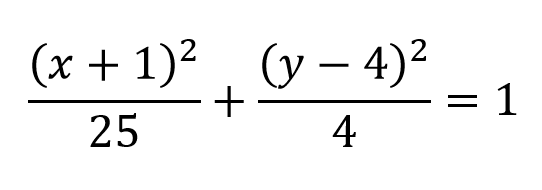
Identify the center and the length of a and b.
a)
C: (0,4)  a= 25, b=4
b)
C: (0,0)  a= 4, b=25
c)
C: (0,5)  a= 2, b=5
d)
C: (0,0)  a= 5, b=2
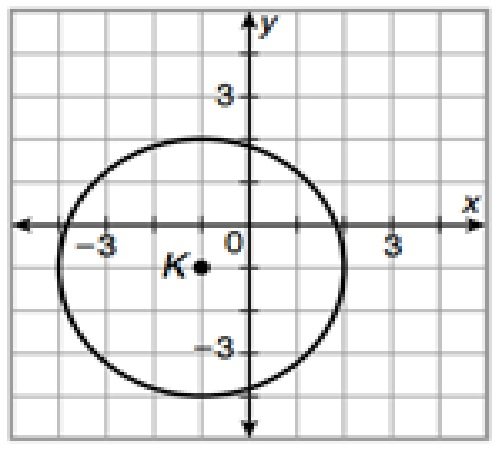
18.
What is the equation of the circle?
a)
(x+1)2 + (y +1)2 = 3
b)
(x+1)2 + (y -1)2 = 3
c)
(x+1)2 + (y +1)2 = 9
d)
(x-1)2 + (y -1)2 = 9
19.
a)

Parabola

b)

Circle

c)

Ellipse

d)

Hyperbola

20.
a)

Parabola

b)

Circle

c)

Ellipse

d)

Hyperbola

21.

Which of the following describes a PARABOLA in general form?

a)

Only one squared term

b)

Two squared terms with same coefficients and same sign

c)

Two squared terms with different coefficients but same sign

d)

Two squared terms with different signs

22.

Which of the following describes a HYPERBOLA in general form?

a)

Only one squared term

b)

Two squared terms with same coefficients and same sign

c)

Two squared terms with different coefficients but same sign

d)

Two squared terms with different signs

23.


x2+ y2 2x + 8y + 12 = 0x^2+\ y^2\ -2x\ +\ 8y\ +\ 12\ =\ 0  

a)

circle

b)

ellipse

c)

hyperbola

d)

parabola

24.

3x2 + 8y2 32y  88 = 03x^2\ +\ 8y^2\ -32y\ -\ 88\ =\ 0  

a)

circle

b)

ellipse

c)

hyperbola

d)

parabola

25.

20x2  8y2  20 x  195 = 020x^2\ -\ 8y^2\ -\ 20\ x\ -\ 195\ =\ 0  

a)

circle

b)

ellipse

c)

hyperbola

d)

parabola

26.
x2+9y2-4x-72y+139
a)
circle
b)
ellipse
c)
hyperbola
d)
parabola
27.

Which of the following describes a CIRCLE in general form?

a)

Only one squared term

b)

Two squared terms with same coefficients and same sign

c)

Two squared terms with different coefficients but same sign

d)

Two squared terms with different signs

28.

Which of the following describes an ELLIPSE in general form?

a)

Only one squared term

b)

Two squared terms with same coefficients and same sign

c)

Two squared terms with different coefficients but same sign

d)

Two squared terms with different signs

29.
Find the direction of vector <0, 4>.
a)
180⁰
b)
90⁰
c)
270⁰
d)
0⁰
30.
Find the direction of vector <6,5>.
a)
219⁰
b)
39⁰
c)
129⁰
d)
309⁰
31.
Find the component form of AB with initial point A(1, -3) and terminal point B(1, 3)
a)
<2, 0>
b)
<0, 6>
c)
2i
d)
6j
32.
Find the component form of AB with initial point A(0, 8) and terminal point B(-9, -3)
a)
-9i + 5j
b)
-9i - 11j
c)
<-9, -11>
d)
<-9, 5>
33.
Find the magnitude of AB if the initial point is (-3, 1) and the terminal point is (3, 9).
a)
6
b)
8.2
c)
10
d)
10.4
34.
Find the magnitude of the vector <-4, -6>.
a)
7.211
b)
52
c)
3.162
d)
4.472
35.
A quantity that has both magnitude and direction is called a scalar quantity.
a)
True
b)
False
36.
Find the magnitude of the vector <-2, 1>.
a)
5
b)
2.236
c)
1
d)
2.646
37.
Find the direction of the vector <-2,1>.
a)
63⁰
b)
333⁰
c)
27⁰
d)
153⁰
38.
Find the direction of the vector <2, -5>.
a)
292⁰
b)
68⁰
c)
112⁰
d)
22⁰
39.
Which statement describes a vector?
a)
It has magnitude but no direction
b)
It has direction but no magnitude
c)
It has both direction and magnitude
d)
It has constant magnitude but no
 direction
40.

Find the magnitude.

a)

0

b)

5

c)

-5

d)

4

41.

Find the magnitude.

a)

-10

b)

-8

c)

6

d)

10

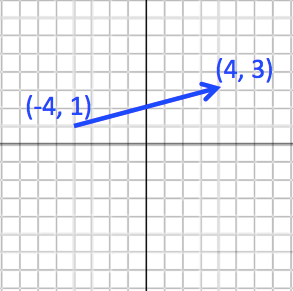
42.

Component Form

a)

<-3, -7>

b)

<3, -7>

c)

<-3, 7>

d)

<7, 3>

43.

Write in component form.

a)

<0, 4>

b)

<8, 2>

c)

<2, 8>

d)

<0, 2>

44.

Find the resultant vector.

a)

<5, 3>

b)

<1, 7>

c)

<7, 1>

d)

<3, 5>

45.

Find the resultant vector.

a)

<9, 15>

b)

<7, 17>

c)

<15, 9>

d)

<11, 13>

46.

Find the resultant vector.

a)

<-10, 10>

b)

<10, -10>

c)

<15, 25>

d)

<25, 15>

47.
Find the dot product of <1, -2> and <3, 2>.
a)
1
b)
<3, -4>
c)
<4, 0>
d)
-1
48.
Find the angle between vectors <1,3> and <2,-5>.
a)
40.24°
b)
49.76°
c)
139.76°
d)
92.57°
49.

Write the complex number in trigonometric form.

a)
√50 (cos π/2 + i sin π/2)
b)
50 (cos π/4 + i sin π/4)
c)
√50 (cos 5π/4 + i sin 5π/4)
d)
√50 (cos π/4 + i sin π/4)
50.

Express the trig form in linear combination form. 4 ( cos π /3 + i sin π /3)

a)
2 + 2√3 i
b)
2 + √3 i
c)
2 - 2√3 i
d)
-2 + 2√3 i
51.

The table shows the number of books two students read each month. Which matrix displays the data in the table?

a)
b)
c)
d)
52.
a)
b)
c)
d)
53.
a)
b)
c)
d)
54.

For  S2 x 6S_{2\ x\ 6}  and  T6 x 5T_{6\ x\ 5}  , what are the dimensions of ST?

a)

2 x 2

b)

2 x 5

c)

5 x 6

d)

6 x 6

55.
a)
b)
c)
d)
56.
a)
b)
c)
d)
57.
a)

-42

b)

-18

c)

18

d)

42

58.
a)

8

b)

12

c)

18

d)

21

59.
a)
b)
c)
d)
60.

What comes second in the order?

a)

Row

b)

Column

61.
What must be true in order to ADD two matrices?
a)
They must be square.
b)
The dimensions must be equal.
c)
The determinant can't equal 0.
d)
The column of the 1st must equal the row of the 2nd.
62.

In Matrix R (pictured) what element is in the second row, second column?

a)

8

b)

9.01

c)

6

d)

5

63.
What is a Matrix?
a)
An equation of over 5 numbers or symbols 
b)
A rectangular arrangement of numbers
c)
A method of finding the nth value of a series
d)
A complicated number system
64.

How many columns are in a 7 x 3 matrix?

a)

7

b)

3

c)

21

d)

10

65.
a)
b)
c)
d)
66.

Solve for the determinant of the following matrix: 
⌈12 −3⌉
⌊−6 15⌋

a)

198

b)

162

c)

-162

d)

-9

67.
Dimensions?
a)
a
b)
b
c)
c
d)
d
68.

True or False: It is possible to multiply a 3x4 matrix with a 3x1 matrix.

a)

True

b)

False

69.
Find the product.
a)
undefined
b)
-3   16
17   12
8   -10
c)
3   12 
-15  -8
-1   -3
70.

Find: BA

a)

47  30

9  5

b)

17  15

42  35

c)

10  25

7  1

d)

not possible because rows do not match columns

71.
Multiply
a)
25
25
5
b)
-25
25
-5
c)
-10
-10
-6
d)
10
10
6
72.
In Matrix R (pictured) what element is a23?
a)
8
b)
9.01
c)
6
d)
1
73.

What is the entry at f42?

a)

23

b)

-81

c)

-44

d)

99

e)

-56

74.

The semester 1 results in English, Maths and Sport for three students are shown in matrix form. Ben’s result for Maths was:

a)

72

b)

76

c)

79

d)

87

e)

90

75.

Find the dot product of f=[3,5]\vec{f} = [3, 5] and g=[2,1]\vec{g} = [2, -1] .

a)

11

b)

1111

c)

66

d)

3-3

76.

Solve for x, y and z.

a)

x = 8, y = 4, z = 3

b)

x = -8, y = 30, z = 3

c)

x = 8, y = 32, z = 9

d)

x = 8, y = -4, z = 3

77.

Solve for x

a)

-5

b)

7

c)

3

d)

-2

78.

Solve the matrix equation using inverse equations.

a)

A

b)

B

c)

C

d)

D

79.

Let A,X and B be matrices. Assume A-1 exists.

Solve AX = B for X

a)

X = AB

b)

X = BA

c)

X = A-1B

d)

X = BA-1

80.

Solve the matrix equation using inverse equations.

a)

A

b)

B

c)

C

d)

D

81.

Solve for matrix X.

a)

-9

5

3

b)

9

13

-9

c)

15

-5

3

d)

10

4

6

82.
Solve for matrix Y.
a)
-4    9
-11    9
b)
4   -8
11   8
c)
4   -9
11   9
d)
-4   9
11   -9