
Font size
 Worksheets
Life Science MAAP Review
Total questions: 47
Worksheet time: 29mins
Which word best describes the following definition?
The process by which individuals that are better adapted to their environment are more likely to survive and reproduce than other members of the same species.
Trait
Generation
Adaptive Trait
Natural Selection
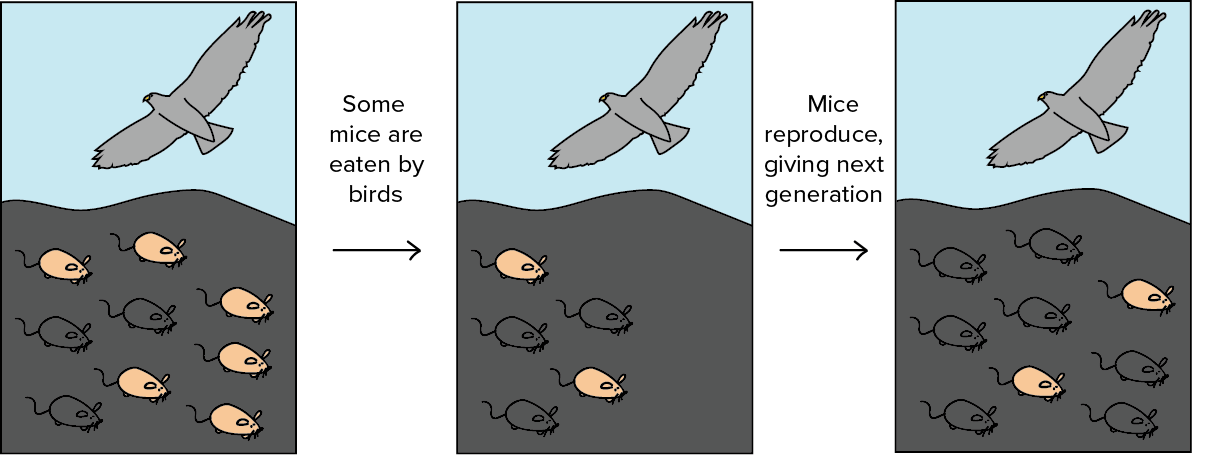
Why is the mouse population changing over time?
The light mice can reproduce more successfully than the dark mice
The hawks eat more dark mice than light mice because the dark mice taste better
The hawks eat more light mice than dark mice because they can see the light mice more easily
The hawks eat more dark mice than light mice because they can see the dark mice more easily
Changes in genetic material are called _____________
Mutations
RNA
Genes
Overproduction of offspring creates...
Competition
Gene Flow
Migration
Genetic Drift
The combined alleles of all individuals in a population are called its...
DNA
Gene Pool
Genome
Genetic Code
_________ is when an organism resembles another animal.
Instinctive behavior
Camouflage
Natural Selection
Mimicry
The venom of a snake is considered to be _____________ adaptation.
Structural
Behavioral
Physiological
Mimicry
The spines on a hedgehog is considered to be _____________ adaptation.
Structural
Behavioral
Physiological
Learned
Running away from a predator is considered to be _____________ adaptation.
Structural
Behavioral
Physiological
Camouflage

When a population becomes divided by an event such as a new river forming, ____________ has occurred.
Differentiation
Isolation
Adaptation
Separation
____________ development of new species when a population is reproductively isolation in some form.
Competitive
Speciation
Isolation
mutation
When has speciation occurred?
When populations no longer look the same
When populations no longer have the same frequency of alleles
When populations are living in different environments
When populations can no longer successfully breed in nature
What do humans do that put species at risk? choose 3
pollution
deforestation
overuse of resources
generate electricity
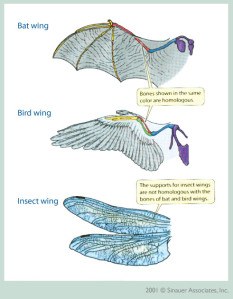
The diagram shows an image of a Pterosaur wing, bat wing, and bird wing. These are all different organisms, but share similar wing structures. If these structures are similar due to common ancestry, which of the following best describes them?
a. Vestigial Organ
b. Embryological Similarities
c. Homologous Structures
d. Analogous Structures

What
type
of structure?
Homologous
Analogous
Embryological
Vestigial
A structure that serves the same purpose, but is not made in the same way is called
a vestigial structure
a homologous structure
an analogous Structure
a pheryngial structure
A body part that is not used or not working by a modern organism but which was needed by its ancestors is called a
Homologous structure
Analogous Structure
Vestigial Structure
Pharyngeal Pouch
The study of evolution by studying the development of the fertilized egg cell and its development into an organism is called
Molecular Biology
Evolution
Embryology
Paleontology
A DNA Strand has the following bases...A A G C C A...What are the bases on its complimentary strand?
A A G C C A
A C C G A A
T T C G G T
C C A T T A
A ______ is a section of DNA that codes for a trait.
gene
genotype
phenotype
gender

This is an example of
(one chromosome of each parent)
Homologous Chromosomes
Non-homologous Chromosomes
Sister Chromatids
Duplicated DNA
Which of these is the correct order showing the largest to smallest parts of genetic material?
DNA, Cell Nucleus Chromosomes, and Genes
Cell Nucleus,, Chromosomes, Genes, and DNA
DNA, Genes, Nucleus, and Chromosomes
Nucleus, Chromosomes, DNA, and Genes
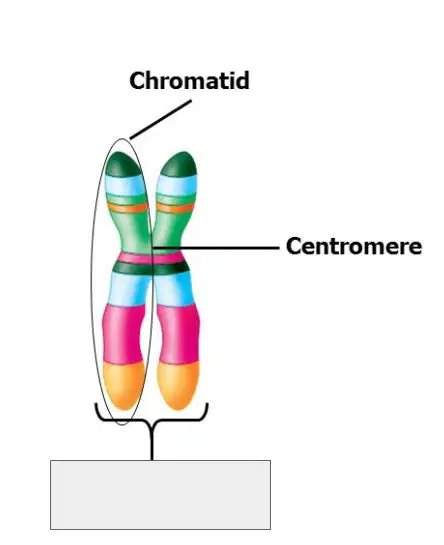
Sister Chromatids are...
Exact copies of each other attached at the centromere
Homologous copies of each other attached at the centromere
Not copies at all, they are different, but they are attached at the centromere
Different sizes with different genes, not attached.
Put the following stages of mitosis in order: anaphase, prophase, metaphase, and telophase.
prophase, metaphase, telophase, anaphase
prophase, anaphase, metaphase, telophase
prophase, metaphase, anaphase, telophase
prophase, telophase, metaphase, anaphase

In which stage of MEIOSIS does crossing over occur? (The exchange of genetic material between chromosomes in a tetrad.)
Anaphase I
Metaphase I
Prophase I
Telophase I
The result of meiosis is:
two diploid cells
two haploid cells
four diploid cells
four haploid cells
Physical expression of an organism's genes
(how the traits are expressed)
Karyotype
Phenotype
Genotype
Meiosis
Genetic information carried in an organism's chromosomes
(what their DNA says)
Phenotype
Genotype
Karyotype
Heredity
One form of a gene
Chromosome
Allele
Phenotype
Genotype
Cells that contain a full set of chromosomes
Haploid cells
Diploid cells
Viruses
Gametes
Cell that contains half the number of chromosomes
Haploid cells
Somatic cells
Diploid cells
Prokaryotic cells
The --------------------- cells undergo Mitosis while the --------- undergo Meiosis
(A) Somatic or body ; Gametes
(B) Gametes; Somatic or body cells
(C) Gametes; Gametes
(D) Somatic or Body cells; Somatic or Body cells

Place these cells in order of mitosis.
A, B, C, D, E
B, E, D, A, C
C, E, A, D, B
B, D, A, E, C
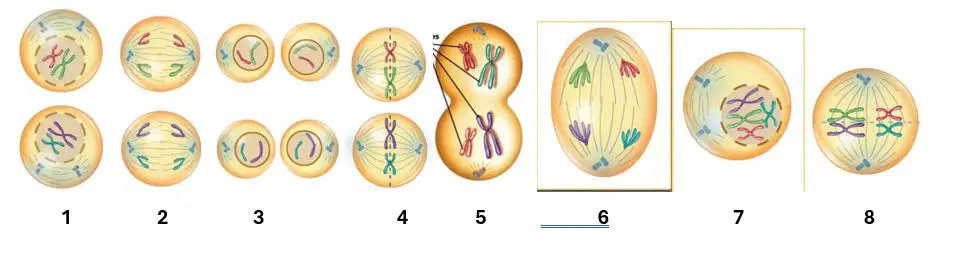
Place the phase of meiosis in order
Prophase I.
Metaphase I.
Anaphase I. ...
Telophase I. ...
Prophase II. ...
Metaphase II. ...
Anaphase II.
Telophase II & Cytokinesis II.
1 2 3 4 5 6 7 8
7 8 6 5 1 4 2 3
7 8 4 3 2 5 6 1
3 2 4 1 5 6 8 7
T3 - Which of the following genotypes is homozygous recessive?
Tt
tt
TT
T
T2 - An allele whose trait always shows up in the organism when the allele is present.
recessive allele
dominant allele
hidden allele
present allele
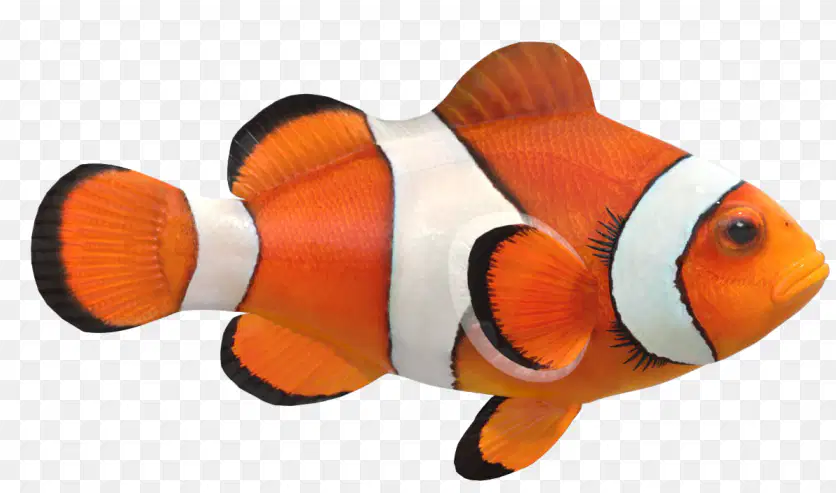
If a muscle cell in a clown fish contains 28 chromosomes, a clown fish egg egg cell would contain:
14 chromosome
12 chromosome
23 chromosome
28 chromosome
Some organisms reproduce asexually. Bacteria in soil is an example. Select the two statements that describe and advantage of asexual reproduction.
Two parents are needed.
Only one parent is required.
Sex cells are formed by meiosis.
Offspring have identical successful traits.
Genetically diverse offspring are produced.
Which characteristic is an advantage of sexual reproduction?
Individuals need to find a mate to reproduce.
There is more genetic variety in the population.
Traits passed to offspring are always beneficial.
The genes of the parent and offspring are identical.
Genetic variation happens two ways during meiosis________ & __________ and one way outside of meiosis_________.
gene & dna
cell
crossing over & independent assortment
random fertilization
crossing over & independent assortment
cell
gene & dna
random fertilization
Which process is involved with genetic engineering?
Allowing organisms to reproduce without human interference
Humans choosing individuals with desirable traits to parent the next generation
Using technology to cut DNA and insert genes to get the traits you want.
Which process is involved in selective breeding?
Allowing organisms to reproduce without human interference
Humans choosing individuals with desirable traits to parent the next generation
Using technology to cut DNA and insert genes to get the traits you want.
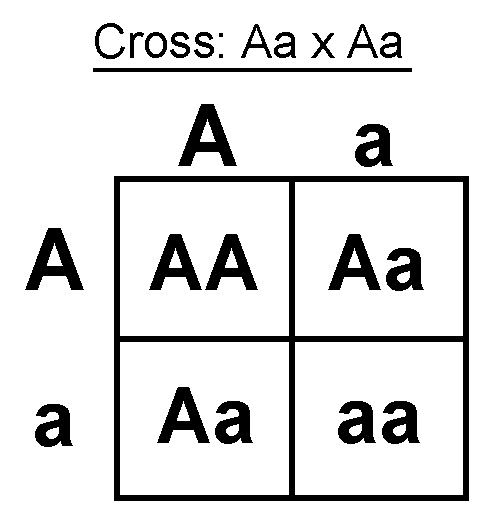
What is the phenotype of the offspring? (A-Brown hair; a-blond hair)
50 % Brown Hair and 50% Blond Hair
25 % Brown Hair and 75% Blond Hair
75 % Brown Hair and 25% Blond Hair
0% Brown Hair and 100% Blond Hair

Both parents in this Punnet square
are homozygous dominant
are homozygous recessive
are heterozygous
have blue eyes

What are the possible genotypes for this cross?
(Click the picture to see it without the text)
TT = 25% Tt= 50% tt=25%
all tall
TT= 75% tt = 25%
Tt = 100%
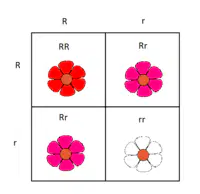
The blending of two traits is known as ---
incomplete dominance
codominance
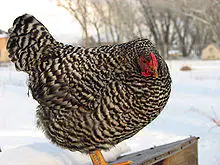
A condition in which both alleles for a gene are expressed so that both traits are visible is known as ---
Codominance
Incomplete dominance

