
 Worksheets
CHEM FINAL
Total questions: 56
Worksheet time: 1hrs 11mins
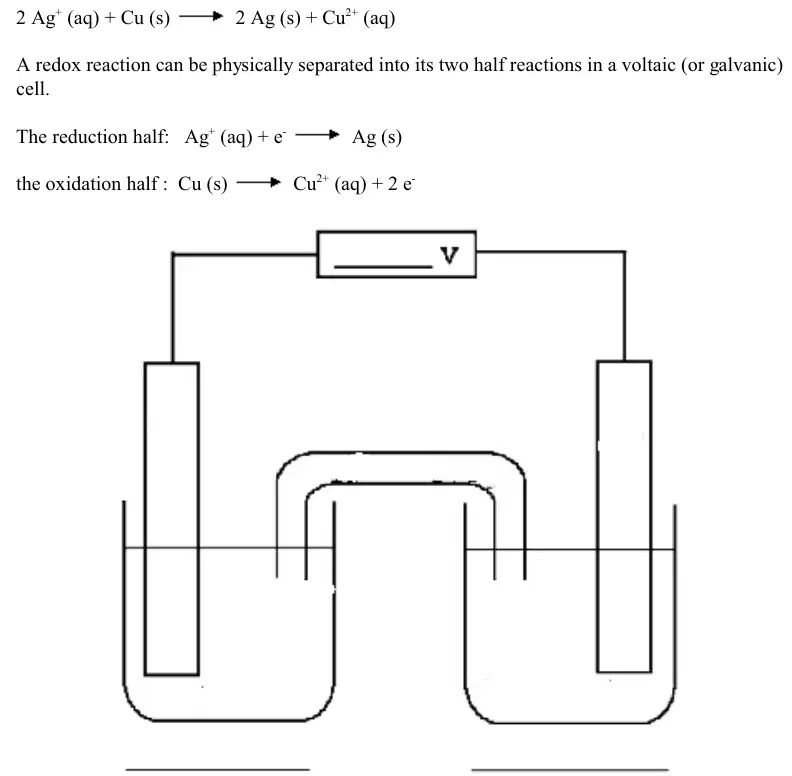
label the diagram:
-put in the arrows representing phase change
-put the arrows representing where unrelated ions will flow
- label the cathode and anode
-label the flow of the electrons
also, define what a cathode and anode is in the textbox
(a)
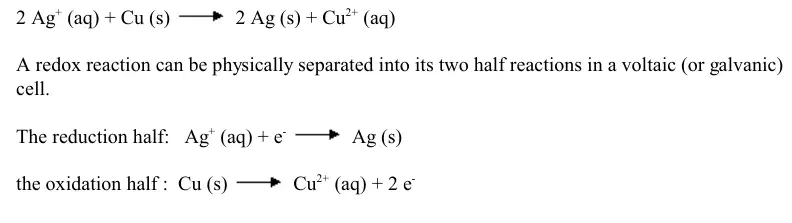
find the voltage by looking up the values on sheet:
how do you find it?
(a)
spontaneity of redox half reactions can be judged by redox potential E°
positive values tend to occur (spontaneously/nonspontaneously
(a)
what is the equation of the potential of the standard cell E°
(a)
using the previous equation, write the shorthand "conventional" notation
(a)
1) write half reactions
2) identify anode and cathode
(the one with the higher potential = cathode, the lower one = anode which need to be flipped around)
3) write overall chemical reaction
4) identify the number of electrons associated with overall chemical equation
5) calculate the standard cell potential
6)write conventional notation of the cell
7) demonstrate the electron flow
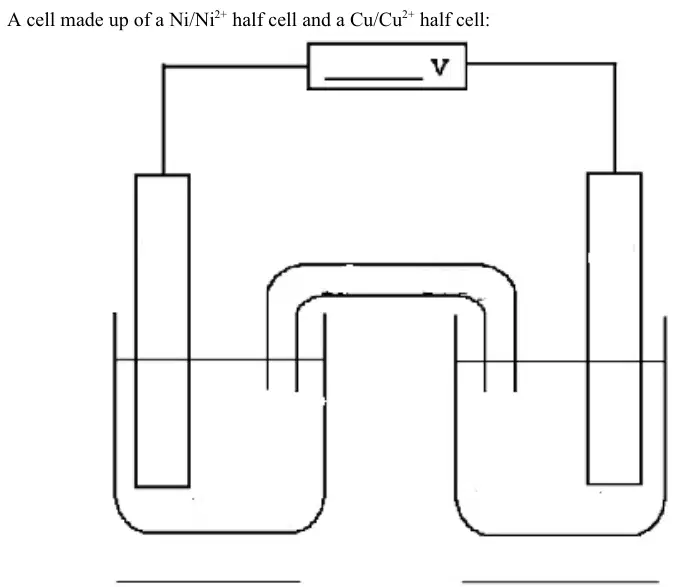
write the reductions
find their voltages
identify the cathod/anode
flip the anode
write overall reaction
determine # of electrons
find the Ecell
draw the diagram
write the conventional diagram
(a)
reducing agents are on the _______ (reactant/product) side of the reaction with the best reducing agents being the most ________(positive/negative)
(a)
to find the potential for the oxidation half reaction, reductions can be changed to oxidation by changing the
(a)
what metal will dissolve in (react with) 1.0M HCl
(a)
silver and copper will not react with 1.0HCl, but will react with (dissolve in) 1.0 HNO3. Why?
(a)
what substances can be "oxidized" by 1.0 M HClO?
(a)
what substances can be "reduced" by tin
(a)
rank the following from strongest oxidizing agent to weakest (in acidic solution)
Br2,Cl2, Fe2+, MnO4-, O2, NO3-
(a)
rank the following from strongest reducing agent to weakest (in acidic solution)
Al,Br-, Fe2+, Pb, Zn
(a)
which of the following can be reduced by manganese metal under certain conditions? select all that apply:
I2
K+
Cu2+
Fe3+
Mg2+
(a)
oxidizing agents
-oxidize anything BELOW the value
-on the reactant side
-higher values = greater agent
reducing agents
-Oxidize anything above it
-on the product side
-lower values = greater agent
when looking for anything that can be oxidized by a metal,
look for the answers on the REACTANT SIDE
Rank the following in order of increasing power as a reducing agent (weakest to strongest)
tin metal (Sn)
manganese metal (Mn)
iodide ion (I-)
(a)
Which of the following can be oxidized by an acidic solution of permanganate ion under standard conditions?
[Select all that apply.]
tin(II) ion, Sn2+
nitrogen monoxide, NO
cerium(III) ion, Ce3+
iodide ion, I-
cobalt(II) ion, Co2+
(a)
Calculate the standard cell potential given the following standard reduction potentials:
Al3++3e−→Al;E∘=−1.66 V
Sn2++2e−→Sn;E∘=−0.140 V
(a)
Which of the following redox reactions do you expect to occur spontaneously in the reverse direction? (Hint: The reactions are occurring under standard conditions (1 MM for the aqueous ions).)
2Cu+(aq)+Co(s) → 2Cu(s)+Co2+(s)2
Fe(s)+Cr3+(aq) → Fe3+(aq)+Cr(s)
2Al(s)+3Pb2+(aq) → 2Al3+(aq)+3Pb(s)
Ca2+(aq)+Zn(s) → Ca(s)+Zn2+(aq)
Which metal dissolves inHNO3 but not in HCl?
Ni
Hg
Au
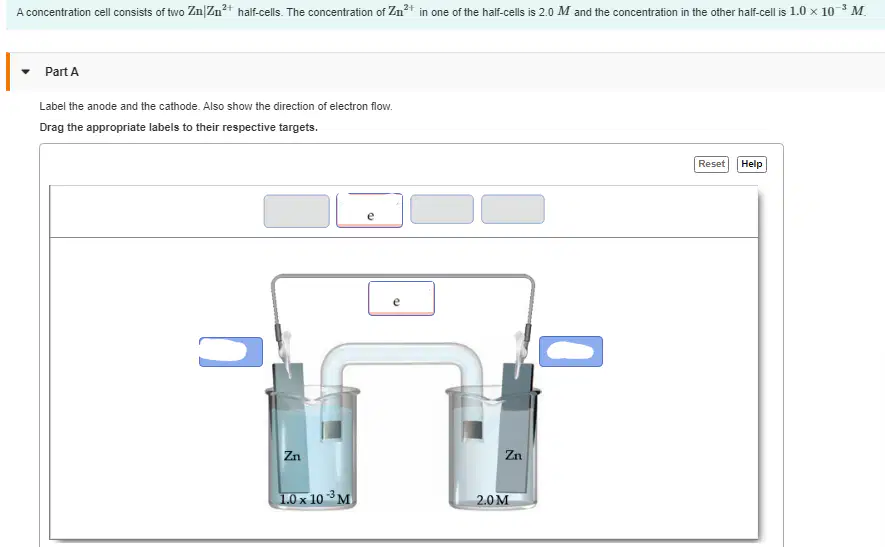
given the information in the blue text, fill out the graph above
(correct format is in explanation
(a)
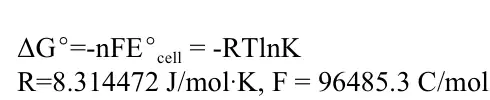

What is the value of G for:
(a)

what is the G for
(a)
lnK = -nFE
-RT
and
nFE
RT
k = e

what is the value of K for this equation?
(a)
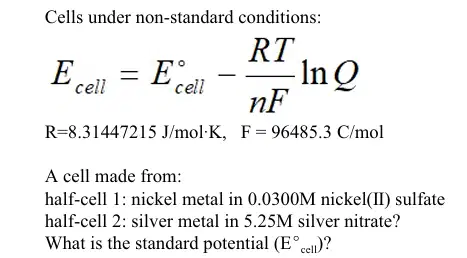
1 -what is the cell potential?
2 - what is the line cell notation?
3 - what is the potential for these concentrations
(a)

answer the question on the picture:
(a)
Consider the electrolysis of molten "liquid" potassium bromide (KBr)
What reaction occurs at the anode?
What reaction occurs and the cathode?
(a)
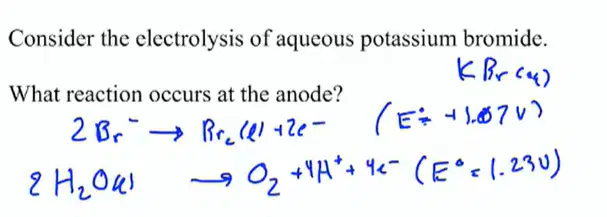
under aqueous conditions, it is important to consider the reaction with water to determine the voltage. This will create a second reaction. In this case, we pick the reaction with the lowest voltage because nature will choose the easiest thing
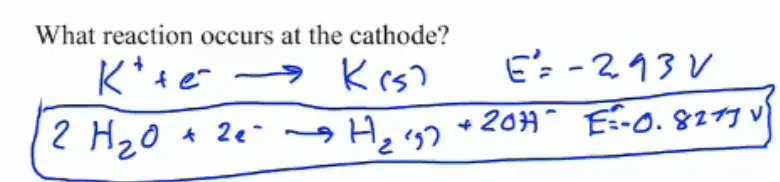
under aqueous conditions, it is important to consider the reaction with water to determine the voltage. This will create a second reaction. In this case, we pick the reaction with the lowest voltage because nature will choose the easiest thing
1 - for light elements ( Z = 2-20), the most stable nucleus has...
2- for heavier elements (Z = 21 to 83 has more...
3 - for super heave elements (Z > 83), there are no...
(a)
typed of RADIATION:
α radiation: particles are equivalent to the nucleus of the ____ atom: (draw the structure)
β radiation: the emissions of electrons (draw the structure) comes out of a n____
positron: a positron is an "______-electron" the positron comes out of a ____
electron capture: an electron falls into the ____ and absorbed by a _____
γ radiation: the emissions of _____ in the gamma region of the electromagnetic spectrum. This is a way for the nucleasus to shed extra energy
(a)
nuclide is a term for a nucleus with a specific value for both Z and A
ALL ISOTOPES WITH Z > 83 ARE UNSTABLE = MOST DECAY VIA _____
isotopes with too many neutrons decay via ________
isotopes with too few neutrons decay by _______ or ____
superheavy elements decay by ________
(a)
if 16O is stable...
what is the most likely mode of radioactive 14O
positron
beta particle
alpha particle
neutron capture
neutron emission
(a)
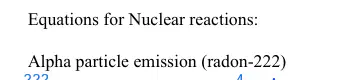
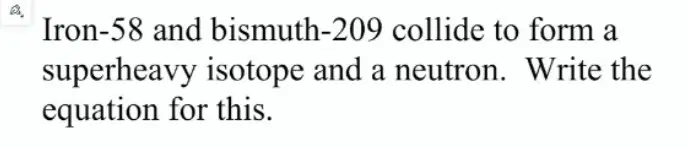
when writing the equations, we want to make sure the particles on each side add up so we have the same total mass number
remember alpha emission is the ONLY thing that will change the mass number (no other emission changes the mass number:
write the equation for this
(a)
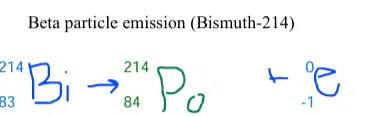
when writing the equations, we want to make sure the particles on each side add up so we have the same total mass number
write the equation for this
(a)
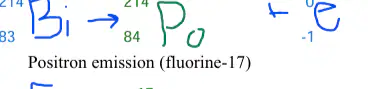
when writing the equations, we want to make sure the particles on each side add up so we have the same total mass number
write the equation for this
(a)
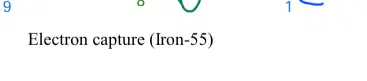
when writing the equations, we want to make sure the particles on each side add up so we have the same total mass number
write the equation for this
(a)

Ecell = Ecell0 = (0.0592V/ n) log Q
(a)
radioactive decay is a (a) order process (1st, 2nd, 3rd) order
recall first order kinetics: lnA - lnA0 = -kt
recall half lives: t1/2 = ln(2)
k
when we want to find percent: [At] = [A0] x (1/2)n
t
n = t 1/2

find the amount in days
(a)
when we don't have even numbers for half lives
log (A / A0) <---- final/initial
n = log (1/)
(a)

(a)

in years
(a)

(a)

(a)

C14 has a half life of 5.73 x 10³
(a)
(a)
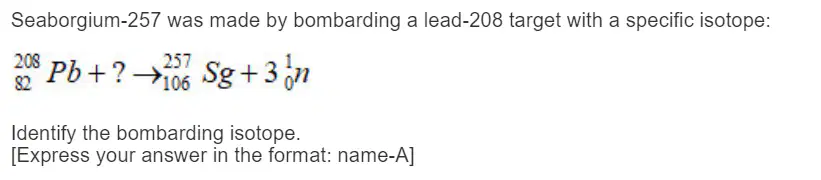
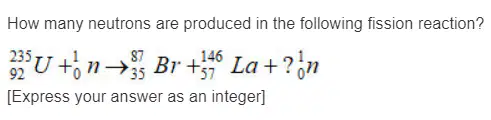
uranium-235 is the ONLY naturally occurring fissile isotope
(a)
(a)

(a)

