
 Worksheets
Unit 8 Evolution Quiz
Total questions: 15
Worksheet time: 8mins
A population of wood mice lives in a cool, moist temperate forest. Several years of hot, dry weather have affected the plants in the area. Which mice in the population are most likely to survive this change and pass their genes on to their offspring?
those with the warmest coats and best camouflage
the largest and strongest mice in the population
those with traits most adapted to the new environment
the youngest and fastest mice in the population
Which cellular organelle is thought to have evolved from a prokaryote that was able to use oxygen?
chloroplast
Golgi apparatus
mitochondrion
ribosome
Manatees are large marine mammals that live in warm coastal waters of the southeastern United States, the Gulf Coast, Central America, and South America. Elephants are large land mammals native to Africa and Southeast Asia. Manatees and elephants share a recent common ancestor. Manatees do not have hind legs, but they do have small bones near their pelvises. Scientists think these bones indicate that ancestors of manatees did have hind legs. Which claim about the common ancestor of manatees and elephants is best supported by the facts above?
The common ancestor lived on land
The common ancestor swam in water
The common ancestor walked upright
The common ancestor was a plant-eater
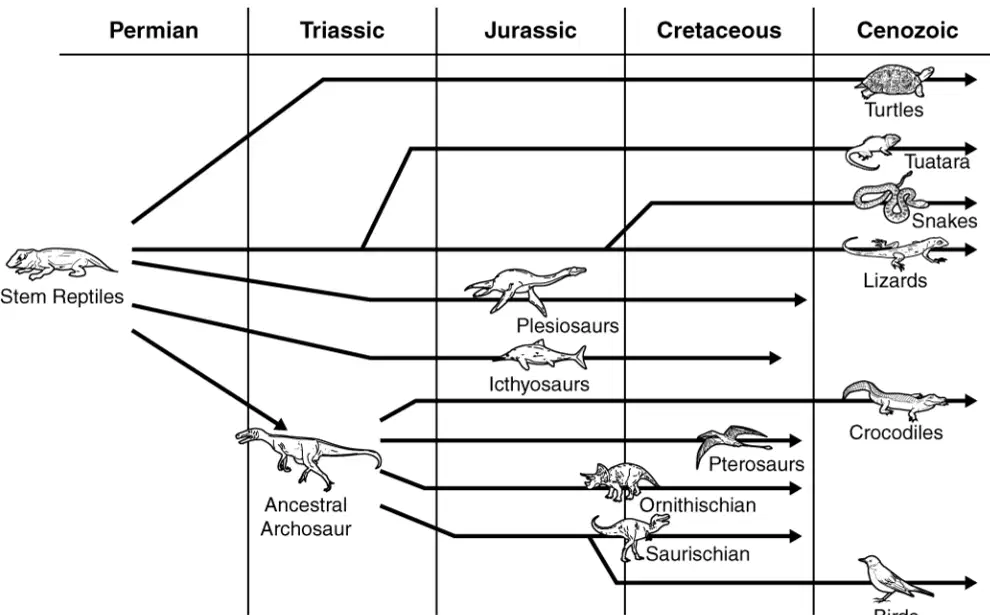
The fossil record provides evidence of change and common ancestries in organisms. The diagram is a portion of the fossil record that shows the common ancestry of certain organisms. Which is illustrated in the diagram of the fossil record?
Crocodiles appear in the fossil record before turtles.
Turtles are a common ancestor of snakes and lizards.
Birds and crocodiles developed separately from turtles.
Turtles and lizards are more closely related than snakes and lizards.
Which of these most likely determines if a mutation will become an adaptation in a species?
A) genetic variation
B) mitosis
C) natural selection
D) succession
Over a long period of time, helpful variations in a species replace the unfavorable ones. This change can lead to
fossilization
evolution
geographic isolation
genetic mutations
In a population of brown snakes, a snake is born with a white-spotted pattern. Which factor will have the most influence on whether this trait will become common in the brown snake population?
the ability of the snake to survive to reproduce
the appearance of other new traits in the baby snake
the history of the pattern in previous snake populations
the presence of thermal energy changing the snake pattern
The breakup of Pangaea had which effect on the subsequent history of animal speciation?
Animals had to become adapted to distinct climates
Animal diversity declined due to loss of available territory
Separated animal populations evolved independently
A single animal kingdom separated into multiple, distinct phyla
Last year farmers discovered that a small amount of a new insecticide rapidly killed a worm species that was damaging their corn crops. The insecticide was so effective that they decided to use it again this year. They applied the same amount as last year, but it did not kill as many worms. What is the most likely reason the insecticide was less effective the second year?
Worms that survived developed passive immunity against the insecticide.
Worms that survived produced offspring that were resistant to the insecticide.
Worms that survived moved to a field that was not treated with the insecticide.
Worms that survived learned to avoid plants that were treated with the insecticide.
In recent decades, a group of scientists has developed a system of biological classification called PhyloCode. PhyloCode organizes all living things using only their genetic ancestry. This system eliminates the use of the taxonomic levels biologists have used for centuries. What will scientists require to classify a newly discovered organism in this new system?
A) the organism’s DNA
B) the organism’s parents
C) the organism’s offspring
D) the organism’s measurements
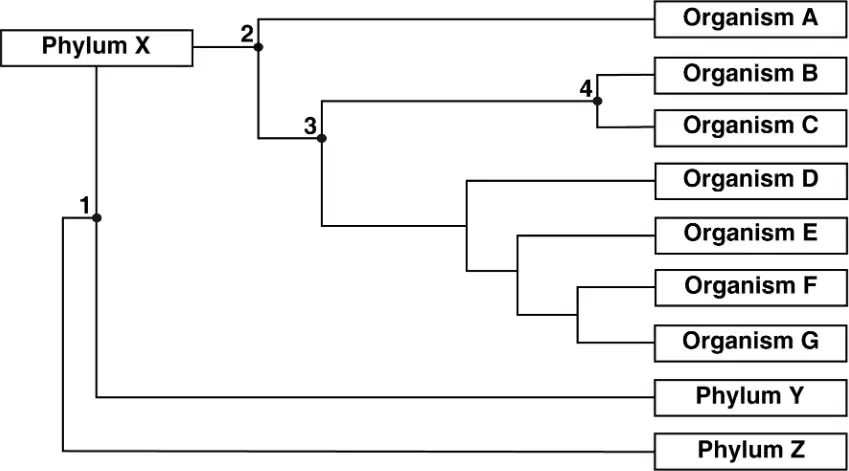
Look at the phylogenetic tree below. Which hypothetical organism is the most recent common ancestor for Organisms A and G?
A) 1
B) 2
C) 3
D) 4
Which factor determines if two individuals are members of the same species?
They live in the same habitat and niche.
They forage and eat the same type of food.
They mate and produce fertile offspring.
They are similar in appearance and color.
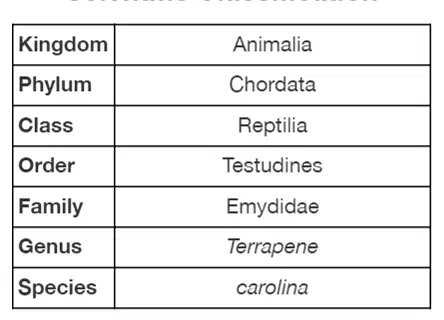
Use the information in the table to answer the question that follows. What is the correct scientific name for the organism classified above?
Reptilia testudines
Chordata reptilia
Emydidae terrapene
Terrapene carolina
A cow and a frog have similar bone structures in their forelimbs. Both have phalanges and radius, ulna, and humerus bones. However, the cow and frog are animals with very different life cycles from each other. Which most likely describes why the body structures of these animals are so similar?
Both have undergone similar mutations.
Both descended from a common ancestor.
Both reacted similarly to environmental pressures.
Both spread out from the same geographical region.
The nonfunctional pelvis and hind limbs found in some snakes support which statement about evolution?
Snakes began to evolve these structures, but selection pressures did not favor them.
Mutations tend to make species evolve to resemble other species in their environment.
Snakes evolved from the same common ancestor as species in which these structures are functional.
Selection pressures promoting snake evolution ceased before snake anatomy was well adapted.

