
NEW
Font size
 Worksheets
L3 YR2 Revision 4 (Hot)
Total questions: 24
Worksheet time: 12mins
In which one of the following positions in an unvented domestic hot water storage system would an anti-legionella valve be fitted?
On the incoming cold water supply.
To the inlet of an expansion vessel.
At the end of the discharge pipe from the expansion valve.
At the end of the discharge pipe from the temperature relief valve.
Legislation covering procedures for the installation of unvented domestic hot water storage systems can be found in both the Building Regulations Part G3 and the Health and Safety at Work etc Act 1974 and which other regulations?
Water Supply (Water Fittings) Regulations 1999 and British Standard 1212
Gas Safety (Installation and Use) Regulations 1998 and the Health & Safety at Work etc Act 1974
Building Regulations Part G3 and the Water Supply (Water Fittings) Regulations 1999.
Legislation covering the installation of unvented domestic hot water storage systems does not apply to
instantaneous multi-point water heaters
gas water heaters with a storage capacity of 25 litres
systems with a storage capacity of 15 litres or less
systems with a storage capacity of more than 100 litres
The maximum permitted straight length of a 22 mm discharge pipe from a tundish is
9 metres
12 metres
16 metres
20 metres
Which one of the following methods should be used to confirm that a cold water supply meets the requirements of an unvented domestic hot water storage system?
Contact the local Water Supplier for details of the mains pressure at the installation location.
Use a flow meter at the cold water service pipe connection to the unvented system.
Use a flow meter at the entry point of the cold water service to the building.
Contact the system supplier to confirm that the system supplied suits the available cold water pressure.
The purpose of a pressure reducing valve or a pressure limiting valve is to
reduce the supply pressure from the storage vessel to prevent backflow
reduce the mains water pressure to the working pressure of the storage vessel or heater
prevent a build up of pressure and subsequent explosion of the storage vessel
increase the pressures at any mixer taps that are fed by a supply from an unvented system.
The test pressure for an unvented domestic hot water storage system is
twice the working pressure
1½ times the working pressure
equal to the working pressure
three times the working pressure.
Which of the following should be carried out in the first stage of flushing an unvented domestic hot water system?
Remove the pressure reducing valve and clean out before replacing.
Remove the diverter valve and flush out before replacing.
Open the cold water supply and fill the storage vessel with water.
Remove the line strainer, flush through, refit and fill.
Once an unvented domestic hot water storage system has been installed, details of the commissioning procedures can be found in the
manufacturer's instructions or specification
Building Regulations Part G3
Building Regulations Part L1
Water Supply (Water Fittings) Regulations.
Which one of the following has an integral test device?
Strainer
Pressure reducing valve
Temperature relief valve
Diverter valve
Which one of the following should happen when the temperature in the storage vessel of an indirectly heated unvented domestic hot water storage system exceeds 85°C?
The high limit stat will operate to open the temperature relief valve to discharge water through the tundish to outside.
The high limit stat will operate to activate the motorised valve to shut down the primary heat supply to the storage vessel.
The temperature relief valve will operate to discharge water through the tundish to outside.
The expansion valve should open to discharge water through the tundish to outside.
Which of the following actions should be taken when draining an unvented domestic hot water storage system?
Open the hot water discharge points.
Open the cold water discharge points.
Test the operation of the expansion valve.
Test the operation of the temperature relief valve.
The maintenance activity, lift gear or twist top for 30 seconds, applies to
an expansion valve
a diverter valve
a line strainer
a check valve
Detail of the procedures for checking and recharging the pressure in an expansion vessel can be found in the
Water Supply (Water Fittings) Regulations
Building Regulations Part G3
Local Authority Building Control Office
manufacturer's information
A possible cause of intermittent discharge from the expansion valve discharge pipe in an unvented domestic hot water storage system, fitted with a bubble top storage vessel could be
failure of high energy cut out
loss of the cylinder air gap
failure of the check valve on the cold supply
failure of the temperature relief valve

Refer to Figure 2. The component labelled A is a
check valve
drain valve
pressure reducing valve
line strainer

Refer to Figure 2. The component labelled B is a
double check valve
pressure reducing valve
stop valve
pressure relief valve
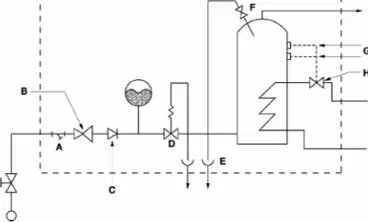
Refer to Figure 2. The component labelled C is a
pressure reducing valve
drain valve
motorised valve
single check valve
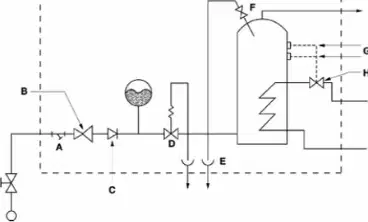
Refer to Figure 2. The component labelled D is:
a pressure reducing valve
an expansion valve
a temperature relief valve
a tundish
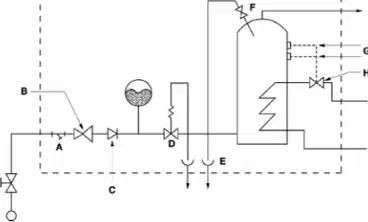
Refer to Figure 2. The component labelled E is:
a tundish
a pressure relief valve
an energy cut out
a high limit thermostat.

Refer to Figure 2. The component labelled F is:
a pressure relief valve
an energy cut out
a temperature relief valve
a diverter valve.
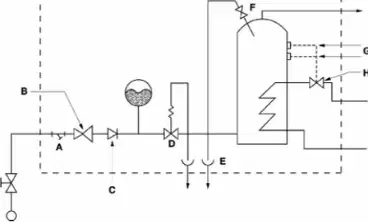
Refer to Figure 2. The component labelled G is:
a temperature relief valve
a sacrificial anode
an operating thermostat and energy cut out
a contents gauge.
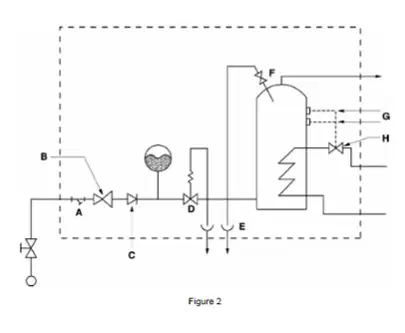
Refer to Figure 2. The component labelled H is a:
double check valve
stop valve
motorised valve
pressure reducing valve
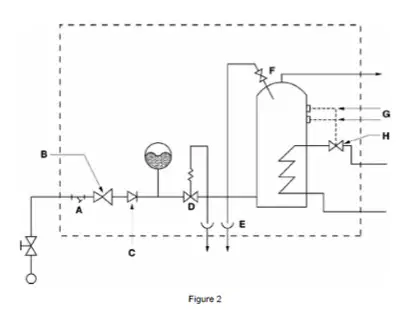
Refer to Figure 2. The components which together form the safety devices which must be incorporated in an unvented domestic hot water system are labelled:
E and G
A and G
D and F
F and G

