wayground logo

Free Printable Worksheets

Font size

S
M
L
XL
Worksheets

Prof. Singh_Review #1_counted as a bonus quiz

Total questions: 80

Worksheet time: 7hrs 40mins
Name
Class
Date
1.
What is the definition of function?
a)
Has inputs and outputs
b)
Every input has only ONE output
c)
Inputs have different outputs every time
d)
x-values and y-values
2.
a)
Function
b)
Not a Function
3.
Is this mapping a function or not a function? 
a)
Function
b)
Not a Function
4.
All of the y values or outputs are called what?
a)
Domain
b)
Range
c)
Relation
d)
Function
5.
All of the x values or inputs are called what?
a)
Domain
b)
Range
c)
Relation
d)
Function
6.
Which of these is NOT the same
a)
Range
b)
Input
c)
Dependent Value
d)
Y-Value
7.
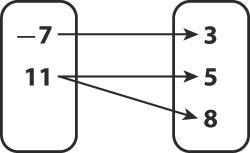
Is the relation a function? Why.
a)
Yes, because the x-value 11 has two y-values pair with it.
b)
Yes, because each x-value has only one y-value paired with it.
c)
No, because the x-value 11 has two y-values pair with it.
d)
No, because each x-value has only one y-value paired with it.
8.
Is this graph a function or not a function? 
a)
Function
b)
Not a Function
9.
Is this table a function or not a function? 
a)
Function
b)
Not a Function
10.
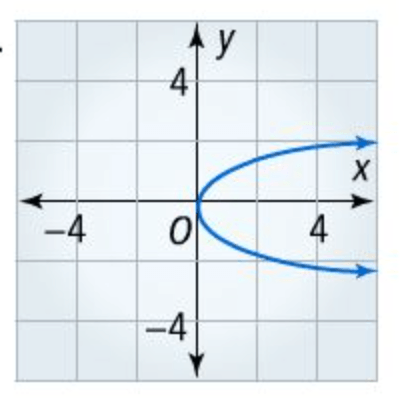
Is this graph a function or not a function? 
a)
Function
b)
Not a Function
11.
Which set of values is a function?
a)
(9,5) (10,5) (9,-5) (10,-5)
b)
(3,4) (4,-3) (7,4) (3, 8)
c)
(6,-5) (7, -3) (8, -1) (9, 1)
d)
(2, -2) (5, 9) (5, -7) (1, 4)
12.
Is this graph a function or not a function? 
a)
Function 
b)
Not a Function 
13.
For the function {(0,1), (1,-3), (2,-4), (-4,1)}, write the domain and range.
a)
D: {1, -3, -4,}
R: {0, 1, 2, -4}
b)
D:{0, 1, 2, -4}
R:{1, -3, -4}
c)
D:{0, 1, 2, 3, 4}
R:{1, -3, -4}
14.
Is this graph a function or not a function? 
a)
Function 
b)
Not a Function
15.
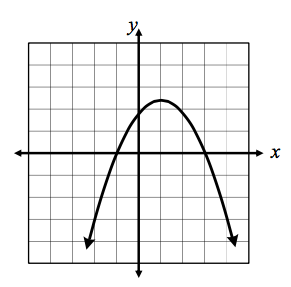
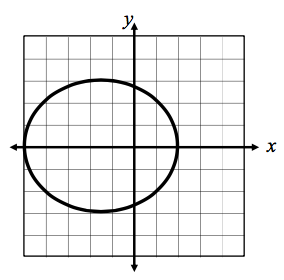
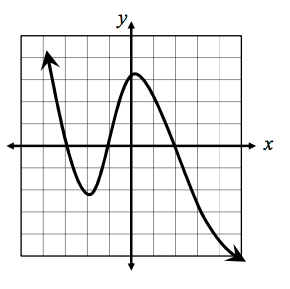
Which graph does NOT pass the vertical line test?
a)
Graph 1
b)
Graph 2
c)
Graph 3
d)
Graph 4
16.

If f(x) = 2x2 + 5x - 3, evaluate f(-1).

a)

f(-1) = -6

b)

f(-1) = 1

c)

f(-1) = -10

d)

f(-1) = -1

17.

f(t) = −2t2+ 1

f(2) = ?

a)

9

b)

17

c)

−17

d)

−7

18.

h(x)=3x5; Find h(x2)h\left(x\right)=3x-5;\ Find\ h\left(\frac{x}{2}\right)  

a)

12x512x-5  

b)

5+32x-5+\frac{3}{2}x  

c)

6x56x-5  

d)

3x+73x+7  

19.

h(x)=3x5; Find h(x2)h\left(x\right)=3x-5;\ Find\ h\left(\frac{x}{2}\right)  

a)

12x512x-5  

b)

5+32x-5+\frac{3}{2}x  

c)

6x56x-5  

d)

3x+73x+7  

20.
f(x) = 3x2 + 7x and g(x) = 2x2 - x - 1, find (f - g)(x).
a)
x2 + 8x + 1
b)
x2 + 6x - 1
c)
5x2 + 8x - 1
d)
x2 + 8x -1
21.

f(x)= x2 - 1

g(x)= x - 1

Find (f(x)/g(x))

Then simplify using x = 10

a)

9

b)

11

c)

90

d)

110

22.

Find the difference of the given functions: f(x)=7x33x2+4x6f\left(x\right)=7x^3-3x^2+4x-6  and  g(x)=6x38x25x7g\left(x\right)=6x^3-8x^2-5x-7  

a)

(fg)(x)=x3+5x2+9x+1\left(f-g\right)\left(x\right)=x^3+5x^2+9x+1  

b)

(fg)(x)=x3+5x2+9x1\left(f-g\right)\left(x\right)=x^3+5x^2+9x-1  

c)

(f+g)(x)=x3+5x2+9x+1\left(f+g\right)\left(x\right)=x^3+5x^2+9x+1  

23.

Which expression do I use for the indicated input, f(-1)?

a)

4 - 5x

b)

3x

c)

4x + 1

24.

What are the intervals where the function is increasing, decreasing, or constant.

Select all that apply.

a)

(,1)\left(-\infty,-1\right) decreasing

b)

(,1)\left(-\infty,-1\right) increasing

c)

(1,)\left(1,\infty\right) decreasing

d)

(1,)\left(1,\infty\right) increasing

e)

(1,1) \left(-1,1\right)\ constant

25.

State the domain of the function given.

Select all that apply.

a)

(,3]\left(-\infty,-3\right]

b)

[0,)\left[0,\infty\right)

c)

(0,3)\left(0,3\right)

d)

(,)\left(-\infty,\infty\right)

e)

(0,)\left(0,-\infty\right)

26.

Use the information given to find the Difference Quotient.

a)

6+h-6+h

b)

6h6-h

c)

6+h6+h

d)

0

e)

none of the above

27.

Use the information to find the Average Rate of Change.

a)

6

b)

-1

c)

0

d)

12\frac{1}{2}

e)

none of the above

28.

Solve for x (if possible in the real numbers).

a)

15-\frac{1}{5}

b)

32\frac{3}{2}

c)

0.2-0.2

d)

5

e)

0

29.
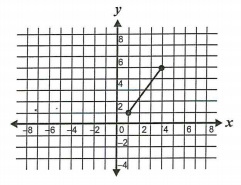
What is the domain of the graph?
a)
-3 ≤ x ≤ 3
b)
3 ≤ x ≤ -3
c)
-2 ≤ x ≤ 10
d)
-3 ≤ x ≤ 10
30.
What is the range of the graph?
a)
1 ≤ x ≤ 5
b)
1 < x < 5
c)
1 ≤ y ≤ 5
d)
1 < y < 5
31.

Noah is depositing money in his account every week to save money (shown in the graph). The amount of money in Elena's account is  M=4w+80M=4w+80  , where  ww  is the number of weeks since the account was opened and  MM  is the amount of money saved.


Who started out with more money in their account?

a)

Noah because $80 is more than $60.

b)

Elena because $80 is more than $60.

c)

Noah because $4 is more than $2

d)

Elena because $4 is more than $2

32.

Lin uses an app to graph the charge on her phone.

When did her phone start losing charge?

a)

2 PM

b)

10 PM

c)

4 PM

d)

8 PM

33.

Lin uses an app to graph the charge on her phone.

When did she start charging her phone?

a)

2 PM

b)

10 PM

c)

4 PM

d)

8 PM

34.

Lin uses an app to graph the charge on her phone.

When did her phone get back to a full charge?

a)

2 PM

b)

10 PM

c)

4 PM

d)

8 PM

35.

This graph shows Andre biking his bike.

What section(s) show that Andre stopped and rested?

a)

A and B

b)

B and C

c)

B and D

d)

A and C

36.

Is this a linear function?

a)

yes

b)

no

c)

cannot be determined

37.

What are the domain and range of the function?

a)

D: (, +)  R: [2, +)D:\ \left(-\infty,\ +\infty\right)\ \ R:\ \left[2,\ +\infty\right)

b)

D: (, +)  R: (, +)D:\ \left(-\infty,\ +\infty\right)\ \ R:\ \left(-\infty,\ +\infty\right)

c)

D: [2, +)  R: (, +)D:\ \left[2,\ +\infty\right)\ \ R:\ \left(-\infty,\ +\infty\right)

d)

D: [4, 4 ] R: [2, 12]D:\ \left[-4,\ 4\ \right]\ R:\ \left[2,\ 12\right]

38.

Is this a linear function?

a)

yes

b)

no

c)

cannot be determined

39.

Does this function have extrema?

a)

yes, it has a maximum at (0, 2)

b)

yes, it has a minimum at (0, 2)

c)

yes, it has multiple relative minimums and maximums

d)

cannot be determined

40.

What is the end behavior of this function?

a)

As x → +∞ ,  y → -∞  AND As x → - ∞ ,  y → -∞

b)

As x → +∞ ,  y → +∞  AND As x → - ∞ ,  y → -∞

c)

As x → +∞ ,  y → +∞  AND As x → - ∞ ,  y → +∞

d)

cannot be determined

41.

What is the best description of this function as it related to increasing/decreasing?

a)

increases as x goes from - ∞ to 0, then decreases from 0 to + ∞

b)

it is a decreasing function 

c)

It is an increasing function

d)

decreases as x goes from - ∞ to 0, then increases from 0 to + ∞

42.

Is this a linear function?

a)

yes

b)

no

c)

cannot be determined

43.

What type of Function is this?

a)

Piecewise Function

b)

Exponential

c)

Absolute Value Function

d)

Quadratic Function

44.
What inequality does the number line graph represent?
a)
x ≥ 3
b)
x > 3
c)
x < -3
d)
x ≤ -3
45.
4x + 1 > 13
a)
x > 48
b)
x < 3
c)
x > 3.5
d)
x > 3
46.

Solve: 5(2+2x)>90Solve:\ 5\left(2+2x\right)>90  

a)

x<8x<8  

b)

x<36x<-36  

c)

x>8x>8  

d)

x>31x>-31  

47.

Solve: 82>2(n5)+7nSolve:\ -82>2\left(n-5\right)+7n  

a)

n>25n>-25  

b)

n<25n<-25  

c)

n<8n<-8  

d)

n>8n>-8  

48.
-4x + 14 ≤ 54
a)
x ≥ -10
b)
x ≤ -10
c)
x ≥ 10
d)
x ≤ 10
49.

What is a y-intercept?

a)

The value of y when x is zero

b)

The value of x when y is zero

c)

Slope

d)

where a line intersects the x-axis

50.

Another name for slope is

a)

y-intercept

b)

Solution

c)

Rate of change

d)

Undefined

51.

The ___________ is the point where a line crosses the x-axis.

a)

y-intercept

b)

x-intercept

c)

domain

d)

range

52.

In the linear equation

y = mx + b,

what does m stand for?

a)

Slope

b)

y-intercept

c)

Solution

d)

x-intercept

53.

Slopes of perpendicular lines are...

a)

opposite reciprocals (flip-flip)

b)

the same

c)

opposite

d)

always 7

54.

What is the slope of the line?

a)

Positive

b)

Negative

c)

Zero

d)

Undefined

55.

What is the slope of the line?

a)

Positive

b)

Negative

c)

Zero

d)

Undefined

56.
Write an equation of a line perpendicular to
y = 2/7x - 5 through (2, -3)
a)
y = -7/2x + 4
b)
y = -4x - 7/2
c)
y = 4x - 7/2
d)
y = 7/2x + 4
57.
Write the linear equation of a line that passes through (2,5) and (2, 9).
a)
y = 0
b)
x = 0
c)
y = 2
d)
x = 2
58.
Write the equation in slope-intercept form: 5x - 2y = 12
a)
y = 5/2x - 6
b)
y = -5/2x - 6
c)
y = 5x +12
d)
y = -5x + 12
59.

Write the equation of the line passes through the point (3,-1) and has a slope of 2.

a)

y = 3x - 1

b)

y = 2x - 5

c)

y = 2x - 7

d)

y = -x + 3

60.

Graph. y = 2/3x - 3

a)
b)
c)
d)
61.

Write the equation of the line shown. Use point-slope form.

a)

y+3=12(x1)y+3=\frac{1}{2}(x-1)

b)

y3=12(x+1)y-3=\frac{1}{2}(x+1)

c)

y4=12(x1)y-4=-\frac{1}{2}(x-1)

d)

y1=12(x+3)y-1=-\frac{1}{2}(x+3)

62.

Write the equation of the line shown on the graph in point-slope form. 

a)

y2=43(x2)y-2=\frac{4}{3}\left(x-2\right)  

b)

y+2=43(x+2)y+2=\frac{4}{3}\left(x+2\right)  

c)

y1=34(x+2)y-1=\frac{3}{4}\left(x+2\right)  

d)

y2=43(x+1)y-2=\frac{4}{3}\left(x+1\right)  

63.

Write an equation of the line that has a slope of 23-\frac{2}{3}  and goes through the point (5, -4).

a)

y4 = 23(x+5)y-4\ =\ -\frac{2}{3}\left(x+5\right)  

b)

y+4=23(x5)y+4=-\frac{2}{3}\left(x-5\right)  

c)

y5=23(x+4)y-5=-\frac{2}{3}\left(x+4\right)  

d)

y+5=23(x4)y+5=-\frac{2}{3}\left(x-4\right)  

64.
Solve in any method
a)
A
b)
B
c)
C
d)
D
65.
Identify the a, b and c values for this equation:
3x2 - 8x + 15 = 0
a)
a=3, b=8, c=0
b)
a=3, b=-8, c=15
c)
a=3, b=8, c=15
66.
Solve by taking square roots:
4m2 - 100 = 0
a)
m=25, -25
b)
m=96
c)
m=5, -5
d)
m=-96
67.
Solve
(4a + 3)(4a - 3) = 0
a)
a = -3/43/4 
b)
a = -4/34/3 
c)
a = -9/169/16 
d)
a = -16/916/9 
68.
What is another word for zeros?
a)
y-intercepts
b)
roots
c)
vertex
d)
axis of symmetry
69.
Simplify the following radical: √32
a)
3√2
b)
4√8
c)
16√2
d)
4√2
70.
Simplify √-28
a)
-√28
b)
-2i√7
c)
2i√7
d)
28i
71.
Simplify
(-6 - 2i)2
a)
32
b)
36-4i
c)
36+24i
d)
32+24i
72.
(4-5i)(4+5i)
a)
41
b)
-9
c)
41+40i
d)
-9+40i
73.
Find the sum.
(5-2i) + (-7+8i)
a)
-2+6i
b)
12+6i
c)
-35-16i2
d)
-35 -16i
74.

9x23=1529x^2-3=-152  

Solve

a)

±1493\pm\frac{\sqrt{149}}{3}  

b)

±i1493\pm\frac{i\sqrt{149}}{3}  

c)

±149\pm\sqrt{149}  

d)

±i149\pm i\sqrt{149}  

75.

Solve  x22=17x^2-2=17  

a)

±19\pm\sqrt{19}  

b)

1±191\pm\sqrt{19}  

c)

±219\pm2\sqrt{19}  

d)

17±2i17\pm2i  

76.

42x269x+20=7x2842x^2-69x+20=7x^2-8  

Solve

a)

{43,12}\left\{\frac{4}{3},\frac{1}{2}\right\}  

b)

{75,43}\left\{\frac{7}{5},\frac{4}{3}\right\}  

c)

{75,47}\left\{\frac{7}{5},\frac{4}{7}\right\}  

d)

{12,75}\left\{\frac{1}{2},\frac{7}{5}\right\}  

77.

If a quadratic equation can be factored and each factor contains only real numbers, then it cannot have an imaginary solution.

a)

True

b)

False

78.

If a quadratic equation cannot be factored, then it will have at least one imaginary solution.

a)

True

b)

False

79.

Rationalize each denominator. Simplify the answer. 41 +3\frac{4}{1\ +\sqrt{3}}  

a)

2 232\ -2\sqrt{3}  

b)

2 +23-2\ +2\sqrt{3}  

c)

4 234\ -2\sqrt{3}  

d)

4 23-4\ -2\sqrt{3}  

80.
Simplify:
a)
2
b)
4√3
c)
2√3
d)
4