
 Worksheets
AP Biology Exam - Unit 3 Review
Total questions: 39
Worksheet time: 22mins

Which of the following is NOT true regarding enzymes.
They are made of proteins
They lower the activation energy of a reaction
They are non-specific and can bind to any substrate
The increase the rate of a reaction

Which option best describes "A"?
Activation energy with enzyme
Activation energy without enzyme
Energy released as heat
Products produced

The location where the enzyme and substrate bind is the...
allosteric site
inhibition site
reaction site
active site
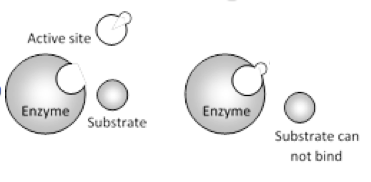
This image shows...
Competitive Inhibition
Enzyme denaturation
Noncompetitive Inhibition
Normal enzyme function
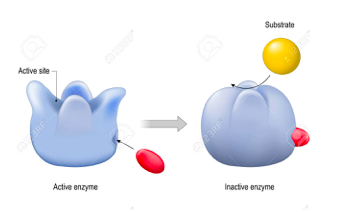
This image shows...
Competitive Inhibition
Enzyme denaturation
Noncompetitive Inhibition
Normal enzyme function

Which factor related to enzyme activity is this graph most likely depicting?
Decreasing temperature
Changing pH
Increasing substrate concentration
Increasing enzyme concentration

Which of these best describes the Calvin Cycle?
Uses ATP, NADPH and enzymes to fix CO2 to 5-carbon sugars to produce glucose
Breaks down pyruvate to produce electron carrier molecules like NADH and FADH2
Converts glucose into 2 pyruvate molecules and a small amount of ATP and NADH
Transfers the energy from photons through the ETC to create NADPH, oxygen and protons

Which of the following is NOT a product of the light reactions in photosynthesis?
Oxygen
Glucose
NADPH
ATP

Photorespiration is the process that occurs when...
a plant can use oxygen to produce glucose
a plant does not have access CO2, so must use O2 and ATP to create an energy molecule
a plant can use carbon dioxide to produce glucose
a plant does not have access to O2, so must use CO2 and ATP to create an energy molecule

The point of the Krebs Cycle (Citric Acid Cycle) is to...
Produce high amounts of ATP using a proton gradient
Move high energy electrons through series of proteins to eventually bind with O2, creating water and protons
Break down pyruvate to produce electron carrier molecules, FADH2 and NADH, as well as CO2 and ATP as byproducts
Use ATP and NADPH to produce 6 carbon sugars

This image shows oxidative phosphorylation, which is made of two steps. These steps are...
ETC and chemiosmosis
chemiosmosis and the Krebs Cycle
ATP Synthase and Glycolysis
Calvin Cycle and ETC

Chemiosmosis is best described as...
Moving high energy electrons through carrier molecules toward oxygen
The use of a proton gradient to power ATP Synthase and produce ATP
The breakdown of pyruvate into electron carrier molecules
The enzyme that combines ADP and inorganic phosphate to produce ATP

This process produces much less ATP than cellular respiration and occurs because...
the plant cell has limited oxygen
the animal cell has limited oxygen
there is no light available
the plant cell has limited CO2

This image shows that the oxygen produced in the light reactions is used in the ETC in respiration. How is it used?
Oxygen is needed to power ATP Synthase
Oxygen donates an electron that moves through the ETC
Oxygen is the last electron acceptor that pulls electrons through the ETC
Oxygen combines with ADP to produce ATP

The breakdown of ATP into ADP is useful because...
It stores energy that can be used later
It releases energy for cells to do work
ADP is smaller and can be stored in cells easily
It releases the least amount of energy, making it most efficient.

Which of these is not true about the electron transport chains in photosynthesis and respiration?
Only respiration produces ATP
Photosynthesis breaks down water to move electrons through the ETC
The ETC in photosynthesis occurs during the light reactions
NADH provides the electrons for respiration that are pulled through the ETC by oxygen.
Photosynthesis goal is to
convert light energy into glucose energy
use light energy to make oxygen gas
convert sugar energy into ATP
convert sugar energy into oxygen gas
Rubisco is important in which step of photosynthesis
energizing the electrons in chlorophyll
carbon fixation when CO2 is connected to RUBP during calvin cycle
regeneration phase as RUBP is made during calvin cycle
reduction of the carbon chain during the calvin cycle
If the proton (H+) pump in the thylakoid was not working which molecule could not be made during the light reaction?
NADPH
ATP
Water
Oxygen gas
What is FALSE about the calvin cycle
uses the light reactions products
produces a three carbon sugar (G3P)
produces carbon dioxide
produces NADP+
During noncyclic photophosphorylation all of the following occur EXCEPT
ATP is made using electron energy that will leave on NADPH
results in oxygen gas being produced
water is split (photolysis)
electrons from photosystem 1 return back to photosystem 1
Photorespiration involves
the production of oxygen gas during the break down of sugar
the breakdown of sugar when CO2 levels are low.
the production of massive amounts of ATP in the thylakoid
water being pulled out of the plant
Why does photorespiration occur?
stomata are closed and CO2 levels are too low.
stomata are closed and O2 levels are too low.
stomata are open and too much water is leaving the plant
stomata are open and the plant receives too much CO2
What does a C4 plant do?
stores CO2 in a separate cell from its photosynthetic cell during the day
stores CO2 in a vacuole during the night.
can't store CO2 so it sufferes photorespiration
can't store CO2 so it speeds up cellular respiration in order to make more CO2
Plants that store CO2 at night as an acid in a vacuole are called
C3 plants
C4 plants
CAM plants
Which step is anaerobic?
Glycolysis
Krebs Cycle
Oxidative Phosphorylation
Which enzyme in the cristae adds the P to ADP?
ADP Phosphorylase
ATP Synthase
Kinase
Phosphatase
Which is the pathway of the electron through cellular respiration?
CO2 > NADH > NADPH
Glucose > NADH > O2
NADH > O2 > Glucose
Water > ATP > NADPH
What is the final electron acceptor in cellular respiration?
ATP
NADH
Oxygen
Water
What donates the electron in photosynthesis?
ATP
NADH
Oxygen
Water
Describe the difference between competitive and noncompetitive inhibitors.
noncompetitive binds to active site and competitive binds to other site
competitive binds to active site and noncompetitive binds to other site
competitive is irreversible and noncompetitive is reversible binding
noncompetitive is irreversible and competitive is reversible binding
What is the process of an endergonic reaction being fueled by an exergonic reaction called?
second law of thermodynamics
energy coupling
first law of thermodynamics
endergonic/exergonic switch
What is the function of the electron transport chain between Photosystem II and Photosystem I?
establish electrochemical gradient of protons
to funnel electrons into photosystem I for the Calvin cycle
transport electrons to oxygen to make water
to synthesize ATP using ATP synthase
Describe the pathway of electrons in the light reactions.
H2O → PSI → ETC → PSII → NADPH
H2O → PSII → ETC → PSI → NADPH
H2O → PSII → ETC → PSI → NADH
H2O → PSI → ETC → PSII → NADH



