
NEW
Font size
 Worksheets
Chapter 12 Review
Total questions: 34
Worksheet time: 29mins


Short = S
Short = t
Short = T
Short = tt

Which of the following genotypes is homozygous dominant?
Yy
yY
yy
YY
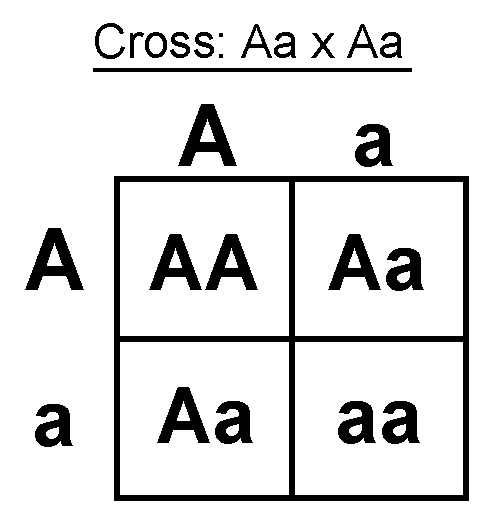
What is the genotypic ratio of the offspring?
3:1
1:3
1:2:1
2:2
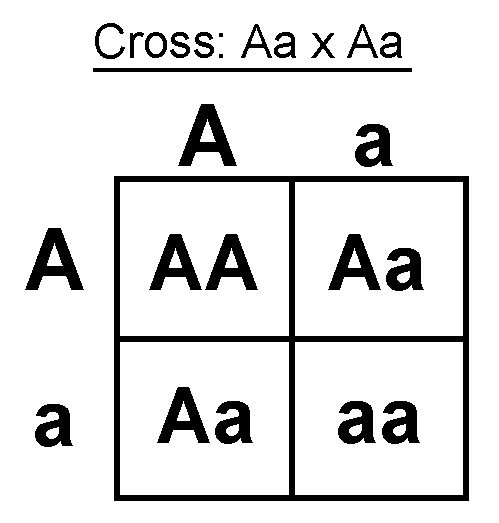
What are the phenotype percentages of the offspring?
(A-Brown fur color; a-white fur color)
50 % Brown fur and 50% White fur
25 % Brown fur and 75% White fur
75 % Brown fur and 25% White fur
0% Brown fur and 100% White fur

(Click the picture to see it without the text)
B=Brown fur
b=tan fur
What percent of the offspring would be tan when you cross BbxBb?
75%
25%
50%
100%


In which phase of Meiosis does crossing-over happen?
Prophase I
Metaphase I
Anaphase I
Telophase I
After meiosis II, which of the following is true about the cells that are produced?
Four cells are produced. They are identical to each other and each contains half the number of chromosomes that the parent cell has.
Four cells are produced. Each is unique and contains half the number of chromosomes that the parent cell has.
Four cells are produced. Each is unique and contains the same number of chromosomes that the parent cell has.
Two cells are produced. Each is unique and contains the same number of chromosomes that the parent cell has.
What effect does crossing over has in terms of traits of offspring?
Results in identical traits of offsprings.
Causes variation in the traits of offsprings.
It really does nothing to the traits of offspring.
The four cells that are produced after Meiosis are _______.
haploid because they contain just half the number of chromosomes as the parent cell.
diploid because they contain as many chromosomes as the parent cell.
diploid because they contain twice as many chromosomes as the parent cell.
WHAT DOES MEIOSIS CREATE?
CHROMOSOMES
GAMETES
DNA
TRAITS
MEIOSIS IS NEEDED BECAUSE...
IT ACTUALLY ISN'T, BUT CAN BE HELPFUL IN SOME ORGANISMS
TO REDUCE THE CHROMOSOME NUMBER BY HALF
SO THAT EVERY CELL IS EXACTLY IDENTICAL
TO MAKE SURE EVERY HUMAN CELL HAS 92 CHROMOSOMES
Phenotypes refer to:
Allele combinations.
Physical Characteristics.
What is true about genotypes?
Genotypes are the physical traits
Genotypes are the allele combinations.
Heterozygous means:
Same alleles. Ex: TT
Different alleles. Ex: Tt

What phase of Meiosis is in this picture?
Prophase I
Metaphase I
Anaphase I
Telophase I

Which phase of meiosis is shown in the picture?
Prophase I
Metaphase I
Anaphase I
Telophase I

Which phase of meiosis is shown in the picture?
Prophase II
Metaphase II
Telophase I
Telophase II

In humans, the haploid number of chromosomes is ____.
23
46
69
92
Which of the following is the best definition for MEIOSIS?
the process of two haploid cells uniting
the counting of chromosomes within a diploid cell
a two-step process that reduces the number of chromosomes in half such that there is only one copy of all the chromosomes
the equational division of a cell into two identical copies
produces identical daughter cells
Mitosis
Meiosis
Both


