wayground logo

Free Printable Worksheets

Font size

S
M
L
XL
Worksheets

Pre-Algebra Year Review

Total questions: 146

Worksheet time: 7hrs 4mins

Name
Class
Date
1.

What is a trend line used for?

a)

To make predictions

b)

To make the graph look pretty

c)

To connect the points

2.

Which graph shows a line of best fit (trend line) for the scatter plot?

a)

Graph A

b)

Graph B

c)

Graph C

d)

Graph D

3.
Which of the following lines represents the line of best fit for the scatter plot?
a)
A
b)
B
c)
C
d)
D
4.
Based on the scatterplot, what is the best prediction of the average number of hours a person spends at work every week, if that person spends an average of 10 hours on recreational activities every week?
a)
33 hours
b)
85 hours
c)
50 hours
d)
65 hours
5.
Based on the scatterplot, what is the best prediction of the average amount of money spent on groceries for a household of 7 people?
a)
$240
b)
$190
c)
$210
d)
$300
6.
Based on the trend in the data, approximately how many free throws would a player be expected to make if he attempted 60 free throws?
a)
50
b)
35
c)
25
d)
60
7.

Based on this scatterplot, approximately what score would a student with 6 absences expect to receive on the final exam?

a)

65

b)

92

c)

67

d)

76

8.
Based on the scatterplot, about how much money would a group of 10 people be expected to spend on food and beverages at this restaurant?
a)
$135
b)
$115
c)
$105
d)
$150
9.
Write an equation for this relationship.
a)
y=18x
b)
y=18.50x
c)
y=22.50x
d)
y=22x
10.
Is this table proportional?
a)
Yes
b)
No
11.
Is this graph proportional?
a)
Yes
b)
No
12.
What makes a graph proportional?
a)
Linear
b)
The line goes through the origin
c)
Curvy line
d)
Linear and the line goes through the origin
13.
Is the graph proportional or non proportional?
a)
proportional
b)
non proportional
14.
Is this table proportional?
a)
Yes
b)
No
15.
Write an equation for this situation.
a)
y=9.75x
b)
y=19x
c)
y=19.25x
d)
y=9.5x
16.
Which equation shows a NON-proportional relationship of x and y?
a)
y = 5x
b)
y = -5.6x
c)
y = x + 3
d)
y = 1/2x
17.
What is the unit rate in this proportional relationship?
a)
60 miles/1 hour
b)
120 miles/ 2 hours
c)
1 mile/ 1 hour
18.
Is this table proportional?
a)
Yes
b)
No
19.
Why does this graph show a non-proportional relationship?
a)
Because it is proportional
b)
It goes through the origin
c)
It does not go through the origin
d)
It is a straight line
20.
In the equation y = 14x, what is the constant of proportionality?
a)
y
b)
x
c)
14
21.

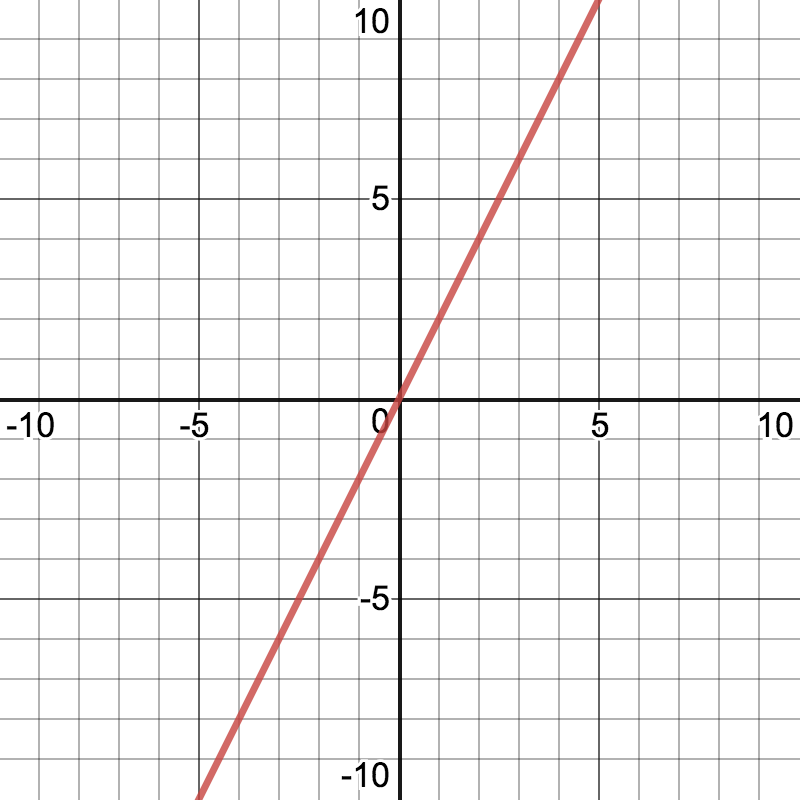
Categorize the slope of the line

a)

Positive

b)

Negative

c)

Zero

d)

Undefined

22.

Categorize the slope of the line

a)

Positive

b)

Negative

c)

Zero

d)

Undefined

23.

Categorize the slope of the line

a)

Positive

b)

Negative

c)

Zero

d)

Undefined

24.
What does the m represent?
a)
Slope
b)
y-intercept
c)
x coordinate
d)
y coordinate
25.
What does the b represent?
a)
Slope
b)
y-intercept
c)
x coordinate
d)
y coordinate
26.

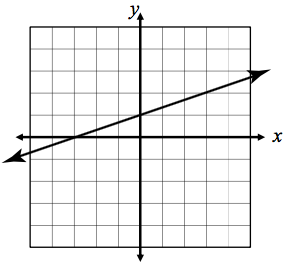
What is the y-intercept?

a)

0

b)

1

c)

-1

d)

12\frac{1}{2}

27.

What is the slope of the line?

a)

25\frac{2}{5}

b)

42\frac{4}{2}

c)

12\frac{1}{2}

d)

21\frac{2}{1}

28.

What is the slope of the line?

a)

32\frac{3}{2}

b)

32-\frac{3}{2}

c)

23\frac{2}{3}

d)

23-\frac{2}{3}

29.

What is the slope of the line?

a)

43-\frac{4}{3}

b)

34-\frac{3}{4}

c)

43\frac{4}{3}

d)

34\frac{3}{4}

30.

What is the equation of the line?

a)

y = 54x + 4y\ =\ \frac{5}{4}x\ +\ 4

b)

y = 45x + 4y\ =\ \frac{4}{5}x\ +\ 4

c)

y = 45x  4y\ =\ \frac{4}{5}x\ -\ 4

d)

y = 54x  4y\ =\ \frac{5}{4}x\ -\ 4

31.

What is the slope of the line?

a)

1

b)

-2

c)

3

d)

-1

32.

What is the slope of the line?

a)

34\frac{3}{4}

b)

43-\frac{4}{3}

c)

43\frac{4}{3}

d)

34-\frac{3}{4}

33.

What is the equation of the line?

a)

y = 12x + 2y\ =\ \frac{1}{2}x\ +\ 2

b)

y = 2x + 2y\ =\ 2x\ +\ 2

c)

y = 12x  2y\ =\ -\frac{1}{2}x\ -\ 2

d)

y = 12x + 2y\ =\ -\frac{1}{2}x\ +\ 2

34.
What is the definition of function?
a)
Has inputs and outputs
b)
Every input has only ONE output
c)
Inputs have different outputs every time
d)
x-values and y-values
35.
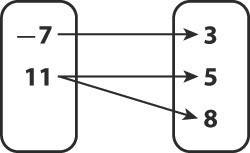
Is the relation a function? Why.
a)
Yes, because the x-value 11 has two y-values pair with it.
b)
Yes, because each x-value has only one y-value paired with it.
c)
No, because the x-value 11 has two y-values pair with it.
d)
No, because each x-value has only one y-value paired with it.
36.
a)

Function; it passes the vertical line test

b)

Not a Function; it fails the vertical line test

37.

How do you use the vertical line test?

a)

Draw vertical lines through your graph. If any of the vertical lines you draw intersects the graph more than once then the graph is not the graph of a function.

b)

Draw vertical lines through your graph. If any of the vertical lines you draw intersects the graph more than once, then it is a function.

38.

Is this mapping a function or not a function?

a)

Function; the x's don't repeat

b)

Not a Function; the x's repeat

39.

Is this table a function or not a function?

a)

Function; the x's don't repeat

b)

Not a Function; the x's repeat

40.
Which set of values is a function?
a)
(9,5) (10,5) (9,-5) (10,-5)
b)
(3,4) (4,-3) (7,4) (3, 8)
c)
(6,-5) (7, -3) (8, -1) (9, 1)
d)
(2, -2) (5, 9) (5, -7) (1, 4)
41.
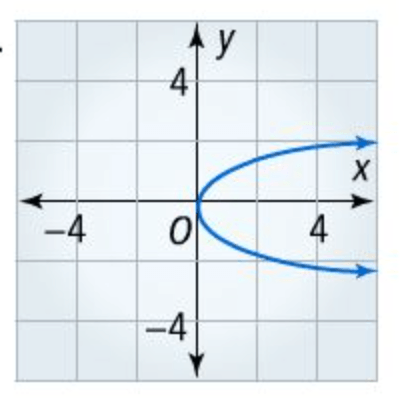
Is this graph a function or not a function? 
a)
Function
b)
Not a Function
42.

Is this graph a function or not a function?

a)

Function; it passes the vertical line test

b)

Not a Function; it fails the vertical line test

43.

Which of the following is NOT a function?

a)
b)
c)
d)
44.
Which graph is a function?
a)
Graph 1
b)
Graph 2
c)
Graph 3
d)
Graph 4
45.
Which graph is NOT a function?
a)
Graph 1
b)
Graph 2
c)
Graph 3
d)
Graph 4
46.

Which of these sets is not a function?

a)

{ (2,3) , (3,5) , (4,9) }

b)

{ (2,3) , (2,5) , (4, 9) }

c)

{ (2,3) , (3,3) , (4,9) }

47.
a)
Yes
b)
No
48.

This table shows a function.

a)

true

b)

false

49.
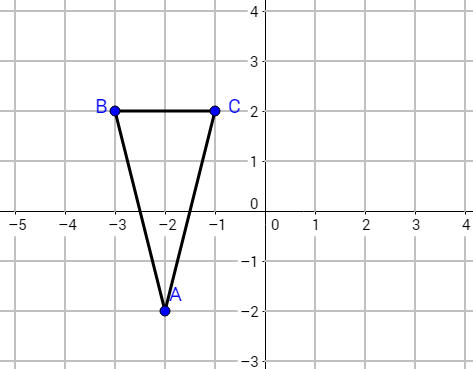
Dilate the figure by a scale factor of 3 with the origin as the center of dilation. What are the coordinates of the image?
A(3,3) B(6,6) C(9,3)
a)
A'(9,9) B'(18,18) C'(27,9)
b)
A'(6,6) B'(9,9) C'(12,6)
c)
A'(0,0) B'(3,3) C'(6,0)
d)
A'(1,1) B'(2,2) C'(3,1)
50.
A triangle has vertices with coordinates (2,0), (3, -1) and (-2,-5). If the triangle is dilated by a scale factor of 3 with the origin as the center of dilation, what are the coordinates of the vertices of the image?
a)
(5,3), (6,2), (1,-2)
b)
(6,0), (9,-3), (-6,-15)
c)
(2/3,0), (1,-1/3), (-2/3,-5/3)
d)
(-1,-3), (0,-4), (-5,-8)
51.
State the coordinate of the image of the given point B (-10,-6) under a dilation with center at the origin with the given scale factor k = 1/2.
a)
(5,3)
b)
(20,12)
c)
(-20,-12)
d)
(-5,-3)
52.
Choose the correct scale factor:
a)
2
b)
3
c)
1/3
d)
1/2
53.
The point (8, 12) was dilated to become point (2, 3). What was the scale factor?
a)
½
b)
¼
c)
4
d)
2
54.
Dilate Point B by a scale factor of 1/2
a)
(1.5,-4)
b)
(-1.5,1)
c)
(-1,-1.5)
d)
(-2,-2)
55.
A dilation is which of the following: 
a)
only an enlargement
b)
only a reduction
c)
Either an enlargement or a reduction
d)
Neither an enlargement or a reduction
56.
What is the definition of dilation,  in mathematical terms?
a)
to make larger or smaller
b)
to only make larger
c)
all of the above
d)
to only make smaller
57.
State the coordinate of the image of the given point B (4,9) under a dilation with center at the origin with the given scale factor k = 2.
a)
(2,4.5)
b)
(-8,-18)
c)
(8,18)
d)
(9,4)
58.
A dilation produces a similar figure
a)
True
b)
False
59.
A dilation produces a congruent figure
a)
True
b)
False
c)
D
60.
When a dilation has a scale factor greater than one, the dilation is an enlargement.
a)
True
b)
False
61.
When the scale factor of a dilation is less than one, the dilation is a reduction.
a)
True
b)
False
62.
How do you write the algebraic notation when the scale factor is 3?
a)
(x, y) goes to (1/3x, 1/3y)
b)
(x, y) goes to (-3x, -3y)
c)
(x, y) goes to (x + 3, y + 3)
d)
(x, y) goes to (3x, 3y)
63.
How do you write the algebraic notation when the scale factor is 1/2?
a)
(x, y) goes to (2x, 2y)
b)
(x, y) goes to (1/2x, 1/2y)
c)
(x, y) goes to (-2x, -2y)
d)
(x, y) goes to (2x, 1/2y)
64.
Tell whether the transformation is a dilation. Explain.
a)
No, scale factor isn't the same.
b)
Yes, scale factor is the same.
65.
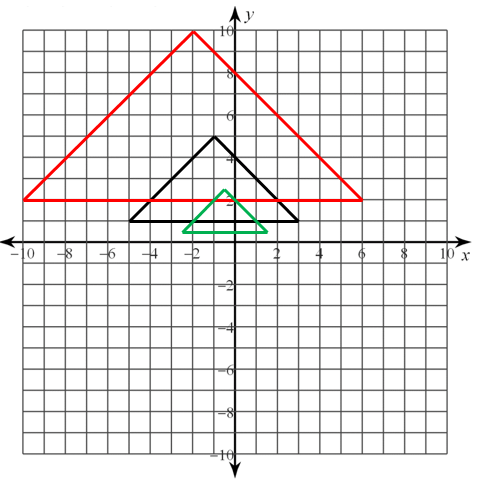
The red triangle has been dilated by a scale factor of 1/4, which triangle is it's new image? 
a)
green triangle 
b)
red triangle 
c)
black triangle
d)
none of these 
66.
A scale factor of less than one means
a)
that the image will be larger than the pre-image.
b)
That the image will be the same as the pre-image.
c)
That you need to subtract that amount off  of each side.
d)
That the image will be a reduction of the pre-image.
67.
Does the image show a Dilation?
a)
Yes
b)
No
68.
Definition: The figure after a transformation has occurred. 
a)
Pre-image
b)
Image
c)
Translation
d)
Reflection
69.
Definition: The figure before a transformation has occurred. 
a)
Pre-image
b)
Image
c)
Translation
d)
Reflection
70.

A dilation always produces a congruent figure.

a)

True

b)

False

71.
A dilation always produces a similar figure. Similar figures have the same ______ but different ______. 
a)
measure; shapes
b)
sizes; shapes
c)
value; measures
d)
shape; sizes
72.
What scale factor was used to produce the image?
a)
1
b)
7
c)
18
d)
49
73.
Changing the size of a figure so that the scale factor is greater than 1.
a)
Translation
b)
Enlargement
c)
Rotation
d)
Dilation
74.
What transformation has been done to this triangle?
a)
A 270 degree clockwise rotation
b)
A 90 ccw rotation
c)
A translation 5 units right and 1 unit up
d)
A translation 1 unit right and 5 units up
75.
A fixed point in the coordinate plane around which a figure expands or contracts.
a)
Center of dilation
b)
Center of rotation
c)
Line of symetry
d)
Line of reflection
76.
What transformation has been done to this image?
a)
A reflection across the y - axis
b)
A translation 6 units up
c)
A reflection across the x - axis
d)
A dilation with a scale factor of 1
77.
 Figures with the same shape, but not necessarily the same size.
a)
Rotation
b)
Pre-image
c)
Scale Factor
d)
Similar
78.
A transformation that enlarges or reduces a figure by a scale factor. 
a)
Transformation
b)
Dilation
c)
Rotation
d)
Reflection
79.
What scale factor was used to perform the dilation on this image?
a)
2
b)
1/3
c)
3
d)
1/4
80.
Changing the size of a figure so that the scale factor is less than 1. 
a)
Reduction
b)
Enlargement
c)
Scale Factor
d)
Kenny has a hot date
81.
What are the new coordinates for this dilated image?
a)
N'(4,4), K'(4,4), I'(4,0)
b)
N(0,0), K(4,4), I(4,0)
c)
N'(0,0), K'(4,4), I'(3,0)
d)
N'(0,0), K'(4,4), I'(4,0)
82.
The amount by which you stretch or shrink the original figure. 
a)
Transformation
b)
Rotation
c)
Scale Factor
d)
Line of Symetry
83.
Determine where X' would be if you translated X 3 units to the left and 9 units down.
a)
(-4, 4)
b)
(-10, 2)
c)
(-4, -5)
d)
(-1, 5)
84.
How is trapezoid ABCD translated to trapezoid A'B'C'D'?
a)
Translated 5 units down and 5 units to the right
b)
Translated 5 units down and 1 to the right
c)
Translated 8 units down and 5 units to the right
d)
Translated 5 units down and 4 units to the right
85.
Determine how to translate triangle A'B'C' to triangle ABC.
a)
right two, down five
b)
right two, down 9
c)
left two, down 9
d)
left two, down 5
86.
How is triangle ABC being translated to triangle A'B'C'?
a)
up 3, left 8
b)
up 9, left 4
c)
down 3, right 8
d)
down 9, right 4
87.
How is Quadrilateral EFGH translated to E'F'G'H'?
a)
6 down
b)
6 down, 1 right
c)
6 down, 3 left
d)
8 down, 1 right
88.
Write the rule for this translation:
Slide 3 up and 2 right
a)
(x, y)---->(x + 3, y + 2)
b)
(x, y)-----> (x+2, y + 3)
c)
(x, y)----> (x - 2, y + 3)
89.
What transformation is happening?
(x, y) ----> (x + 2, y - 3) 
a)
slide up 2, left 3
b)
slide right 2, up 3
c)
slide right 2, down 3
d)
slide left 3, right 2
90.

Translate the blue shape to the pink shape...

a)

5 Right

2 Down

b)

5 Left

2 Up

c)

3 Right

1 Down

d)

3 Left

1 Up

91.

Translate shape A to shape B...

a)

5 Right

3 Up

b)

5 Left

3 Down

c)

3 Right

3 Up

d)

3 Left

3 Down

92.

Translate shape B to shape A...

a)

5 Right

3 Up

b)

5 Left

3 Down

c)

3 Right

3 Up

d)

3 Left

3 Down

93.

The Pythagorean Theorem ONLY works on which triangle? 

a)

Obtuse

b)

Right

c)

Acute

d)

Isosceles

94.

What is the side of a right triangle across from the right angle called?

a)

Square

b)

Arm

c)

Leg

d)

Hypotenuse

95.

If a right triangle has side lengths 6, 6.7 and 3, which side is the hypotenuse?

a)

6

b)

6.7

c)

3

d)

Not enough information

96.

Find the length of the missing side

a)

17

b)

15

c)

22

d)

13

97.

Side c on a right triangle is ALWAYS the longest.

a)

True

b)

False

98.

Find the length of the missing side

a)

20

b)

68

c)

16

d)

80

99.

Is this a right triangle

a)

Yes

b)

No

100.

In a right triangle, if a = 8 and c = 17, what is the correct setup to find the value of b?

a)

172+82=b217^2+8^2=b^2  

b)

82+b2=1728^2+b^2=17^2  

c)

172+b2=8217^2+b^2=8^2  

d)

82b2=172100\frac{8^2}{b^2}=\frac{17^2}{100}  

101.

What is the opposite of squaring a number

a)

divide

b)

multiply

c)

square root

d)

fractions

102.

The Pythagorean is used to find what

a)

missing sides only

b)

missing angles only

c)

either missing sides or angles

103.

John leaves school to go home. He walks 6 blocks North and then 8 blocks west. How far is John from the school? 

a)

14 blocks

b)

12 blocks

c)

10 blocks

d)

8.5 blocks

104.

What is the formula for Pythagorean Theorem?

a)

a^2+b^2=c^2

b)

b-a=c

c)

c^2+b^2=a^2

d)

a+b=c

105.
Which set of sides would make a right triangle?
a)
4,5,6
b)
8,10,12
c)
5,12,13
d)
5,10,12
106.

Find the length of the missing side

a)

48

b)

108

c)

83.6

d)

72

107.
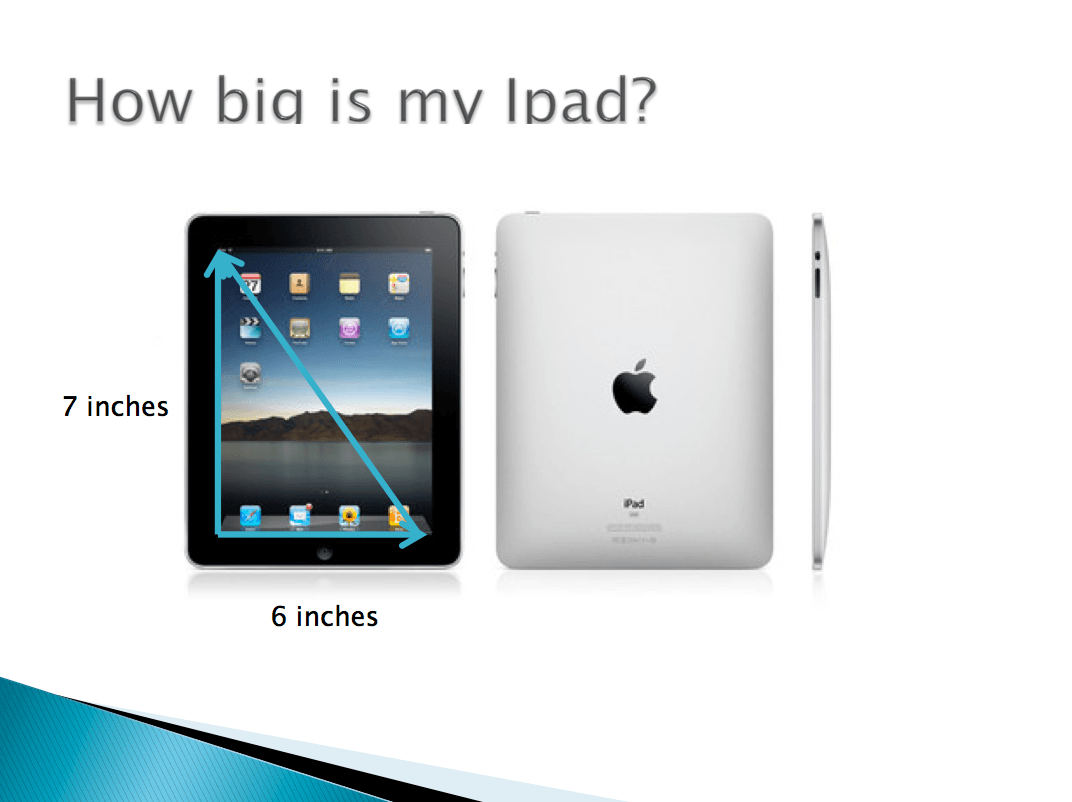
What is the diagonal length of the iPad?
a)
9.2 in
b)
11 in
c)
13 in
d)
9.6 in
108.
Find the missing side
a)
9
b)
41
c)
6.4
d)
6.2
109.
Tanya runs diagonally across a rectangular field that has a length of 40 yards and a width of 30 yards. What is the length of the diagonal, in yards, that Tanya runs? 
a)
26.5 yards
b)
10 yards
c)
50 yards
d)
46.7 yards
110.
Which equation is modeled by the picture shown?
a)
32+52=42
b)
32+42=52
c)
52+42=32
d)
92+162=252
111.
Solve for x:
8x + 2 + 3x + 5 = x + 12
a)
-1/2
b)
2
c)
-2
d)
1/2
112.
Solve     -20 = -4x - 6x
a)
x = -2
b)
x = 10
c)
x = 2
d)
x = -10
113.
Find the error in the problem below
19 - 2k = 3k - 1
     +3k   +3k
19 + 1k = -1
-19           -19
k = -20
a)
They should have divided by 1 for the last step
b)
They should add 19 instead of subtracting 19
c)
I can not find an error
d)
Instead of adding 3k they should subtract 3k
114.

Austin solved the equation as shown below. Which correctly describes the error that Austin made in his work?

a)

Austin did not combine 7x and 8x correctly.

b)

Austin did not combine -3 and -9 correctly.

c)

Austin did not divide correctly.

d)

Austin did not make an error in his work.

115.

List the following numbers from least to greatest:

-64 , 3.5 , √27 , 6.666...

a)

-64 , 3.5 , √27 , 6.666...

b)

3.5 , √27 , 6.666..., -64

c)

3.5, -64, √27, 6.666...

d)

6.666, √27, -64, 3.5

116.

Order 10.5, √105 , and 3π + 1 from greatest to least.

a)

√ 105 , 3π + 1, 10.5

b)

3π + 1,√ 105 , 10.5

c)

√ 105 , 10.5, 3π + 1

d)

10.5, √ 105 , 3π + 1

117.

Order 10.5, √105 , and 3π + 1 from greatest to least.

a)

√ 105 , 3π + 1, 10.5

b)

3π + 1,√ 105 , 10.5

c)

√ 105 , 10.5, 3π + 1

d)

10.5, √ 105 , 3π + 1

118.
Order from least to greatest:
[10, -5, 3, 16, -1, 0, 1]
a)
-1, -5, 0, 1, 3, 10, 16
b)
16, 10, 3, 1, 0, -1, -5
c)
-5, -1, 0, 1, 3, 10, 16
d)
0, -1, 1, 3, -5, 10, 16
119.
List the following numbers from least to greatest:
-64 , 3.5 , √27 , 6.666...
a)
-64 , 3.5 , √27 , 6.666...
b)
3.5 , √27 , 6.666..., -64
c)
3.5, -64, √27, 6.666...
d)
6.666, √27, -64, 3.5
120.
Point B could represent which of the following numbers?
a)
√24
b)
√30
c)
√35
d)
√42
121.
Which list of numbers is in order from least to greatest?
a)
A √23, 5, 6, 43%
b)
B 5, √23, 6, 43%
c)
C 43%, 5, √23, 6
d)
D 43%, √23, 5, 6
122.

Place the numbers in order from least to greatest

a)

π, 31%, -0.32, 1/3, 3.1

b)

-0.32, 31%, 1/3, 3.1, π

c)

-0.32, 1/3, 31%, 3.1, π

d)

-0.32, 31%, 1/3, π, 3.1

123.

Place numbers in order from least to greatest.

a)

-1.7, -0.7, 1 7/10, 172%, √3

b)

-1.7, -0.7, √3, 1 7/10, 172%

c)

-0.7, -1.7, √3, 1 7/10, 172%

d)

-0.7, -1.7, 1 7/10, 172%, √3

124.

Place numbers in order from greatest to least.

a)

6 1/6, 62%, 0.6, 2π, -0.062

b)

2π, 62%, 6 1/6, 0.6, -0.062

c)

6 1/6, 2π, 62%, 0.6, -0.062

d)

2π, 6 1/6, 62%, 0.6, -0.062

125.
What does the "B" in the volume formula V = Bh stand for?
a)
Bottom of the object
b)
Box
c)
Between
d)
Area of the base
126.
Soda is sold in aluminum cans that measure 6 inches in height and 2 inches in diameter.  How many cubic inches of soda are contained in a full can?
a)
12.0
b)
24.0
c)
75.4
d)
18.8
127.
What does the "B" in the volume formula V = Bh stand for?
a)
Bottom of the object
b)
Box
c)
Between
d)
Area of the base
128.
Soda is sold in aluminum cans that measure 6 inches in height and 2 inches in diameter.  How many cubic inches of soda are contained in a full can?
a)
12.0
b)
24.0
c)
75.4
d)
18.8
129.
What is the radius of this circle?
a)
12
b)
6
c)
24
130.
A cylinder has a height of 4 m and a diameter or 4 m. What is the volume?
a)
64π m3
b)
16π m3
c)
64π m2
d)
16π m2
131.
Which cylinder will have a larger volume?
a)
Cylinder A
b)
Cylinder B
132.
Find the volume of the prism.
a)
27 cm3
b)
72 cm3
c)
180 cm3
d)
360 cm3
133.
a)
55 yd3
b)
121 yd3
c)
22 yd3
d)
330 yd3
134.
a)
Prisms
b)
Pyramids
c)
Cones
d)
Spheres
135.
A cereal box is 12cm tall.  The area of the base is 7cm.  What is the volume?
a)
84 cm2
b)
84 cm3
c)
83 cm
d)
84
136.
Volume is the amount of space an object takes up.
a)
True
b)
False
137.

What is the formula for VOLUME of a CONE?

a)

V = 13BhV\ =\ \frac{1}{3}Bh

b)

V = BhV\ =\ Bh

c)

V = πr2V\ =\ \pi r^2

d)

V = bhV\ =\ bh

138.

A styrofoam model of a volcano is in the shape of a cone. The model has a circular base with a diameter of 48 centimeters and a height of 12 centimeters. Find the volume of foam in the model to the nearest tenth.

a)

7,234.56 cm3

b)

28,952.9 cm3

c)

1,809.6 cm3

d)

21,703.68 cm3

139.

Find the volume of the cone. Round your answers to the nearest tenth. Use 3.14 for π.

a)

340.2 mm3

b)

1020.5 mm3

c)

68.0 mm3

140.

What is the formula for a sphere.

a)

V = πr2hV\ =\ \pi r^2h

b)

V= 13πr2V=\ \frac{1}{3}\pi r^2

c)

V = 43πr3V\ =\ \frac{4}{3}\pi r^3

d)

V = πr2V\ =\ \pi r^2

141.

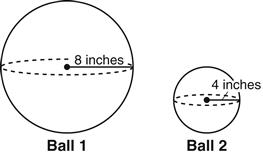
Kayla has two spherical gazing balls in her yard.

(see picture). Which statement about their volumes is true?

a)

The volume of Ball 2 is twice the volume of Ball 1.

b)

The volume of Ball 1 is 8 times the volume of Ball 2.

c)

The volume of Ball 1 is twice the volume of Ball 2.

d)

The volume of Ball 2 is 8 times the volume of Ball 1.
142.
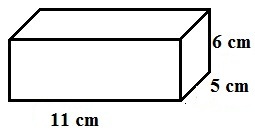
You want to wrap the box in the image.  How much wrapping paper would you need?
a)
415 squared cm
b)
489 squared cm
c)
302 squared cm
d)
612 squared cm
143.

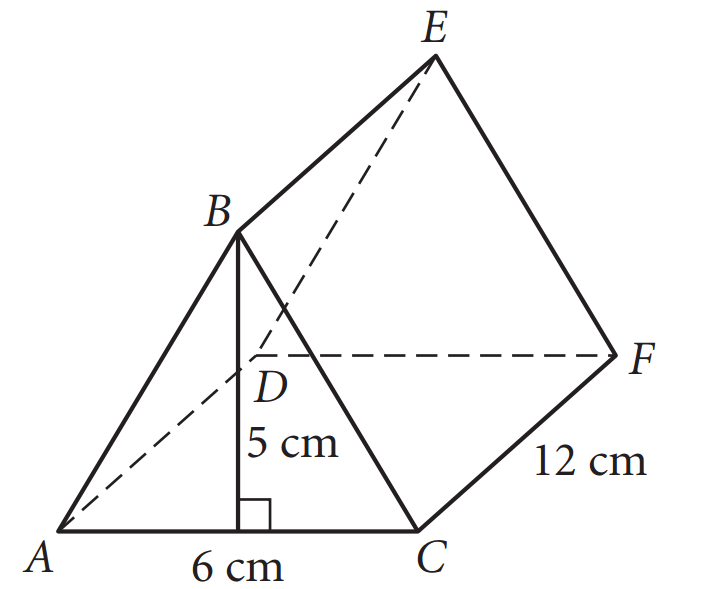
Find the surface area of the shape.  The height of the triangle in the picture is 5 m.

a)

246 square meters

b)

254 square meters

c)

216 square meters

d)

325 square meters

144.

Find the lateral surface area of the shape.  The height of the triangle in the picture is 5 m.

a)

246 square meters

b)

254 square meters

c)

216 square meters

d)

325 square meters

145.
A soup can has a radius of 2.5 inches and a height of 5 inches.  How much metal is needed to make the can?
a)
119.5 inches 2
b)
122.75 inches 2
c)
78.5 inches 2
d)
117.75 inches 2
146.

You need to paint your rectangular prism bedroom. Your room is 10 feet by 12 feet and has 8 foot tall ceilings. A gallon of the paint you want covers 250 square feet. If you painted the floor, the walls, and the ceiling of your room, how many gallons would you need?

a)

2 gallons

b)

3 gallons

c)

4 gallons

d)

5 gallons