
NEW
Font size
 Worksheets
Critical Path Analysis (CPA)
Total questions: 66
Worksheet time: 33mins
What is another name for Critical Path Analysis (CPA) as mentioned in the document?
Critical Job Analysis
Network Analysis
Task Sequence Analysis
Operational Pathway Analysis
What is the primary purpose of using Critical Path Analysis (CPA) in project management?
To increase the project cost
To extend the project duration
To plan activities for timely completion
To reduce the number of tasks in a project
Which sectors commonly use Critical Path Analysis?
Education and Healthcare
Manufacturing and Construction
Retail and Entertainment
Information Technology and Telecommunications
What does Critical Path Analysis (CPA) primarily focus on in a project?
The financial aspects
The dependency of tasks
The marketing strategies
The hiring of staff
What does an arrow represent in a network diagram?
The direction of the activity
The length of the activity
The importance of the activity
The resources required for the activity
What shape is used to represent a node in a network diagram?
Triangle
Square
Circle
Rectangle
Which statement is true regarding the nodes in a network diagram?
Nodes represent only the start of an activity
Nodes are optional in a network diagram
Every network must start and end with a node
Nodes can be represented by any geometric shape

What is the first step a business must take before building a new factory according to the diagram?
Draw up plans
Buy the land
Start construction
Hire employees
How many weeks does it take to complete Activity A in the process of building a new factory?
3 weeks
12 weeks
5 weeks
10 weeks
According to the network diagram, how long does Activity B take to complete?
12 weeks
3 weeks
6 weeks
1 week
What is the duration in weeks for the activity labeled "AA" as mentioned in the example of simultaneous activities?
12 weeks
3 weeks
14 weeks
10 weeks
According to the diagram, how many weeks does it take to move from activity A to activity B?
14 weeks
12 weeks
3 weeks
5 weeks
What is the purpose of the activity "AA" in the process described in the image?
To buy the land
To sell the land
To apply for planning permission
To construct a building
What is a major problem with the previous network development as mentioned in the slide?
The nodes are too complex to understand
There is no way of identifying the nodes
The network is fully developed
The nodes provide excessive information
According to the slide, what will the right-hand quarters of the nodes be used for in the network development?
To show the sequence of activities
To hold additional information
To decrease the size of the network
To identify the crucial activities
What information will be shown in the left-hand semi-circle of each node?
The importance of each node
The cost associated with each node
The order of activities
The completion time for activities
What is the main reason for drawing a network in project management?
To allocate resources efficiently
To identify the CRITICAL activities
To calculate the total cost
To determine the project duration
What does EST stand for in the context of project scheduling?
Estimated Start Time
Earliest Start Time
Expected Start Time
Effective Start Time
How is the Earliest Start Time (EST) of an activity calculated?
EST = Duration of previous activity + EST of Previous activity
EST = EST of Previous activity - Duration of previous activity
EST = EST of Previous activity + Duration of previous activity
EST = Duration of previous activity / EST of Previous activity
Where is the information about the Earliest Start Time (EST) placed in the node according to the slide?
Top left-hand quarter
Bottom right-hand quarter
Top right-hand quarter
Bottom left-hand quarter
What is the EST of the first node as mentioned in the slide?
1
10
0
5

According to the slide, how is the EST for each activity calculated in the provided example?
By adding the values inside the nodes
By subtracting the values inside the nodes
By multiplying the values inside the nodes
By dividing the values inside the nodes
What does EST stand for in the context of simultaneous activities in project management?
Estimated Start Time
Earliest Start Time
Estimated Submission Time
Effective Strategy Time
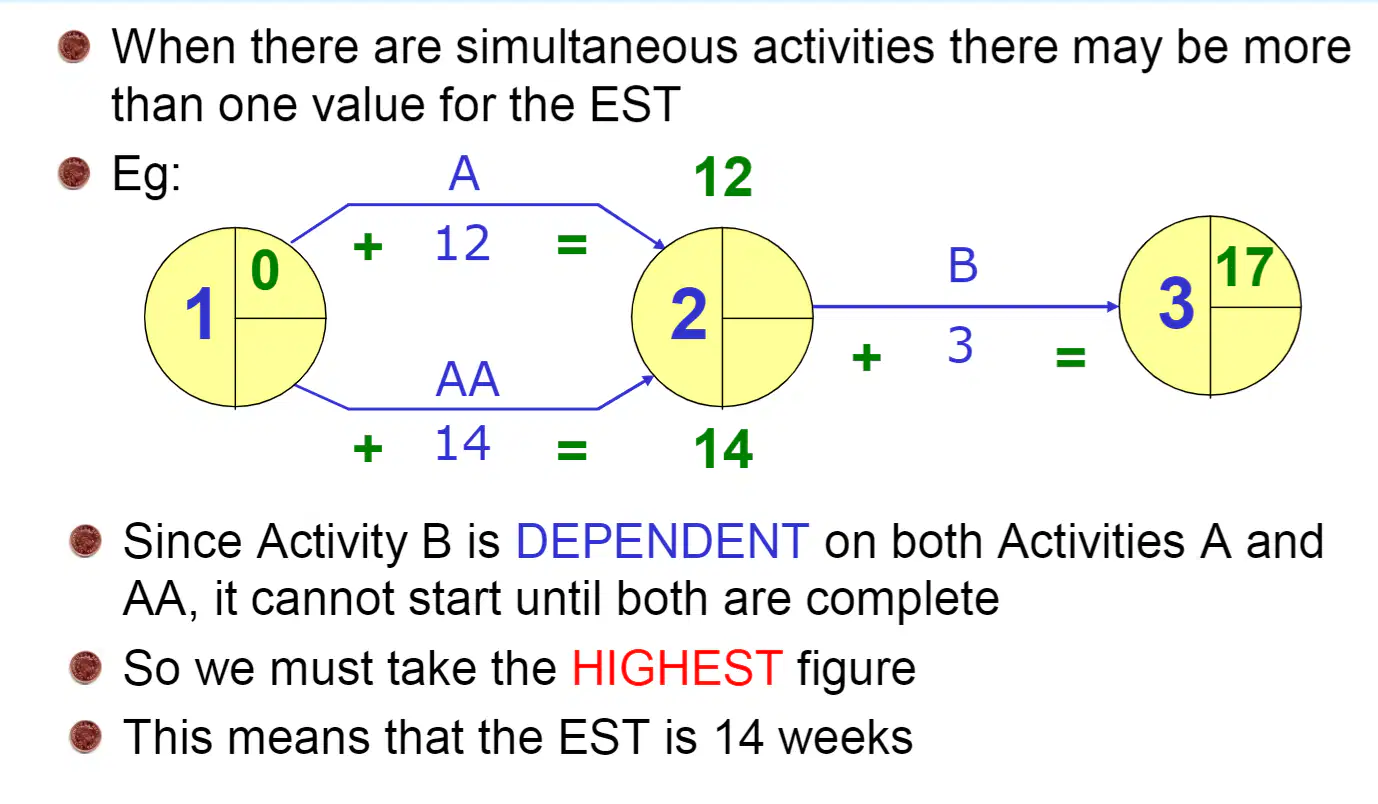
According to the image, what is the EST for Activity B if it is dependent on Activities A and AA?
12 weeks
14 weeks
17 weeks
3 weeks
Why must Activity B wait before it starts?
It is not dependent on any other activity.
It has the lowest priority.
It must wait for the completion of Activities A and AA.
It requires additional resources.
What is the initial Earliest Start Time (EST) of the first activity in a project schedule?
1
0
The duration of the first activity
The EST of the second activity
How is the EST calculated for activities in a project schedule?
EST of Previous activity - Duration of previous activity
EST of Previous activity + Duration of previous activity
EST of Next activity + Duration of previous activity
EST of Next activity - Duration of previous activity
When two activities start simultaneously, how is the EST determined?
By taking the lowest EST of the two activities
By averaging the ESTs of the two activities
By taking the highest EST of the two activities
By summing the ESTs of the two activities
What does LFT stand for in the context of network diagrams?
Latest Full Time
Least Finishing Time
Latest Finishing Time
Last Formal Time
How is the Latest Finishing Time (LFT) calculated in a network diagram?
LFT at start of following activity + Duration of following activity
LFT at end of following activity - Duration of following activity
LFT at end of previous activity + Duration of previous activity
LFT at start of previous activity - Duration of previous activity
Why is it important to know the Latest Finishing Time (LFT) for critical activities in project management?
To determine the earliest start of the project
To allocate resources more efficiently
To identify the latest time an activity must end without delaying the project
To calculate the total cost of the project
Where is the Latest Finishing Time (LFT) information placed in a node according to the slide?
Top left-hand quarter
Bottom right-hand quarter
Center of the node
Top right-hand quarter
What is the LFT of the first node always set to?
1
10
0
5
According to the example provided, what is the LFT for activity B?
12
3
15
0
What is the relationship between the EST and LFT of the last node in the project?
They are different
They are always zero
They are always the same
They are not related
What does LFT stand for in the context of simultaneous activities in project management?
Latest Finish Time
Least Flexible Term
Longest Feasible Timeline
Last Formal Task
According to the example provided, if Activity AA starts on week 2 and cannot be completed by week 14, what should be considered?
The highest value of LFT
The average value of LFT
The lowest value of LFT
The most recent value of LFT

What is the LFT for Activity B as shown in the diagram?
Week 14
Week 17
Week 3
Week 12
What does LFT stand for in the context of project management?
Latest Finish Time
Least Frequent Term
Last Formal Technique
Longest Feasible Time
How is the LFT of the last activity in a project network typically determined?
It is equal to the duration of the last activity
It is always zero
It is equal to its earliest start time (EST)
It is calculated using a specific formula
What is the LFT of the first activity in a project network?
It is equal to the total duration of the project
It is always zero
It is the sum of all activity durations
It is determined by the project manager
Which formula is used to calculate the LFT in a project network?
LFT = LFT at end of following activity + Duration of following activity
LFT = LFT at end of following activity - Duration of following activity
LFT = EST + Duration of activity
LFT = Duration of all preceding activities
When there are two simultaneous activities in a project, how is the LFT determined?
By taking the average of the LFTs of the activities
By selecting the highest LFT
By selecting the lowest LFT
By adding the LFTs of both activities
What is referred to as "CRITICAL" in project management?
An activity with the most resources
An activity without spare time
An activity with the highest cost
An activity with the longest duration
What does "FLOAT" refer to in project management?
The total cost of a project
The total resources of a project
Spare time in a project's schedule
The number of tasks in a project
How many types of float are mentioned, and what are they?
One type: Free Float
Two types: Free Float and Total Float
Three types: Free Float, Total Float, and Extra Float
Four types: Initial Float, Free Float, Total Float, and Final Float
What is the formula for calculating "Free Float"?
Free Float = EST at End of activity - (EST at start + Duration of activity)
Free Float = (EST at start + Duration of activity) - EST at End of activity
Free Float = Total Duration - EST at End of activity
Free Float = EST at start + Duration of activity
What is the formula for calculating "Total Float"?
Total Float = Activity’s LFT - (Activity’s EST + Activity’s Duration)
Total Float = (Activity’s EST + Activity’s Duration) - Activity’s LFT
Total Float = Activity’s Duration - Activity’s LFT
Total Float = Activity’s EST + Activity’s Duration
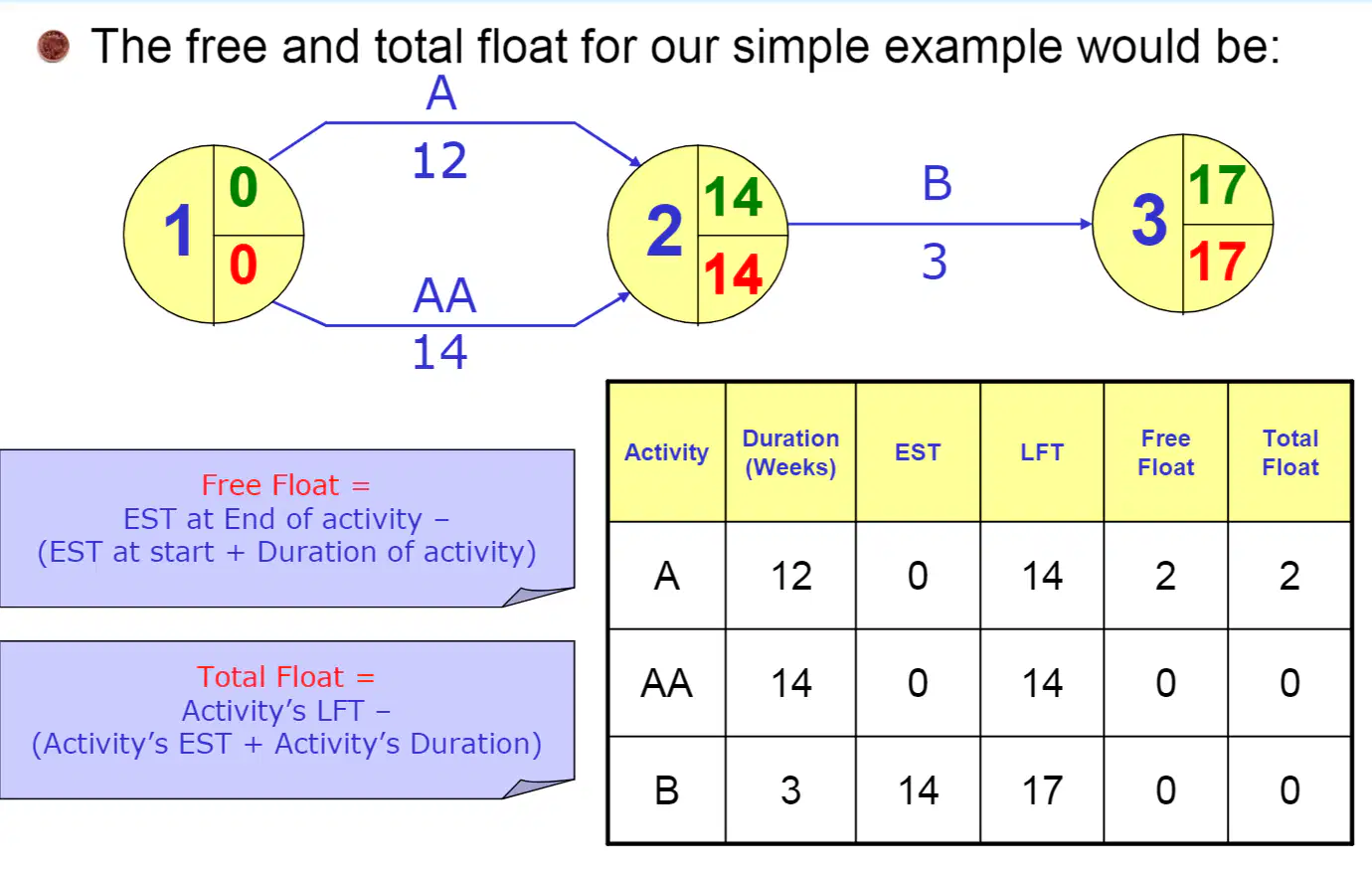
What is the formula for calculating Free Float as shown in the image?
Free Float = (EST at End of activity) - (EST at start + Duration of activity)
Free Float = (EST at start + Duration of activity) - (EST at End of activity)
Free Float = (LFT - EST at End of activity) + Duration of activity
Free Float = (Duration of activity + EST at start) / (EST at End of activity)
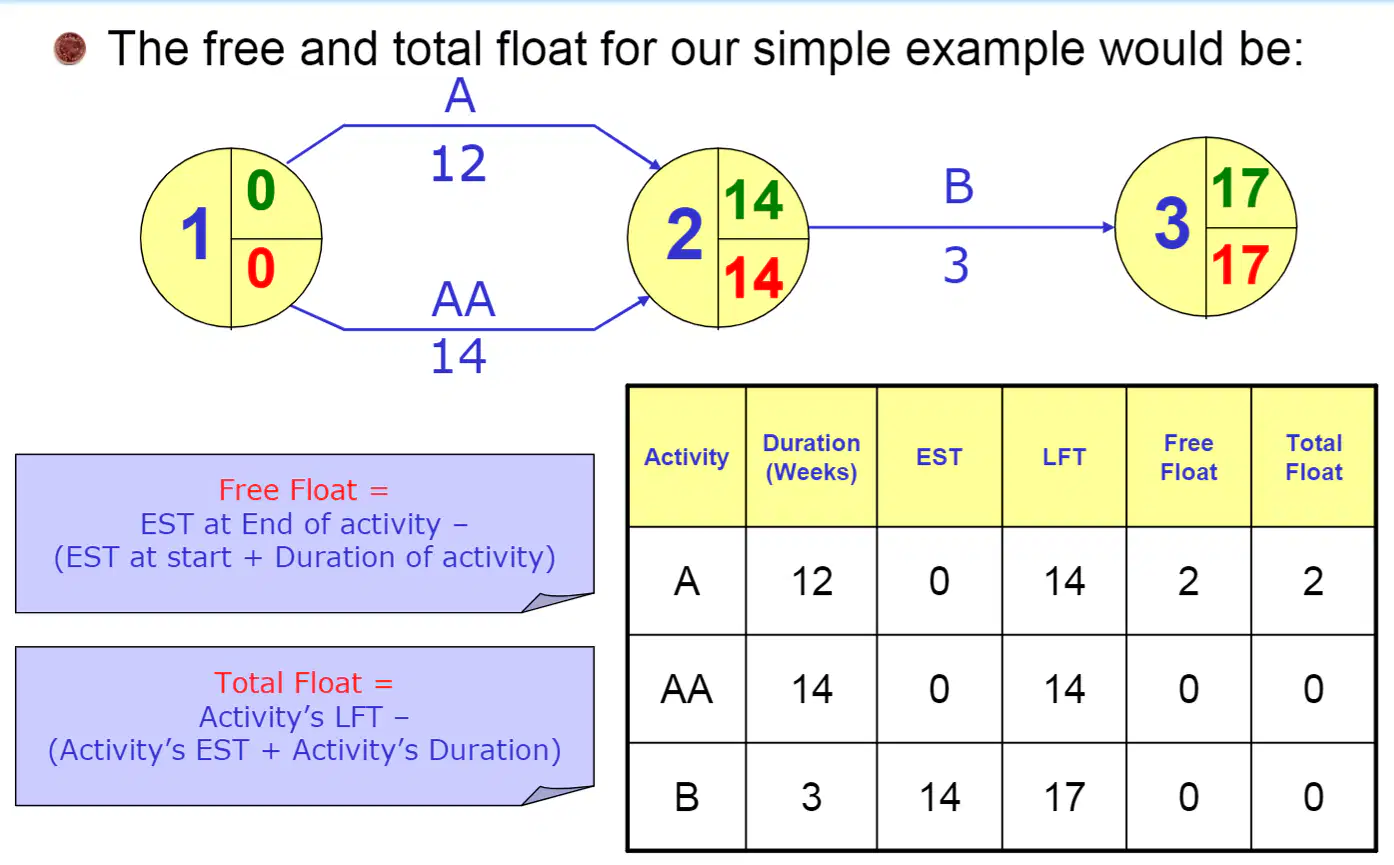
According to the image, what is the Total Float for activity AA?
2
0
14
17

How is Total Float calculated as per the image?
Total Float = Activity's LFT - (Activity's EST + Activity's Duration)
Total Float = (Activity's EST + Activity's Duration) - Activity's LFT
Total Float = (Activity's Duration - Activity's LFT) + EST
Total Float = Activity's LFT / (Activity's EST + Activity's Duration)
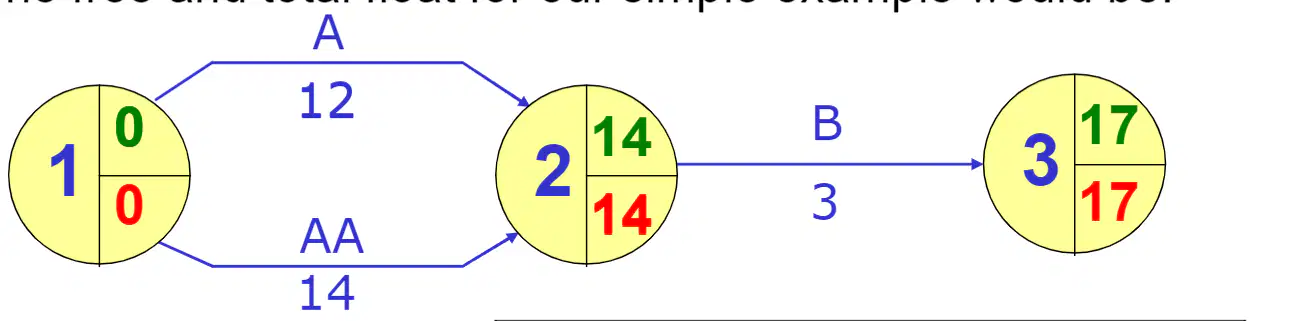
What is the Free Float for activity B as shown in the image?
0
2
3
17
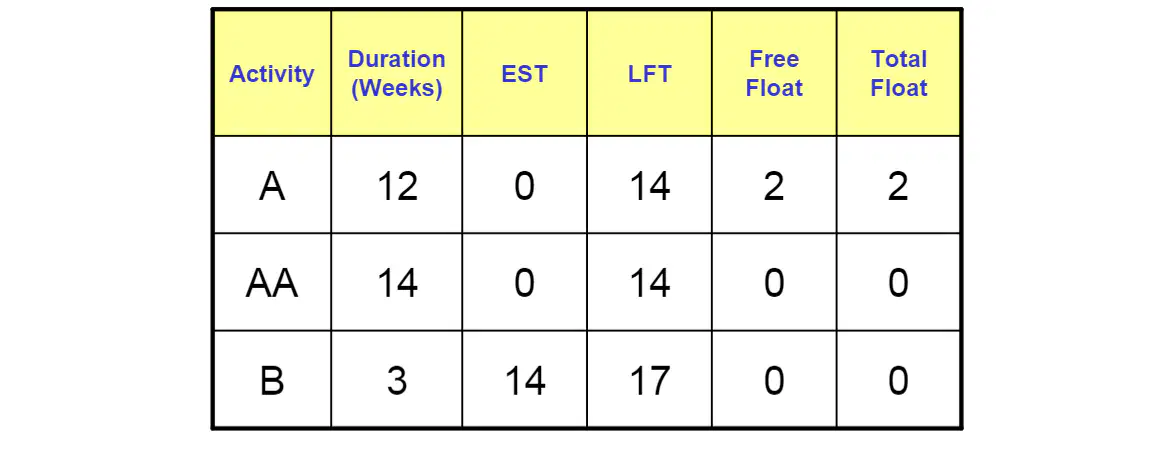
What is the duration of Activity A as shown in the table?
12 weeks
14 weeks
3 weeks
17 weeks
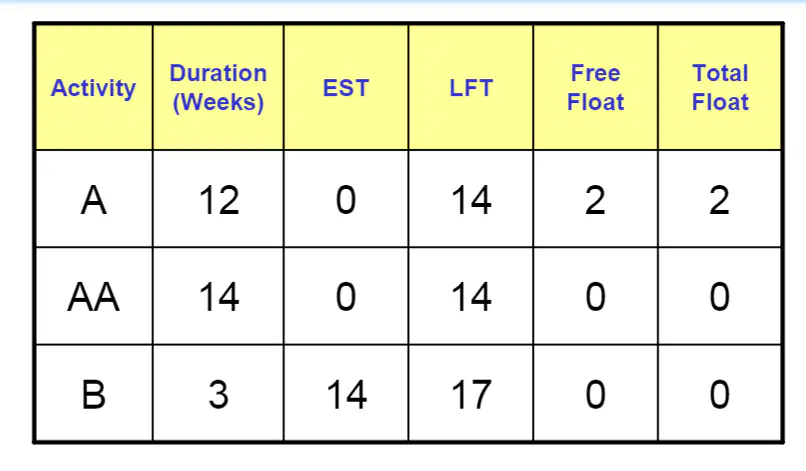
According to the table, how many weeks can Activity A be delayed without affecting the entire project?
0 weeks
2 weeks
14 weeks
17 weeks
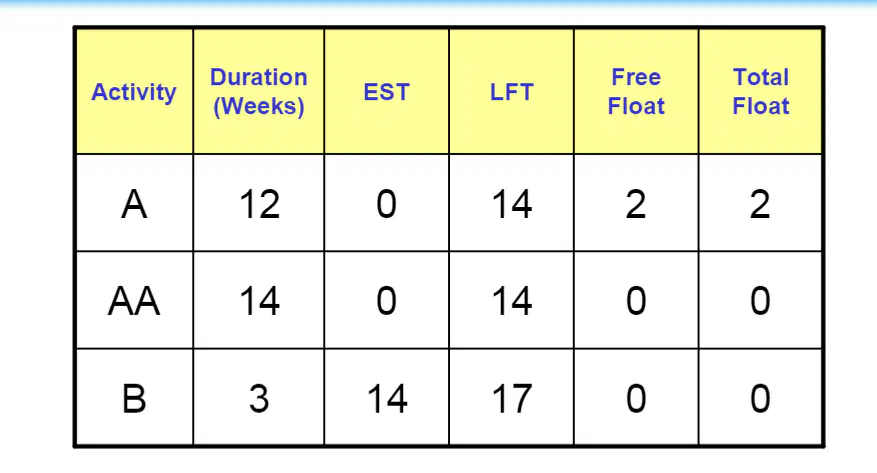
Which activity is identified as CRITICAL, meaning any delay will hold up the project?
Activity A
Activity AA
Activity B
Both Activity AA and Activity B
What does the critical path in a project management diagram indicate?
The sequence of activities that can be delayed without affecting the project completion date
The sequence of activities that have no float time and directly affect the project completion time
The activities with the most resources allocated
The activities that are easiest to complete
How can one visually verify if a critical path is correct in a diagram?
By checking if the diagram has a dotted line
By ensuring all activities are connected
By confirming that each node on the critical path has equal Earliest Start Time (EST) and Latest Finish Time (LFT)
By checking the color of the nodes
What is the purpose of the dotted line in the diagram related to the critical path?
It indicates the direction of workflow
It represents dependencies between tasks
It highlights the critical path
It shows tasks that can be skipped
Which activities must be completed before Activity C can begin according to the network diagram instructions?
Activity A
Activity B
Both Activity A and Activity B
Activity D
How many days does Activity D take to complete?
1 day
3 days
4 days
5 days
Which activity ends the project?
Activity A
Activity B
Activity C
Activity E
What is essential to make it possible in the scenario described in the slide?
Using a dummy activity
Removing all activities
Adding more connections
Ignoring dependencies
Why is the network shown in the diagram considered incorrect?
Activity C is not dependent on Activity A
Activity C is not dependent on Activity B
Activity C is dependent on both Activity A and B
There are too many activities
What is the purpose of a dummy activity in project management?
A) To allocate resources
B) To illustrate a dependency
C) To extend the project duration
D) To reduce costs
How are dummy activities represented in a project network diagram?
A) With a solid line
B) With a dashed line
C) With a double line
D) With a bold line
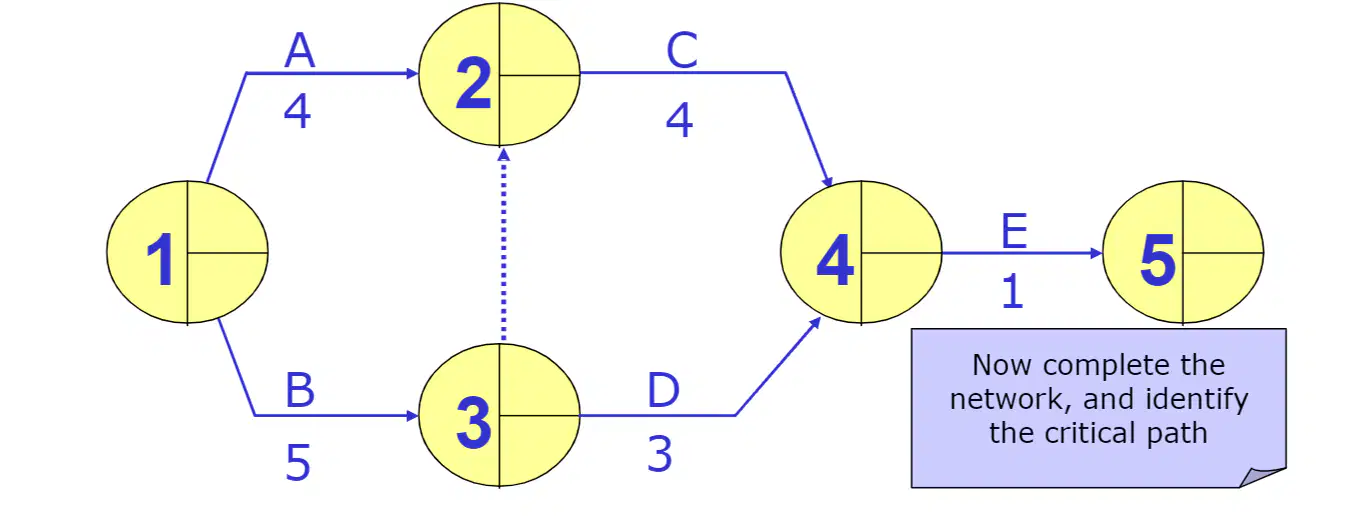
According to the diagram, which activity number is a dummy activity?
A) 1
B) 2
C) 3
D) 4

