
 Worksheets
Nature of Science 1.1 SSA Review Quizizz
Total questions: 15
Worksheet time: 9mins
Christopher is following these steps during a lab.
Procedure:
1. Fill 4 cups halfway with water
2. Add 10 drops of both blue and red food coloring to each cup to make purple water3. Label the cups with: 10 min, 20 min, 30 min, and 40 min
4. Place 1 stalk of celery in to each cup for the amount of time on each cup
5. Record your observations every 5 minutes
Which of the following statements is he most likely testing?
If blue and red food coloring are added to water in equal amounts, then the water will turn purple
If there are 60 seconds in a minute, then 40 minutes will take 2,400 seconds
If the celery absorbs the water through its stem, then the plant will change color
If the celery absorbs purple water, then it will taste better

A student is setting up an experiment with several plants. Her teacher recommends that she set up a control plant.
Why should the student have a control group in her experiment?
To make sure the plant would have grown under normal circumstances
To help the student become a better plant caretaker
To give the student more work to complete
To create a competition between the plants to encourage growth

After each trial in an investigation, a student changes the mass of an object by adding additional weight. The student then places the object at the top of a ramp that is 25 centimeters in height and measures the distance the object travels down the ramp. Why is the distance the object travels different in each trial??
The force applied to the object at the top of the ramp changes.
The height of the ramp changes.
The mass of the object travelling down the ramp changes.
The material the ramp is made of changes.
Which experiment below will best determine how height affects the forces acting on an object as it hits the ground??
Drop several balls with different masses from the same height on to the same surface.
Drop the same ball from different heights on to the same surface.
Drop the same ball from the same height on to different surfaces.
Drop the same ball from different heights on to different surfaces.

A student measures the distance a toy car travels down a ramp. After each trial, the student adds an additional textbook to increase the height of the ramp by 5 centimeters.? Which question is the student most likely trying to answer with this scientific investigation?
How does the height of the ramp affect the distance an object will travel?
How does the mass of an object affect the distance it will travel on a ramp?
What causes an object to travel down a ramp?
How does the height of the ramp affect the speed of an object?
Lori wants to see if dark colored soda loses its carbonation faster than clear colored soda. The steps she followed in her experiment are below.
1. Get several types of dark and clear sodas.
2. Pour equal amounts of soda in similar glasses.
3. Recycle all of the bottles that the soda came from
4. Leave glasses on the counter in an open environment.
5. Each hour come back and record carbonation results.
Which step in Lori's experiment was not needed?
Leave glasses on the counter in an open environment.
Each hour come back and record carbonation results.
Recycle all of the bottles that the soda came from
Get several types of dark and clear sodas.
Pour equal amounts of soda in similar glasses.
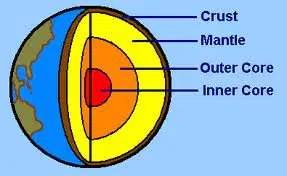
The picture above shows the Earth's layers. Why might a student use a model to study the Earth's layers?
People, animals and plants are all on the surface.
The Earth's layers are unknown.
The Earth's layers are too large to study directly.
The Earth's layers are too small to study.
Which of the following questions would best be explored using a scientific experiment?
What color were dinosaurs?
How many spiders are in the world?
Which brand of light bulb lasts longer?
How many shrimp are in the oceans?

Farmer Verret is a chicken farmer. He has 100 chickens that lay eggs. He wants to get as many eggs as possible. Farmer Verret's hypothesis is his chickens will lay more eggs at 75°F than any other temperature. What is the only variable that will change in his experiment?
Temperature
Weight of the chickens
Chicken's food
The number of chickens
Cheryl notices that most grass is green. She wants to know why. Which of the following is a testable question that Cheryl could ask about the color of grass?
Why isn't most grass blue?
Why aren't plants red?
What would grass look like if it were purple?
What gives grass its green color?

