Wayground logo

Free Printable Worksheets

Font size

S
M
L
XL
Worksheets

state check up

Total questions: 50

Worksheet time: 42mins

Name
Class
Date
1.

a)

a

b)

b

c)

c

d)

d

2.

a)

a

b)

b

c)

c

d)

d

3.
A material in which electrons are able to move easily
a)
Circuit
b)
Insulator 
c)
Resistance 
d)
Conductor 
4.
Which are located at the very BOTTOM of an energy pyramid? 
a)
producers
b)
consumers - Level 1
c)
consumers - Level 2
d)
decomposers
5.
Carnivores, herbivores, omnivores, and scavengers are all examples of __________.
a)
producers
b)
consumers
c)
decomposers
d)
abiotic factors
6.

Herbivores are also called...

a)

secondary consumers

b)

primary consumers

c)

producers

d)

tertiary consumers

7.
Read the following information Jonathan recorded about an experiment.
At the start of the experiment, both plants were 3 inches tall.
At the end of the experiment, Plant A was 7 inches tall, Plant B was 5 inches tall.
Plant A grew taller because it had more sunlight.
What part of Jonathan's notes provides an explanation of his results?
a)
Plant A was 7 inches tall.
b)
Plant B was 5 inches tall.
c)
Plant A grew tall because it had more sunlight.
d)
At the start of the experiment, both plants were 3 inches tall.
8.
When the temperature of water changes from 10 degrees Celsius to -10 degrees Celsius, the water changes from a...
a)
solid to a gas.
b)
a liquid to a gas.
c)
a liquid into a solid.
d)
a solid to a liquid.
9.
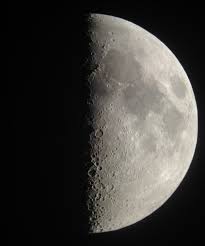
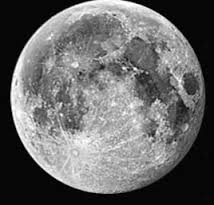
Name the moon phase
a)
First Quarter
b)
Last Quarter
c)
New Moon
d)
Full Moon
10.
Name the moon phase
a)
Waning Crescent
b)
Waxing Crescent
c)
Waning Gibbous
d)
Waxing Gibbous
11.
Name the moon phase
a)
First Quarter
b)
Waxing Crescent
c)
New Moon
d)
Full Moon
12.
What is a PUSH or PULL of an object?
a)
Motion
b)
Force
c)
Friction
d)
Gravity
13.
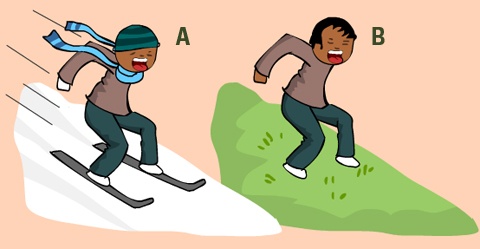
Why is it harder for the boy in Image B to get down the hill?
a)
Motion
b)
Friction
c)
Work
d)
Displacement
14.
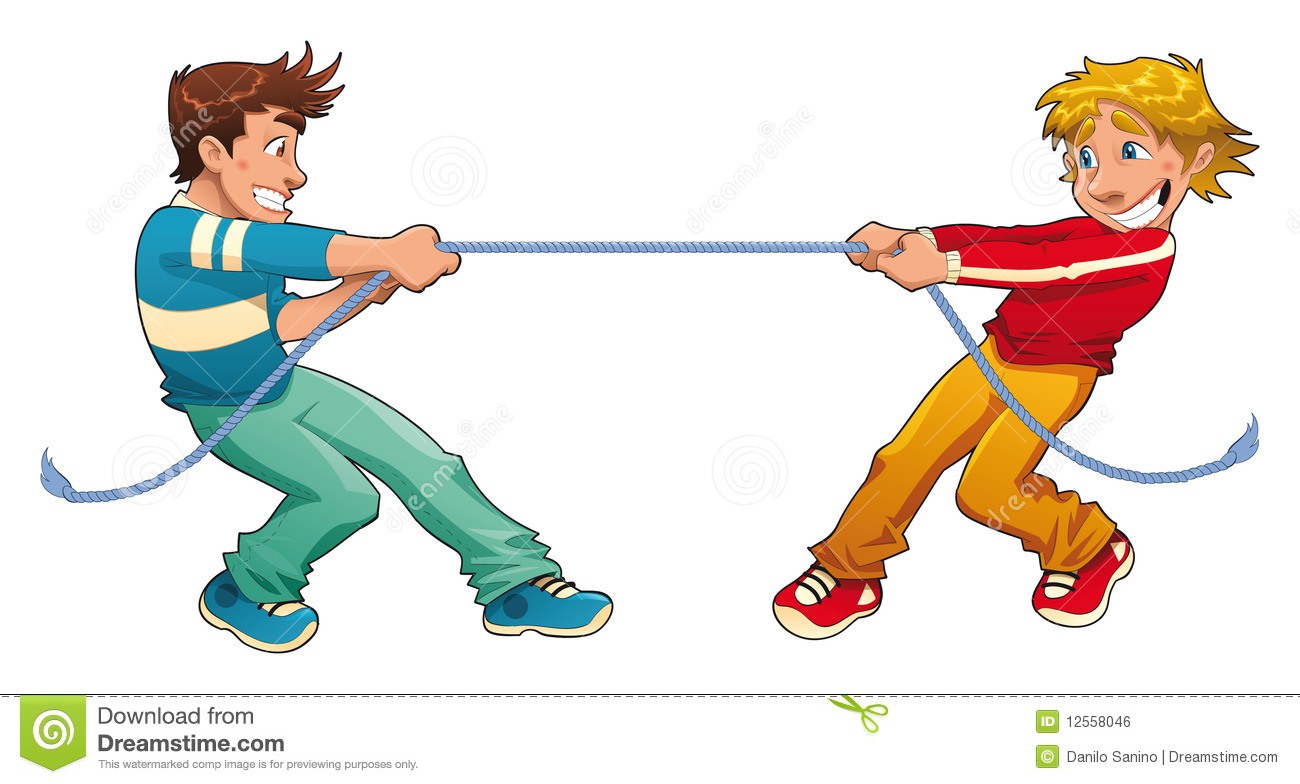
If these boys are pulling with the same amount of force.  What will happen?
a)
The boy in blue will win.
b)
They will not move at all.
c)
The boy in red will win.
d)
Both will fall down.
15.
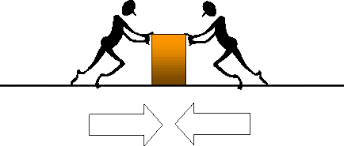
Which force produces a change in motion?
a)
unbalanced force
b)
balanced force
c)
gravitational force
d)
frictional force
16.
At which point is potential energy greatest
a)
W
b)
X
c)
Y
d)
Z
17.
It takes more force to accelerate the iron man on the left than the iron man on the right because the iron man on the left has more mass. This best describes
a)
Newton's first law, the law of inertia
b)
Newton's second law, the law of acceleration
c)
Newton's third law, the law of action reaction 
d)
The law of universal gravitation
18.
For every action, there is an equal and opposite reaction.
a)
Newton's
1st
Law of Motion
b)
Newton's
2nd
Law of Motion
c)
Newton's
3rd
Law of Motion
19.
An automobile you are riding in suddenly stops, but you continue to go forward.
a)
Newton's
1st
Law of Motion
b)
Newton's
2nd
Law of Motion
c)
Newton's
3rd
Law of Motion
20.
If an object is stationary (not moving) the forces acting upon it are _____________
a)
unbalanced
b)
weak
c)
balanced
d)
Hulk Smash!
21.
When you push a boat off from the dock, you are demonstrating Newton's 3rd Law of Motion. It simply states that for every action there is an equal and opposite _______________?
a)
Motion
b)
Change
c)
Reaction
d)
Push
22.

Friction and air resistance are forces that:

a)

can make an object slow down or stop

b)

pulls an object toward the center of Earth

c)

changes an object's position

d)

can't be described

23.

A student gets frustrated in class and slaps his hand against the desk. The student exerts force on the desk, and the desk exerts the same amount of force back on the students hand.

a)

True

b)

False

24.
Baking soda and vinegar combine to make carbon dioxide
a)
Chemical Change
b)
Physical Change
25.
Students observed as small drops of water collected on the outside of a glass.
Which statement BEST describes why the water vapor in the air formed liquid water on the outside of the glass?
a)
The humidity outside the glass turns the vapor to liquid water.
b)
The water vapor pulls the water from inside the glass to outside the glass.
c)
The temperature of the water inside the glass is colder than the air outside the glass.
d)
The temperature of the water inside the glass is warmer than the air outside the glass.
26.
A student is creating a potting soil mix. She combines 100 grams of sand, 200 grams of soil, and 200 grams of pebbles to make her potting soil. What is the mass of the potting soil?
a)
100 grams 
b)
200 grams
c)
300 grams
d)
500 grams
27.
Jace measures 20 grams of water in a pan and then freezes it.  A day later he takes the ice cubes out of the pan and notices it is larger than before. What will it weigh? 
a)
40 grams 
b)
30 grams 
c)
20 grams 
d)
10 grams 
28.
Why does a block of wood float, but a small nail sink in water? 
a)
The nail is more dense than the wood
b)
The wood is more dense than the nail
c)
They are equal in density but made of different materials.
29.
Water that is heated and changed to steam is a 
a)
Physical change
b)
Chemical change
30.

In the photo, what is an example of a living thing?

a)

air

b)

plant

c)

sunlight

31.

Identify the ecosystem

a)

Forest

b)

Tundra

c)

Freshwater

d)

Grassland

32.
This ecosystem contains salt water.
a)
Forest
b)
Grassland
c)
Ocean
d)
Lakes/Ponds
33.
This ecosystem has very few trees and a lot of varieties of grasses.
a)
Forest
b)
Grassland
c)
Wetland
d)
Lakes/Ponds
34.
_____________ are bodies of freshwater that are surrounded by land.
a)
Oceans
b)
Estuaries
c)
Lakes/Ponds
d)
Forests
35.

When a substances mixes with and becomes incorporated into the liquid and forms a solution. The solute is blended evenly in the solvent.

a)

dissolves

b)

evaporation

c)

properties

d)

atom

36.

What method could you use to separate a mixture of rock and sand?

a)

sink/float

b)

magnetism

c)

evaporation

d)

sifting with a sieve

37.

anything you can observe about matter (size, shape, state, etc.) 

a)

molecule

b)

physical property

c)

particle

d)

condensation

38.

Choose the largest planet in our solar system.

a)

Jupiter

b)

Neptune

c)

Mercury

d)

Earth

39.
How long is a day on earth?
a)
22 hours
b)
365 days
c)
12 hours
d)
24 hours
40.
The earth orbits around the _________
a)
sun
b)
moon
c)
other planets
d)
solar system
41.
Which movement of Earth causes day and night?
a)
rotation
b)
revolution
42.
What are the reasons for the season?
a)
Earth's tilt & rotation
b)
Earth's tilt & revolution
c)
Earth's rotation & rovolution
d)
Earth's tilt & resolution
43.
What motion of the Earth takes 365 days?
a)
Rotation
b)
Tilting 
c)
Revolution
d)
Spinning
44.

True or Fasle: The northern and southern hemispheres are always in the same season.

a)

True

b)

False

45.

When it is Summer in the Northern Hemisphere, it is _______ in the Southern Hemisphere.

a)

Summer

b)

Fall

c)

Spring

d)

Winter

46.
The image shows the orbit of Earth around the Sun with its axis tilted. In which position will the Northern Hemisphere have the greatest number of daylight hours? 
a)
Position 1
b)
Position 2
c)
Position 3
d)
Position 4
47.
Which day has the most sunlight in the United States? 
a)
June 18 
b)
March 25
c)
September 26
d)
December 19
48.
Which day has the least sunlight in the United States? 
a)
June 18 
b)
March 25
c)
September 26
d)
December 19
49.

Why do we see different constellations during different seasons?

a)

Because of Earth's rotation on it's axis

b)

Because of Earth's revolution around the sun

c)

Because Earth is an inner planet

d)

Because the stars move across the sky

50.
Which season is taking place in the Northern Hemisphere in Position 1?
a)
Winter
b)
Spring
c)
Summer
d)
Fall