wayground logo

Free Printable Worksheets

Font size

S
M
L
XL
Worksheets

Unit 5b Test Corrections SP24

Total questions: 34

Worksheet time: 17mins
Name
Class
Date
1.
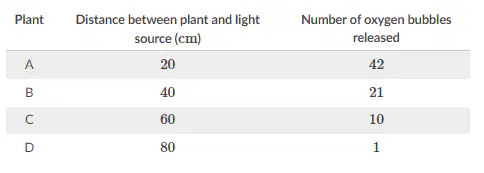
Bonus: A group of students are conducting an experiment on Elodea canadensis, a species of aquatic plant. In order to test the effect of light intensity on the rate of photosynthesis, they place each Elodea canadensis plant into an aquarium tank and place each tank at a different distance from a light source. After a few minutes, oxygen bubbles begin to form in each of the tanks. The students count the number of oxygen bubbles released during a \[5\] minute period for each tank. The results of their experiment are shown below. Which of the following conclusions is best supported by the results of the experiment?
a)
As light intensity increases, the production of photosynthetic products remains constant.
b)
As light intensity increases, the production of photosynthetic products decreases.
c)
As light intensity decreases, the production of photosynthetic products decreases.
d)
As light intensity decreases, the production of photosynthetic products remains constant.
2.
Bonus: Name the 2 main reactions in photosynthesis:
4 lines
3.
Bonus: Which of the following best indicates that the light reactions of photosynthesis have completed and that the Calvin cycle has begun?
a)
An electrochemical gradient forms across the thylakoid membrane.
b)
ATP and NADPH accumulate in the stroma.
c)
A high concentration of carbohydrates is found in the thylakoid lumen.
d)
Electrons are transferred across the electron transport chain (ETC) on the thylakoid membrane.
4.
Bonus: RuBisCO catalyzes the joining of carbon dioxide with RuBP during carbon fixation. In an experiment, researchers apply a toxin to a plant cell that inhibits RuBisCO. Which of the following explains the most likely effect this toxin will have on the Calvin cycle?
a)
Excited electrons will not be transferred across the electron transport chain.
b)
Carbon and oxygen will not be released after the breakdown of carbon dioxide.
c)
Carbon dioxide will not be converted into carbohydrates.
5.
1. Energy is released from ATP when...
a)
a. a third phosphate group is added and a bond forms between the second and third phosphate group.
b)
b. adenine bonds to ribose.
c)
c. ATP is exposed to sunlight.
d)
d. the bond between the second and third phosphate is broken.
6.
11. Most plants appear green because chlorophyll...
a)
a. absorbs green light.
b)
b. absorbs violet light.
c)
c. reflects green light.
d)
d. reflects violet light.
7.
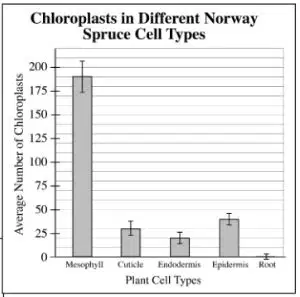
23. Chloroplasts are organelles, compartments within cells, that help plant cells harness solar energy and produce sugar molecules. Cells within plants are specialized; groups of similar cells form tissues, or layers of cells with different functions. Some cell types have more chloroplasts than others. A botanist is interested in learning more about the cell types within a Norway Spruce Tree. She collects cells from different parts of the pine needle and the tree and uses 3D imaging technology to measure the number of chloroplasts in each cell. For each type, she counts the chloroplasts in 20 individual cells. The data is shown in the graph. Which cell type has the most chloroplasts per cell?
a)
a. mesophyll
b)
b. cuticle
c)
c. epidermis
d)
d. root
8.
7. Organisms, such as plants, that make their own food are called...
a)
autotrophs
b)
heterotrophs
c)
thylakoids
d)
pigments
9.
10. Which statement best describes the biological process of photosynthesis?
a)
Light energy is transformed into chemical energy and oxygen is released.
b)
Light energy is transformed into chemical energy and carbon dioxide is released.
c)
Chemical energy is transformed into light energy and carbon dioxide is released.
d)
Chemical energy is transformed into light energy and oxygen is released.
10.
11. The process of photosynthesis can be represented by the chemical formula...
a)
6CO2 + C6H12O6 --> 6O2 + 6H2O + Sunlight
b)
Energy + 6CO2 + 6O2 --> C6H12O6 + 6H2O
c)
Sunlight + 6CO2 + 6H20 --> C6H12O6 + 6O2
d)
C6H12O6 + 6O2 --> 6CO2 + 6H2O + Energy
11.
13. Plants gather energy with light-absorbing molecules embedded in the thylakoid membrane called...
a)
pigments
b)
thylakoids
c)
chloroplasts
d)
glucose
12.
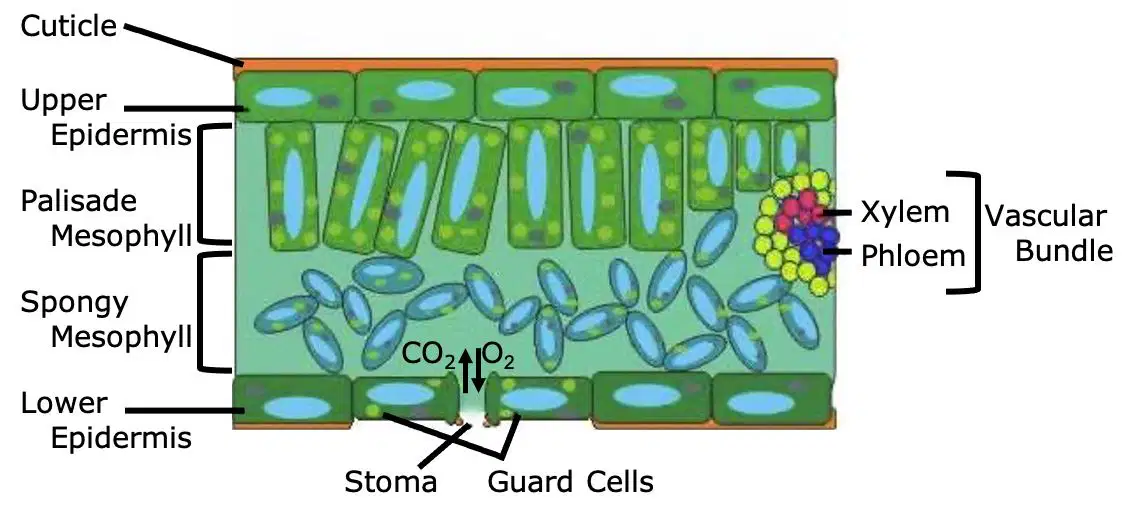
14. Chloroplasts are concentrated in the palisade mesophyll. Chloroplasts are the site of photosynthesis and contain chlorophyll which is important for making glucose in photosynthesis. How do plants use chlorophyll in photosynthesis?
a)
Chlorophyll stores glucose made in photosynthesis and absorbs green light.
b)
Chlorophyll stores carbon dioxide for photosynthesis and absorbs violet light.
c)
Chlorophyll absorbs sunlight energy for photosynthesis and reflects green light.
d)
Chlorophyll stores oxygen made in photosynthesis and reflects violet light.
13.
15. Where do the light-dependent reactions take place?
a)
in the stroma of the chloroplast
b)
within the mitochondrial membranes
c)
within the thylakoid membranes of the chloroplast
d)
in the outer membrane of the chloroplasts
14.
16. Which of the following activities happens within the stroma of a chloroplast?
a)
Photosystem I absorbs light.
b)
ATP synthase produces ATP.
c)
The Calvin Cycle produces sugars.
d)
Electrons move through the electron transport chain.
15.
17. The Calvin Cycle is another name for the...
a)
light-independent reactions.
b)
light-dependent reactions.
c)
Krebs cycle.
d)
electron transport chain.
16.
18. During the second set of photosynthetic reactions, called the Calvin cycle, all BUT ONE of the following occurs. Which statement below DOES NOT occur in the Calvin Cycle?
a)
By-products of the Calvin cycle include water vapor and oxygen.
b)
ATP and NADPH, high energy molecules, are utilized to produce stored chemical energy.
c)
Glucose is the end product of the Calvin cycle.
d)
Carbon dioxide, a reactant of photosynthesis, is utilized during the Calvin cycle.
17.
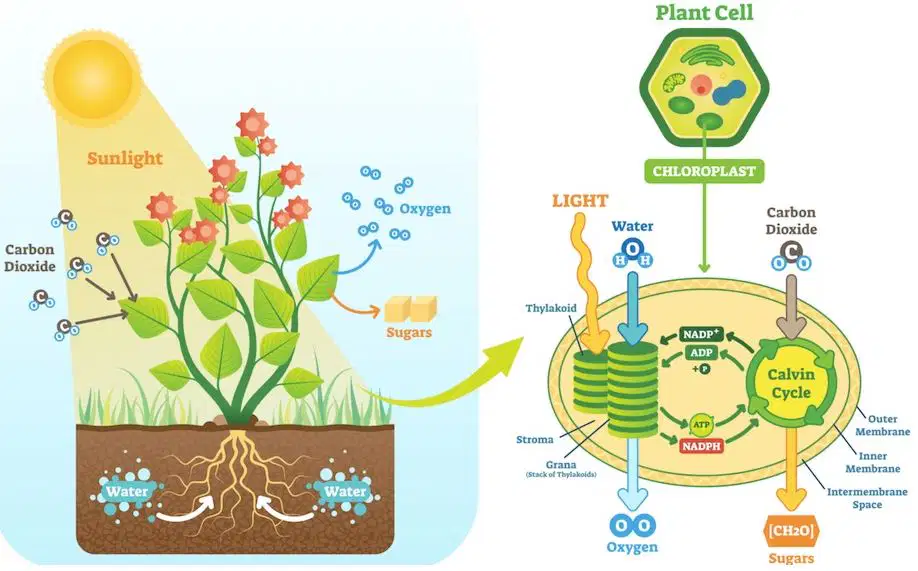
20. Review the schematic diagram of photosynthesis and the involvement of the chloroplast in this process. We know that the purpose of photosynthesis is to convert light energy into usable chemical energy. That process takes several steps. One of the first steps in this energy conversion process is what?
a)
Energy from sunlight is absorbed by the thylakoid membranes, used to decompose water and transform carbon dioxide.
b)
Energy from sunlight is converted into a usable form of chemical energy, glucose.
c)
Energy from sunlight is absorbed by chlorophyll and converted into stored chemical energy, in the form of NADPH and ATP.
d)
Stored chemical energy in the forms of ATP and NADPH are transferred to the grana in order to produce glucose.
18.
24. In an experiment two potted plants, labeled Plant 1 and Plant 2, are placed in transparent plastic bags and left in the open. Plant 1 is given more carbon dioxide. Plant 2 has carbon dioxide removed. Both plants are watered regularly with the same amount of water. After several days, a starch (like glucose/sugar) test results indicate starch in leaf 1 but an absence of starch in leaf 2. This experimental data confirms the...
a)
role of sunlight in photosynthesis.
b)
role of carbon dioxide in photosynthesis.
c)
role of nutrients in photosynthesis.
d)
role of water in photosynthesis.
19.
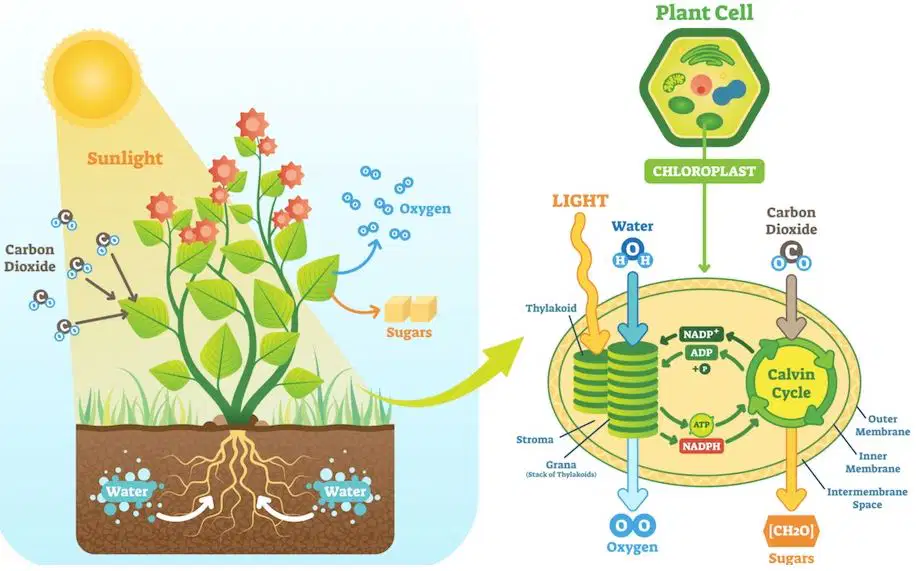
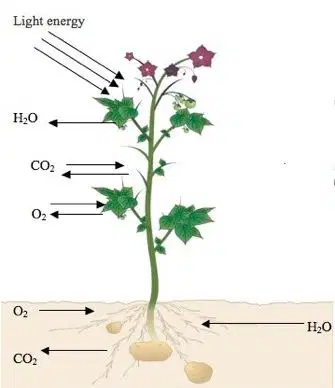
43. Notice in the image of the plant below that both oxygen and carbon dioxide enter and exit the plant. Using what you know about photosynthesis and cellular respiration, what is happening with regard to these two gases?
a)
Unlike animals, plants use carbon dioxide in cellular respiration and produce oxygen.
b)
Plants require carbon dioxide for photosynthesis and produce oxygen as a byproduct. Plants then use the oxygen released in cellular respiration, producing carbon dioxide as a byproduct.
c)
Plants, as autotrophs, only undergo photosynthesis and both use and produce oxygen and carbon dioxide in this process.
d)
Plants require oxygen for photosynthesis and produce carbon dioxide. Plants then use the carbon dioxide produced in cellular respiration, releasing oxygen as a byproduct.
20.
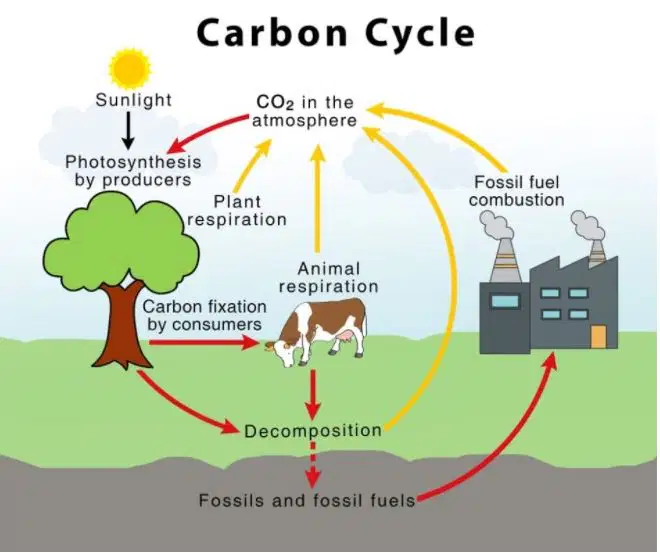
45. Photosynthesis and cellular respiration are two biological processes that make a significant contribution to the carbon cycle and are said to be opposite of each other. Using the diagram below, what can be said about these processes?
a)
Photosynthesis releases energy, and cellular respiration stores energy.
b)
Photosynthesis removes carbon dioxide from the atmosphere, and cellular respiration puts it back.
c)
Photosynthesis removes oxygen from the atmosphere, and cellular respiration puts it back.
d)
Photosynthesis consumes glucose, and cellular respiration produces glucose.
21.
A molecule used in cell respiration and released as a byproduct in Photosynthesis
a)
oxygen
b)
glucose
c)
atp
d)
water
22.
Reactions that occur in the thylakoid membrane and requires light.
a)
chlorophyll
b)
phosphorous
c)
calvin cycle
d)
light-dependent
23.
A series of chemical reactions that occur in the stroma during photosynthesis.
a)
Carbon Dioxide
b)
Calvin Cycle
c)
Chlorophyll
24.
A carbohydrate that is a product of photosynthesis.
a)
glucose
b)
water
c)
calvin cycle
25.
A gas used by plants in photosynthesis.
a)
glucose
b)
oxygen
c)
carbon fixation
d)
carbon dioxide
26.
The process of converting carbon dioxide into organic compounds.
a)
carbon dioxide
b)
calvin cycle
c)
oxygen
27.
Reactions that occur in the Calvin Cycle and do not require light.
a)
calvin cycle
b)
carbon fixation
c)
carbon dioxide
d)
light-independent
28.

Energy is released from ATP when...

a)
a third phosphate group is added and a bond forms between the second and third phosphate group.
b)
adenine bonds to ribose.
c)
ATP is exposed to sunlight.
d)
the bond between the second and third phosphate is broken.
29.

Which type of molecule is produced during photosynthesis?
a)
carbohydrate
b)
protein
c)
lipid
d)
nucleic acid
30.

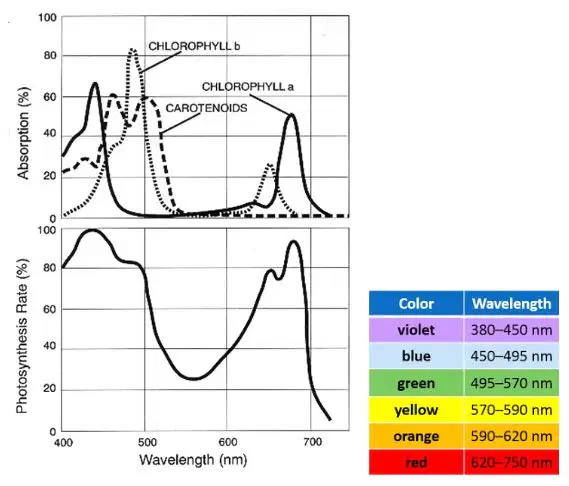
Lilly and her lab partner, Alberto are investigating factors that influence the rate of photosynthesis. They know that any change to the reactants in photosynthesis could have an effect on the production of glucose and oxygen. They conduct an experiment to see if colors of light affect rate of photosynthesis and test this on two plants exposed to red light only and two plants exposed to green light only. Based on the data collected and displayed in the diagram below, which color of light caused the highest rate of photosynthesis and why?
a)
The plants under the red light had a higher rate because chlorophyll a and b absorb red light best.
b)
The plants under the red light had a higher rate because chlorophyll a and b reflect red light.
c)
The plants under the green light had a higher rate because chlorophyll a and b absorb green light.
d)
The plants under the green light had a higher rate because chlorophyll a and b reflect green light.
31.

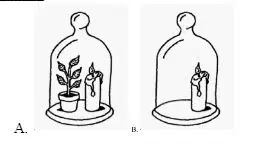
Below are two domes: dome A has a plant and a burning candle under it while dome B has just a burning candle under it. Why might the candle under dome A burn longer than the candle under dome B?

a)
Carbon dioxide produced by the plant allows the candle to burn longer.
b)
Chlorophyll produced by the plant allows the candle to burn longer.
c)
Glucose produced by the plant allows the candle to burn longer.
d)
Oxygen produced by the plant allows the candle to burn longer
32.

Which process below does NOT release energy from glucose?
a)
glycolysis
b)
photosynthesis
c)
fermentation
d)
cellular respiration
33.

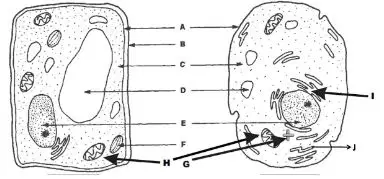
Using the figure below, which pairing matches the structures shown in the cell diagrams with the processes that take place within those structures?
a)
A: photosynthesis; B: cellular respiration
b)
C: photosynthesis; D: cellular respiration
c)
F: photosynthesis; H: cellular respiration
d)
E: photosynthesis; D: cellular respiration
34.

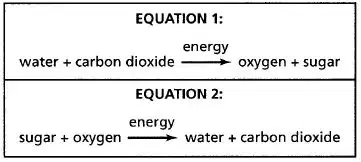
Two energy conversion processes that occur in typical cells are shown here. Compare the two processes. Which description BEST compares the energy conversions in the processes shown?

a)
Equation 1 is illustrating photosynthesis as solar energy is being used to convert inorganic compounds into organic compounds (glucose).
b)
Equation 1 is illustrating cellular respiration as chemical energy is being used to convert carbon dioxide and water into glucose and oxygen gas.
c)
Equation 2 is illustrating photosynthesis as chemical energy is being used to convert glucose and oxygen into water and carbon dioxide.
d)
Equation 2 is illustrating cellular respiration as solar energy is being used to convert inorganic compounds into organic compounds.