wayground logo

Free Printable Worksheets

Font size

S
M
L
XL
Worksheets

Digital Design Graphics - Unit 1 Review

Total questions: 37

Worksheet time: 37mins

Name
Class
Date
1.
What is Design Theory?
a)

The theory of making things look nice.

b)

The fundamentals and principles of creating visual communication and all types of art.

c)

The fundamentals of creating graphics for marketing.

d)

The theory of designing elements based on looks.

2.
How many Principles of Digital Design are there?
a)
5
b)
10
c)
7
d)
Trick question, it depends on which website you look at.
3.
What is Color Theory?
a)
The science and art of using color.
b)
The theory of why some people suffer from color blindness.
c)
The fundamentals of deciding which coloring utensils to use in a certain situation.
d)
I have no idea.
4.
What are the primary colors?
a)

Green, Blue, Yellow

b)

Red, Blue, Green

c)

Red, Blue, Yellow

d)

Green, Purple, Orange

5.
What are the secondary colors?
a)

Red, Blue, Yellow

b)

Green, Purple, Orange

c)

Purple, Blue, Red

d)

Orange, Green, Red

6.
What are 3 examples of tertiary colors?
a)

yellow-orange, red-violet, blue-green

b)

black, white, gray

c)

red, yellow, orange

d)

blue, green, violet

7.
What are 3 examples of warm colors?
a)

yellow-orange, red-violet, blue-green

b)

black, white, gray

c)

red, yellow, orange

d)

blue, green, violet

8.
What are 3 examples of cool colors?
a)

yellow-orange, red-violet, blue-green

b)

black, white, gray

c)

red, yellow, orange

d)

blue, green, violet

9.
What is the additive color mixing model?
a)
The fact that you subtract the light from the paper by adding more color.
b)
You can create colors by mixing red, green and blue light sources of various intensities.
c)
You can add colors together to get other colors
10.
What is the subtractive color mixing model?
a)
The fact that you subtract the light from the paper by adding more color.
b)
You can create colors by mixing red, green and blue light sources of various intensities.
c)
You can add colors together to get other colors
11.
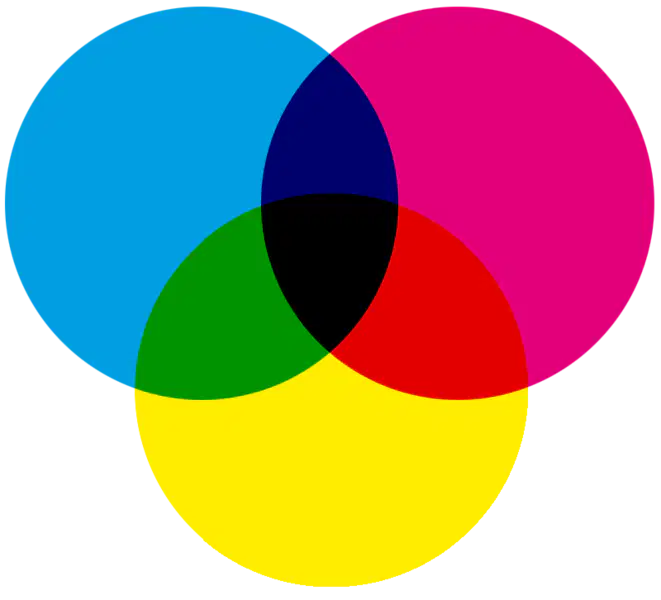
This is an example of which mixing model?
a)
subtractive color mixing model
b)
additive color mixing model
12.
This is an example of which mixing model?
a)
subtractive color mixing model
b)
additive color mixing model
13.
What is hue?
a)
Add gray to the color.
b)
The pure color.
c)
Add black to the color.
d)
Add white to the color.
14.
What is tint?
a)
Leave the color alone.
b)
A hue to which black has been added.
c)
A hue to which white has been added
d)
A color to which black and white (or grey) have been added.
15.
What is shade?
a)
Leave the color alone.
b)
A hue to which black has been added.
c)
A hue to which white has been added
d)
A color to which black and white (or grey) have been added.
16.
What is tone?
a)
Leave the color alone.
b)
A hue to which black has been added.
c)
A hue to which white has been added
d)
A color to which black and white (or grey) have been added.
17.
What is a color scheme?
a)

The fundamentals and principles of creating visual communication and all types of art.

b)

an arrangement of colors designed to create a specific response

c)

The science and art of using color.

18.
What are complementary colors?
a)

colors that are next to each other on the color wheel

b)

using three colors that are equal distance apart on the color wheel

c)

Colors located directly opposite one another on the color wheel

19.
What are analogous colors?
a)

colors that are next to each other on the color wheel

b)

using three colors that are equal distance apart on the color wheel

c)

Colors located directly opposite one another on the color wheel

20.
What are triadic colors?
a)

colors that are next to each other on the color wheel

b)

using three colors that are equal distance apart on the color wheel

c)

Colors located directly opposite one another on the color wheel

21.
Which Principle of Design is a distribution of equal visual weight?
a)
Balance
b)
Movement
c)
Emphasis
d)
Unity
e)
Pattern
22.
Which Principle of Design is an arrangement forming a straight line?
a)
Alignment
b)
Movement
c)
Balance
d)
Emphasis
e)
Unity
23.
Which Principle of Design is an accentuation of importance?
a)
Emphasis
b)
Movement
c)
Balance
d)
Unity
e)
Pattern
24.
Which Principle of Design is a scaling of objects in relation to each other?
a)
Proportion
b)
Movement
c)
Balance
d)
Emphasis
e)
Unity
25.
Which Principle of Design is a directed path of optical motion?
a)
Movement
b)
Balance
c)
Emphasis
d)
Unity
e)
Pattern
26.
Which Principle of Design is an orderly repetition of an object?
a)
Pattern
b)
Movement
c)
Balance
d)
Emphasis
e)
Unity
27.
Which Principle of Design is the difference between things?
a)
Contrast
b)
Movement
c)
Balance
d)
Emphasis
e)
Unity
28.
Which Principle of Design is a harmonious arrangement of elements?
a)
Unity
b)
Movement
c)
Balance
d)
Emphasis
e)
Pattern
29.
What are vector graphics?
a)
These graphics are points, lines, curves and shapes that are based on mathematical formulas.
b)
These graphics are created using colorized pixels.
30.
What are raster graphics?
a)
These graphics are points, lines, curves and shapes that are based on mathematical formulas.
b)
These graphics are created using colorized pixels.
31.
When enlarged, vector graphics look blocky, or "pixelated."
a)
True
b)
False
32.
When raster graphics are enlarged they do not lose their image quality.
a)
True
b)
False
33.
Which type of graphics are ideal for logos, business cards, and billboards?
a)
Vector Graphics
b)
Raster Graphics
34.
The following file extensions are examples of which graphics? (.BMP, .TIF, .GIF, .JPG)
a)
Vector Graphics
b)
Raster Graphics
35.
Raster graphics can typically be scaled down with no loss of quality.
a)
True
b)
False
36.
Most images found on the Web and photos you import from your digital camera are raster graphics.
a)
True
b)
False
37.
What is typography?
a)
The art of creating different types of fonts.
b)
The visual art related to writing.
c)
The art of arranging letters and text in a way that makes the copy legible, clear, and visually appealing to the reader.