
 Worksheets
24 9th gr Waves Review
Total questions: 46
Worksheet time: 2hrs 37mins
Waves transfer _______.
particles
matter
energy
In the context of wave mechanics, identify the wave type characterized by parallel particle movement.
longitudinal
transverse
electromagnetic
seismic

In wave mechanics, the _______ of a wave, measured in hertz (Hz), is the number of wave cycles per second. Which term describes this?
Frequency
Wavelength
Amplitude

In a longitudinal wave, what is the term for the region where particles are farthest apart and the term for the region where particles are closest together?
crest, trough
compression, rarefaction
rarefaction, compression
trough, crest
When a sound source moves relative to an observer, the observed frequency changes due to their relative velocity. For example, a police car siren seems to have a lower pitch after passing an observer.
pitch
frequency
Doppler Effect
medium
In which state of matter does sound travel the fastest?
solid
liquid
gases
What is the process called when a wave is redirected back into the original medium, like echoes?
diffraction
refraction
reflection
interference
What is the process called when a wave changes speed and direction as it passes from one medium to another, like a pencil appearing bent in water?
diffraction
refraction
reflection
dispersion
What causes a wave?
Shaking
Potential energy
Light
Vibrations
In which states of matter can mechanical waves propagate, given they need a medium?
A. Solids only
B. Liquids only
C. Gases only
D. Solids, liquids, and gases
What property of a sound wave primarily determines its pitch?
frequency
amplitude
wavelength
speed
The loudness of sound depends on
wavelength
amplitude
frequency
Does light refract by bending or reflect by bouncing when passing through different mediums?
refract by bending
reflect by bouncing
A blue t-shirt looks blue because of ___.
Which process mainly forms a rainbow due to light dispersion?
Refraction
Reflection
Diffraction
Absorption
The time for one complete oscillation is called the ...
Wave speed
Frequency
Wavelength
Amplitude
Period
The maximum displacement from the midpoint is the ...
Wave speed
Frequency
Wavelength
Amplitude
Period

Which frequency range is associated with x-rays?
1.41 x 10⁻¹⁰ Hz to 1.41 x 10⁻⁸ Hz
1.41 x 10¹⁶ Hz to 1.41 x 10²⁰ Hz
1.41 x 10¹⁰ Hz to 1.41 x 10¹² Hz
1.41 x 10⁻¹⁸ Hz to 1.41 x 10⁻¹⁶ Hz
As the frequency of a wave increases, the energy -
Increases
Decreases
Reorder the following from lowest to highest energy:
Radio
Infrared
Visible light
Ultraviolet
X-ray
What is it called when waves combine to form a wave of greater amplitude?
Wave Propagation
Wave Interference
Destructive Interference
Constructive Interference
Wave Diffraction
What is the phenomenon called when two waves completely cancel each other out with a phase difference of 180 degrees?
Constructive interference
Destructive interference
Interference
Transmission
Diffraction
The bending of light as it enters a medium with a different refractive index
Diffraction
Reflection
Scattering
Refraction
What describes the nature of electromagnetic waves like light in terms of their oscillation direction?
Transverse, oscillating perpendicular to the direction of propagation
Longitudinal, oscillating parallel to the direction of propagation
Which phenomenon explains why a police car siren sounds different as it approaches and then passes an observer?
pitch
frequency
Doppler Effect
medium

Which principle of wave interference is used by noise-cancelling headphones to reduce sound?
Constructive Interference: It amplifies sound waves.
Destructive Interference: It cancels sound waves.

Which type of wave interference amplifies sound in musical instruments, affecting nodes and antinodes?
Constructive interference, which increases the amplitude at antinodes while nodes remain stationary.
Destructive interference, which decreases the amplitude at nodes while antinodes remain stationary.
Electromagnetic waves vary in which characteristic, crucial for differentiating types like radio waves and gamma rays?
Their ability to penetrate materials.
Their speed in various media.
Their wavelength and frequency, determining energy and application.
Their interaction with electric and magnetic fields.
What best describes the electromagnetic spectrum?
The sequence of colors visible in a rainbow
The entire range of electromagnetic wave frequencies, including radio waves, microwaves, infrared, visible light, ultraviolet, X-rays, and gamma rays
The spectrum of light visible to the human eye
Radiation that has enough energy to remove tightly bound electrons from atoms, thus ionizing them
Which type of radiation has the highest energy and can ionize atoms?
radio waves
microwaves
gamma rays
infrared
How are the electric field, magnetic field, and wave propagation directions related in an electromagnetic wave?
All are parallel
Electric and magnetic fields are parallel, but both are perpendicular to wave propagation
Electric and magnetic fields are perpendicular to each other, and both are parallel to wave propagation
Electric and magnetic fields are perpendicular to each other, and both are perpendicular to wave propagation
How does the speed of sound in air change with temperature, and why?
It increases with higher temperature due to faster molecular motion
It decreases with higher temperature because of reduced air density
It remains constant regardless of temperature
The more energy a wave has, the (a) the frequency.
Increases
Decreases
Remains constant
Varies
When standing in front of an approaching police car, an observer will experience a change in sound waves. As the police car gets closer, the sound waves from the siren will (a) in frequency, have a (b) pitch, and a (c) wavelength. This is due to the (d) of the sound waves in the front of the car as it is moving.
increase
higher
shorter
compression
How does increasing temperature affect sound speed in a medium?
It increases sound speed.
No effect on sound speed.
It decreases sound speed.
Sound waves dissipate completely.

crest
A
amplitude
C
wavelength
B
Trough
D
wavelength
E
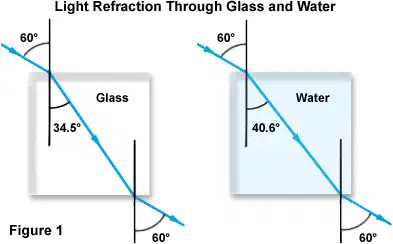
In which substance does light travel faster?
Glass, because it refracts less.
Water, because refracts more.
The speed of light is the same in both glass and water due to similar refractive properties.
Glass, because it refracts more.
Water, because it refracts less.
Reflection is to bouncing as refraction is to:
bending.
breaking.
dissipating.
halting.
How does the angle of incidence compare to the angle of reflection according to the law of reflection?
They are equal, as per the law of reflection.
The angle of incidence is twice that of the angle of reflection.
The angle of reflection is twice that of the angle of incidence.
They add up to 180o.
Which question would reveal if a wave is electromagnetic or mechanical?
Is a medium necessary for its propagation?
Can it travel through air and water?
Does it have a measurable speed?
Is its frequency measurable?

A tuning fork produces a sound wave in air at 20°C. If the speed of sound is 343 m/s and the frequency is 512 Hz, what is the wavelength? (Round to two decimal places and include units.)
(a)

When sound waves move from water to air, what is likely to happen?
wave speed increases
wavelength decreases
wave speed decreases
wavelength is unaffected

Where is the speed of sound effectively zero?
Outer space, due to no medium
Deep ocean, due to high pressure
Dense forest, due to absorption
Desert, due to high temperatures

What is it called when two coherent waves meet and form a wave with greater amplitude?
Constructive Interference
Destructive Interference
Reflection
Refraction
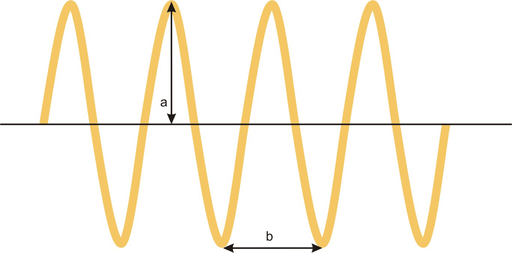
How many complete wavelengths are in the wave chain shown?
6
3
4
5
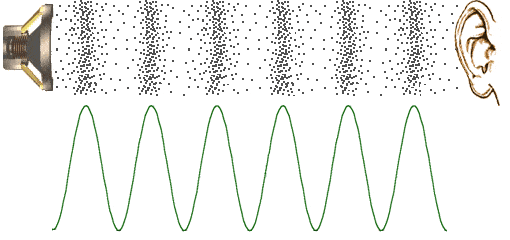
A sound wave has a frequency of 250 hertz and a wavelength of 8 meters. If the wavelength changes to 6 meters while the frequency remains constant, what is the new speed of the sound wave?
1500 m/s
2000 m/s
2500 m/s
3000 m/s

