
 Worksheets
4th Grade Science Review Chapters 1,2,5 and 6
Total questions: 134
Worksheet time: 1hrs 7mins
Mr. Benedict's class was working on an engineering design problem. Here are three of their solutions:
-Louise made a very strong model house. All of its parts were held strongly together.
-Edgardo made a flexible tower. It could bend and twist without breaking.
-Beau made a building with springs between it and the ground.
Mr. Benedict's students were most likely trying to design buildings that could stand going through a/an _____________.
flood
earthquake
wildfire
tsunami
A hurricane is a large storm with strong wind and heavy rain. Clouds spiral around the center of the hurricane. What is true about hurricanes? Select all that apply.
Hurricanes are large spiral storms.
Hurricanes form over oceans and can move onto land
Hurricanes bring large amounts of rainfall.
The lunchroom at Sunset Elementary School floods each year. When there is more than one inch of water on the ground outside, water flows under the doors and into the building. Dr. Rogers, the principal, wants to find a way to protect the lunchroom from flooding. Select 3 times the lunchroom is most likely to flood.
When a river next to the school overflows.
During a storm with a lot of rain
When large amounts of snow melts quickly
During a drought, when there is not much rain.
The lunchroom at Sunset school is near a river. When it rains a lot, the river gets full and overflows. The extra river water flows toward the lunchroom. The water collects around the lunchroom doors. If the water is more than one inch deep, it can get into the lunchroom through the spaces around the doors. There are many ways to solve this flooding problem. Which of the following actions would help keep the lunchroom from flooding? Select all that apply.
Build a new lunchroom uphill from the river to keep water from reaching the lunchroom
Build a wall along the river to keep the river from overflowing
Block the lunchroom doors to stop water from getting in.
Some buildings are designed so that their bases are not directly connected to the ground. Instead, isolation bearings at such a building's base allow it to slightly move relative to the ground it rests on. Using isolation bearings is one way that engineers protect a building from
flooding
tsunamis
earthquakes
erosion
What natural disaster is caused by plates shifting that results in the ground shaking?
flood
earthquake
tornado
hurricane
Wetlands are shallow areas covered by water. Wetlands are able to absorb a tremendous amount of water. Wetlands could reduce the effects of which of the following weather hazards?
Tornadoes
Floods
Blizzards
Earthquakes
What natural disaster is created when thunderclouds touch Earth’s surface and spin rapidly?
flood
earthquake
tornado
hurricane
Which of the following things might help prevent further erosion on a beach?
Sea walls
shock absorbers on buildings
houses on stilts
Which of the following things could protect a house in floods?
Houses on stilts
houses with shutters
houses with more interior walls
Dr. Rogers wants to protect the lunchroom because flooding can cause problems. Which two problems might Sunset School have because of flooding?
Wind could blow the lunchroom roof off
Water could ruin the lunchroom walls and floors
Mud and sand could cover the lunchroom floor.
During an earthquake, objects and furniture can fall and hurt people. Leaders have created a checklist to help people prepare for earthquakes. What could people do to prepare for an earthquake without needing other materials?
Strap water heaters and heavy furniture to walls.
Move heavy items to the floor or to low shelves.
Use putty or wax to prevent small objects from sliding.
Place breakable objects on the top level of cabinets.
Susan wants to build a house that is safe from floods. She is considering either building the house on a raised platform or installing a metal roof. Which of these options will be the most effective in protecting the house against flooding?
building the house on a raised platform to prevent flood water from entering the house
building the house on a raised platform so that it drains the flood water faster
installing a metal roof to prevent flood water from entering the house
installing a metal roof so that minimum damage is done to the house
The strong wind of a hurricane blows on the outside of a house. If the wind is strong enough, it can blow the roof off or blow the walls over. If a window or door breaks during a hurricane, the strong wind blows inside the house, too. The wind can damage the roof and the walls of the house and any objects inside. If any people are in the house, they could get hurt. Rainfall is another issue with hurricanes. Hurricanes can bring large amounts of rainfall and can cause storm surges too that can flood an area. How can people protect the insides of their homes from the strong wind and water of a hurricane? Choose all that apply.
They can cover windows to keep them from breaking.
They can place sandbags at their doorways.
They can open all windows to keep them from breaking.
They can move people and furniture to the basement or lowest level in homes.
There are many ways to solve the flooding problem in the lunchroom. But not all of them will work for Sunset School. To choose the best solution, the school must think about the constraints of the problem. A constraint is something that holds you back from taking a certain action. For example, cost can be a constraint. If something costs more money than you have, you won't be able to buy it right away. Several parents and teachers form a planning team to help solve the flooding problem. The team receives the following letter from the principal: To the Planning Team: Thank you for working with me to solve the flooding problem at our school. As you think of ideas to solve this problem, please keep these two constraints in mind: We cannot build any new buildings. That would cost too much money. It would also take too long. We can make changes only to our school. We are not allowed to make changes to other parts of the city, including the area next to the river. Sincerely, Dr. Rogers Based on these constraints, what can the school do to solve the flooding problem?
Build a new lunchroom uphill from the river to keep water from reaching the lunchroom
Build a wall along the river to keep the river from overflowing
Block the lunchroom doors to stop water from getting in.
Robin's class researched tsunamis (huge tidal waves). They learned about different ways people and towns protect themselves from tsunamis. Some of these ways are: building a seawall to protect the town in case a tsunami comes, moving everyone to high ground when a tsunami is coming, moving people into deep water in boats when a tsunami is coming. These last two work best in places that teach the people what to do if a tsunami is coming. How can Robbin's class best compare these solutions to learn which one saves the most lives?
Research how well each solution worked in the past.
Try each solution in a real tsunami and observe the results.
Improve each solution using engineering design.
Test whether it takes longer to get to high ground or to deep water.

Ryan is eating lunch with a metal spoon. His spoon feels cool to the touch. He thinks about what objects are made out of and how they feel. He decides to place his hands on different spoons at the same time to determine which feels cooler. Which question is Ryan most likely to be able to answer with this experiment?
How cold are the objects?
How do different materials compare in how cool they feel?
Why does the wooden spoon not feel cold?
Why did the school railing not feel cold?
Ben plugs in his radio into the wall. Electricity goes from the outlet, through the cord and to the radio. What choice best describes the cord?
conductor
insulator
resistor
current
What statement best describes heat?
Heat moves from the hot object to the cold ones
Heat only moves by conduction when two things touch.
Heat moves from the cold object to the hot ones.
Heat only moves with a fire.
What causes sound energy?
Heated objects
Charged particles
Light energy
Vibrating objects
What is the ability to cause motion or create change?
Conduction
Energy
Speed
Temperature
Which of the following is a conductor?
metal spoon
Plastic spoon
wooden spoon
cotton

What claim could we make from this picture?
A car needs electrical energy to travel
When cars travel they always go the same distance and in the same direction.
When objects collide, they push on each other and can even change motion.
Speed of cars is always the same.
The more potential energy something has the more kinetic energy it will have.
true
false
Jane is doing an experiment with rubber bands. She pulls a rubber band back 1 inch and releases it. She pulls the same rubber band back 2 inches and releases it. She repeats this again pulling back the same rubber band back 3 inches and releases it. What would you expect to happen?
The rubber band she pulled back 1 inch will go the farthest.
The rubber band she pulled back 2 inches will go the farthest.
The rubber band she pulled back 3 inches will go the farthest.
They will all go the same distance

What type of energy transfer is happening in this picture?
electrical to light and heat
electrical to sound
kinetic to light and heat
light and heat to kinetic

This is an example of
heat energy.
the transfer of energy (kinetic and potential).
solar energy.
the transfer of heat to solar energy.
Which of these things happen in a collision?
energy is transferred
sound is produced
motion from one object goes into the other
all of the above
Vibrations from an object traveling through matter to your ear is
heat energy
light energy
mechanical energy
sound energy
This energy comes from a source, bounces off an object, and goes into your eye.
light energy
heat energy
wind energy
sound energy
A thermometer measures
light energy.
sound energy.
heat energy.
wind energy.
If you add a cell (battery) to a working circuit, what will happen to the bulb?
the bulb will get dimmer
the bulb will blow up
the bulb will get brighter
nothing will happen
Which of these is the best conductor of electricity?
wooden spoon
a piece of string
plastic fork
copper wire
Why do electric wires and plugs have plastic or rubber coatings?
Plastic and rubber are insulators and prevent shock.
Plastic and rubber are conductors and prevent shock.
Plastic and rubber help kinetic energy.
Plastic and rubber help potential energy.
____________ moves from warmer things to cooler things.
Heat
Thermal energy
The only form of energy that can be seen is
chemical.
potential.
mechanical.
light.
Turn on a radio and you hear music.
Electrical energy changes to light energy
Electrical energy changes to chemical energy
Electrical energy changes to sound energy
A material that heat and electricity can move through easily is called a(n)
insulator.
conductor.
_______________ does not allow heat or electricity to move easily through them.
Conductor
Insulator
What makes a lamp cord safe to handle?
rubber or plastic insulation
copper wire
An example of a GOOD conductor is
metal pan
glass bowl
rubber ball
wooden spoon
Preserved parts or traces of animals and plants that lived in the past are called
fossils
erosion
deposition
Erosion is one of the processes involved in the formation of sedimentary rock. Which of these best describes the process of erosion?
Rocks are broken into smaller pieces that remain in the same location.
Pressure compacts layers of sediment and turns them into rock.
Pieces of rock or soil are carried from one place to another.
Sediment grains fall to the bottom of a lake to form sedimentary layers.
How are fossils created?
Traces of organisms get turned into stone.
Dead organisms are quickly buried for millions of years.
Animals get trapped.
All of the above
Sedimentary rocks form when broken bits of other rock are deposited and then -
buried and squeezed and cemented together
melted by the heat of the Earth's core
completely dissolved in the salt water of the ocean
used by humans as a natural resource
Which of the following is NOT something you could learn from a fossil?
The size of the animal
What the animal ate
The color of the animal
Where the animal lived
Which of the following fossil discoveries best demonstrates a change in the Earth's surface?
Scientists discover fossils of straight teeth buried below fossils of curved teeth.
Scientists discover fossils of underwater organisms in an area of dry land.
Scientists find an area that contains a variety of plant fossils but no animal fossils.
Scientists discover a large number of footprints of different sizes

Scientists found an index fossil in layer Z that was about 400 million years old. They determined that in that area, a new layer of earth was deposited every 50 million years. If a fossil was found in layer W, how old was the fossil?
about 300 million years old
less than a million years old
about 100 million years old
over 400 million years old
Scientists began to dig in a new location where there are many layers of artifacts and fossils. Today, archaeologists reached the lowest layer and discovered fossils of fish bones and plants there. What might have been in this area many years ago before all of the other layers of fossils came into being?
mountains
desert
water
restaurants

What type of rock is shown above?
sedimentary rock
igneous rock
metamorphic rock
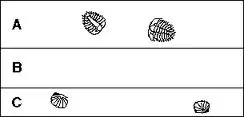
What evidence from the picture shows that this is sedimentary rock? Choose 2 answers.
The rocks are in layers.
The rocks contain fossils.
The rocks have other rock parts in them.
Layer B has no fossils.
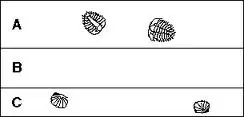
Which layer has the oldest fossil in the image?
Layer A
Layer B
Layer C

Below is a drawing that represents rocks layers found in the middle of the United States. What claim can you make about this area?
In the past this area was covered by water.
In the past this area was dry land only.
Plants covered this area in the past.
This area was hit by an earthquake in the past.
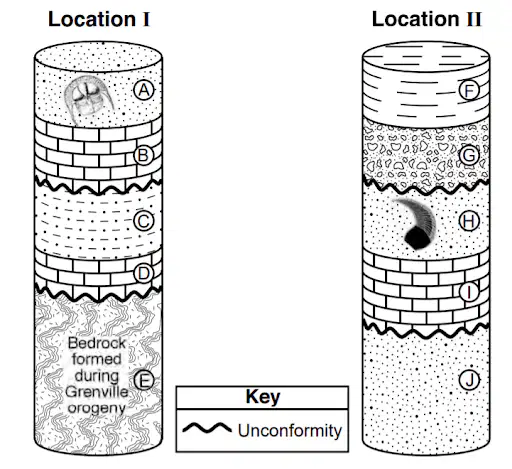
Below is a drill core of an area. Scientists use a special tool to dig deep into the ground to pull out a core or cylinder. This core gives us a sample of what is underground. Based on the image above Which layer would be the youngest in this core?
Layer A
Layer B
Layer C
Layer D
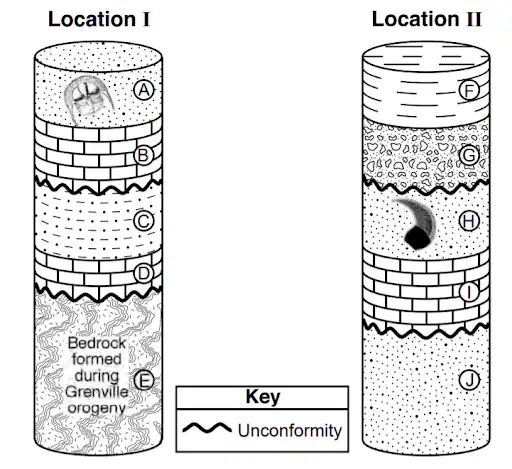
This is a picture of the layers of rock from North Dakota. What can you conclude based on these layers? Choose 2.
This area was covered by water at one time.
Energy from the sun was less in this area a long time ago.
The animals in the area have changed over time.
Fishes are older than trilobites.
If you wanted to know which fossil is older rodents or whales under which heading would you look?
Fossils
Collecting Fossils
Where are fossils found?
Fossil Timeline
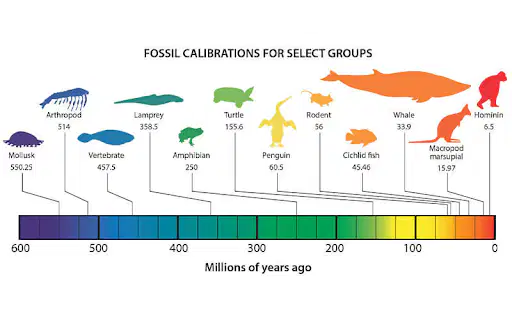
What can we learn from the fossil record? Choose 2.
Which animals and plants lived long ago
How animals and plants change over time
How animals and plants ate food
The fossil record does not teach us anything
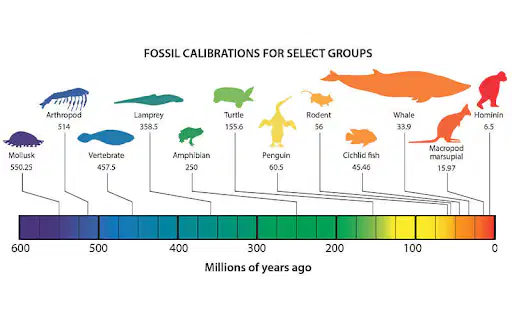
How long ago did penguins appear in the fossil record?
6.5 million years ago
39.3 million years ago
60.5 million years ago
358.5 million years ago
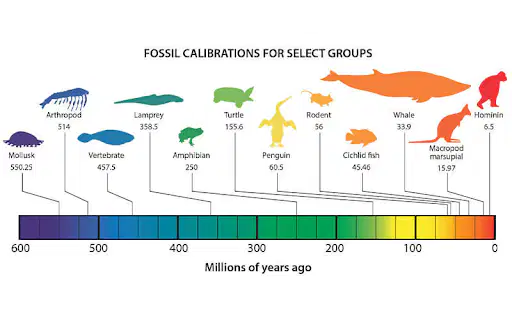
How much older are arthropods than amphibians based on the fossil record?
264 years
1,000 years
25 years
4 billion years
Organisms that live in water are referred to as _______organisms.
fossil
land
marine
oldest
Terrestrial organisms are referred to as ________organisms.
fossil
land
marine
oldest
In layers of rocks, the ______fossils are found in the bottom layers.
fossil
land
youngest
oldest
In layers of rocks, the ______fossils are found in the top layers.
fossil
land
youngest
oldest
A layer of rocks is called a _____________.
sedimentary rocks
strata
fossils
erosion
Rocks that are formed from sediments or layers of clay, mud, sand being pressed together over time.
sedimentary rocks
strata
fossils
erosion
The process of sediments or soil being carried away by wind, water or gravity.
sedimentary rocks
strata
fossils
erosion
The remains of organisms found in rocks.
sedimentary rocks
strata
fossils
erosion
The only type of rock fossils form in are _________rocks.
sedimentary
strata
fossils
erosion
A diagram or picture of layers or rocks. You will see fossils in these rocks and can compare their age.
geologic column
strata
sediment
erosion
Matter that settles. Usually this matter is sand, parts of mud or clay. Over time these can form sedimentary rocks.
geologic column
strata
sediment
erosion
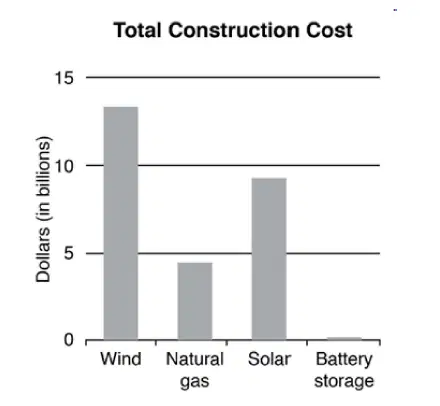
What are the two renewable energy sources on this graph?
Wind and natural gas
Natural gas and solar
Solar and battery storage
Solar and wind

Which statement is supported by the data in the graph?
A natural gas plant cost the most to build.
Wind plants cost less than solar plants.
Plants that use renewable energy are often more expensive than plants that use nonrenewable energy.
Plants that use renewable energy are often less expensive than plants that use nonrenewable energy.
Sam makes a list in his science notebook of renewable energy sources. Which of the following should NOT be included in his list of renewable energy sources?
Wind
Solar
Coal
water
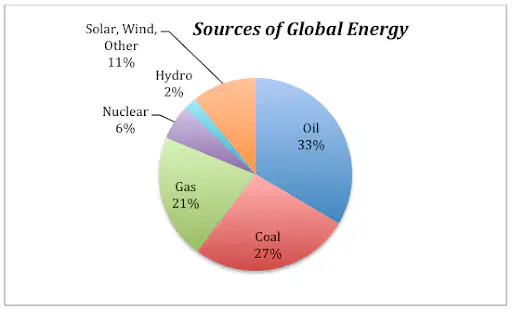
Which non renewable energy provided the most energy to the world?
Nuclear
Coal
Oil
Gas
Solar, Wind and Other
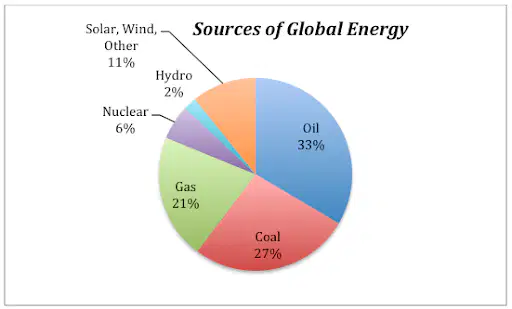
Which renewable energy provided the most energy to the world?
Nuclear
Coal
Oil
Gas
Solar, Wind and Other
Sam makes a list in his science notebook of renewable energy sources. Which of the following should NOT be included in his list of renewable energy sources?
Wind
Solar
Coal
Nuclear
Water
wind
nuclear
water
solar
The meaning of hydro is
wind
sun
water
plants
Moving water has a lot of _____________energy when it passes through turbines in the dam.
kinetic
potential
electric
sun
______________is used to convert kinetic energy into electricity.
generator
turbine
magnet
microphone
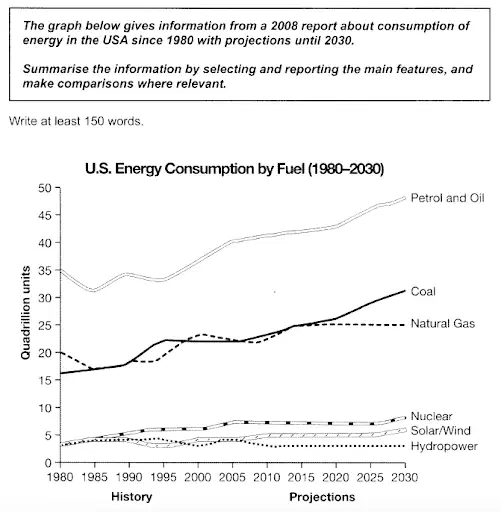
Based on the graph above, which statement best represents energy used in the United States?
Most energy that is used is renewable.
Most energy that is used is nonrenewable.
The energy used from renewable sources and nonrenewable sources is equal.
What is one disadvantage of using biomass or plants as a source of energy?
They are renewable but take millions of years to regrow.
They are nonrenewable but are expensive to produce.
They are renewable but take up a lot of space to grow.
They are nonrenewable and cause a lot of air pollution.
How are fossil fuels formed?
Old plants and animals decay underground over millions of years.
Uranium is split apart to make energy.
Air moves constantly and can make energy.
Why is solar energy renewable?
It takes millions of years of years to make.
It constantly comes to the Earth from the Sun.
It comes from a natural resource that is hard to find.
It causes a lot of air pollution.
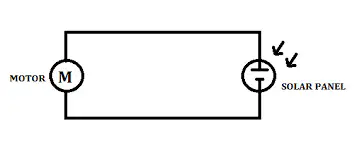
What type of energy is being converted in this circuit?
Solar energy is converted to electrical energy to kinetic energy.
Solar energy is converted to light energy to kinetic energy.
Solar energy is converted to heat energy to light energy.
What is one disadvantage of using the solar panel to turn the motor?
It makes air pollution when used.
It only works when the sun is out or when light shines on the panel.
It requires water to be located behind the dam.
What is a disadvantage of using coal for an energy source?
Burning coal causes a lot of air pollution. Coal takes millions of years to make and is hard to replace.
It takes a lot of land to grow the plants used for coal. At night when the sun stops shining, we can’t use coal as an energy source.
At night when the sun stops shining, we can’t use coal as an energy source.
The solid waste from the uranium can be dangerous for millions of years.
Coal takes millions of years to make and is hard to replace. The solid waste from the uranium can be dangerous for millions of years.
A rabbit in a grassy field hears in the distance the rustling of vegetation. The rabbit then quickly runs into a rabbit hole. Which of the following best describes the reaction of the rabbit to the sound?
The rabbit hears the sound, the information goes directly to the rabbit's muscles, and it runs to safety.
The rabbit hears the sound, and because of memory stored in the brain, it reacts by running to safety.
The rabbit hears the sound and learns that the sound represents danger at the same time.
The rabbit's muscles sense the sound which makes it run to safety.
When your eye sees a pencil, it sends a signal to your brain. Your brain then signals muscles in your hand and arm, and you can reach and pick up the pencil. In the process that was described, which was a sensory receptor?
brain
eye
muscle
bone
Young wolves learn how to hunt with their pack. When a young wolf smells the scent of a rabbit, it sees an older pack member pounce on the rabbit as prey. When this young wolf is mature and hunting and smells the scent of a living rabbit, it prepares itself to pounce on the rabbit. How does the wolf know that the rabbit is good for food?
The wolf remembers the smell and taste of rabbit from when it was younger.
The wolf learns about the rabbit scent as it smells it.
The wolf senses the same scent from the rabbit as from other animals.
The wolf is born with the ability to know what a rabbit smells like.
Some animals have senses that humans do not have. These senses may have come about because they help the animals adapt to different environments and ways of life. Which of the following is an example of an animal using a sense that humans do not have?
A monkey uses its sense of taste to decide which fruit is ripe.
A bat uses echolocation to catch a flying insect.
A bird uses its sense of hearing to find its family.
A dog uses its sense of smell to find a bone.
An eagle on a tree branch sees an injured squirrel 50 meters away on the ground. The eagle then flies from the tree to prey on the injured squirrel. Which of the following best describes what happened with the eagle before it started to fly toward the squirrel?
The eagle's brain recognized the squirrel as prey.
The sense received from the squirrel went directly to the eagle's eyes to its muscles.
The eagle was born with the ability to prey on squirrels, so no brain activity was required.
The sight of the squirrel came only from the eagle's memory, which stimulated the muscles to move.
Organ that controls sight
eye
skin
sense receptors
temperature
A change that causes a response
stimulus
skin
sense receptors
temperature
Animals that hunt another organism
stimulus
skin
predator
temperature
Eyes, ears, skin, tongues, noses are all _____________ _________________
stimulus
skin
sense receptors
temperature
Seasonal movement of animals from one location to another
migration
instinct
environment
perceive
This word means to become aware of
migration
instinct
environment
perceive
This organ is used for smell
nose
brain
temperature
perceive
This organ is used for smell
nose
brain
temperature
perceive
This organ is used to take in and interpret all information gathered from all sense organs. It then sends a message to how to react.
nose
brain
temperature
perceive
Place where an organisms live and collects information
stimulus
environment
instinct
migration
These are found on the tongue and used for taste
temperature
taste buds
skin
instinct
This organ is responsible for feeling textures, temperature changes, etc.
temperature
taste buds
skin
instinct
Typical or ingrained behavior that is in response to a stimulus
temperature
taste buds
skin
instinct
Skin can detect changes in ______________
temperature
taste buds
skin
instinct
This is a reaction to a stimulus
response
taste buds
skin
instinct

What is the difference in beats per minute between minute 0 and 1?
23
39
16
4
Orchid bees, monarch butterflies, and Costa’s hummingbirds are pollinators that consume nectar from flowers. Nectar is found inside the flower usually toward the bottom of the flower. Which table shows the structure that helps each pollinator remove nectar from a flower?


A student measured her heart rates in beats per minute (bpm) before and after different amounts of exercise. What is a reasonable estimate for heart beats per minute after 5 minutes of exercise?
160
200
60
90
A tortoise uses its eyes to see something moving nearby. The tortoise feels threatened by the movement. It pulls its head, legs, and tail into its shell. The tortoise's shell is hard and thick. This helps protect the turtle's soft body parts from any danger. Which of these describes a response of the tortoise to sensory information processed by its brain?
The tortoise's soft body parts are protected from any danger.
The tortoise's shell is hard and thick.
The tortoise uses its eyes to see something moving nearby.
The tortoise pulls its head, legs, and tail into its shell.
Why do animals need their senses?
Animals must take in and process information in order to make a response.
Animals need their senses for their brains to function.
Animals must use their senses to breathe.
Animals need their senses for their hearts to function.
Amanda's dad made a new recipe for dinner. Amanda looked at the food and saw that it was red and white in color. She picked up a few pieces and felt that they were firm. As she moved the pieces to her mouth, she recognized the scent of tomatoes and oregano. When she took a bite, she noticed it was salty and sweet.
Amanda used her sense of smell and compared the odor to other foods she remembers.
Amanda used her sense of hearing and compared the sound to other foods she knows.
Amanda used her sense of touch and compared the feeling to other foods she knows.
Amanda used her sense of sight and compared the colors to other foods she remembers.

Meerkats, like the one shown in the picture, live in large family groups. To communicate, meerkats make loud calls that can have many different meanings. The animals often use these calls to warn their family members about nearby predators, such as snakes and hawks. Which of the following senses is most important to meerkats when using calls to communicate?
smell
taste
hearing
sight
Tina woke up one night because she heard a loud alarm sound. Her radio and television were announcing that a tornado was approaching her town. Her family needed to find shelter.
Tina's sense of _______ helped her to avoid the danger of the fire.
hearing
sight
taste
touch
Some animals have senses that humans do not have. These senses may have come about because they help the animals adapt to different environments and ways of life.
Which of the following is an example of an animal using a sense that humans do not have?
A monkey uses its sense of taste to decide which fruit is ripe.
A bat uses echolocation to catch a flying insect.
A bird uses its sense of hearing to find its family.
A dog uses its sense of smell to find a bone.
Which answer choice includes ONLY renewable resources?
Sedimentary rock, coal, oil
Coal, natural gas, oil
Petroleum, fossils, coal
solar, water, wind, geothermal
Which answer choice includes ONLY fossil fuels?
Sedimentary rock, coal, oil
Coal, natural gas, oil
Petroleum, fossils, coal
solar, water, wind, geothermal

According to the diagram, how are sedimentary rock and fossil fuels related?
Fossil fuels are buried beneath sedimentary rock layers.
Fossils are found above sedimentary rocks.
Coal, oil, and gas are sedimentary rocks.
Sedimentary rocks are broken down into fossil fuels.

The bar graph above shows how fast a sound wave can travel through different types of media.
Through which medium will a sound travel the slowest?
Iron
Glass
oxygen
water
What conclusion is supported by the data shown in the bar graph?
Sound waves travel faster through air than through water.
Sound waves travel faster through water than air.
Sound waves travel at the same speed in different mediums.
Which device can receive and transmit digital signals?
mirror
prism
computer
water
Which statement best describes the impact of digital technology on communications?
Digital technology made the distance and speed of communication slower.
Digital technology has made the speed of communication faster.
_____________carries energy from one place to another.
waves
crest
trough
amplitude

What letter represents a crest in the wave below?
D
C
E
G
If you wanted to measure the amplitude, what would you measure?
From B to the midline
Distance from E to G
Length of the whole red line
If you wanted to measure the wavelength, what would you measure?
From B to the midline
Distance from E to G
(or D to F)
Length of the whole red line

If more energy was added to the wave above, what would you predict would happen to the wave?
The amplitude would increase.
The amplitude would decrease.
The wavelength would decrease.
The wavelength would decrease.
Isaac is looking at a red apple on an apple tree. Which of these choices explains why the apple is red?
Light hits the apple, and red light is reflected back to the eye.
Light hits the apple, and all light is reflected back to the eye.
The apple makes its own red light for the eye to see.
Why is the eye considered a system?
The different parts of the eye work together to detect the light and create an image with the help of the brain.
The eye has its own brain separate from the body.
The eye can detect all types of waves, even ones that you can’t see.
What is weathering?
A. The movement of soil or rocks by wind, water or ice.
B. The laying down of soil after it moves.
C. The process that breaks rocks or soil down.
What is erosion?
A. The movement of soil or rocks by wind, water or ice.
B. The laying down of soil after it moves.
C. The process that breaks rocks or soil down.
In a city every time there is precipitation the rocks gradually change. What would you call this process?
A. Weathering by acid rain
B. Weathering by water and ice
C. Weathering by animals
D. Weathering by wind
If you wanted to have the BEST workout to burn the most calories, what would be your best path?
A path with uphill and downhill sections
A path with elevation that stays the same
Susan and Max set up this experiment. Susan stands behind the sand and the rock and blows in the direction of the box. Max measures how much of the sand traveled. Which process is Susan and Max most likely acting out?
A. Water erosion
B. Chemical weathering
C. Physical weathering
D. Wind erosion

