
 Worksheets
Q4 Summative Science G4
Total questions: 157
Worksheet time: 1hrs 26mins
What is the most basic definition of force?
It is anything that moves
It is a push or pull
It is an interaction between two or more objects
It is anything that causes change
What is a characteristic of force?
It acts only on moving objects?
It acts the same way in all objects.
It acts in a certain direction.
It acts only on stationary objects.
Which is the following activities needs a pulling force?
standing straight beside a pole
typing using the laptop keyboard
sipping a drink using a straw
holding a pen
Which of the following objects goes back into its original shape when you let go of it after squeezing?
Flour dough
cooked pasta
glass bottle
sponge
Which of the following actions uses a pulling force only?
pressing
twisting
pounding
stretching
Why do some objects permanently change in shape and some do not?
Objects are affected by force, depending on their properties.
Objects change for a short time only if pulling forces are used.
Objects permanently change their shape if pushing force is used only.
Objects do not permanently change in shape but change in size instead.
Which of the following activities uses pull forces to change the shape of an object?
stretching dough to make noodles
pounding aluminum to make a foil
using a rolling pin to flatten the dough
pressing clay to make a cup
Which is true about crumpled paper?
The paper will go back to its original shape after the force is removed.
Pull forces cause the paper to crumple.
Push forces cause the paper to crumple.
The paper will flatten itself back into a sheet when the force is removed.
Why are cardboard folders used to keep paper sheets neat?
Folders pull the paper sheets from all sides to keep them neat.
Folders protect the paper sheets from outside forces that can change their shape.
Folders fold the paper sheet into the desired shape.
Folders change the shape of the paper sheets so that they can be folded.
You notice that when toothpaste is squeezed out of its tube, it follows the shape of the tube opening. What can be inferred based on the observation?
Toothpaste has properties that allow it to stay in shape after a force is applied to it.
Toothpaste is shaped like a tube, and we see that shape once it is out of the tube.
Pushing and pulling changed the shape of the toothpaste from flat to tube.
Forces act on the toothpaste and change its shape once it is our of the tube.
Which of the following objects is a magnetic object?
golden crown
copper pan
steel cable
silver coin
Which of the following substances is a magnetic metal used in making blue paint and jet engines?
nickel
cobalt
copper
steel
Which of the following substance is the only nonmagnetic metal?
plastic
silver
cobalt
nickel
Which of the following statements best describes a magnetic object?
any object that has metal in it
any object that does not have wood or rubber
any object that has iron, cobalt or nickel
any object that is attracted to magnets.
Which of the following statements is true?
All metals are attracted to magnets.
All magnets will stick to metals.
All magnets are magnetic objects.
All magnetic materials are magnets.
Which best describes a nonmagnetic object?
any object that is not made of iron
any object that has wood component
any object that attracts magnets
any object without any magnetic metal
How will one know if an object is magnetic or nonmagnetic?
If a magnet is placed near the object and it does not stick, then it is nonmagnetic.
If a magnet is placed near the object and it sticks, then it is magnetic.
If a magnet is placed near the object and it sticks, then it is nonmagnetic
If a magnet is placed near the object and it does not stick, then it is magnetic.
RIta accidentally left a magnet on her talking plush toy. She noticed that it did not fall even when she lifted the teddy bear. What could be inferred from the situation?
The magnet placed in the plush toy is a nonmagnetic material.
The talking plush toy is made of nonmagnetic metal.
The talking teddy bear is heavy and metallic.
The talking plush toy has at least one magnetic component.
Randy wants to find out if the metal he is holding is a magnetic or nonmagnetic. What question would lead him to find out if it is magnetic or nonmagnetic?
Will a nonmagnetic material sticks on the magnet?
Is the metal heavy or light?
Will a magnet stick on the metal?
Does it have iron, nickel or cobalt?
Jovy is sure that his toy is a nonmagnetic object. Which of the following reasons made him so sure?
It is not as shiny as the steel.
It is not as hard as a metal.
It is not made of iron, copper or nicke.
It is not attracted to a magnet.
In which object will light pass through and in which will light not pass through at all?
Reading glasses
Opaque
Transparent
Translucent
In which object will light pass through and in which will light not pass through at all?
clay
Opaque
Transparent
Translucent
In which object will light pass through and in which will light not pass through at all?
Cooking oil
Opaque
Transparent
Translucent
In which object will light pass through and in which will light not pass through at all?
chalk
opaque
transparent
translucent
Where does the light travel at its fastest speed?
in opaque objects
in space
in water
in transparent objects
Which best describes the path of light from its source?
It moves slowly in gases slow but fast in solide.
It travels in a straight path.
It bends as it travel in the space.
It scatters as it travels.
What will happen if you block the path of light with an opaque object?
light will pass through
light will find another path
light will let the object cast a shadow
light ray will be crooked
Which describes a glass window that lets you see the other side clearly as if there is no glass?
dense
translucent
transparent
opaque
When light travels from space to the earth's air, what happens to its speed?
It stops for a while
It does not change
It slows down
It travels faster
How will the speed of light change as light travels from air to an aquarium filled with water and back to air again? Arrange the sequence of changes in the speed of light.
glass to air: faster
air to glass: slower
water to glass: slower
glass to water: faster
1,2,3,4
2, 4,3,1
3,4,2,1
2,1,4,3
Which materials can be used to make shadow puppets?
plastic water bottles
wax paper
dolls
cardboard
At night, the curtain in Lydia's room is closed to block the light from the windows and her lights are off. When she woke up and look at the curtains, she saw that it was day time already. How would Lydia know it is daytime by looking at the closed curtain?
The curtain must be translucent; some light passes through.
The curtain must be opened some time during the night.
The curtain must be opaque; it lets the shadow in the room.
The curtain must be transparent; it did not really block the light at night.
Gina's umbrella protects her from the rain but it does not help her when she uses it to protect herself from the sunlight. What could be the material of Gina's umbrella?
It must be transparent; it changes the speed of light.
It must be opaque; it does not block off light.
It must be transparent; it lets light through.
It must be translucent; it lets some light through.
What kind of image will form from each mirror? Categorize the description of images.
same size as the object
plane
convex
concave
What kind of image will form from each mirror? Categorize the description of images.
smaller than the object
plane
concave
convex
What kind of image will form from each mirror? Categorize the description of images.
inverted from left to right
plane
concave
convex
What kind of image will form from each mirror? Categorize the description of images.
inverted upside down
plane
concave
convex
What kind of mirror is shaped like the back of a spoon?
plane
convex
concave
combination of convex and concaves
Which best describes the path of light from its source when it strikes a reflective surface?
light rays travel through a mirror
light rays bounce back
light rays form images
light rays go back where it came from
Which of the following names will be read the same way when reading it from the image in the mirror?
VIU
OMA
IVY
AIA
When Lara looked in a mirror, her image was upside down. What kind of mirror is she looking at?
combination of concave and convex
convex
plane
concave
Why are convex mirrors often used for store security?
It makes images larger
It can reflect images from wider area
It can reflect images faster that other mirrors
It males images inverted.
Which if the following statements best describes a mirror?
a smooth and shiny object that has an image on it
a smooth object that has an image of an object
a shiny object made of metal and reflects light
a smooth surface which produces an image when it reflects light
Which property of concave mirrors make it good to use when applying face makeup?
It produces an inverted image, so it would be easy to see what is above your face.
It enlarges images when used near the face, allowing one to put make up details on parts of the face.
It produces smaller image when the object is near, so anyone can put on makeup when near the mirror.
It makes an image bigger when the object is far, so anyone can put on makeup when far from the mirror.
What would happen if a light bulb is attached at the center of a concave mirror?
The light rays will spread outwards in all directions.
The light rays will be enlarged when viewed near the bulb.
The light rays will collect in the center, making all light travel from the center.
The light rays will be inverted when far from the bulb.
When you take a picture in front of a plane mirror using a camera with flash, which of the following may happen to the picture?
Light rays from the camera will bounce back, and the reflected light will cover parts of your image in the picture.
Light rays will bounce back from the camera and the image in the picture will be upside down.
Light rays will spread in the mirror and no picture will form.
Light rays will collect in the middle and the picture will be brighter.
Soil is a mixture of broken rocks, minerals, decayed matter, and tiny living organisms.
True
False
Loam is the best kind of soil for growing plants.
True
False
Clay has the finest texture and highest porosity compared to sand and clay.
True
False
Sand becomes sticky and moldable when added with water.
True
False
The layers of the soil are called humus.
True
False
The soil formation starts with the disintegration of rocks.
True
False
The soil formation ends with the invasion of worms and small animals in the soil.
True
False
Loam soil has higher water holding capacity than clay.
True
False
Sand has the smallest particle size among soil types.
True
False
Clay is normally present in beaches and deserts.
True
False
The type of soil depends on its composition and physical characteristics.
True
False
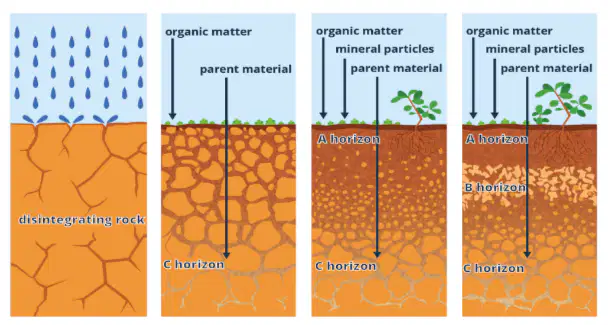
Arrange the entire process of soil formation.
1. horizon forms
2. bedrock begins to disintegrate
3. organic materials facilitate disintegration
4. developed soil supports thick vegetation
1, 2, 3, 4
2, 3, 1, 4
4, 2, 1, 3
3, 1, 2, 4
Which part of the soil formation process in which small soil organisms like worms and
fungi enrich the nutrient content of the soil through decomposition process.
bedrock begins to disintegrate
organic materials facilitate disintegration
horizon forms
developed soil supports thick vegetation
Soil is composed of different layers with different composition and characteristics. Each
layer of the soil is called a ____________.
humus
horizon
porosity
soil particles
It is the topmost horizon of the soil. topsoil. It is where plants grow and some
small animals like insects and worms live.
Topsoil
Subsoil
Regolith (Parent Rock)
Bedrock
This the horizon of the soil which is rich in minerals and humus.
Topsoil
Subsoil
Regolith (Parent Rock)
Bedrock
Humus plays an important role in growing plants since it provides nutrients for plants to grow.
True
False
In this horizon, small rocks, sand, and clay are loosely arranged.
Topsoil
Subsoil
Regolith (Parent Rock)
Bedrock
This horizon is rich in minerals that are washed down from the topsoil. But
unlike topsoil, it does not contain humus.
Topsoil
Subsoil
Regolith (Parent Rock)
Bedrock
This is the horizon where plants’ roots try to reach to get water.
Subsoil
Regolith (Parent Rock)
Bedrock
Topsoil
This horizon is composed of rocks that are slowly breaking apart. This horizon has no available nutrients and very little water.
Regolith (Parent Rock)
Subsoil
Topsoil
Bedrock
This is a solid unbroken piece of rock from which most of the parent rock came from.
Topsoil
Subsoil
Bedrock
Regolith (Parent Rock)
It is a firm type of soil that is composed of fine grains of rocks and clay minerals.
Clay
Sand
Loam
It holds as much water as it can which makes it sticky and moldable. But become very hard, flaky and brittle when dried.
Clay
Sand
Loam
Clay is highly malleable due to fine particles and water holding capacity.
True
False
It has a bumpy feel due to its coarse particles, usually formed from broken rocks.
clay
sand
loam
It has a poor capacity to hold water in it.
sand
clay
loam
This is the type of soil that has humus or materials from decaying matter.
Loam
clay
sand
It has the ability to retain water without becoming soggy or sticky. It can retain enough water for plants to use.
loam
clay
sand
Which of the following soil has high water retention capacity?
Sand
Clay
Loam
A clear pond can reflect light like a ______________ if it is undisturbed.
mirror
image
plane
reflection
An image can be upside down when viewed from a ______________ mirror.
convex
concave
mirror
reflection
When light bounces from a surface, ______________ of light occurs.
reflection
image
mirror
plane
When reading from a ______________ mirror, the letters will be laterally inverted.
convex
concave
plane
reflection
A representation of the object that you see in a mirror is called an ______________.
refection
image
mirror
Some objects can scatter or bounce back the light instead of absorbing it.
True
False
A plane mirror shows an upright but laterally inverted image.
true
false
A convex mirror shows an image that is upright but larger than the object in front of it.
true
false
The image formed in a concave mirror is dependent on the
distance of the object from the mirror.
True
False
Headlights and flashlights usually have bulbs that are attached
to a convex mirror.
True
False
Headlights and flashlights usually have bulbs that are attached
to a convex mirror.
True
False
How fast light travels?
It moves at a speed of approximately two hundred million meters per
second in a vacuum.
It moves at a speed of approximately three hundred million meters per
second in a vacuum.
It moves at a speed of approximately one hundred million meters per
second in a vacuum.
It moves at a speed of approximately four hundred million meters per
second in a vacuum.
A _____________ refers to space without any material in it.
light
vacuum
path
shadow
Sound travels faster than light,
True
False
It is a dark area or pattern that is formed on a
surface when light rays are blocked by an object.
shadow
reflection
vacuum
image
If the object that is blocking the light is near to its source, the shadow that is cast by the object is smaller.
True
False
sunglasses have tint or shade that is transparent.
True
False
light bulb is an example of transparent object.
True
False
What causes the pencil to appear broken inside the glass?
The pencil appeared to be broken inside the glass of water as the speed of light
changes as it travels through the different states of matter.
The pencil appeared to be broken inside the glass of water because the speed of light
did not change as it travels through the different states of matter.
The pencil appeared to be broken inside the glass of water as the speed of light
slowers as it travels through the different states of matter.
Light travels at the same speeds as it passes through solids, liquids and gases.
True
False
Light travels in a __________ path.
space
straight
speed
opaque
Some light can pass through __________ objects.
translucent
transparent
opaque
space
Light cannot pass through __________ objects.
translucent
opaque
transparent
space
The __________ of light changes as it passes through different states of matter.
speed
space
straight
translucent
Light travels fastest in __________ where there are no obstacles in its path.
straight
space
speed
translucent
Identify whether the object is magnetic or nonmagnetic.
coins made of nickel and copper
nonmagnetic
magnetic
Identify whether the object is magnetic or nonmagnetic.
cotton buds made with plastic and cotton
magnetic
nonmagnetic
Identify whether the object is magnetic or nonmagnetic.
knife made of steel
magnetic
nonmagnetic.
Identify whether the object is magnetic or nonmagnetic.
gloves made of rubber
magnetic
nonmagnetic
Identify whether the object is magnetic or nonmagnetic.
alkaline batteries with steel cover
magnetic
nonmagnetic
Identify whether the object is magnetic or nonmagnetic.
ruler made of wood
magnetic
nonmagnetic
Identify whether the object is magnetic or nonmagnetic.
fence made of cast iron
magnetic
nonmagnetic
Identify whether the object is magnetic or nonmagnetic.
shoes made of leather
magnetic
nonmagnetic
Identify whether the object is magnetic or nonmagnetic.
buckle made of iron
magnetic
nonmagnetic
Force acts on two or more interacting objects.
True
False
Force has no direction.
True
False
Force cannot make things move.
True
False
Force can keep an object in place.
True
False
Equal and opposite forces act between the objects and the table, keeping them from moving.
True
False
Force can change the shape and the size of an object.
True
False
(a) is forming a curved shape from a straight one.
(a) or squeezing a solid object is a pushing down action that flattens its shape.
(a) is pulling an object that makes its shape elongated.
(a) is a combination of a push and a pull. You push one end and pull the other end, distorting or curling the shape of the object.
(a) is a continuous pushing that flattens an object.
(a) is a push and pull action that crushes or breaks an object, which results in varied
shapes and sizes.
(a) is a combination of push and pull that is applied to deliberately change an object’s shape.
(a) the Japanese art of paper
folding, is an example of how folding can change the shape of a material.
Identify which action is best to use to accomplish the given task.
packing clothes in a luggage
folding
crushing
stretching
twisting
Identify which action is best to use to accomplish the given task.
flattening metal into sheets
pounding
crushing
pressing
stretching
Identify which action is best to use to accomplish the given task.
aiming an arrow in a bow
stretching
folding
pounding
crushing
Identify which action is best to use to accomplish the given task.
preparing ice for halo-halo
crushing
pounding
stretching
twisting
Identify which action is best to use to accomplish the given task.
tying a rope in an anchor
twisting
lifting
pounding
folding
Identify which action is best to use to accomplish the given task.
preparing tin cans to be recycled
pounding
stretching
folding
lifting
Identify which action is best to use to accomplish the given task.
making an origami
crushing
folding
twisting
lifting
Identify which action is best to use to accomplish the given task.
elongating a spring
twisting
stretching
crushing
folding
Identify which action is best to use to accomplish the given task.
pulverizing black pepper
pounding
stretching
folding
twisting
Identify which action is best to use to accomplish the given task.
removing excess water from a cloth
twisting
pounding
lifting
folding
Materials that are (a) easily break into smaller pieces even when little force is applied.
Materials that are (a) can be stretched into bigger or longer sizes.
Some materials such as sponge and cloth are (a) . This means that they can be compressed or squeezed in a container.
Identify the actions that will best change the size of the object(s) in each situation.
making flour from rice grains
grinding
pounding
compressing
stretching
Identify the actions that will best change the size of the object(s) in each situation.
inflating a balloon
stretching
grinding
pumping air
pounding
Identify the actions that will best change the size of the object(s) in each situation.
fitting gas in a portable container
grinding
compressing
stretching
pounding
Identify the actions that will best change the size of the object(s) in each situation.
breaking a ceramic tile into several small pieces
compressing
stretching
grinding
pounding
Identify the actions that will best change the size of the object(s) in each situation.
making a rubber band longer
stretching
compressing
pounding
slicing
Draw ☹️ if the force applied will make the object bigger and 😊 if it will make the object
smaller.
folding a shirt to fit inside a bag
☹️
😊
Draw ☹️ if the force applied will make the object bigger and 😊 if it will make the object
smaller.
crushing rocks to make concrete
☹️
😊
Draw ☹️ if the force applied will make the object bigger and 😊 if it will make the object
smaller.
compressing oxygen in a diver’s tank
☹️
😊
Draw ☹️ if the force applied will make the object bigger and 😊 if it will make the object
smaller.
blowing bubbles
☹️
😊
Draw ☹️ if the force applied will make the object bigger and 😊 if it will make the object
smaller.
slicing a birthday cake
☹️
😊
Draw ☹️ if the force applied will make the object bigger and 😊 if it will make the object
smaller.
elongating a rubber band
☹️
😊
Draw ☹️ if the force applied will make the object bigger and 😊 if it will make the object
smaller.
heating a hot air balloon
☹️
😊
Draw ☹️ if the force applied will make the object bigger and 😊 if it will make the object
smaller.
frying pork
☹️
😊
Draw ☹️ if the force applied will make the object bigger and 😊 if it will make the object
smaller.
folding your blanket
☹️
😊
Draw ☹️ if the force applied will make the object bigger and 😊 if it will make the object
smaller.
crushing your cookies
☹️
😊
Most of the time, a material that changes its shape changes in size too.
True
False
The change in the size of an object due to force may also bring harm.
True
False
Solids are more compressible than gases which make them easier to decrease in size.
True
False
Elastic materials can become shorter when stretched.
True
False
Flattening an elastic object like clay allows it to cover
bigger space.
True
False

