
 Worksheets
Q3 recovery
Total questions: 28
Worksheet time: 28mins
Which of the following is NOT an example of a Density Dependent Factor?
Parasitism
Natural Disasters
Predation
Competition
The movement of individuals into an area is known as:
Supplementation
Emigration
Immigration
Eradication
Typical population growth is described as:
Logarithmic growth
Logistic growth
Linear growth
Exponential growth
Emigration is:
When a population continues to increase.
When individuals move into an area.
When individuals move out of an area.
The study of human popuations.
Which of the following would cause a population to increase in size?
Emigration
Decreased Birthrate
Immigration
Increased Deathrate
In a given area, if the population of predators increases, the population of prey will _____________.
increase
decrease
remain about the same
go extinct
Which factor would contribute to an exponential growth rate in a given population?
higher death rates
less competition
less resources
lower birth rates

exponential growth curve
logistic growth curve

b
exponential growth
growth slows
growth stops
growth begins
Which of the following is NOT an example of a Density Dependent Factor?
Parasitism
Natural Disasters
Predation
Competition
A density-dependent limiting factor only becomes limiting if:
A population begins to decrease in size.
Random events occur in nature.
There are predator-prey interactions.
A population reaches its carrying capacity.
The movement of individuals into an area is known as:
Supplementation
Emigration
Immigration
Eradication
Typical population growth is described as:
Logarithmic growth
Logistic growth
Linear growth
Exponential growth
The maximum amount of organisms of a species that can be supported by an environment is:
exponential growth
logistic growth
population growth
carrying capacity
If a natural disaster devastates an ecosystem, what will this do to the carrying capacity of the population of a species within that ecosystem?
Increase it.
Will not affect it, so it will stay the same.
Always reduce it down to zero.
Decrease it.
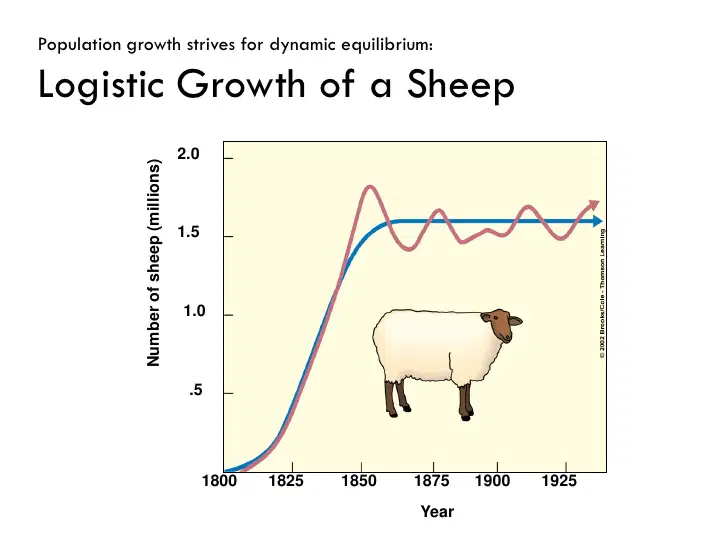
What is the carrying capacity for this sheep population?
1.8 million
1.25 million
1.6 million
1.0 million
What is a density-dependent factor?

Predator population lags behind prey population because......
Increase in predators leads to decrease in prey
Increase in predators leads to increase in prey
Increase in predators leads to decrease in producers
Increase in producers leads to increase in prey

A species that is vital to maintaining the stability of the food web or ecosystem is known as a :
Trophic Cascade
Trophic Level
Invasive Species
Keystone Species
A species that out competes native species and causes the native species to die out or go extinct is a:
Dominant Species
Primary Species
Invasive Species
Keystone Species
A lion lives in the savannah and competes with hyenas for food. The savannah is the organisms:
Niche
Habitat
Primary Trophic Level
A dung beetle is an insect that gathers waste from animals, rolls it into a compact ball, lays eggs in it, and buries it in the soil. This gives the eggs a warm, safe place to hatch and provides a food source for the developing larvae. Which impact does the dung beetle MOST likely have on its ecosystem?
It helps return nutrients to the soil.
It makes animal waste harder to degrade.
It causes an unhealthy accumulation of animal waste.
It depletes nutrients from the soil to benefit its young.
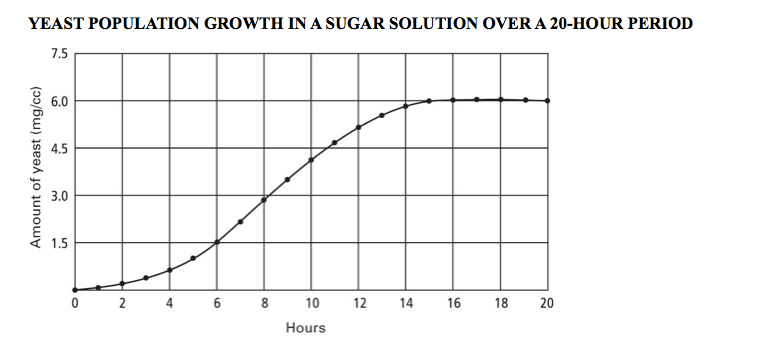

A population of foxes has 36 individuals. In one year, 10 baby foxes are born and 6 older foxes die. The population at the end of the year is (a) .
Which will most likely result in a negative growth rate in the human population of a country?
The death rate is higher than the birth rate.
The birth rate is higher than the death rate.
The country has improved economic conditions.
The country has made improvements in sanitation.

