
 Worksheets
Math Vocabulary Review
Total questions: 47
Worksheet time: 2hrs 34mins
An _____ angle is an angle that measures between 1-89 degrees and is a thinner, smaller angle.
obtuse
right
straight
A _____ angle is an angle that measures exactly 90 degrees.
acute
obtuse
straight
A _____ angle is an angle that measures between 91-179 degrees and is a wider, bigger angle.
acute
straight
reflex
A _____ angle is an angle that measures exactly 180 degrees and is a _____ line (use the same word in the spaces).
reflex
right
obtuse
A _____ angle is an angle that measures between 181-359 degrees and has the curve for the angle on the outside.
right
obtuse
acute
A _____ measures exactly 360 degrees.
obtuse
acute
reflex
All angles use the measurement unit or are measured in _____ .
tenths
hundredths
square
_____ is when you line up numbers from smallest to biggest.
ascending order
rounding
estimate
plot
When you _____ a number, you mark a point and write the correct number of the location on a number line.
rounding
fraction greater than 1
ascending order
The answer to a question about the area of a shape should always be measured in _____ units/measurements.
circle
true
obtuse
_____ is when you find the number that is shown the most amount of times in a line plot or stem and leaf plot.
mode
median
range
prime
_____ is when you find the highest number subtracted from the smallest number in a line plot or stem and leaf plot.
range
mode
median
composite
_____ is when you put the numbers in ascending order and find the middle number in a line plot or stem and leaf plot.
median
mode
range
prime
_____ is a number that you multiply with another number to get a product.
factor
multiple
quotient
difference
All numbers that are _____ have only 2 factors: the number 1 and itself.
composite
compatible numbers
factor
All numbers that are _____ have 3 or more factors, or multiple times tables that can equal it.
prime
product
perimeter
When writing a number in _____ , it is when you write it using regular numbers or number form.
word form
expanded form
rounding
When writing a number in _____ , it is when you write it using only written words.
standard form
expanded form
equivalent
When writing a number in _____ , it is when you separate the number by adding up each value of the digit in each place value like 4,000 + 50 + 9 = 4,059.
standard form
word form
prime
_____ are the numbers that are easy to add, subtract, multiply, or divide quickly in your head, usually in your multiplication times tables and used when estimating.
compatible numbers
quotient
composite
area
The _____ place value is the first place value after a decimal point, like 0.1
hundredths
fraction greater than 1
mixed number
The _____ place value is the second place value after a decimal point like 0.01
tenths
word form
rounding
_____ is found using Length x Width (or LxW).
area
perimeter
product
area model
_____ is found using Length + Length + Width + Width (or L+L+W+W).
perimeter
area
expanded form
standard form
If an equation is _____, this means it is correct, or equal.
true
false
rounding
divisibility
If an equation is ____, this means it is NOT correct, or wrong.
true
equivalent
compatible numbers
The answer to a multiplication problem is called the _____.
quotient
sum
difference
The answer to a division problem is called the _____.
product
sum
difference
The answer to an addition problem is called the _____.
difference
quotient
product
The answer to a subtraction problem is called the _____.
sum
product
quotient
When you take your division answer and split up the number by each place value, this is called __________ like 310 divided by 2 = 155 or 100 + 50 + 5.
partial quotients
composite
partial products
estimate
______ is when you divide a number evenly without there being a remainder and with nothing left over.
divisibility or divisible
partial quotient
product
partial product
The top number in a fraction that shows how many parts that you already have is called a _____.
denominator
equivalent
partial products
The bottom number in a fraction that shows how much is needed in total to make a whole is called a _____.
numerator
equivalent
sum
________ means that the numbers or fractions are equal.
numerator
prime
denomintor
An example of a ________ is 3 and 5/9.
mixed number
fraction greater than 1
estimate
sum
An example of a ________ is 19/5.
fraction greater than 1
mixed number
product
tenths
An ________ is when you make a close answer to the question using either rounding or compatible numbers in your times tables.
equivalent
quotient
factor

What is the name of the graph shown in the picture?
line plot
stem-and-leaf plot
rounding
fraction greater than 1

What is the name of the graph shown in the picture?
stem-and-leaf plot
line plot
mixed number
standard algorithm

What is the name of the type of multiplication shown in the picture?
standard algorithm
partial product
area model
quotient
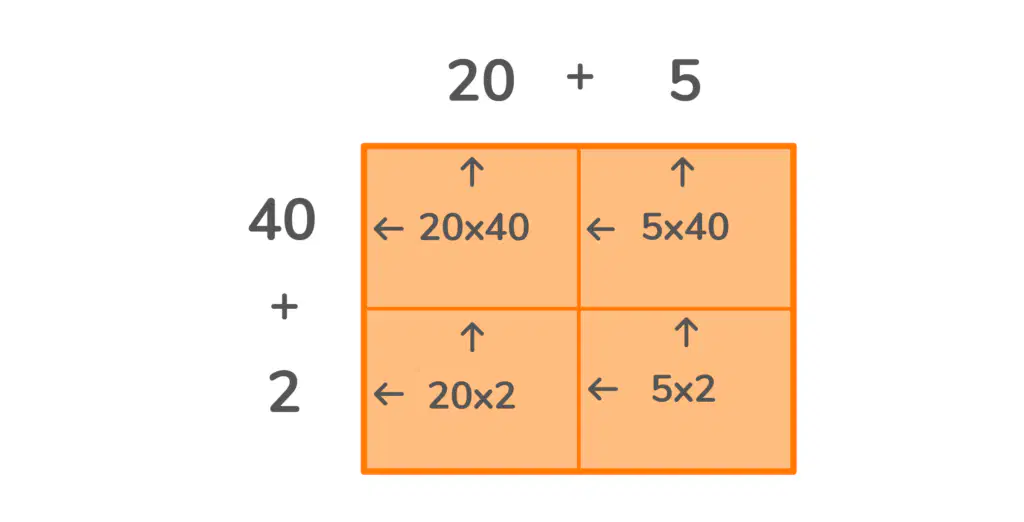
What is the name of the type of multiplication shown in the picture?
area model
partial product
standard algorithm
quotient

What is the name of the type of multiplication at the BOTTOM shown in the picture?
partial products
product
standard algorithm
quotient


What type of angles can be found in a rectangle or square?
right
reflex
straight
acute
obtuse


Name that figure!
acute angle
right angle
obtuse angle
straight angle

