
Font size
 Worksheets
US History 1 Review
Total questions: 75
Worksheet time: 4hrs 35mins
The process where one person or group blends and becomes part of a larger group
cultural diffusion
amalgamation
assimilation
cultural absorption
Which of these did the Homestead Act do?
Allowed settlers to build two-story homes
Allowed settlers to settle into Florida
Allowed settlers to claim 160 acres in the West for free


What does this image say about the control of Standard Oil?
Standard Oil is a monster trying to control the entire USA
Standard Oil is trying to save government from political bosses
Standard Oil is trying to keep government on the right track to benefit laborers
Stand Oil had control over many aspects of government

What does this image say is the controlling factor of decisions by political machines?
resources
influence
power
money

This picture represents Rockefeller's power over what?
oil industry
organized labor
automobile industry
federal government

Standard Oil (Rockefeller) is an example of what?
Vertical Integration
Laissez-faire
Monopoly
Immigration
What was the Progressive Movement?
to reform laws & change society for the better
to go backwards in time
to make things worse
to stop immigration to America
What was a muckraker?
a city street sweeper
a dirty politician
journalist who exposed corruption to the public
a garbage collector
Who was America's first Progressive president?
William McKinley
Theodore Roosevelt
Rutherford B. Hayes
Mrs. Malec
What is a suffragist?
Someone who wants to stop suffering.
Someone who fights to ban monopolies.
Someone who fights for the right to vote.
Someone who wants to end child labor.
What gave women the right to vote?
13th Amendment
14th Amendment
15th Amendment
19th Amendment
What was a settlement house?
a hotel for the wealthy
a community center for the poor and immigrants in cities
a hotel for the city's poor and immigrants
a house on the Great Plains
Which U.S. President was known as the Trustbuster?
Andrew Johnson
Mrs. Tallman
Ulysses S. Grant
Theodore Roosevelt
What law prohibits (or stops) trusts or other businesses from limiting competition?
Sherman Anti-Trust Act
Monopolies Must Go Act
Malec Anti-Monopoly Act
Ross Anti-Big Business Act
What were Jim Crow Laws?
laws that aided in the education of African Americans
laws of segregation against African Americans
laws that helped African Americans get better jobs
laws that helped African Americans vote
Which of the following describes Booker T. Washington?
Born a slave
Promoted higher education for African Americans
accepted social segregation
wrote: Up From Slavery
believed African Americans should put off their demands for civil rights and instead work for economic growth
Which of the following describes W.E.B. DuBois?
Born after the Civil War
Promoted higher education for African Americans
Promoted vocational educaation for African Americans
wrote: The Crisis
believed in full political, civil, and social rights for African Americans

What does this photo illustrate?
desegregation
prohibition
suffrage
Jim Crow Laws
Which person thought African Americans could gain equality by working harder and longer?

Booker T. Washington

W.E.B. DuBois

Ida B. Wells

Homer Plessy
What court decision upheld Jim Crow Laws declaring "separate but equal"?
Plessy v. Ferguson
Brown v. Board of Education
Loving v. Virginia
Dred Scott v. Sandford
Which person fought against the injustices suffered by African Americans by publicizing lynchings in newspapers?

Booker T. Washington

W.E.B. DuBois

Ida B. Wells

Homer Plessy
Jim Crow Laws went directly against two Constitutional Amendments. Which two?
14th
15th
16th
17th
18th
If someone is prevented from voting they are...
disfranchised
unfortunate
disbarred
promoted
Which people formed/founded the NAACP?

Booker T. Washington

W.E.B. DuBois

Ida B. Wells

Homer Plessy
How did Jim Crow Laws affect African Americans in terms of GOVERNMENT?
created separate water fountains
didn't allow white and black children to attend the same school
required seprate by equal restrooms for whites and blacks
imposed impossible voting regulations so African Americans couldn't vote
Which of the following defines Yellow Journalism?
Writing about bad stuff to cause change
Exaggerating events to sell newspapers
Investigative journalism
Reporting only the truth

This type of foreign policy encourages stronger nations to extend their influence over weaker ones.
Imperialism
Isolationism
Globalism
Communism
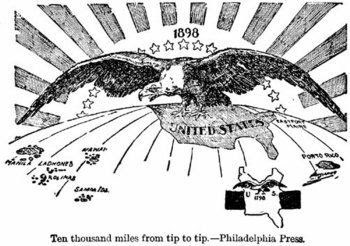
This political cartoon best supports the idea that, after the Spanish American War, the United States became a...
World Power
"Woke" Power
Head of the United Nations
Conquered Nation
America's Great White Fleet was established to do which of the following?
Maintain cleanliness in America's Navy.
Display America's Naval Power to the world.
Encourage countries to declare war on America's Navy.
Conquer the world one ocean at a time.
Which of the following primary source used during the war that helped the United States decision in joining World War I?
They had better weapons.
The Zimmerman Telegram
The Central Powers
Hot Cheetos chip bag
Who was the President During World War 1?
President Barack Obama
President Joe Biden
President George Washington
President Woodrow Wilson
Source 4- What justification does Roosevelt give for helping Great Britain?
That fascism is directly against the principles of democracy and must be fought against at all times.
Supporting Great Britain helps it to remain strong and deal with the war so the US won't have to fight.
Germany has betrayed the trust of the global community and the United States needs to take control as a world leader.
That the crimes against humanity by the Nazis in Europe have made it necessary to do the right thing and become involved.
Multi- Source 7- What actions did the U.S. take in 1940-1941 that would upset Japan at this time?
The US terminated its trade treaty with Japan.
Pres. FDR declared an embargo on trading scrap iron and steel to the Japanese.
The United States loaned millions of dollars to Japan's enemy China to help defend itself.
The United States moved its fleet to Hawaii to serve as a warning to Japan to stop aggressive action.
This was a group of African American settlers who related to the Bible story of Exodus.
Buffalo Soldiers
Cowboys
Miners
Exodusters
Which group of workers were left out of the original celebration of the Transcontinental Railroad?
Chinese
Italian
African Americans
Whites
The Bolshevik Revolution of 1917 was a major turning
point in history because
Russia became the first nation with a
Communist economic system
it was the last revolution in the 20th century
Russia ceased to be an important force in
world affairs
the royal family was exiled to Mexico
A key principle of the economic theory of Communism
is
restoration of a bartering system
organization of workers’ unions
government ownership of property
privatization of business

Laws passed by Congress that made it illegal to criticize the war. Those who participated in anti-war activities faced fines and prison.
War Bonds
Propaganda
Mobilize
Espionage and Sedition Acts
Espionage
The act of being disobedient to an authority figure.
Having no formal government.
The act or practice of spying
Compulsory enrollment in the military; the draft
Schenck v. United States (1919)
The Supreme court case which created the "imminent lawless action" test.
Supreme Court Justice who first used the phrase "yelling fire in a crowded theatre."
The Supreme Court case which established the "clear and present danger" test.
A newspaper publisher who was arrested for publishing "The Left Wing Manifesto".
Which amendment banned the sale, manufacutre and transportation of alcohol (prohibition)?
(a)
What was the french term for "leave it alone"?
Laissez Faire
Credit
Hooverville
Red Scare


The policy of appeasement helped cause World War II because this policy
reduced the armaments of major European powers
gave too much power to the United Nations
increased sea trade between England and the United States
allowed the aggressive actions of Germany to go unchecked
Which agreement was labeled by the Nazis as unfair to Germany?
Treaty of Versailles
Soviet Nonaggression Pact
Munich Pact
Treaty of Brest-Litovsk
Leader of the Soviet Union who signed a pact with Hitler:
Adolf Hitler
Joseph Stalin
Benito Mussolini
Francisco Franco
Dictator of Nazi Germany:
Benito Mussolini
Joseph Stalin
Hideki Tojo
Adolf Hitler
Dictator of Italy:
Benito Mussolini
Joseph Stalin
Adolf Hitler
Hideki Tojo
Which of the following was a punishment inflicted on Germany by the Treaty of Versailles?
Germany had to accept full blame for starting WWI
Germany had to pay reparations
Germany had to give up colonies & land
All of These
What was the initial U.S. response to Japanese aggression in the Pacific?
declare war
drop atomic weapons
oil embargo
ignore it
A law passed in 1941 that allowed the US to ship arms and other supplies without immediate payment to nations fighting the Axis powers.
Cash and Carry
Lend Lease Act
Neutrality Acts
Atlantic Charter
The US program to develop an atomic bomb for use in World War II.
Chicago Project
Bronx Project
Manhattan Project
Los Angeles Project
Policy adopted by the United States in 1939 to preserve neutrality while aiding the Allies. Britain and France could buy goods from the United States if they paid in full and transported them.
Lend Lease Act
Atlantic Charter
Neutrality Act
Cash and Carry
1942 World War II battle between the United States and Japan, a turning point in the war in the Pacific
Battle of Midway
Pearl Harbor
Hiroshima
Battle of the Bulge
Allied invasion of Nazi occupied France on June 6, 1944
P-Day
D-Day
I-Day
B-Day
Forced relocation and incarceration in camps in the interior of the U.S. of between 110,000 and 120,000 people of Japanese ancestry who had lived on the Pacific coast.
Internment of Japanese Americans
Holocaust
Genocide
Trail of Tears
A series of laws created to prevent US arms sales and loans to nations at war.
Cash and Carry
Lend Lease Act
Atlantic Charter
Neutrality Acts
The strategy employed by the United States navy to gain military bases and secure the many small islands in the Pacific.
Island Hopping
Island Vacation
Island Getaway
Island of No Return

