
NEW
Font size
 Worksheets
Review - Physical and Chemical Properties of Matter
Total questions: 40
Worksheet time: 2hrs 50mins
Which of the following describe a physical property of matter?
Sulfur is yellow and smells like rotten eggs.
Sodium reacts with water.
Baking soda creates carbon dioxide bubbles when placed in vinegar.
Iron will rust when exposed to air and water.
Which statement describes a chemical property of the element magnesium?
Magnesium is malleable.
Magnesium conducts electricity.
Magnesium reacts with an acid.
Magnesium has a high boiling point.
Which statement describes a chemical property that can be used to distinguish between compound A and compound B?
A is a blue solid, and B is a white solid.
A has a high melting point, and B has a low melting point.
A dissolves in water, and B does not dissolve in water.
A does not burn in air, and B does burn in air.
The particles of a substance are arranged in a definite shape and are constantly vibrating. This substance can be in
the solid phase, only
the liquid phase, only
either the liquid or the solid phase
neither the liquid nor the solid phase
Which best describes the motion and volume of particles of a substance in a gaseous state?
Particles are freely flowing with a fixed volume.
Particles are vibrating in fixed positions with a definite volume.
Particles are moving quickly past each other to fill the space that is available.
Particles are moving quickly with a definite volume.
Which grouping of the three phases of bromine is listed in order from left to right for increasing distance between bromine molecules?
gas, liquid, solid
liquid, solid, gas
solid, gas, liquid
solid, liquid, gas
The change from liquid to solid, or the reverse of melting, is called
a. condensation
b. boiling
c. sublimation
d. Freezing
The freezing point of water is the same as its
a. melting point.
b. boiling point.
c. sublimation point.
d. evaporation point.
What is vaporization?
a. a gas becoming a liquid
b. a liquid becoming a solid
c. a gas becoming a solid
d. a liquid becoming a gas
The opposite of vaporization is called
a. Condensation
b. Sublimation
c. Evaporation
d. Freezing
Which of the following is an example of condensation?
a. Wet clothes dry outside on the clothesline.
b. Icicles disappear when the temperatures increase.
c. Clouds form in the sky when water vapor cools into liquid.
d. Water vapor in the air becomes frost on the windows.
In which process does a solid change directly into a vapor?
a. Condensation
b. Sublimation
c. Deposition
d. Evaporation
What term describes a process that absorbs energy from its surroundings?
Endothermic
Exothermic
Chemical change
Physical change
Which physical changes are endothermic?
Melting of ice
Freezing of water
Condensation of steam
Deposition of frost on windows
During which type of reaction does a system release energy into its surroundings?
Endothermic
Exothermic
Neutralization
Combustion
During which two processes are exothermic?
Condensation and Freezing
Photosynthesis and Evaporation
Melting and Vaporization
Condensation and Sublimation
The temperature of a substance is a measure of the
average kinetic energy of its particles
average potential energy of its particles
ionization energy of its particles
activation energy of its particles
In which sample of water do the molecules have the highest average kinetic energy?
20 mL at 100°C
20 mL at 80°C
20 mL at 60°C
20 mL at 40°C
Which Kelvin temperature is equal to -73°C?
100 K
173 K
200 K
346 K
If the temperature is 100 Kelvin, what is it in Celsius?
100°C
-100°C
-173°C
-173°C

Base your answers on the graph titled "Heating Curve for H2O". What is the melting point of water?
a. 0°C
b. 100°C
c. -100°C
d. 200°C

Base your answers on the graph titled "Heating Curve for H2O". Which letter represents the boiling point of water?
a. A
b. B
c. C
d. D

Base your answers on the graph titled "Heating Curve for H2O". What is the boiling point of water?
a. 0°C
b. 100°C
c. -100°C
d. 200°C
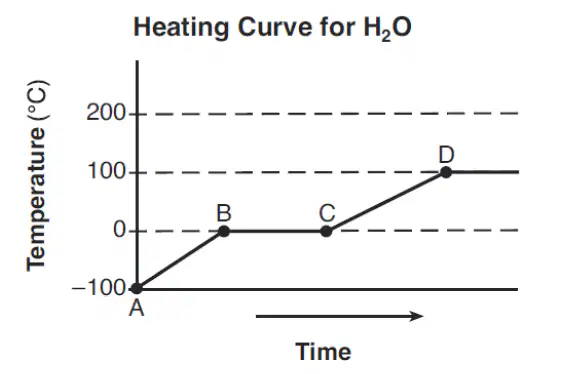
Base your answers on the graph titled "Heating Curve for H2O". Which statement correctly describes the energy of the particles of the sample during interval BC?
a. Potential energy decreases and average kinetic energy increases
b. Potential energy increases and average kinetic energy increases
c. Potential energy increases and average kinetic energy remains the same
d. Potential energy remains the same and average kinetic energy increases

Base your answers on the graph titled "Heating Curve for H2O". What state(s) of matter are present during the interval CD?
a. Solid, only
b. Solid and liquid
c. Liquid, only
d. Liquid and gas
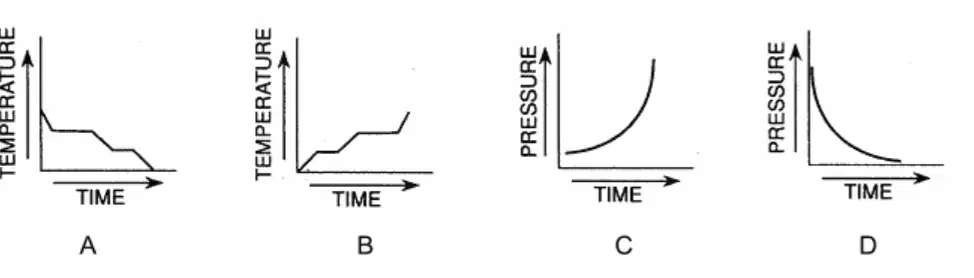
Which graph best represents a change of phase from a gas to a solid?
A
B
C
D
Which set of procedures and observations indicates a chemical change?
a. Ethanol is added to an empty beaker and the ethanol eventually disappears.
b. A solid is gently heated in a crucible and the solid slowly turns to liquid.
c. Large crystals are crushed with a mortar and pestle and become powder.
d. A cool, shiny metal is added to water in a beaker and rapid bubbling occurs.
Which of the following represent a physical change?
a. A slice of apple turns brown when exposed to air.
b. The metal on your bicycle rusts when it is left outside in the rain.
c. Wood burning to produce heat and smoke.
d. Water boiling in a pot on the stove.

Which statement describes the type of change and the chemical properties of the product and reactants given the balanced particle-diagram equation?
a. The equation represents a physical change, with the product and reactants having different chemical properties.
b. The equation represents a physical change, with the product and reactants having identical chemical properties.
c. The equation represents a chemical change, with the product and reactants having different chemical properties.
d. The equation represents a chemical change, with the product and reactants having identical chemical properties.
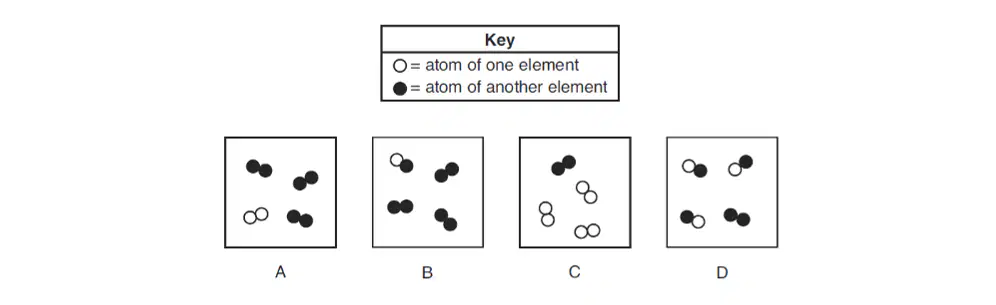
The models below represent different mixtures of elements and compounds. Which two particle diagrams represent mixtures of diatomic elements?
A and B
A and C
B and C
B and D
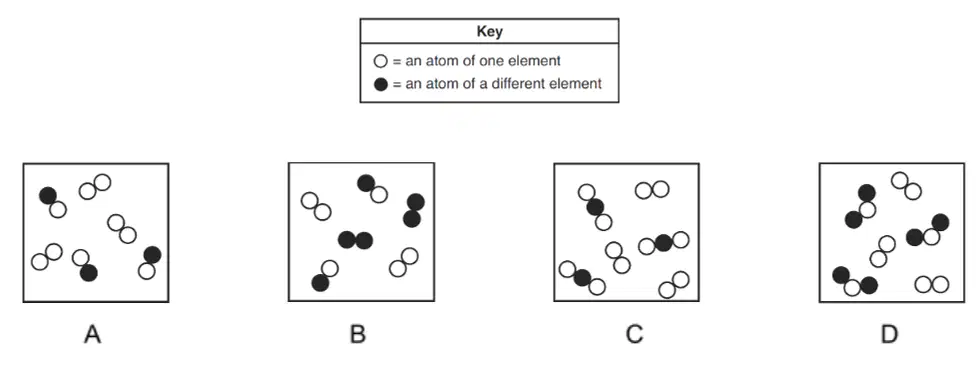
The models below represent different mixtures of elements and compounds. Which particle diagram represents a mixture of three substances?
A
B
C
D
Which must be a mixture of substances?
Solution
Compound
Element
Pure Substance
Which of these terms refers to matter that could be heterogeneous?
Element
Mixture
Compound
Solution
Which statement is an identifying characteristic of a mixture?
A mixture can consist of a single element.
A mixture can be separated by physical means.
A mixture must have a definite composition by weight.
A mixture must be homogeneous.
Which statement describes a mixture of sand and water at room temperature?
It is heterogeneous, and its components are in the same phase.
It is heterogeneous, and its components are in different phases.
It is homogeneous, and its components are in the same phase.
It is homogeneous, and its components are in different phases.
Which of the following substances can not be broken down through physical processes?
A 10 gram sample of copper
A solution of NaCl and water
A 10 gram sample of brass
A mixture of sand and water

Which of the following types of matter correctly describes these substances?
Element
Diatomic element
Compound
Mixture

