
Font size
 Worksheets
Last Quiz
Total questions: 35
Worksheet time: 35mins
what is output :
import numpy
speed = [99,86,87,88,111,86,103,87,94,78,77,85,86]
x = numpy.mean(speed) print(x)
y = numpy.median(speed) print(y)
z = stats.mode(speed) print(z)
(a)
Regression is
Supervised
un Supervised
rain forsment
Logistic Regression is
Regression
Classification
Regression data is
continuous data
category data
Classification data is
continuous data
category data
when learning rate almost to zero
in gradient descent Equation ??
Maximum iterations
Minimum iterations
Machine learning models should work automatically without the need for the
user to manually set the hyperparameters.
True
False
While training your regression model using Gradient Decent, you noticed that the
value of loss increases with epochs, this behavior can be due to high learning
rate.
True
False
Cleaning Empty Cells which function we use ?
df.dropna()
df.fillna(130, inplace = True)
df.loc[7, 'Duration'] = 45
A & B
Non of them
Removing Duplicates which function we use ?
df.dropna()
df.fillna(130, inplace = True)
df.loc[7, 'Duration'] = 45
A & B
NON of them
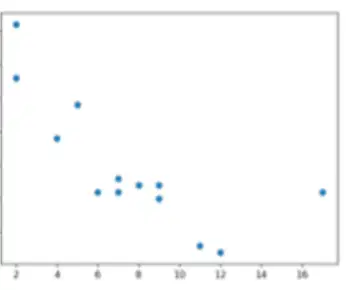
Draw: underfitting regression
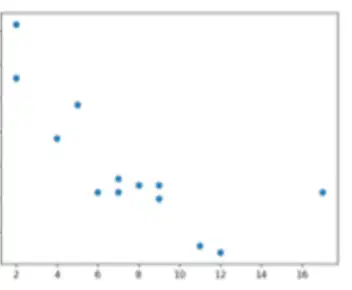
Draw: overfitting regression
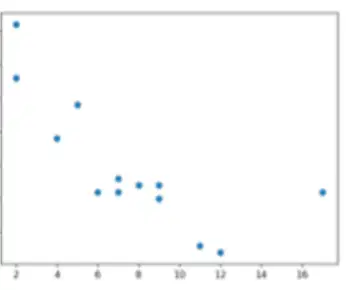
Draw: Liner regression
Draw: Multiple regression

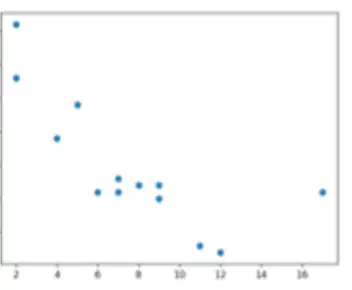
Draw : Polynomial regression
which Equation is polynomial regreesion
y=Ax+B
y=Ax1+Bx2+c
y=Ax1+Bx2^2+c
e ^ -x
Stochastic Gradient Descent (SGD) needs to go through the individual data
samples to update the model parameters.
True
False
While training your regression model using Gradient Decent, you noticed that the
value of loss increases with epochs, this behavior can be due to high learning
rate.
True
False
If you would run 5-fold cross validation on a dataset of 1000 examples, you will
need (a) examples for the validation set in each run.
Mention reasons for overfitting ??
increase the model complexity (order of the hypothesis function)
Increase number of used features
Use small training dataset
B&C
all of them
Ridge regression ?? && Lasso regression ??
L2 , L1
L1 , L2
The ... problem occurs when the model performs well in the training set, but badly in the test set.
(a)
The learning rate is (a)
The mean square error function is used to solve the ....... problem.
Regression
Classification
A&B
Non of them
(a) learning is an area of machine learning concerned with how agents ought to take actions
in an environment to maximize some notion of cumulative reward.
(a) algorithm is used to reduce the loss function
The output range of sigmoid activation function ??
[-1,1]
[0,1]
nothing of them
The output range of SVM function ??
[-1,1]
[0,1]
nothing of them
The output range of tradtional activation function ??
[-1,1]
[0,1]
nothing of them
The goal of Regularization is reduce ...... error
generalization
Validation
training
(a) is a method for solving for the regression model parameters analytically.
If you would run 10-fold cross validation on a dataset of 100 examples, how many
examples you will need for the training set in each run?
(a)
In Stochastic Gradient Descent used for optimizing your regression model, the model's
parameters would be updated after ..... training examples.
one
m
all
You observe the following while fitting a linear regression to the data; As you
increase the model complexity, the test error increases and the training error
decreases. What do you think is the main reason behind this behavior?
(a)
Which of the following statement(s) is/are true for batch Gradient Decent (GD)?
1) You update a set of parameters in an iterative manner to maximize the error
function.
2) You have not to run through all the samples in your training set for a single update
of a parameter in each iteration.
Only 1
Only 2
1 & 2
Both is error

