
 Worksheets
2024 ENGL 1102 Final Exam
Total questions: 72
Worksheet time: 36mins
From whom is Grendel descended?
God
Cain
Able
What reason does Beowulf want to be a hero?
To have money and treasure
To be king
To have glory
To marry a queen
Whale-road is an example of:
alliteration
kenning
simile
hyperbole
Why is Beowulf an epic poem?
it's a long, narrative poem which begins in Media Res; has a large, vast setting
Outstanding hero who has superhuman courage.
Universal ideas such as good and evil
Written in heightened poetic language.
All of the above.
Which of the following is not a characteristic of an epic?
It is a story that is told that is told in a serious manner
It uses elevated language.
It uses plain, straightforward language.
It depicts a hero battling forces that threaten in the world order.
A mentor or a helper is...
A character that becomes known to the hero as an expert in which the hero needs help in.
A character that understands why the hero wants to save the world, but doesn't get involved.
A character that makes fun of the hero.
A character who cries constantly.
The person who who advises hero, preps for quest & develops special skills is called
a friend
a priest
a mentor
a trickster

What language did the Anglo- Saxons speak?
Old English
Spanish
Romanian
Beowulf is the earliest known English ____________.
Who is the only one who comes to help Beowulf against the dragon?
Wiglaf
Brecca
Unferth
Higlac
The pilgrims are traveling to Canterbury because —
the shrine of St. Thomas à Becket is there
they want to escape the plague that is attacking London
the innkeeper has dared them to make the journey
it is part of a longer tour of England
You know the Cook’s dishes may not be quite as appetizing as might be hoped when Chaucer mentions that the Cook —
refuses to consult recipe books
has a large, festering sore
adds too much salt to his cake
burns everything he makes
The Wife of Bath is a —
pious churchgoer and religious teacher
well-traveled vendor of fine silk clothing
veteran of several pilgrimages and marriages
widow of a prosperous doctor in Bath
Which member of the clergy is actually a good person?
The Nun
The Friar
The Parson
The Monk
Who is the author of The Canterbury Tales?
King Arthur
Geoffrey Chaucer
Geoffrey of Monmouth
Chaunticleer
Why are The Canterbury Tales considered an important historical literary work?
The descriptions of the characters provides a picture of what the people were actually like at the time.
The work won all the literary awards of the time period.
The tales document the history of major Scottish events.
It is the only literary work translated from Latin.
What is the setting of the Wife of Bath’s story?
Britain during the time of King Arthur
Canterbury during Chaucer’s lifetime
the land of the Elf-Queen in days of yore
the Caucasus during the reign of Boethius
The stories from The Canterbury Tales were originally written in -
Old English
French
Middle English
Elizabethan English
The gallantry, honor, and courtesy expected of knight is called -
mace
jousting
chainmail
chivalry

True or False: All the tales narrated by the various pilgrims are the inner frame stories.
True
False

An allegory is a story in which:
Characters, setting and actions stand for something beyond their literal meaning
a story in which characters, settings, and symbols have magical powers
a story in which characters, settings, and symbols have new definitions
a story in which characters, settings, and symbols know one another
The characters in The Canterbury Tales represent the three estates:
The women, the men, and the children.
The royalty, the nobility, and the workers.
The nobility, the clergy, and the commoners.
The pilgrims, the farmers, and the city folks.
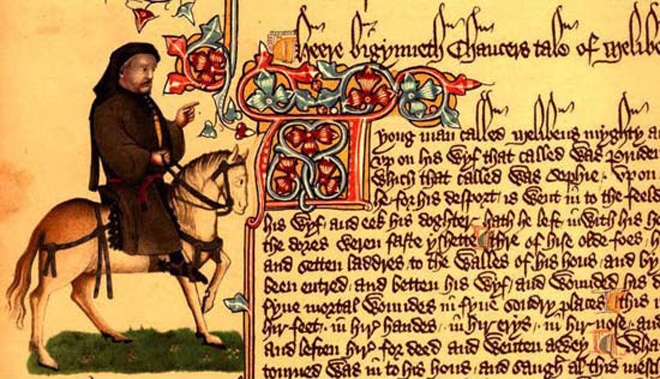
Thomas a Becket was
a Catholic priest
the Archbishop of Canterbury
a former friend of King Henry II
all of the above
When an author places two characters in a story side by side to show an exaggerated contrast (difference), this is called a(n):
soliloquy
foil
pun
dramatic irony
Dramatic irony is when:
something happens that is the opposite of what you would expect to happen
something funny happens after something sad
the audience/reader knows something that the character does not
a character is alone on stage and expresses his/her thoughts out loud
A theme of Othello is:
True love can never be shattered.
Jealousy is a powerful emotion that can destroy lives.
Good always wins in the end.
Be careful what you wish for because you just might get it.
Identify the rhetorical appeal being used in the following scenario: Iago telling Roderigo that he himself has license to criticize and hate Othello because of how long they have worked together.
logos
ethos
pathos
Identify the rhetorical appeal being used in the following scenario: Iago using reverse psychology on Othello to make him think about Cassio and Desdemona even more.
logos
ethos
pathos
"Vanish into thin air" comes from Othello.
We use this phrase today to mean:
go on a hot air balloon ride
fly into the open sky
completely disappear without a trace
evaporate
Othello's tragic flaw is:
Ambition
Jealousy
Pride
Prejudice
Who kills Othello?
Iago
Cassio
Brabantio
Othello
A short speech spoken by an actor directly to the audience but unheard by other actors on the stage
aside
rationale
blocking
dramatic irony
Which characters from Othello are the best example of foils?
Desdemona/
Emilia
Cassio/ Roderigo
Othello/ Iago
Brabantio/ Lodovico
A long speech to the audience:
aside
monologue
soliloquy
Shakespeare's plays fall into three genres:
comedies, tragedies, and romances
romances, tragedies, histories
histories, mysteries, romances
comedies, tragedies, histories
If Shakespeare didn't have a word to express what he wanted to say, he . . .
made up a new one!
Googled it.
consulted the only dictionary in town.
asked his wife.

What group of actors did Shakespeare work with first in his career?
The Queen's Men
The Lord Chamberlain's Men
The King's Actors
The Queen's Acting Company

Who was one of Shakespeare's greatest supporters?
King Richard VIII
Queen Elizabeth II
King Richard the Lion Heart
Queen Elizabeth I

What do we find out is O’Brien’s job?
Agent of the Thought Police.
Agent of the Newspeak Dictionary.
Agent of Goldstein's Army.
Agent of the Eurasian Forces.

What is the Party’s only goal?
Limitless power and control
No power at all
Complete anarchy
Freedom for all people

It is not sufficient to obey Big Brother; Winston must ______ Big Brother.
hate
love
like
admire
What is the name of the ideology that controls Oceania in the novel 1984?
Democratic
Totalitarian
Socialist
Fascist
What is the term used in Newspeak to hold two conflicting beliefs and consider both as equal?
Thoughtcrime
Doublethink
Duckspeak
Black/White
What is the main attribute of Oceania in controlling information to such an extent that facts are not reality?
Censorship
Mass atrocities
Class division
Technological differences
The note from the dark haired girl makes Winston feel
Violent - he wants to tie her up and shoot arrows at her
Hopeful - he has a sudden desire to stay alive and live a fuller life
Angry - he is mad and dismayed that she has singled him out
Scared - her note indicates that she has told The Party about his diary
Winston believes that he had a part in killing his mother and younger sister. What does he believe he did to cause this?
He told The Party that his mother should be sent to a forced labor camp
He refused to contribute his rations to the household and later abandoned them
He became separated from his mother and sister during an air raid and never went back to look for them
He stole food out of his sister's hand, ran out of the house and didn't return to the house for hours
Where is the telescreen in the secret room hidden?
behind the picture of the church
underneath the glass paperweight
behind the bed frame
behind the curtain next to the room's only window

When was the novel 1984 written?
1984
1849
1948
1894

What does dystopia mean?
society that possesses highly desirable or nearly perfect qualities for its citizens.
society in which there is great suffering or injustice, typically one that is totalitarian or post-apocalyptic.
society in which everyone eats pizza everyday for breakfast, lunch and dinner.
What is the goal of Newspeak?
to make new words
to restrict thought
to make it easier to talk to people
to annoy Some
Who does Winston think can rebel but doesn't?
proles
inner party
Big Brother
Parsons
How can the the party watch the citizens in their home?
Telephone
Cell phones
Telescreen
Yo mama
How does Winston commit a crime in the first two chapters?
writes in a diary
kills a man
participates in the Two Minute Hate
Who is the author of Sherlock Holmes?
William Shakespeare
Sir Arthur Conan Doyle
Tavion Holloway
Charles Dickens
Who is Sherlock Holmes's great friend?
John Straker
Adriana
James Moriarty
Dr. Watson
How did Sherlock Holmes deduce that the young lady arrived by train?
He saw mud splatters on her clothing
He observed her disheveled appearance
He noticed the train schedule in her bag
He saw the second half of a return ticket in her glove
Why did the young lady and her sister always lock their doors at night?
To keep out intruders
To protect themselves from the cheetah and baboon
To prevent their stepfather from entering
To ensure their own safety
What did Holmes say was something that threw his investigation off and puzzled him at the beginning of the mystery?
The house bell in the room.
The behavior that Dr. Roylott displayed towards Holmes.
The house that Helen liven in.
The gipsies and Julia's use of the word "band".

