
Font size
 Worksheets
World War II: Prelude and Outbreak
Total questions: 23
Worksheet time: 17mins
How did the results of World War I cause World War II?
The League of Nations declared war on Italy because World War I created problems between Germany and Italy.
The war debt from World War I that Germany had to pay was one of the causes of the political and economic instability in Europe.
President Wilson's peace plan called for the invasion of Germany if the country failed to pay its war debt.
When Great Britain was blamed for World War I, Great Britain invaded France to demand payment for the war.
What was the consequence of the global economic collapse in the late 1920s for Germany?
Strengthening of the Weimar Republic
Increased popularity of the Nazi Party
Decreased military spending
Alliance with Britain and France
What was the main reason Britain and France declared war on Germany?
Germany's economic collapse
The Munich Agreement failure
Hitler's book Mein Kampf
Germany's invasion of Poland
Which country did Hitler aim to make strong again and regain lost territories?
Austria
France
Germany
Poland
Which treaty limited Germany's military capabilities after World War I?
Treaty of Versailles
Treaty of Munich
Treaty of Berlin
Treaty of Paris
What was Hitler's reaction when Britain declared war in 1939?
He surrendered immediately
He was pleased
He was surprised and angered
He was indifferent
Who was the British Prime Minister who met with Hitler to try to avoid war?
Neville Chamberlain
Joseph Stalin
Franklin D. Roosevelt
Winston Churchill
What event in 1939 marked the beginning of the Second World War?
Hitler's invasion of Poland
The Munich Agreement
The signing of the Treaty of Versailles
The formation of the Nazi Party
What was the primary goal of the Munich Agreement?
To end World War I
To start World War II
To expand Germany's borders
To find a peaceful solution to territorial disputes
What did Hitler violate that led to the annexation of Sudetenland?
Non-aggression pact with Poland
The Treaty of Versailles
The Munich Agreement
Economic agreements with Britain
Which of the following is a cause of WWII?
European democracies encouraged Hitler to rearm Germany.
The US was unsuccessful in stopping Soviet expansion peacefully.
The US continued involvement in Europe after WWI, causing mistrust.
The Treaty of Versailles created bitterness and resentment.
Analyze the long-term effects of the Treaty of Versailles on Germany's political landscape leading up to World War II.
It had little to no effect on Germany's politics.
It led to economic prosperity in Germany.
It created political instability and contributed to the rise of extremism.
It strengthened Germany's alliances with neighboring countries.
What was a major cause of World War II?
The signing of the Treaty of Versailles
The invention of the airplane
The discovery of penicillin
The start of the Industrial Revolution
What was the main reason for the United States to enter World War II?
The invasion of Poland
The bombing of Pearl Harbor
The Battle of Britain
The signing of the Axis Pact
What was the main goal of Adolf Hitler's foreign policy?
To establish a lasting peace in Europe
To create a union of socialist states
To expand German territory and undo the Treaty of Versailles
To promote democracy in neighboring countries
What policy did Britain and France follow in an attempt to prevent World War 2?
Isolationism
Appeasement
Militarism
Totalitarianism
The policy of appeasement helped cause World War II because this policy
reduced the armaments of major European powers
gave too much power to the United Nations
increased sea trade between England and the United States
allowed the aggressive actions of Germany to go unchecked
When was Hitler's surprise attack on Poland?
dawn September 1, 1989
dawn September 1, 1939
dawn September 1, 1739
dawn September 1, 1639
Atatürk’s Fashion Police
Turkey’s restrictions on wearing overtly religious-oriented attire are rooted in the founding of the modern, secular Turkish state, when the republic’s founding father, Mustafa Kemal Atatürk, introduced a series of clothing regulations designed to keep religious symbolism out of the civil service. The regulations were part of a sweeping series of reforms that altered virtually every aspect of Turkish life—from the civil code to the alphabet to education to social integration of the sexes.
The Western dress code at that time, though, was aimed at men. The fez—the short, conical, red-felt cap that had been in vogue [fashion] in Turkey since the Ottoman Sultan Mahmud II made it part of the official national attire in 1826—was banished. Atatürk himself famously adopted a Panama hat to accent his Western style gray linen suit, shirt, and tie when he toured the country in the summer of 1925 to sell his new ideas to a deeply conservative population. That autumn, the Hat Law of 1925 was passed, making European-style men’s headwear de rigueur [fashionable] and punishing fez-wearers with lengthy sentences of imprisonment at hard labor, and even a few hangings. . . .
— Roff Smith, “Why Turkey Lifted Its Ban on the Islamic Headscarf,” National Geographic, October 12, 2013
According to this article by Roff Smith, the goal of Atatürk’s reforms was to
prevent the elimination of the civil service system
implement a legal system based on religious teachings
revive Turkey’s interest in Ottoman-era customs
modernize Turkey in the image of European nations
The phrases “deeply conservative population,” “lengthy sentences of imprisonment,” and “a few hangings” suggest that
Atatürk’s reforms were eagerly embraced throughout Turkey
tensions existed between reformers and traditionalists in Turkey
the policy of westernization was abandoned by the Turkish government
most Turks preferred punishment to rapid change
“Stalin Solidifies Power for Communists”
“Adolf Hitler Declares Third Reich”
“Mussolini Establishes Fascist State”
Which situation was most responsible for the rise of the political systems referred to in these headlines?
emergence of the United States as a world power
worldwide economic instability
What is a common characteristic of the political systems represented in these headlines?
multinationalism
humanitarianism
capitalism
totalitarianism
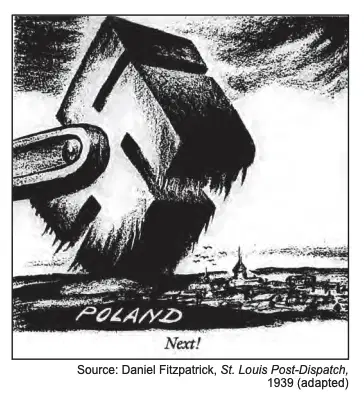
Which term is most closely associated with the event shown in this cartoon?
disarmament
Holodomor
blitzkrieg
containment

