
 Worksheets
Science MAP Review
Total questions: 45
Worksheet time: 2hrs 41mins
Match the following
gas
no definite shape or volume
liquid
no definite shape, definite volume
solid
definite shape and volume
Match the following
mass
amount of material in a substance
matter
substance that has both mass and volume
mixture
2 substances physically combined
volume
amount of space an object takes up
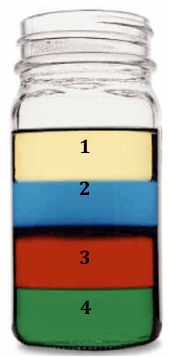

Which column headings should the students use for their table?


The table lists some physical properties of two objects...
Based on their properties, which of the objects is most likely a metal?
Object 1, because it is a solid that is less dense than water
Object 2, because all metals float in water
Object 2, because metals conduct thermal energy and electricity
Object 1, because it can be used to provide insulation for thermal energy

Yohana stirs 15 grams of each substance listed below into 200 milliliters of water to form four different mixtures. Yohana then tries to separate the water from each mixture by pouring the mixture through a kitchen tea strainer. Which mixture can Yohana separate most easily with the strainer?
Salt and water
Gravel and water
Shampoo and water
Sugar and water

A student places 250 g samples of clay, sand, gravel, and silt in separate flower pots. The pots are set on a wire rack, and dishes are placed beneath the pots so that water can drip through holes and collect. The student then pours 100 mL of water over the sample in each pot. The student measures the time it takes for water to begin dripping from the bottom of each pot.What property of soils is the student most likely examining with this procedure?
The amount of time it takes different soils to dry
How well different soils retain water
How much water is needed to dissolve different soils
The differences in texture between wet and dry soils

A student helped his father prepare soup for dinner. His father asked him to use a wooden spoon to stir the soup as it heated.
Why would the student's father ask him to use a wooden spoon?
The wooden spoon is able to float in the soup
the wooden spoon is able to sink in the soup
the wooden spoon is a good conductor of thermal energy
The wooden spoon is a good insulator of thermal energy
Which object shows an energy transformation from electrical to mechanical?


Elijah is making a trivet. A trivet is placed on a table beneath a hot pot.
He knows that he must choose something that will NOT allow heat to pass easily from the hot pot to the table. Which material should Elijah use to make the trivet?
Wood
Aluminum
Copper
Silicon

The diagram shows an electrical circuit with a buzzer. The students noticed that the buzzer was not making any sounds. What could be done to this circuit to make the buzzer work?
Add another battery to the circuit.
Replace the buzzer with a smaller one.
Close the switch to complete the circuit.
Switch the wires to get a better connection.

A diagram of a circuit is shown on the right. When the switch is closed, all three lightbulbs light up, but the bell does not ring. What is the best explanation for the bell not ringing?
Electrical circuits cannot be used to ring bells.
The lightbulbs use up all the energy before it gets to the bell.
There is no switch between the battery and the bell.
The bell is not connected to the circuit with a complete path.

The diagram shows an electrical circuit. What object could be placed in the open space between the wires to complete the circuit?
Penny
Toothpick
Eraser
Crayon
Students conducted an investigation in which they measured the distance a toy car traveled after rolling down a ramp covered with sandpaper or wax paper. Which of these questions can the students answer by analyzing the results of their investigation?
How does changing the height of a ramp affect the distance of toy car rolls?
How does changing the surface of a ramp affect the distance of toy car rolls?
How does mass affect the distance of toy car moves after rolling down a ramp?
How does the design of a toy car affect its movement after rolling down a ramp?
If a student has two magnets, how might it be determined which magnet is stronger?
measure the length and mass of both magnets
submerge each magnet in a bowl of water
examine each magnet to determine the north pole
count how many paper clips each magnet can lift

Marissa grows tow marigold plants in two hanging pots. She plants one marigold upright and she plants the other upside down, as seen in the picture above. Both marigold roots grow downward. What evidence could Marissa use to support the claim that gravitational force affects the motion of an object?
The roots grow downward because the plants are hanging from a hook.
The roots grow downward because they are affected by the force of gravity.
The roots grow downward because they are trying to reach the air below the pots.
The roots grow downward because the plants are up in the air and the roots are trying to get to the ground.
Which of these is NOT an example of deposition?
Renewable
Materials from Earth that can be replaced by nature within a relatively short period of time
Non renewable
resources that cannot be replaced by natural processes within a lifetime
Conservation
The protection of resources and avoidance of wasteful and destructive use.

What most likely happened to the dead plants and animals?
They were eaten by scavengers.
They were washed away by water.
They became fossil fuels.
They became an underground aquifer.

The pictures show a forest before and after deforestation, a process where many trees are cut down.
Which of the following best explains why trees are called a renewable resources?
If a tree is cut down, a new tree can be planted in its place.
If a tree is cut down, the animals that depended on the tree will help the tree grow back.
Only humans use trees, so tree populations will never fall below the number that are needed.
Only paper is made from trees, so the tree population will never run out.
What is it called when an object is spinning on its axis?
Axis
Rotation
Revolution
Constellation
What is the movement of one object around another object called?
Rotation
Axis
Constellation
Revolution
Which of the following best describes why the Earth has four seasons?
The Sun is closer to the Earth during summer and farther away during Winter.
The Sun shines directly onto the equator all year long.
The tilt of the Earth is the main reason for the seasons.
The movement of water through the water cycle is the main reason for seasons.

Which of the following completes the lunar cycle?


The picture shows the position of the Sun, Earth, and the Moon on one night.
What moon phase did people on Earth see on this night?
New moon
First quarter
Full moon
Third quarter

What time of day is the shadow most likely occurring? (a)

A diagram of the water cycle is shown below.
What important form of energy, needed for evaporation, is missing from the water cycle diagram?
Thermal energy from the ground
Potential energy from falling precipitation
Solar energy from the Sun
Chemical energy released from plants during photosynthesis

The graph shows the amount of daylight during different months. Which season tends to have the shortest periods of daylight?
Fall
Winter
Spring
Summer
Which table correctly classifies statements about weather and climate?


What type of front is currently passing over Dallas, TX? (a)

The populations of which organisms will most likely increase as a result of a disease that suddenly reduced the population of Texas horned lizards?
Grasses and ants
Ants and grasshoppers
Grasshoppers and Texas Cottonmouths
Texas cottonmouths and red shouldered hawks

This food web represents organisms in a field. What role do raccoons play in this food web? (5.9B)
Prey
Producer
Decomposer
Consumer

The colors & patterns on a turtles shell help it blend in with the forest floor. This is:
Hibernation
Habitat
Ecosystem
Camouflage
What is an adaptation?
A physical feature or behavior that helps living things survive.
The food that an animal eats.
A place where an animal lives
How animals evolve throughout time.
Eagles catch fish in rivers with their talons. They fly with the fish to a tree branch and tear the fish into small pieces. Which bird most likely catches and eats it food the way an eagle does? (5.10A)


The whiskers of a river otter and the antennae of a cockroach are shown here. How do structures such as whiskers and antennae benefit organisms? (5.10A)
They help the organisms detect their surroundings.
They help the organisms eat food quickly.
They help the organisms fight predators.
None of these

During science class, students were asked to observe the cactus plant at the front of the classroom and record their observations. Which of the following student observations is NOT an inherited trait of the cactus?
The cactus is in a brown pot.
The cactus is green.
The cactus has sharp spines on it.
The cactus has a waxy covering on the stem.

Fox squirrels live in the trees of city parks throughout Texas. Each spring they build nests of twigs and leaves in the tops of the trees. Fox squirrels are often found near park benches, waiting to be fed by visitors. For fox squirrels, which of these is a learned behavior? (5.10B)
Building a nest each spring
Taking food from people
Having a long, bushy tail
Having sharp claws
Which of these is a learned behavior of a dog? (5.10B)
Begging for food
Drinking water
Panting on a hot day
Chewing on a bone

Lacewings are insects that hatch from eggs. Which of these correctly compares the LACEWING life cycle with the FROG life cycle?
Adult lacewings lay eggs, but adult frogs give birth to live larvae.
When they hatch, young lacewings and young frogs look different from their adult forms.
When they hatch, both lacewings and frogs have long legs for jumping.
Both adult lacewings and adult frogs have more legs than they had as larvae.
Reorder the following, starting with a sprouting seed.


Reorder the following, starting with frog eggs.



