
 Worksheets
Test 4 REVIEW
Total questions: 80
Worksheet time: 4hrs 7mins
Which of the following functions are NOT polynomial functions?
f(x)=x2+2
f(x)=3x−2x+x
f(x)=3x2−x2
f(x)=12−x4+3x−2
f(x)=3x11−2x13
Which expression simplifies to a quadratic binomial?
(3x2−5a−1)+(2a+7a−1)
(2x−5)(2x+5)
(x2+1)2
3x26x6−3x
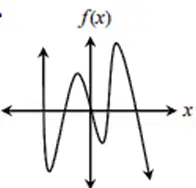
Which of the following descriptions is not true about the polynomial?
Fifth Degree polynomial
Sixth Degree Polynomial
... has negative coefficient
Odd Degree polynomial
By inspection, which of the following best describes the graph of the polynomial function y=x3−4x2+3x−12 ?
Graph falls to the left and rises to the right.
Graph rises to the left and falls to the right.
Graph rises on both sides.
Graph falls on both sides.
How do you describe the behavior of the graph if the degree is even and the leading coefficient is negative?
The graph rises to the left and falls to the right.
The graph falls to the left and rises to the right.
The graph falls on both sides.
The graph rises on both sides.
By inspection, where is the turning point of the graph of f(x)=x4+1 located on the cartesian plane?
Hint: solve for x-intercepts and observe end behavior
above the x-axis
below the x-axis
on the x-axis
on the y-axis
Determine the remainder of (9x2−6x+2) divided by x−3 .
If ( p(x) ) is divided by ( (2x - 1) ) using synthetic division, the value indicator to be used will be equal to ________.
If ( p(a) ) is divided by (a+1) , and the remainder is equal to zero, then (a+1) is a (a) of p(a).
What is the degree of f(x)=(x+3)(x−4)2(x+1)5?
Which factor in f(x)=(x+3)(x−4)2(x+1)5 has a multiplicity of 5?
(x + 3)
(x - 4)
(x + 1)
Which of the following is a true statement about the graph of (p(x)=(x−4)(x+2)(3x2+6x)?
The graph crosses the x-axis four times and is never tangent to the x-axis.
The graph crosses the x-axis three times and is never tangent to the x-axis.
The graph crosses the x-axis twice and is tangent to the x-axis once.
The graph crosses the x-axis three times and is tangent to the x-axis once.
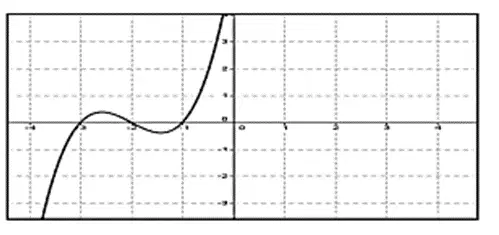
Write the polynomial function with the least degree in factored form (whose a =1) that is represented by the given graph.
What are the x-intercepts of the graph of y=(x−3)(x+1)(x−1)?
x = { (a) }
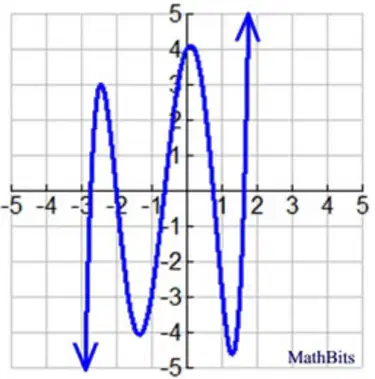
A fifth degree polynomial function is shown below. Which of the statements are NOT true about this function?
Leading coefficient is positive
Only two relative maximums
Only two intervals of increasing
Positive from
x = -2 to x = 1.75
Exactly 5 zeros
Which zero will "bounce" off of the x-axis for x(x - 1)2(x + 2)(x + 3)
-1
1
-2
-3

What degree is the graphed polynomial?
Even positive a value
Odd positive a value
Even negative a value
Odd negative a value

For the pictured polynomial, how many relative minimas are there?
1
2
3
4


For the pictured polynomial, determine in (x,y) the absolute maximum point.
(a)

Which root has a multiplicity of 2?
(provide the value only)

On the interval of (0, 2) what is happening?
the graph is decreasing
the graph is increasing
the graph remains constant
Complete the table for Q2:

What is the end behavior of this function: f(x)=−2x7−3x4+7
As x →−∞, f(x) →−∞ As x→+∞, f(x)→+∞
As x→−∞, f(x)→−∞ As x→+∞, f(x)→−∞
As x→−∞, f(x)→+∞
As x→−∞, f(x)→+∞
As x→+∞, f(x)→+∞
What is the end behavior of this function: f(x)=−2x6+7x2−8
As x →−∞, f(x) →−∞
As x→+∞, f(x)→+∞
As x→−∞, f(x)→−∞
As x→+∞, f(x)→−∞
As x→−∞, f(x)→+∞
As x→+∞, f(x)→−∞
As x→−∞, f(x)→+∞
As x→+∞, f(x)→+∞

Abigail is tracking the height of a ball thrown into the air. The graph shows the ball's height over time. Identify the y-intercept of the graph.
(0, -3)
(0, 1)
(0, 3)
(2, 1)

Find the decreasing interval
(-1, infinity)
(-infinity, -1)
(-infinity, 4)
(4, infinity)
Write this polynomial in standard form:
100a+45a2−14a3−54a7
f(x)= x3 -6x2 +3x +10?
(x3 +7x2 +7x -15) ÷ (x -1)?
Match the following appropriately.
It is important you can recognize the connection between factors and solutions.
x + 3 is a factor of p(x).
-3 is a solution of p(x).
x - 5 is a factor of p(x).
5 is a solution of p(x).
3x - 5 is a factor of p(x).
5/3 is a solution of p(x).
x + 5 is a factor of p(x).
-5 is a solution of p(x).
If (x−4) is NOT a factor of f(x), then...
f(4)=0
f(−4)=0
f(4)=0
f(−4)=0

Which of the following shows the correct set up to prove that an x-intercept is a solution?
f(x) = x2+2x−3(−3)2+2(−3)−3 and (1)2+2(1)−3
(3)2+2(3)−3 and (−1)2+2(−1)−3
(−3)2+2(−3)−3 and (−1)2+2(−1)−3
(3)2+2(3)−3 and (1)2+2(1)−3
zeros of the polynomial
y = 3(x + 4)(x + 1)(x - 3)?
y = (x + 2)(x - 7)3
Divide: 2x+56x2+7x−20
6x2−8x
6x−8
3x−4
3x2−4x
Divide: 2x−32x4−9x3+21x2−26x+12
x3−3x2+6x−4
2x3−6x2+12x−8
x4−3x3+6x2−4x
2x4−6x3+12x2−8x
Divide: x−23x3−4x2−9x+10
3x2+2x−5
3x3+2x2−5x
3x2−10x−29−x−248
3x2−10x−29+x−248
Is (x−2) a factor of f(x)=x3−8x2+14x−4 ?
Yes, (x-2) is a factor.
There is a remainder.
No, (x-2) is not a factor.
The remainder is zero.
Yes, (x-2) is a factor.
The remainder is zero.
No, (x-2) is not a factor.
There is a remainder.
What should be the correct order of the coefficients when setting up synthetic division for (3x−4x3+6x4+1)÷(x+3) ?
3 0 -4 6 1
6 -4 3 1 0
6 -4 0 3 1
-6 4 0 -3 -1
If you were dividing x6+4x3+2 , how many 0's would you need as placeholders when setting up the top row of your synthetic division?
0
2
4
6
Which graphs have a POSITIVE leading coefficient? (Check all that apply)


Which graph depicts the function f(x)=(x−2)2(x−8)?


Which is the equation for the graph shown?
f(x)=x3(x−5)2
f(x)=x2(x−5)
f(x)=x3(x+5)2
f(x)=x2(x+5)2
Express the END BEHAVIOR of the function: f(x)=−12x7−19x3+22
x→∞, f(x)→−∞
x→−∞, f(x)→−∞
x→∞, f(x)→∞
x→−∞, f(x)→∞
x→∞, f(x)→−∞
x→−∞, f(x)→∞
Classify this polynomial by degree and classification.
Cubic
Linear
Monomial
Trinomial
Which of the following is NOT a polynomial?
7x2+1
37x
x+37
10x2+5x−1
Which of the following are NOT polynomials? There's more than 1!
20x3+5x−2
8x5
207x+1
x
23x+x2−1
Polynomial
Not a Polynomial
What is the degree of the polynomial?
m(x)=x(x+5)(x−6)3
2
9
6
What are the zeros with multiplicities?
g(x)=(x+4)2(x+8)3(x−5)-4 multiplicity 1, -8 multiplicity 1, 5 multiplicity 3
4 multiplicity 2, 8 multiplicity 3, -5 multiplicity 1
4 multiplicity 3, 8 multiplicity 2, -5 multiplicity 1
-4 multiplicity 2, -8 multiplicity 3, 5 multiplicity 1
What are the zeros with multiplicities?
h(x)=(x−2)(x−5)(x+6)2 multiplicity 1, 5 multiplicity 1, 6 multiplicity 1
-2 multiplicity 1, -5 multiplicity 1, -6 multiplicity 1
2 multiplicity 1, 5 multiplicity 1, -6 multiplicity 1
-2 multiplicity 1, -5 multiplicity 1, 6 multiplicity 1
What is the equation of a polynomial with 5 factors of (x – 5), 6 factors of (x + 5), and 4 factors of (x + 4)?
f(x)=(x−5)5(x+5)6(x+4)4
f(x)=(x−5)6(x+5)5(x+4)4
f(x)=(x+5)5(x−5)6(x−4)4
f(x)=(x−5)4(x+5)5(x−4)6

Find the incorrect statement
This function passes through the x-axis at 3
This function touches and turns around at −4
This function passes through the x-axis at −2
This function passes through the x-axis at 1
Write the polynomial in standard form given the following zeros. x = -2, 1, 4
f(x) = (x+2)(x-1)(x-4)
f(x) =x3 - 3x2 - 6x + 8
f(x) = x3 + 8
f(x) = x3 - 3x2 + 8

Given f(x)=x3−6x+k , and x−2 is a factor of f(x) , then what is the value of k ?
Given f(x)=x3+kx+1, , and x−1 is a factor of f(x) , then what is the value of k ?
Given f(x)=2x3+x+k , and the remainder when f(x) is divided by x+1 is -4, then what is the value of k ?
Given f(x)=2x2+kx−1 , and the remainder when f(x) is divided by x−2 is 11, then what is the value of k ?
Which of the following is a polynomial function?
f(x)=x2+11
f(x)=x3−4x+7
f(x)=2x
f(x)=x+3
What is the degree of the polynomial? f(x)=−2x(x+3)2(x−7)(x+5)3
A polynomial's end behavior is determined by the (a) and the (b) of the leading term.
When constructing a polynomial from its graph, you must consider the (a) , the (b) of each root, and the (c) of the graph.

Which is true about the equation of the graph shown?
The function has an Odd degree
The function has an Even degree
The function has 5 real zeros
The function has a positive leading coefficient

Select the two descriptions that best describe the polynomial FUNction's graph.
Even degree
Odd degree
Positive leading coefficient
Negative leading coefficient
How is this rational function transformed from the parent function: y=x3
Stretched by a factor of 3
Compressed by a factor of 3
Shifted up by 3
Shifted down by 3
Select all transformations which are true for the equation: f(x)=(x−h)a+k
Stretches by a factor of a (if a > 1)
Translates right by h
Translates up by k
Compresses by a factor of a (if 0 < a < 1)
Reflects vertically if 'a' is negative (a < 0)
Which of the following is used to find the y-intercepts of a rational function?
Set the numerator equal to 0
Set the denominator equal to 0
Plug 0 into the simplified function
Compare the degrees of the numerator and denominator.

(−∞, ∞)
(−∞, 0)U(0, ∞)
(−∞, −2)U(−2, ∞)
(−∞,∞)U(∞, ∞)

Describe the transformations from the parent function.
Left 3, up 1
Left 1, up 3
Right 3, down 1
Right 1, down 3

Simplify.
(m−3)(m+6)
(m−3)7
7(m+6)
(m−3)
How else can you write x ?
x21
x2
x−2
x41
831
-2
4
38
2
Rewrite as a radical expression
472
47
742
427
74
Use the Properties of Exponents to simplify
(a2)94
a96
a922
a98
a911

Rewrite x3/4 in radical form
3√(x)4
4√(x)3
x√(3)4
1/(3√(x)4)

