
 Worksheets
(HPC) 1.8 and Chapter 3 Test Review
Total questions: 78
Worksheet time: 4hrs 47mins


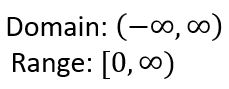
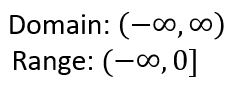
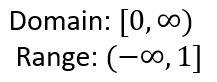
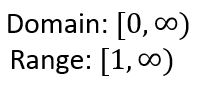

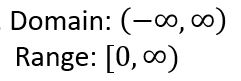
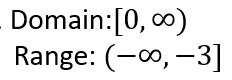
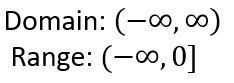
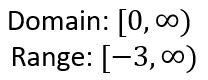
Find the inverse of
f(x) = (1/4)x - 7
f-1(x) = 4x + 7
f-1(x) = -4x + 28
f-1(x) = -4x - 7
f-1(x) = 4x + 28
f(1) = -3
f(2) = -2
f(-1) = 2
f(3) = -1
If f and g are inverse functions, and
f(2) = -1 g(1) = -2 f(1) = -2,
then which of the following MUST be true?
g(-2) = -1
g(2) = 1
g(-2) = 1
g(1) = 2
None of the above
If a function's inverse is also a function, what is true about the original function.
It passes through (0,1)
It is one-to-one
It passes the diagonal line test
It has an infinite domain
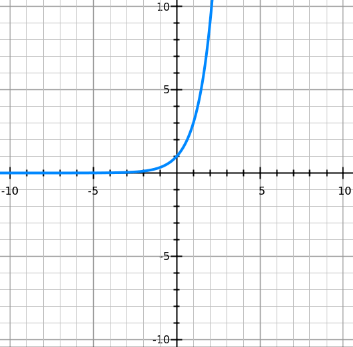
On the graph y =3x + 4,
What is the equation of the asymptote
y = 0
y = 3
y =4
(0,3)
log232 = 5
log381
Rewrite log28 = 3 in exponential form.
28 = 3
23 = 8
32 = 8
83 = 2
None of the above


Which equation is the inverse of the equation above?


Which graph best represents the following logarithmic function?
y=log4x


None of the above
Which graph best represents the following logarithmic function?
y=log2x
The natural logarithm has what base?
10
0
e
-e
log381
Evaluate.
1/2
4
-3
-4
Evaluate.
1/2
-9
1/3
9
None of the above
Evaluate.
1/2
-2
2
-1/2
Evaluate.
4
e^4
e
ln e
Evaluate.
150
10
log15
15
Evaluate.
-1
0
1
1/10
None of the above
Evaluate.
log3(31)
-1
-1/3
1/2
1
None of the above
What is the domain of the following function?
(5,inf)
(-inf,5)
(6,inf)
(-inf,6)
None of the above
What is the y-intercept of the following function?
4
5
6
7
Without graphing, where is the asymptote of the following function?
y=4
y=6
x=4
x=6
None of the above
Find the inverse of the following function.
f−1(x)=(x−2)2+4; x≥4
f−1(x)=(x−2)2+4; x≥2
f−1(x)=(x+2)2+4; x≤4
f−1(x)=(x+2)2+4; x≥4
f−1(x)=(x+2)2+4; x≥2
What domain restriction will the inverse function need?
x≥0
x≤0
x≥−5
x≤5
None of the above
Describe the transformation that occurred
p(x) = f(x + 3)
Right 3 units
Vertical Stretch
Up 3 units
Left 3 units
Describe the transformation that occurred.
h(x) = f(x) + 2
up 2 units
left 2 units
Vertical Strech
right 2 units
Which of the following is a transformation used in the function f(x)=2⋅6(x−4)+3
Right 3 units
Horizontal stretch by a factor of 2
Left 4 units
Horizontal shrink by a factor of 2
Right 4 units
Which of the following is a transformation used in the function g(x)=−log2(3x)−8
Reflection over the x-axis
Right 8 units
Vertical stretch by a factor of 3
Horizontal shrink by a factor of 2
Up 8 units
Let the point (x,y) be a point on the graph of f(x). How will the point be changed if the graph of f(x) undergoes the following transformation:
Left 6 units
(x/6,y)
(x,6y)
(x-6,y)
(x,y-6)
Let the point (x,y) be a point on the graph of f(x). How will the point be changed if the graph of f(x) undergoes the following transformation:
Vertical shrink by a factor of 1/3
(3x,y)
(x,y/3)
(x,3y)
(x/3,y)
Which transformation is performed third?
Reflection
Horizontal Shift
Vertical Shift
Stretch/Shrink
Find the accumulated value of an investment of $6000 for 3 years at an interest rate of 1.8% if the money is compounded monthly.
$6240.98
$6332.65
$8012.34
$10254.84
None of the above
Find the accumulated value of an investment of $13000 for 8 years at an interest rate of 0.8% if the money is compounded semiannually.
$13857.43
$14023.01
$14590.23
$15480.85
None of the above
Find the accumulated value of an investment of $10000 for 20 years at an interest rate of 0.5% if the money is compounded continuously.
$11051.71
$11702.45
$12793.56
$13409.37
None of the above
Consider the function f(x)=x−41 .
What is the range of its inverse function?
(-inf,inf)
(4,inf)
(-inf,0)
(-inf,4)u(4,inf)
None of the above
If a one-to-one function has a domain of (-inf, inf), passes through the points (-1,4), (0,1), (2,0.5), (5,0), and (8,-3), and has a horizontal asymptote at y=-4, what is the y-intercept of the graph of its inverse function?
-4
1
4
5
None of the above
logx(x3y) - logx(xy)

Write the expression as a single logarithm. Then simplify if possible.
log53 + log56 - log59
log50
log556
log52
log598
(log a)(log b) = log (a+b)
True
False


Simplifying using the laws of logarithms
log(10)
log(3)
log(20)
log(75)

Evaluate
2
4
-2
1

Simplifying using laws of logarithms
log(31)
log(108)
5log(6)
5log(5)
To solve, 165x = 64x+7, what would be the correct set-up?
There is more than one correct answer.
44(5x)=416(x+7)
82(5x)=88(x+7)
42(5x)=43(x+7)
24(5x)=26(x+7)


Solve:
log9(x)+log9(x+2)=log9(35)
5
-7
5, -7
-7, -13
Which is equivalent to the following equation?
23x+1 = 12
ln(2)= 3x+1
log2(12)= 3x+1
ln(6)=3x+1
log12(2)= 3x+1
Write an exponential function to model this situation:
$12,000 invested at a rate of 6% compounded quarterly
12000⋅(1.06)4t
12000⋅(1.015)t
12000⋅(1.015)4t
12000⋅(1.06)t
What will the balance be if $500 is invested at a rate of 2.5% compounded annually, after 10 years?
$4,656.61
$640.04
$1,280.08
$2,560.16

