
 Worksheets
2nd Semester KickOff
Total questions: 73
Worksheet time: 1hrs 17mins
What is an acute angle?
An acute angle is an angle that measures less than 90 degrees.
An acute angle is an angle that measures more than 180 degrees.
An acute angle is an angle that measures exactly 90 degrees.
An acute angle is an angle that measures more than 90 degrees.
What is an obtuse angle?
An obtuse angle is an angle that measures more than 90 degrees but less than 180 degrees.
An obtuse angle is an angle that measures more than 180 degrees.
An obtuse angle is an angle that measures exactly 90 degrees.
An obtuse angle is an angle that measures less than 90 degrees.
What is a right angle?
An angle that measures exactly 90 degrees.
An angle that measures more than 90 degrees.
An angle that measures less than 90 degrees.
An angle that measures exactly 180 degrees.
What is a straight angle?
An angle that measures more than 180 degrees.
An angle that measures exactly 90 degrees.
An angle that measures exactly 180 degrees.
An angle that measures less than 180 degrees.
What is a line segment?
A line segment has infinite length.
A line segment is a curved line.
A line segment has only one endpoint.
A line segment is a part of a line that is bounded by two distinct endpoints.
What is a line?
A line is a curved path that extends infinitely in both directions.
A line is a straight path that extends infinitely in both directions.
A line is a two-dimensional shape with length but no width or height.
A line is a closed shape with three or more sides.
What is a ray?
A ray is a line that starts at a point and extends infinitely in one direction.
A ray is a line segment with a fixed length.
A ray is a line that starts at a point and extends infinitely in both directions.
A ray is a curved line that changes direction at every point.
What is a point?
A point is a small dot on a surface.
A point is a precise location in space that has no size or dimension.
A point is a unit of measurement in geometry.
A point is a line segment with two endpoints.
What is a midpoint?
The point that divides a line segment into four equal parts.
The point that divides a line segment into three equal parts.
The point that divides a line segment into two equal parts.
The point that divides a line segment into two unequal parts.
What is a plane?
A plane is a type of tool used for smoothing wood surfaces.
A plane is a mathematical term used to describe a flat surface.
A plane is a type of vehicle used for air travel.
A plane is a flat, two-dimensional surface.
What are collinear points?
Points that form a triangle.
Points that do not lie on the same straight line.
Points that are equidistant from each other.
Points that lie on the same straight line.
What are coplanar points?
Points that lie on the same plane.
Points that are collinear.
Points that are not on a plane.
Points that lie on different planes.
What are vertical angles?
Congruent angles formed opposite each other by the intersection of two lines.
Angles formed by the intersection of two intersecting lines at a right angle.
Angles formed by the intersection of two perpendicular lines.
Angles formed by the intersection of two parallel lines.
What are adjacent angles?
Two angles that share a common side but do not have a common vertex.
Two angles that share a common vertex and a common side, but do not overlap.
Two angles that do not share a common vertex.
Two angles that share a common vertex and overlap.
What are complimentary angles?
Two angles that add up to 180 degrees.
Two angles that add up to 45 degrees.
Two angles that add up to 270 degrees.
Two angles that add up to 90 degrees.
What are supplementary angles?
Two angles that add up to 180 degrees.
Two angles that add up to 45 degrees.
Two angles that add up to 270 degrees.
Two angles that add up to 90 degrees.
Two items are congruent if they...
have the same size and shape.
have a different size and shape.
have the same size but a different shape.
have a different size but are the same shape.
Point
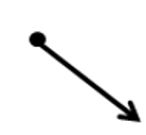

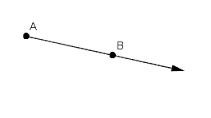
Ray
Point
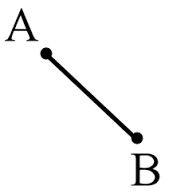
Line Segment


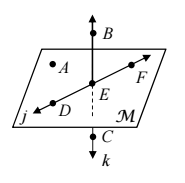



∠1 & ∠2 are corresponding angles
∠2 & ∠4 are corresponding angles
∠5 & ∠8 are corresponding angles
∠1 & ∠5 are corresponding angles

∠1 & ∠8 are alternate interior angles
∠2 & ∠3 are alternate interior angles
∠4 & ∠5 are alternate interior angles
∠7 & ∠4 are alternate interior angles

∠A=82°
∠A=98°
∠A=180°
∠A=8°

∠D=116°
∠D=64°
∠D=180°
∠D=26°

Identify the relationship
Alternate Interior Angles
Alternate Exterior Angles
Corresponding Angles
Consecutive Interior Angles

Identify the relationship between angle 1 and 2
Alternate Exterior Angles
Alternate Interior Angles
Corresponding Angles
Consecutive Interior Angles
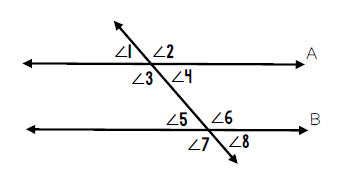
Angle 3 and Angle 6 are examples of which type of angle pair?
Alternate exterior angles
Alternate interior angles
Vertical angles
Corresponding angles
Which of the following angles would NOT be congruent to the measure of ∠7 ?
∠2
∠3
∠6
∠8
If the m∠7 = 115°, find the measure of ∠2.
115°
65°
180°
Cannot be determined

Angles 4 and 6 are...
supplementary
congruent

Find the measure of the indicated angle.
(a)

Find the measure of the indicated angle.
(a)

Find the measure of each angle indicated.
(a)

Find the value of k.
(a)

Solve for x.
(a)

Find x.
(a)

Find the ?
(a)

Find the measure of each angle indicated.
(a)

Find the measure of each angle indicated.
(a)

What is the value of x?
(a)

Using the number line find the length of the given segments
CD = (a) , DB = (b) , DA= (c)
-4
5

Using the Segment Addition postulate, which is the correct equation relating the segments?
AM + MB = AMB
AB + AM = MB
AM + MB = AB
A + B = AMB

What is the length of PR?
11
8
5
3

What is the length of YZ?
type the just the number.

Suppose AC = 48, find the length of AB.
Remember not asking for the value of x.

Write an equation that correctly models the lengths shown.
2x + 20 + x + 21 = 9
2x + 20 + 9 = x + 21
9 + x + 21 = 2x + 20
2x + 20 - 9 = x + 21

Use Segment Addition Postulate to write and equation and solve for x.
5
7
14
21

Use Segment Addition Postulate to write and equation and solve for x.
x = 3
x = 2
x = 6
x = 5

What is the measure of the angle?
50°
65°
75°
70°

What is the measure of the angle?
25°
45°
60°
35°

Find m∠ABC.
45°
60°
105°
15°

Find m∠EFG

Find m∠A.
25°
30°
35°
90°

50°
58°
115°
226°

If m∠ABC = 103° find x.
(a)

Given m∠QST = 135°, find the value of x.
x = 26
x = 28
x = 27
x = 29

