
 Worksheets
AP European History Review
Total questions: 135
Worksheet time: 1hrs 23mins
Divine right monarchy was a term used to refer to
a king's power derived from God
the pope's authority over bishops
the rights of subjects under a king
the requirement that kings be ordained by the pope
Among the principle characteristics of 17th and 18th century absolutist states were all of the following EXCEPT
large standing armies
development of constitutions
weakening the nobility
absolutist rule based on divine right
Charles I of England faced a revolt against royal authority led by
Parliament
the Anglican Church
peasants
French agents
Which of the following is the most significant outcome of Charles I's execution in 1649?
It was the first time in history that a Parliament had voted for the execution of a monarch.
The execution restored the Tudors to the throne.
The execution led to the abolition of the monarchy.
England was invaded and conquered by the Scots and Ireland gained independence.
All of the following contributed to the growing opposition to Cromwell's rule in England EXCEPT
his strict Puritan social policies alienated moderate Anglicans
his growing reliance on France to prop up his government
his cruel treatment of Catholic dissenters in Ireland
his dissolution of the Rump Parliament
After the restoration of the Stuart dynasty, which of the following contributed the most to growing opposition to Charles II?
his growing alliance with the Dutch
his conversion to Calvinism midway through his rule
his inability to establish a rival commercial center in London
his growing admiration for Catholocism and Louis XIV
Which of the following is the most significant result of the Glorious Revolution of 1688 and the English Bill of Rights?
The United Kingdom was formed.
Equal rights and political representation were extended to subjects of the Crown in the English colonies.
Limited monarchy was firmly established in England.
England became the dominate power until 1870.
The most serious problem confronting Poland in the 18th century was
the end of serfdom
Swedish expansion after the death of Charles XII
resurgence of the Ottoman Empire
weak central government
One common concern of both Maria Theresa and Joseph II was
providing state social services to the needy
granting autonomy to the various ethnic groups within the Austrian Empire
industrializing the country
centralizing power
Why did Frederick the Great of Prussia only abolish serfdom on crown lands and not the lands held by the Junkers?
The Junkers didn't possess serfs because they were a military caste.
He wanted to keep the loyalty of the Junkers.
85% of Prussia's serfs lived on Crown lands.
He thought it was immoral for the monarchy to keep peasants in serfdom.
What two major events limited the scope of Catherine the Great's reforms in Russia?
the Pugachev Rebellion and the French Revolution
the wars against the Ottoman Empire and the partition of Poland
the Pugachev Rebellion and Catherine's active social life
the American and French Revolutions
European Jews benefited the most from which enlightened despot?
Louis XVI
Frederick the Great
Joseph II
Philip II
Overall, the reforms of the enlightened despots
were not able to take hold because of limited support among the nobility.
paved the way for democratic systems and the welfare state.
led to a counter-reaction and the return of absolutist rule all over Europe.
led to the feudalization of Europe.
"We forbid our subjects of the so-called Reformed religion to assemble any more for public worship."
This statement was most likely issued as a result of
Edict of Nantes
Ninety-Five Theses
Edict of Fontainebleau
Peace of Augsburg
Which of the following French kings is acknowledged as the embodiment of an absolute monarch?
Henry IV
Louis XIII
Louis XIV
Louis XV
The partition of Poland 1772-1795
eliminated Poland as an independent state.
divided Poland between Sweden, Finland, and Lithuania.
divided Poland between Russia, Hungary, and Austria.
led to the emergence of an independent Lithuanian state.
In 1713 Emperor Charles VI sought approval of the Pragmatic Sanction in order to guarantee
indivisibility of the Hapsburg lands.
political privileges for Catholics.
borders between Holland and the Austrian Netherlands.
the dynastic union of the Hapsburgs and the Romanovs.
Sweden lost its position as a formidable European power as a result of
the Thirty Years' War
the Great Northern War
the War of Spanish Succession
weak central government
The ideals of the French Revolution were best expressed in the phrase
nobility, power, aristocracy
equality, humanity, godliness
liberty, equality, fraternity
justice, honor, socialism
Voting in the Estates General in France was traditionally
based on the principle of one person/one vote
done by estate
in the form of a national referendum
the exclusive reserve of the nobility
The Declaration of the Rights of Man and Citizen proclaimed all of the following EXCEPT
the emancipation of women
an elective legislature
protection of rights of property
religious toleration
The Bastille in Paris was stormed on July 14, 1789
in order to capture the royal family
to free the Marquis de Lafayette
to arrest refractory priests opposing the revolution
to seize arms to defend against royal reprisals
The Woman's March on Versailles on October 4, 1789 was a crucial turning point in the French Revolution because it
brought the king and assembly back to Paris
was embraced and supported by the king and queen
was a peace offering to the monarchy after the storming of the Bastille
forced the renunciation of feudal privileges
The term emigres was used to describe
nobles who stayed in France to fight against the revolution
supporters of the revolution who came from other countries
members of mobs in the Paris streets
nobles who fled France
The French Constitution of 1791
abolished the monarchy
established a constitutional monarchy
gave the vote to all citizens
reestablished the old provinces
During the Reign of Terror, Robespierre tried to
execute all French nobles
restore the Catholic Church
crush all opposition to the revolution
sign a separate peace treaty with countries fighting against France
Besides the violence, how was the Jacobin phase of the revolution more radical than the previous National Assembly phase?
The Jacobins called for universal male suffrage and an end to all forms of monarchy.
The Jacobins called for the elimination of private property and the redistribution of wealth.
The Jacobins called for women of talent to hold key government positions.
The Jacobins called for the abolition of all borders for a united Europe.
Which of the following best explains the attitude of many European monarchs toward the French Revolution?
Since the revolution was strictly the internal affair of the French government, European monarch paid little attention.
Many rushed to aid Louis XVI.
On the one hand they welcomed anything that would weaken France's position; on the other hand, they feared the revolution spreading to their countries.
Many felt that it was time that radical reform came to France; therefore, they supported the revolution.
Which French colony was inspired by and used the instability of the revolution to declare and eventually gain its independence?
Haiti
Algeria
Guadeloupe
French Guiana
What became apparent after the Directory asked Napoleon to suppress pro-Royalist sympathizers in 1797?
Pro-Royalist sympathizers lost their final battle to try to turn the clock back in France to 1789.
The Directory came to rely more and more on the army for its power.
France was vulnerable to foreign enemies since the army was asked to establish order within France.
All of these choices.
None of these choices.
Czar Alexander I's most successful strategy in countering Napoleon's invasion of Russia was to
stand and fight at the Neman River.
surrender St. Petersburg.
make a stand in front of Moscow.
retreat and destroy food supplies.
The Napoleonic Code, enacted by Bonaparte in 1804, did all of the following EXCEPT
create laws that favored business and private enterprise.
reaffirm the patriarchal nature of the traditional family.
grant special privileges to the aristocracy.
form a basis for civil law copied in many countries.
To strangle the British economy, Napoleon imposed an economic blockade on his rival called
the Napoleonic Code
the Bastille Embargo
the Continental System
Anti-British Economic Policy
Overall, the general goal of the allies at the Congress of Vienna was to
spread the revolutionary gains made in France to the rest of Europe.
anoint Russia as the new leader of Europe.
established boundaries and conditions in Europe to contain France.
create a permanent "Holy Alliance" between Austria, Prussia, Russia, and Great Britain.
In the 18th century, the principle economic activity of the Netherlands was
banking and maritime commerce
tulip cultivation
timber production and export
agricultural production
Mercantilism was principally characterized by
government efforts to build a strong, self-sufficient economy
the efforts of the merchant class to influence policy by subsidizing the government
the efforts of bankers and exporters to establish free trade
the view that labor ought to be able to seek its own market
All of the following were reasons why the Dutch were the commercial and financial leaders in Europe in the 17th century EXCEPT
they standardized currency throughout Europe
the Dutch government guaranteed the safety of the deposits
the Dutch charged no interest on long-term loans
depositors were allowed to draw checks against their accounts
All of the following mercantilist policies were implemented by Jean-Baptiste Colbert between 1648 and 1653 EXCEPT
establishing new industries and improving infrastructure
increasing internal tariffs
founding the French East India Company
creating a commercial code for businesses covering the entire country
Which of the following became a British possession as a result of the treaty that ended the War of the Spanish Succession?
Jamaica
Gibraltar
Canada
India
The scientist responsible for developing calculus and the theory of gravity was
Kepler
Leibniz
Mendeleev
Newton
What major impact did the Scientific Revolution have on the Enlightenment?
Through application of the concept of natural law to political theory, society could be governed in a more rational way.
With the confirmation of the existence of a supreme divinity, the concept of the divine right of kings was strengthened.
Failure to discover all of the laws that governed nature meant skepticism in separation of powers.
The Scientific Revolution had a marginal impact on the Enlightenment since the latter encompassed political theory, education, and culture while the former dealt with mathematics and science.
John Locke is most famous for advancing the concept of
a heliocentric concept of the universe
universal suffrage and a modern welfare state
all people having natural rights based on life, liberty, and property
economic justice for all
The center of the Enlightenment was
France
England
Prussia
Russia
Which of the following would be most adversely affected by the increase in the price of food?
urban workers
wealthy merchants
the clergy
the nobility
Typically, the largest expenditure item in the budget of an 18th century state - excluding interest on national debt - was
military
royal palaces
education
infrastructure projects
By the 1600s, what event had occurred between Europe and the New World?
Native Americans moving to Europe
The transfer of plants, animals, and diseases
Europe conquering all of the New World
How did the Europeans justify forcing indigenous peoples and Africans into forced labor and slavery? Choose BEST answer.
Glory
Gold
Religion
Freedom
How were Europeans able to conquer indigenous populations so easily?
Europeans outnumbered indigenous populations
Europeans didn't understand indigenous populations culture
Advances in technology and immunity to diseases native populations weren't
What impact would lower wages do on Western European families?
Wellfare programs started to help poor families
Western European women delayed marriage to limit the number of children they would have
Western Europeans left the cities for the countryside
Western European farmers started growing food crops
What kind of people would have commissioned art from Northern Renaissance artists like Albrecht Dürer?
Middle class elites who wanted art that showed everyday life and naturalist style
The Church who wanted to see more emotion in paintings
Monarchs who wanted classic mythology paintings
Protestant leaders who wanted art that broke from the Church
What did the Peace of Augsburg do for Lutheranism?
Made it illegal
Made it legal/legitimate
Nothing
All of the following are effects of the printing press EXCEPT:
Development of unique cultures throughout Europe
Cheaper printing materials
More access to books in the vernacular language
Catholic Church getting more power
Why would women have lower literacy rates than men?
Growth of convents for women to go to
The expectation that women would engage in different social and economic norms than men
Weakening of Catholic institutions because of the Protestant Reformation
Delaying marriage
What was the major difference between Italian humanists and Northern humanists?
Italian humanists look at classical sources but Northern humanists do not
Both look at classical sources, but Northern humanists also look at Christian sources
Only Northern humanists look at classical sources
What would cause an increase in sugar consumption in Europe?
Increased European trade with Asia
Creation of planation colonies in the Caribbean
Increase agricultural production in Europe
What are the major differences between Calvinism and Lutheranism?
Calvinism emphasizes predestination, while Lutheranism emphasizes salvation by faith alone.
Calvinism emphasizes salvation by faith alone, while Lutheranism emphasizes predestination.
Calvinism emphasizes the authority of the Pope, while Lutheranism emphasizes the authority of the Bible.
Calvinism emphasizes the authority of the Bible, while Lutheranism emphasizes the authority of the Pope.
In the sixteenth century, Geneva and other European towns and cities experienced what demographic changes?
People moving from the countryside to cities
Immigration from overseas colonies
Decreasing population
Larger birthrate
What did Calvinists believe laws should be based off of?
Freedom
Slavery
Religion
What was the goal of the Council of Trent?
To address the criticisms of the Protestant Reformation and strengthen Catholic doctrine.
To promote the spread of Protestantism and challenge Catholic doctrine.
To establish a new Christian denomination separate from Catholicism and Protestantism.
To negotiate peace between Catholic and Protestant nations.
What did the Edict of Nantes do?
The Edict of Nantes banned Protestantism in France.
The Edict of Nantes established Catholicism as the official religion of France.
The Edict of Nantes granted religious freedom to Protestants in France.
The Edict of Nantes granted religious freedom to Catholics in France.
What event developed the baroque art style?
Age of Exploration
The printing press
The Commercial Revolution
The Catholic Reformation
What city dominated European trade and finance in the early seventeenth century?
Venice
Paris
London
Amsterdam
Before the Industrial Revolution, how were goods typically produced?
Silks and cottons being imported from Asia
More guilds
Putting out system of the cottage system in the countryside
Railroad system
Why was Dutch life so prosperous for middle class people during the 17th century?
Dutch gained territory in the 30 Years War
Dutch made significant financial and trade advances
Dutch oligarchy
Dutch attacking Spanish fleets
How was Europe able to dominate the world trade system in the 1700s?
Europeans having better quality goods
European powers working together
The creation of large European land empires in Asia and Africa
Europe having naval superiority and technology
Who fought in the English Civil War?
The Dutch
The Puritans
The Quakers
Royalist (cavaliers) and parliamentary (roundheads) forces
Why did Spain start to decline in the 17th century?
30 Years War
Wars w/ Protestants
Empire stretched too thin with resources
Religious toleration
Secret treaties
What was the goal of Peter the Great during his rule?
Westernize Russia
Reform the church
Defeat the Ottomans
Get rid of the nobility
What would the "invisible hand" do according to Adam Smith?
checks and balances among government branches
religious toleration
enlightened monarchy
balance out self interests w/ economic benefit
What BEST helped the population in Europe to increase in the 1700s?
Rising birth rate
Decline in death rate
Elimination of all diseases and introduction of vaccines
Decline in food prices
The reign of Joseph II of Austria is often an example of
enlightened monarchy
divine right
mercantilism
absolutism
What were the goals of the French Revolution?
Create an enlightened monarchy
Religious revival
Change the current and traditional political order/society
Spread ideas to other European nations
How would the American Revolution impact European history?
led to new alliances
new balance of power
set the stage for France's financial crisis that led to meeting of Estates-General
inspired England’s Glorious Revolution
What was created during the French Reign of Terror?
women's march to Versailles
Committee of Public Safety
The Declaration of the Rights of Man and Citizens
What would the Napoleonic Wars inspire in Germany and Spain?
Nationalist sentiments
Nothing
Resistance to monarchal rule
New artwork
When Napoleon conscripted (drafted) men into the military, it was a continuing the tradition from what French event?
the Thirty Years’ War
Fronde uprising
French Revolution
7 Years War
The basic goal of Napoleon’s Continental System was to
isolate Russia
weaken England economically
unite France and Spain
unify Germany
conquer Italy
What did the Napoleonic Code do?
It was Europe’s first written law code.
Protected private property rights but took away the rights of women to their husbands
Legalized free speech
Eliminated the secret police
The Romantic movement was a reaction to what?
The Renaissance
Religious toleration
Scientific Revolution
The Enligthenment
At the Congress of Vienna, what was the end goal?
balance of power
imperialism
war
mercantilism
Which of the following advocated an evolutionary, as opposed to a revolutionary, theory of Marxism?
Eduard Bernstein
V. I. Lenin
Rosa Luxemburg
Joseph Stalin
Which of the Following was an economic belief of 19th century Liberalism?
Limited government
Free trade
Anarchism
Unions
In The Communist Manifesto (1848), Karl Marx and Friedrich Engels asserted that
capitalism was a necessary stage of economic and social development
a socialist revolution was most likely to occur in Russia
the goals of nationalism and socialism were inseparable
the working class was so oppressed that it was unable to help itself
European liberals in the first half of the nineteenth century typically supported
women’s suffrage
the right of workers to unionize and strike
a written constitution and wider suffrage
the establishment of overseas colonies to improve conditions at home
European feminists such as the Pankhursts had all of the following goals EXCEPT
eliminating poll taxes
opening up more professions to women
liberalizing marriage and divorce laws
broadening the franchise to include women
In the first half of the nineteenth century, which of the following was a field of employment that was exclusively male?
Agriculture
Teaching
The legal profession
Factory work
The first European country to develop a state social welfare system was
Sweden
France
Belgium
Germany
A major goal of English Chartists in the 1840's was
protective tariffs for farm products
war with France
abolition of the monarchy
the vote for all men
The British Great Reform Act of 1832 did which of the following?
Gave women the right to vote.
Limited the power of the monarchy.
Abolished the right of the House of Lords to veto legislation.
Increased the voting power of the middle class.
"The history of all hitherto existing societies is the history of class struggles."
The quotation above is from the writings of
Saint-Simon
Marx and Engels
Malthus
Bismarck
Who was the "Father" of socialism?
Kevin Systrom
Mark Zuckerburg
Robert Owen
Maude Barlow
What is the radical version of socialism?
Capitalism
Feminism
Nationalism
Communism
Socialism was an alternative to what movement?
Communism
Nationalism
Feminism
Capitalism
Who are the bourgeoisie?
Middle and upper classes
Working classes
A form of revisionism
A French form of fast food
Which of the following statements best reflects the ideas of Karl Marx?
Humans share a common ancestry with apes.
The market is governed by an invisible hand.
A classless society will emerge at the end of the dialectical process.
Happiness results from the greatest good for the greatest number.
Which of the following is accurate about late-nineteenth-century Socialist parties in western and central Europe?
They generally supported imperialist expansion.
They included members who emphasized electoral success and participation in government.
They were effectively controlled by the First International.
They publicly repudiated Marxism.
Which of the following was a common theme among nineteenth-century Utopian socialists?
Rejection of the institution of marriage
Advocacy of social and economic planning
Revolutionary overthrow of the existing order
Promotion of mass political parties
Which of the following best explains the movement of women into the teaching profession in the nineteenth century?
The increasing professionalization of nonindustrial jobs pushed men away from teaching positions.
The education of children in schools was increasingly seen as a respectable occupation for women.
The teaching profession was becoming increasingly open to working-class women.
The use of domestic paid labor declined over the course of the century.
Of the following, which was the central issue for nineteenth-century European advocates of women's rights?
The right of women to control their own property
Equal pay for equal work
The right to serve in the military
Alimony and child support in cases of divorce
Which of the following was a major demographic change in Western Europe between 1850 and 1914?
A dramatic shift of population to urban areas
A rapidly increasing birth rate
A rapidly increasing death rate
A pronounced trend toward larger families
which of the following goals of public education systems in the period before the First World War?
Instilling feelings of nationalism
Training bureaucrats for imperial posts
Greater appreciation of the Ottoman legacy in the Balkans
Heightening awareness of the dangers of international conflict

Which of the following developments within France during the nineteenth century is best understood as a reaction to the divisions shown on the map?
A gradual move toward industrialization
The modernization of transportation networks through railroad construction
The expansion of French colonies in North and West Africa
The development of a system of compulsory education
Which of the following was most central to the development of the early Industrial Revolution?
The replacement of iron by steel
The decline of individual enterprise
The shift from human and animal power to mechanical power
The decline of individual enterprise in favor of cooperative efforts
Between 1870 and 1914, the heavily industrialized nations of Western Europe earned the loyalty of their citizens by all of the following EXCEPT
extending the right to vote to almost all adult males
acquiring colonies to promote economic expansion and national pride
dividing farmland equally among peasants
increasing the availability of public education
The rebuilding of Paris during the 1850’s and 1860’s resulted in the
reduction of open spaces for recreation
improvement of military fortifications
prevention of popular uprisings in the city
destruction of much working-class housing
Match the following definitions to the appropriate terms.
Roadside inns found along the silk roads that were spaced about 100 miles apart
Caravanserai
Trading cities that grew along the Silk Roads
Samarkand & Kashgar
System of credit that allowed a merchant to deposit paper money under his name in one location and withdraw the same amount at another location
Flying cash
Chinese invention; used paper bills as currency instead of heavy metal coins
Paper money
Large Chinese ship for carrying trade goods
Junk
Match the following historical developments to the theme that is MOST appropriate.
Silk Roads, paper money, and flying cash
Economics
The fall of Baghdad, the fall of the Song Dynasty, and the rise of the Mongol Empire
Politics
The magnetic compass and the stern rudder
Innovation / Technology
The spread of the Black Death from Asia to Europe due to infected fleas on rats, which followed the trade caravans
Environment
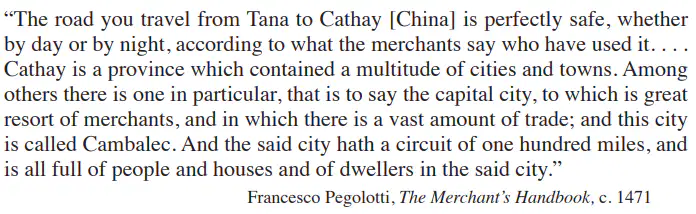
Which statement about China and trade does this passage best support?
Trade between Europe and Cathay was greatly enhanced by the security established by the Mongol and Ming Empires.
Merchants rarely traveled between Tana and Cathay because the road was very dangerous.
Cambalec was an important trading hub, but it was not a large city.
The author felt the risks of trade with China outweighed the rewards.
Which development was the turning point that led to the expansion of trade between Asia and Europe?
The formation of the Silk Roads by Marco Polo allowed goods from Asia to be imported into Europe for the frst time.
The conquests by Mongols, which led to improved trade routes and reduced trading costs.
The invention of silk cloth during the early Mongol rule allowed the Mongols to trade for pottery, wool, and other European goods.
The invention of paper money by Venetian bankers helped to facilitate trade between Europe and Asia.
Match the following definitions to the appropriate terms.
Latin for "Mongolian Peace". Century long period of peace that followed the Mongol conquest of Eurasia
Pax Mongolica
King
Khan
Establish by Kublai Khan, Genghis Khan's grandson, to replace the Song Dynasty after the Mongol conquest.
Yuan Dynasty
Established by the Buddhist monk Zhu Yuanzhang in 1368. Overthrew the Mongol's Yuan Dynasty. Ruled China from 1368-1644.
Ming Dynasty
Led by Batu, Genghis Khan's grandson. Conquered much of Russia and eastern Europe.
Golden Horde
Match the following Mongol attempts at conquest to their outcome.
Failed. The Mongol envoys were executed and their heads displayed on the Cairo gate. The Mongols lost the battle of Ain Jalut because their enemy was unified and prepared.
Mamluk Sultanate
Failed the first six attempts. Finally succeeded on the seventh invasion.
Korea
Succeeded in 1258. Executed the Caliph of the Abbasid Caliphate and massacred around 1 million citizens.
Baghdad
Failed twice. Both times the Mongols were held back by samurai armies and their fleets were destroyed by tsunamis.
Japan
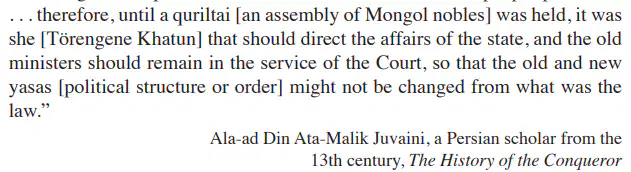
Based on the passage, what can be inferred about the status of women in Mongol society compared to women in the Song Dynasty and Dar al-Islam c. 1250?
The Mongol culture was more accepting of women in power than the cultures of the Song Dynasty or Dar al-Islam.
The women in the Song Dynasty ran the government while the men were subject to foot-binding.
The women in Dar al-Islam ran the government while the men were held as concubines in harems.
Women were of essentially equal status throughout all societies c. 1250.
Match the following definitions to the appropriate technological innovations.
Muslim navigators used it to aid navigation by determining their distance from the equator.
Astrolabe
Possibly an Arab invention; their triangular shape could easily catch winds coming from many different directions.
Lateen sail
Chinese invention which gave their ships more stability and made them easier to maneuver.
Stern rudder
Chinese invention; aided ship navigation by always pointing north.
Magnetic compass
Large Chinese ship for carrying trade goods.
Junk
Match the following trading locations to the main products they exported (sent out for trade).
Gold, ivory, and slaves.
Swahili Coastal Cities (East Africa)
Cotton, carpets, steel, and pepper.
Calicut
(Vijayanagara Empire)
Trade city at the midway point between the eastern and western Silk Roads
Samarkand
Nutmeg, cinnamon, cloves, and other spices.
Spice Islands
(Malaysia / Indonesia)
Silk, porcelain, tea, paper, gunpowder
Yuan Dynasty/ Ming Dynasty (China)
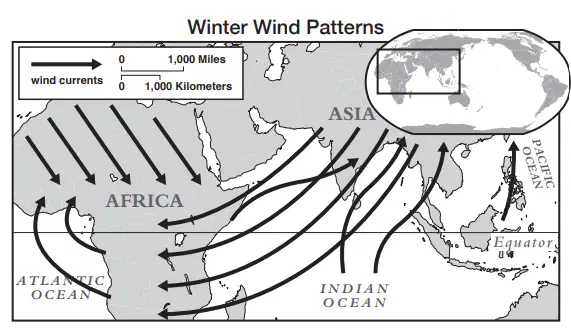
The map helps explain why South Asian merchants preferred to travel
to Africa in the winter months
to Southeast Asia in the winter months
to China in the summer months
to the Middle East in the summer months
Since merchants were often delayed in foreign ports for lengthy periods of time, they frequently
became involved in local political affairs
married wives who often converted to their religion
lost their connection to the culture of their homeland
settled in the foreign port and converted to the local faith
Some of the wind currents show in the map are monsoon winds. How did monsoon winds affect merchant activity in the Indian Ocean Basin?
Understanding of the patterns of monsoon winds facilitated merchant activity because merchants could predict the best times to make a voyage.
Lack of understanding of the monsoon winds facilitated merchant activity because merchants used technology like nuclear reactors to sail their ships.
Monsoon winds had no effect on merchant activity in the Indian Ocean Basin.
Understanding of the patterns of monsoon winds facilitated merchant activity because merchants could use monsoon winds to go where they wanted at any time.
Which of the following accurately explains an interaction between culture and economics?
Muslim merchants helped spread Islam along trade routes and the Islamic religion held merchants in high regard because the founder, Muhammad, had once been a merchant.
Buddhist merchants helped spread Buddhism along trade routes because the highest goal of Buddhism is to gain wealth.
Confucian merchants helped Confucianism spread outside of China because, in the Confucian philosophy, merchants were the highest rank in the social order.
Mongol merchants helped spread belief in the Blue Sky God as they peacefully traded because the Mongol religion forbids the taking of human life.
A diaspora is a settlement of people away from their homelands. Current examples of diasporas include the "Chinatowns" found in many American cities, the "Little Havana" Cuban neighborhood in Miami, Florida, and the 1.6 million strong Jewish community in New York City.
In one or two sentences, describe how a diaspora might affect the culture of the place they settle.
(Hint: culture includes not only religion, but also food, music, clothing, holidays, language, traditions).
Zheng He was a Muslim, Chinese admiral of the Ming Dynasty who led a great fleet throughout the Indian Ocean (1405-1433). After his voyages, the Ming Dynasty stopped such voyages and shut itself off from the world.
Which aspects of Chinese culture likely played a role in the Ming Dynasty's decision to shut itself off from the world?
Confucian philosophy had always been very open to outside influence and this interacted with the Chinese view that all societies were equal
Confucian philosophy put forth a strict social hierarchy and this interacted with the traditional Chinese sense of superiority towards the outside world.
The Chinese traditionally followed Islam which argued for equality of all believers, and this led to a Chinese sense of superiority towards the outside world.
The Chinese traditionally followed Hinduism which put forth a strict caste system, and this led to a Chinese sense of superiority towards the outside world.
Using the chart on page 104, match the best pack animal to each situation.
Carrying a heavy load across 100 miles of scorching desert with no water until you reach your destination.
Camel
Carrying the heaviest load a short distance (from one village to the next) when speed is not essential.
Ox
Carrying you into battle, where speed and precise control are essential.
Horse
Carrying a moderate load across a range of tall, snow-covered mountains.
Llama
Use pages 105-106 to match the following definitions to the appropriate terms.
Founded Mali in 1235. Known as the "Lion Prince". Established Mali's gold trade.
Sundiata
Mansa Musa, marvelous Muslim monarch of Mali, who marched to Mecca and made many mosques.
Grand nephew of Sundiata. Richest ever.
Great city in the Mali Empire that became a center of Islamic learning.
Timbuktu
Financed Mali's government and military, making them wealthy and powerful enough to conquer resource-rich areas
Taxes on the gold trade
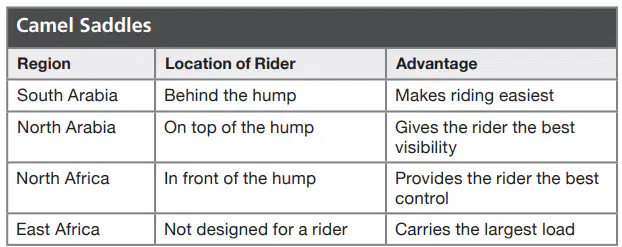
Which was the most important impact of the improvements in saddles in assisting the spread of Islam in Africa?
They allowed younger people to ride camels.
They increased the demand for camels.
They contributed to increased trans-Saharan trade.
They strengthened Islamic armies.
The information on camel saddles is an example of how
people adapted technology based on their needs
differences in camels suited them for different tasks
innovation results from outside influences
climate variations influenced the relationship between people and animals
Identify ONE example of transportation technology that led to growth in interregional trade during the period 1200–1450.
Camel saddles
The fall of the Mali Empire and the rise of the Songhai Kingdom
Muslim merchants helped spread the Islamic religion throughout North and West Africa
The Pax Mongolica ensured safety for merchants and travelers along the Silk Roads
Use page 116 to match the following descriptions to the travel writers they best describe.
Italian who traveled to China and described the Mongol Empire. As the son of a merchant, he often focused on economic matters.
Marco Polo
An Islamic scholar, he spent 30 years traveling to Muslim lands all over Afro-Eurasia and wrote about culture, especially the Islamic religion.
Ibn Battuta
English mystic and mother of 14 children. She made pilgrimages to many Christian holy sites.
Margery Kempe
Spread the Black Death plague all the way from Asia to Europe by hitching rides on caravans along the Silk Roads.
Infected fleas traveling on rats
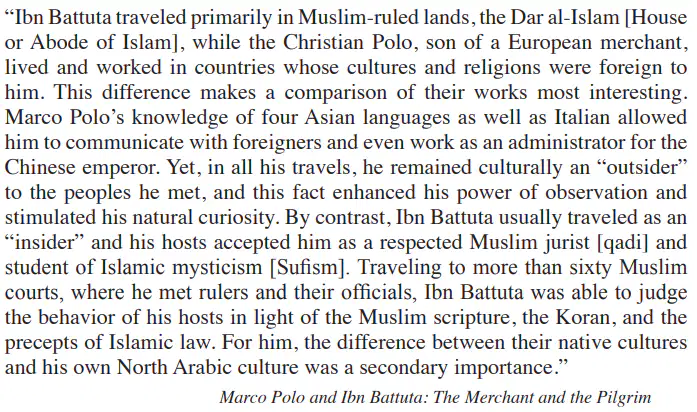
Which of the following would have been most likely to “set the stage” for Marco Polo to have been able to travel to the lands that he did?
The Pax Mongolica
The voyages of Vasco da Gama
The conquests of the Umayyad Dynasty
The development of the printing press
Which of the following were most responsible for infuencing the point of view of the travelers mentioned in the passage?
Religion and economics
Military and technology
Social hierarchy and governance
Religion and philosophy
Which of the following statements most accurately describes the difference in the worlds in which Polo and Ibn Battuta traveled?
(Hint: reread the descriptions on page 116 if you're not sure).
Polo traveled to areas that shared his language and religion while Ibn Battuta traveled to areas that did not.
Polo traveled primarily to areas that were less prosperous than where he grew up while Ibn Battuta traveled primarily to areas that were more prosperous than where he grew up.
Polo traveled to regions very different from Europe while Ibn Battuta traveled mostly within the Islamic world.
Polo traveled to regions that Europe was closely connected to while Ibn Battuta traveled to regions that were not closely connected to his home region.
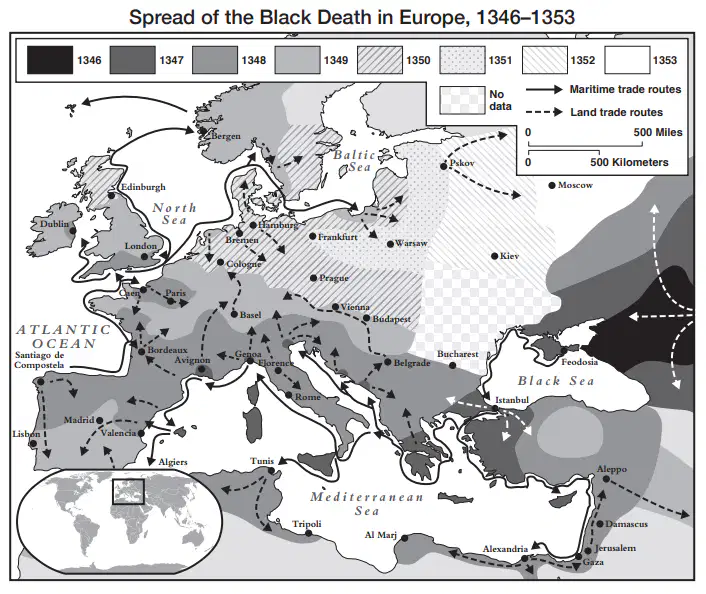
Which explanation for the cause of the rapid spread of the Black Death is best supported by this map?
The migrations of Central Asians into eastern Europe
The spread of rodents through trade
Pollution caused by growing concentrations of people in cities
Poverty among Europeans resulting from feudalism
One signifcant long-term impact of the Black Death was
the end of the Indian Ocean as a viable trade network
the decline of the feudal system in Europe
the increased use of camels in the Silk Roads trade
the rise of the Ottoman Turks
(Page 123) One way in which the Black Death affected the feudal system in Europe was:
As Black Death killed so many, agricultural production declined. However, each person’s labor became more valuable, so workers could demand higher wages.
As the population grew, agricultural production grew along with it.
As Black Death killed so many, agricultural production increased, and the manorial system became more efficient.
As Black Death killed so many, agricultural production declined. However, wages went down because there were plenty of workers available.
(Pages 121-122) Match the following agricultural advancements to the correct description.
Given to the Chinese by Vietnam. It is drought-resistant, flood-resistant, and yields two crops per year.
Champa rice
Introduced to Sub-Saharan Africa from Indonesia. Supplemented yams.
Bananas
Came from Southwest Asia but were widely grown and sold near cities like Samarkand.
Citrus fruits (Limes, oranges, etc.)

