
 Worksheets
LED Quiz
Total questions: 19
Worksheet time: 10mins
What does LED stand for?
(a)
When does an LED emit light?
When the exit voltage is zero
When the power rating is greater than 1
When a current pass through it
When the inductance value is greater then the voltage
What kind of device is an LED?
Conductor
Semiconductor
Insulator
Superconductor
What is an LED commonly described as due to the way its light generates within the solid semiconductor material?
A gas discharge device
A solid-state device
A mechanical device
A super conductor device
What are photons?
Semiconductor materials
Subatomic particles with a positive charge
Light particles
Subatomic particles with a neutral charge
What determines the color of the light emitted by an LED?
The size of the LED
The wavelength of the emitted light
The weight of the LED
What happens when an electric current is passed through an LED?
It cools down the device
It emits sound
It emits light
It stops functioning
What is the primary advantage of using parallel LED circuits as opposed to series LED circuits?
They require a higher voltage source.
They can light several LEDs with a minimum voltage.
What is a potential disadvantage of connecting LEDs in parallel?
It can shorten the lifespan of the LED.
It increases the brightness of the LEDs.
It reduces the voltage requirement.
It simplifies the circuit design.
What is the forward voltage required for a red LED to conduct electricity?
1.8 V
2.1 V
2.2 V
3.2 V
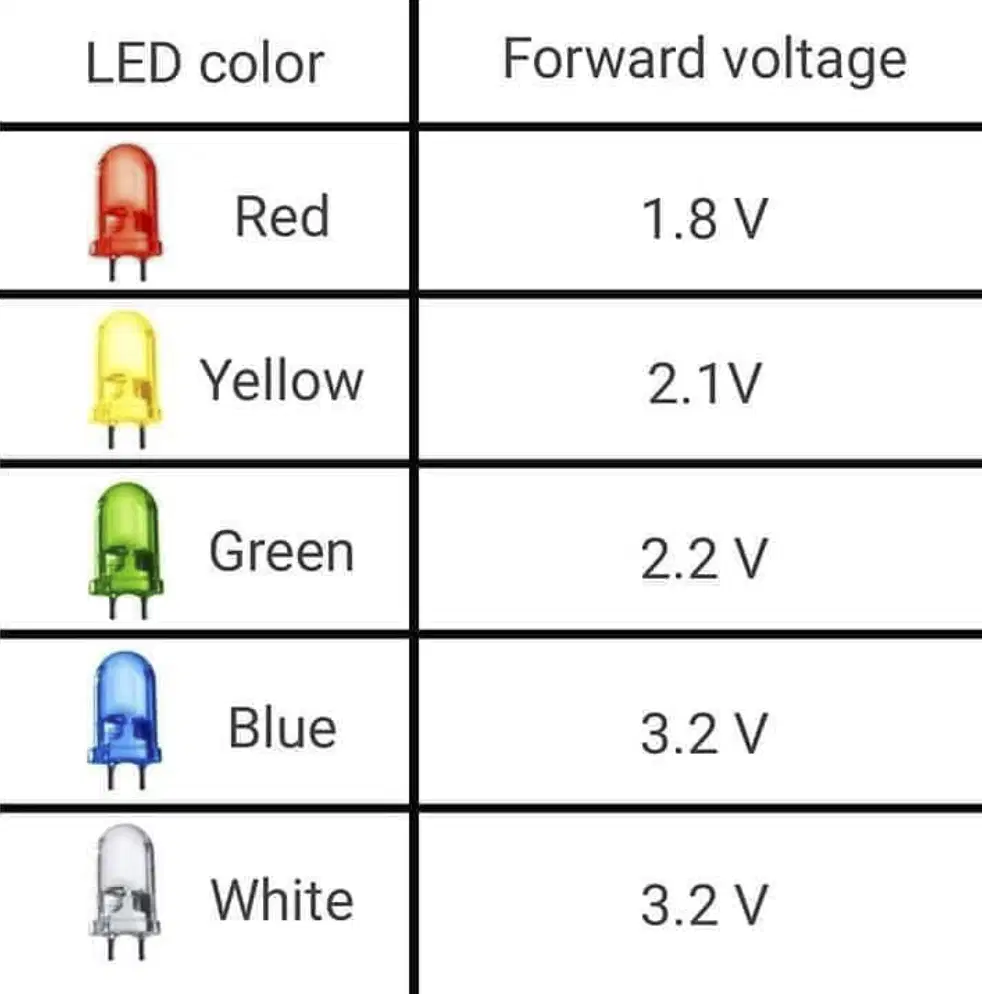
Which color LED has the highest forward voltage according to the table?
Red
Yellow
Green
Blue or White
What is the typical forward current range for visible-light LEDs?
20 mA
50 mA
30 mA
40 mA
What happens to an LED if the current through it exceeds the maximum current specified in its datasheet?
The LED will become brighter.
The LED will change color.
The LED will be destroyed.
The LED will consume less power.
What is the purpose of using LED current limiting resistors?
To increase the voltage across the LED.
To decrease the brightness of the LED.
To prevent the LED from being destroyed.
To change the color of the LED.
What must be known to determine the value of a current limiting resistor for an LED?
The supply voltage (Vsupply), LED forward voltage (VLED), and LED forward current (ILED).
The manufacturer of the LED.
The size of the LED.
What characteristic must the power rating of the LED current limiting resistor exceed?
The power rating must be less than the LED power consumption.
The power rating must be equal to the LED power consumption.
The power rating must be greater than the power dissipated by the resistor.
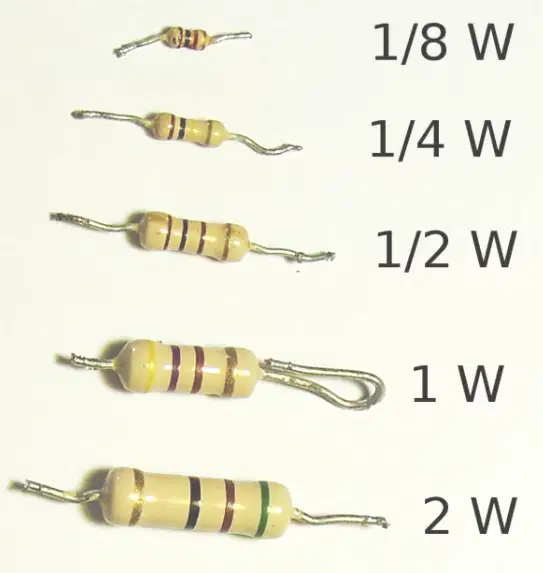
What is the power rating of the smallest resistor shown in the image?
1/8 W
1/4 W
1/2 W
1 W
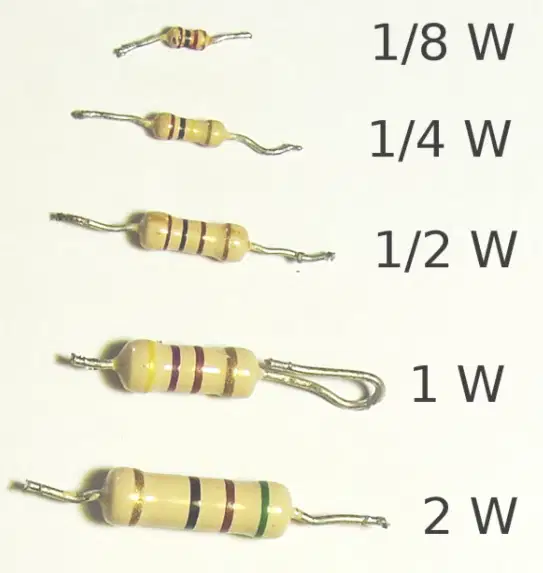
Which resistor in the image has the highest power rating?
1/8 W
1/4 W
1 W
2 W
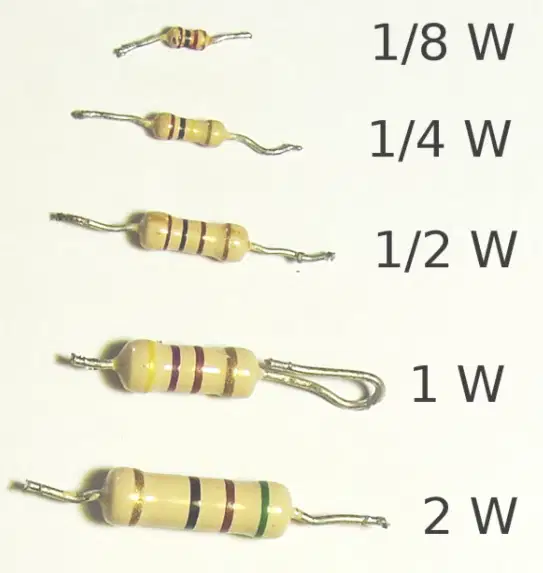
How does the physical size of resistors generally relate to their power ratings based on the image?
Smaller resistors have higher power ratings
Larger resistors have higher power ratings
Physical size does not relate to power ratings
All resistors are the same size regardless of power rating

