
 Worksheets
Q3 QUIZ REVIEW
Total questions: 49
Worksheet time: 28mins

Which of the following conditions can result in evolution in a population?
Mutation is not occurring
All mating is totally random
Natural selection is not occurring
None of the above
This involves organisms that share common ancestors but perform different functions.
Analogous Structure
Homologous Structure
Analogic Structure
Homologic Structure
Which is an example of an analogous structure?
Dog and Bird
Lizard and Dolphin
Bat and Butterfly
Human’s arm and whale flipper
What is an example of a homologous structure?
Penguin and shark fins
Bird and butterfly wings
Bat and Butterfly wings
Human’s arm and whale flipper
Put the following units of geological time in order from largest to smallest unit of time.
Epoch, Eon, Era, Period
Epoch, Period, Era, Eon
Eon, Era, Period, Epoch
Period, Eon, Period, Era
What two methods are used to divide and classify the geological time scale?
Living organisms
rock strata or layers
DNA
fossils
Which era is the most recent, the one that we are currently in?
cenozoic
mesozoic
paleozoic
precambrian


Refer to the attached image. Which fossil is relatively the oldest?
Which genetic engineering technique allows us to produce multiple, identical copies of a single gene?
Cloning
Hybridization
Gene Splicing
Inbreeding
Hybridization is...
Selective Breeding between two unrelated organisms
Selective Breeding between two inbred organisms
Selective Breeding within a species
Selective Breeding within a population
Which is used to cut DNA molecules at specific points for gene splicing?
Helicase
Ligase
Restriction enzymes
Plasmid
What was Carl Linnaeus known for in the field of systematics?
Developing a system of binomial nomenclature
Introducing the concept of genetic drift
Establishing a 5-kingdom system
Discovering the process of gene flow
What is the term for breeding animals with desired characteristics to produce offspring with those traits?
Inbreeding
Hybridization
Selective Breeding
Gene Therapy
Which of the following organisms is correctly matched with their respective geological periods?
Brachiopods - Paleogene
Dinosaurs - Permian
Ammonites - Jurassic
Saber-toothed Cats - Triassic
Which of the following genetic engineering practices is correctly matched with its example?
Gene Splicing: Introducing a gene from a firefly into tobacco plants to make them glow in the dark
Artificial Selection: Modifying the DNA of corn to resist pests and herbicides
Inbreeding: Producing hybrid corn by crossing two different varieties
Hybridization: Creating identical copies of a prized orchid through tissue culture
How did the Cretaceous-Paleogene Extinction event impact Earth's biodiversity?
Caused widespread glaciation.
Resulted in the emergence of new species
Triggered increased volcanic activity.
Led to the extinction of non-avian dinosaurs.
Which type of animal is a cross-breed of a male lion and a female tiger?
Liger
Tigon
Mule
Dachshund
Who proposed the use of fossils and faunal succession suggesting that fossils in rock layers are laid down in succession to each other representing a "slice" of time?
Smith
Steno
Chadwick
Arduino
What is a concern associated with genetically engineered food plants?"
Potential global economic impacts
Unstudied side effects
Reduced taste compared to existing products
Possibility of unintended harm to ecosystems
Imagine you are examining sedimentary rock layers in a cliffside. You observe that a layer of sandstone contains fossilized dinosaur footprints, while a layer of shale above it contains fossilized tree trunks. What inference can you make about the relative ages of the sandstone and shale layers?
The sandstone layer is younger than the shale layer.
The shale layer is younger than the sandstone layer.
Both the sandstone and shale layers formed at the same time.
The relative ages of the layers cannot be determined from the information provided.
What sheep breed was Dolly?
Ewe
Finn-Dorset
Scottish Blackface
Merino
Which of the following technology enables geneticists and medical researchers to edit parts of the genome by removing, adding or altering sections of the DNA sequence?
CRISPR-Cas9
Gene Therapy
Gene Pharming
Vaccines
What is the correct sequence in the hierarchical system of taxonomy?
Domain-Phylum-Class-Kingdom-Order-Genus-Family-Species
Domain-Phylum-Kingdom-Family-Class-Order-Genus-Species
Domain-Kingdom-Phylum-Class-Family-Order-Genus-Species
Domain-Kingdom-Phylum-Class-Order-Family-Genus-Species
Which of the following does not belong to the group?
Jurassic
Triassic
Carboniferous
Cretaceous
What is the primary source of genetic variation in a population?
mutation
genetic drift
gene flow
natural selection
What term refers to the process by which organisms better adapted to their environment tend to survive and produce more offspring?
genetic drift
mutation
natural selection
gene flow
The founder effect is best illustrated by which of the following scenarios?
A large population experiences a sudden reduction in size.
A small group of individuals colonizes a new habitat.
A population experiences a gradual change in allele frequencies.
A species evolves into two distinct species in the same geographic area.
Which of the following best describes a genetic bottleneck?
A population undergoes a rapid increase in size.
A population experiences a significant reduction in genetic diversity.
A population evolves new traits due to environmental pressures.
A population becomes isolated and evolves into a new species.
Gene flow is most likely to occur in which of the following situations?
Two populations are completely isolated from each other.
Individuals migrate between two populations and interbreed.
A population undergoes a genetic bottleneck.
A population experiences disruptive selection.
1. The process of choosing parent organisms for desired characteristics is called
natural selection
Artificial selection
random selection
genetic manipulation
Gene Splicing
What is the Central Dogma of Molecular Biology?
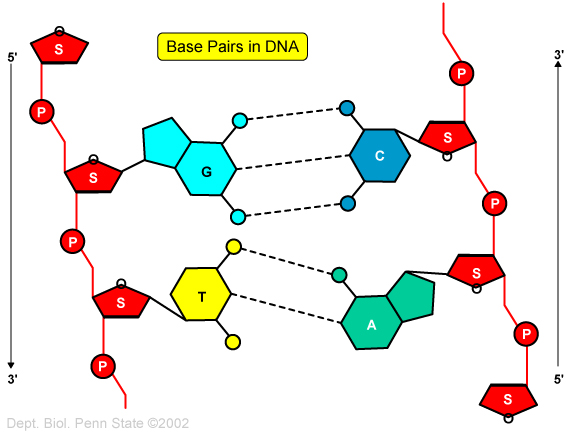
Gyrase
ATG TGA CAG
Okazaki fragments form on the:
Association
What are expressed as proteins?
Exons
Introns
RNA polymerase
Promoters
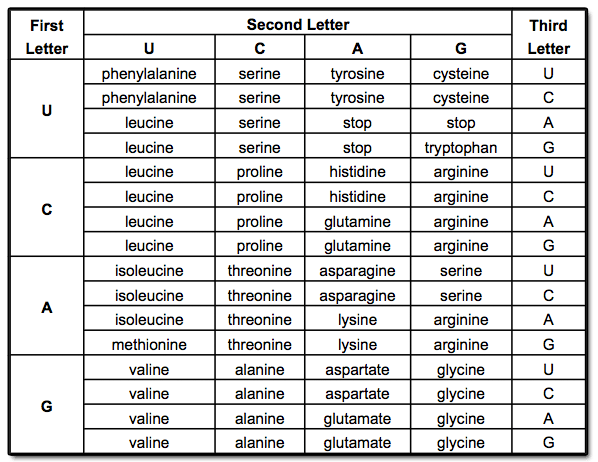
What is the correct amino acid sequence for the mRNA code:
5' AUG CCA GUA 3'
Met-Pro-Ala
Tyr-Arg-His

