
Font size
 Worksheets
Thermodynamics Final Review
Total questions: 34
Worksheet time: 35mins
According to the First Law of Thermodynamics, which of the following statements is true?
Heat is a form of energy that can be created and destroyed.
Heat can be transferred from a cold object to a hot object without external energy.
Heat is a form of energy that can neither be created nor destroyed, only transferred.
Heat is not a form of energy and does not follow the law of conservation.
What does the Zeroeth Law of Thermodynamics state?
If two bodies are in thermal equilibrium with a third body, they are not in equilibrium with each other.
If two bodies are in thermal equilibrium with a third body, they are also in equilibrium with each other.
If two bodies are in thermal equilibrium, they must be at the same temperature.
If two bodies are not in thermal equilibrium, they cannot exchange heat.
What is the Second Law of Thermodynamics primarily concerned with?
The unrestricted creation and destruction of heat energy.
The transfer of heat energy from a body at a lower temperature to a body at a higher temperature without the addition of outside energy.
The prediction of energy costs for heating and cooling systems.
The concept of entropy and the direction of heat transfer.
What is "absolute zero" according to the Third Law of Thermodynamics?
The temperature at which matter contains a maximum amount of energy.
The temperature at which matter is at its most disordered state.
The temperature at which matter has absolutely no energy at all.
The temperature at which matter changes from one state to another.
What does entropy describe in a thermodynamic system?
The transition of energy from one form to another.
The amount of disorder in the system.
The process of heat transfer by direct contact.
The emission and absorption of electromagnetic radiation.

At which state of H2O does it have the highest entropy?
Ice
Water
Vapor
What statement is true about ENTROPY?
Entropy refers to DISORDER, the unusable energy that escapes from a system.
Entropy refers to the temperature balance between two or more systems.
Entropy refers to the average kinetic energy of molecules.
Entropy refers to the inability to destroy or create energy.
What is an example of entropy diminishing in a closed system?
Boiling water
Frozen water
Cells in a body coming together
Ice melting
Is it possible to reach absolute zero?
true
false
How can energy be transferred from a cold object to a warm object?
Work must be done
Increase the thermal energy
Use convection
Q=mTC
How can energy be transferred from a cold object to a warm object?
Work must be done
Increase the thermal energy
Use convection
Q=mTC
When you place a piece of cold metal in boiling water, heat flows from _________ to _______?
metal to boiling water
bottom of the metal to the top of the metal
bottom of the water to the top of the water
boiling water to the metal
What principle explains the natural tendency of heat to flow from a hot object to a cold one?
The Principle of Caloric Flow
The Zeroth Law of Thermodynamics
The Principle of Thermal Dynamics
The Second Law of Thermodynamics
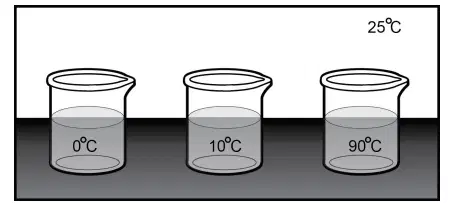
Three bakers containing the same volume of water at three different temperatures are placed in a room with air at a standard temperature.
Which of the following will be the most likely result?
The amount of total energy in the water molecules for all three bakers will increase
The temperature in all three bakers will eventually be 25° C.
The baker at 0° C will eventually by 25° C.
The surrounding room temperature will eventually be 100° C.
Which of the following situations is an example of entropy increasing?
A pond freezing during the winter.
A glass of water sitting on a table at room temperature.
A pot of boiling water cooling to room temperature.
A water heater turning cold water into hot water.
In which of the following situations is entropy increasing?
A pitcher of hot water set out on a countertop.
Water on a stove beginning to boil.
Icicles forming on leaves during the winter.
Condensation forming on the outside of a cold can.
A bowl of hot soup and a glass of ice water are left in a room. Eventually the soup and the water become the same temperature as their surroundings. Which of the following explains the flow of heat that led to the final outcome?
The heat of the soup and the cold of the water were exchanged cancelling each other out?
Heat energy went from the soup to the room and from the room into the ice water.
Heat energy went from the ice water to the soup and from the soup to the room.
The low temperature of the water was transferred to the room and from the room to the soup.
Do molecules generally move faster at 45 C or at 106 C?
45 C because the molecules have more energy than at 106C
106 C because the molecules have more energy than at 45C
106 C because the molecules have less energy than at 45C
45C because the molecules have less energy than at 106 C

When thermal energy is added to a substance, the particles of the substance move:
More rapidly at a greater distance apart.
More rapidly with less distance between them.
More slowly with a greater distance apart.
More slowly with a reduced distance between them.

A substance with a high specific heat:
Always extremely hot.
Requires a lot of energy to heat up.
Is not heavy.
Does not require much energy to heat up.

Thermal energy always moves:
From an object of high temperature to an object of low temperature.
From an object of low temperature to an object of high temperature.
From an object with lower kinetic energy to an object with higher kinetic energy.
From an object of greater mass to an object of lesser mass.
Although closer to the sun, gases that rise in the Earth's atmosphere cool with altitude. One possible explanation is that with an increase in altitude -
solar radiation increases
conduction increases
specific heat decreases
pressure decreases
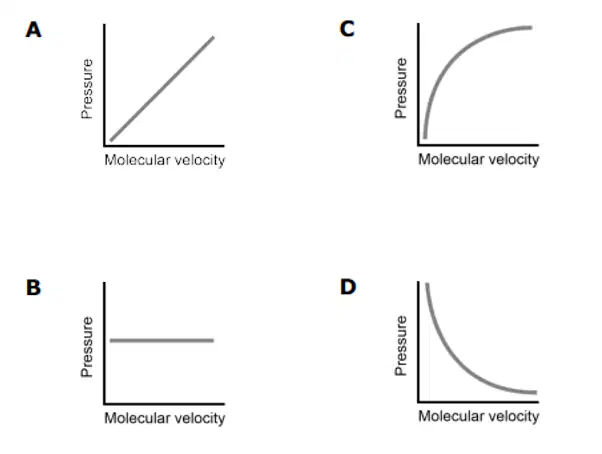
Which graph below shows the relationship between the pressure of a gas and the average velocity of the molecules of a gas.
A
B
C
D
Which of the following would be evidence that supports the claim that a copper kettle heats water faster than a steel kettle? Cooper molecules -
vibrate a lower frequencies than steel molecules.
have more free electrons than steel molecules.
are under less pressure than steel molecules.
move at higher velocities than steel molecules.
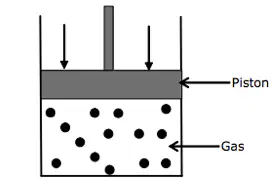
Consider the thermodynamic system shown.
If one Joule of work is done on the gas by pushing the piston down, what happens to the pressure and the kinetic energy of the gas in the cylinder if no energy leaves the system?
Both kinetic energy and pressure increase.
Kinetic energy increases and pressure decreases.
Kinetic energy decreases and pressure increases.
Kinetic energy remains the same and pressure increases.
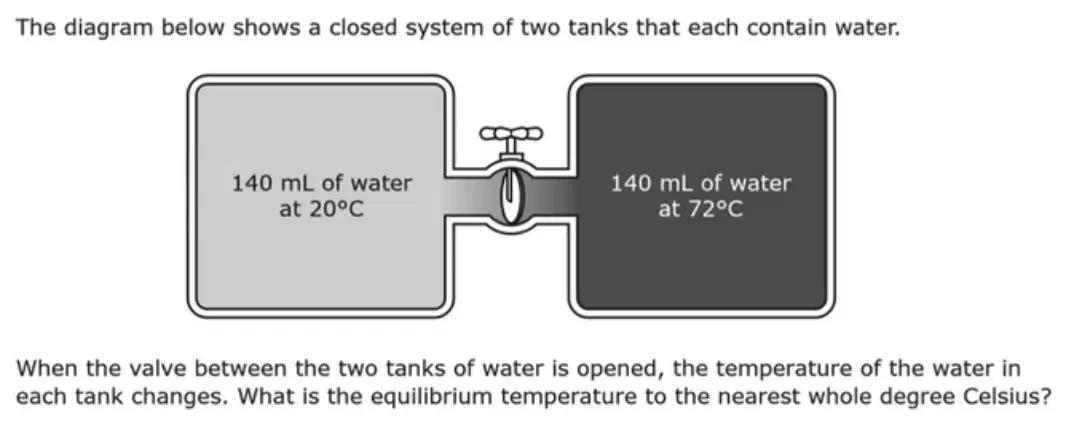
The diagram below shows a closed system of two tanks that each contain water.
When the valve between the two tanks of water is opened, the temperature of the water in each tank changes. What is the equilibrium temperature to the nearest whole degree Celsius?
20° C
46° C
90° C
52° C
As the molecules of a substance gain energy, -
collisions become less frequent.
temperature increases.
they vibrate more slowly.
they increase in size.
During hot summer days, automobile tires, filled with air, sometimes burst. Tires bursting due to elevated temperatures is most likely cause by -
the tire walls becoming weaker during the summer.
an increase in the average kinetic energy of the air molecules inside the tire.
a decrease in the average kinetic energy of the air molecules inside the tire.
a higher atmospheric pressure.
Cooking noodles in a pot of boiling water on an electric stove demonstrates thermal heat transfer by convection when the -
electricity is converted to heat energy in the stove.
heating elements of the stove transfer heat to the pot.
metal pot transfers heat to the water in the pot.
water in the pot transfer heat to the noodles-
How can popcorn be made using conduction?
Cooking in a hot pan.
Heating it with hot air.
Popping it in with a microwave.
Placing it under a heat lamp.
Heat transfer by conduction when -
ice melts in a microwave
s shirt touches a hot iron
water warms in sunlight
a ceiling fan moves air.
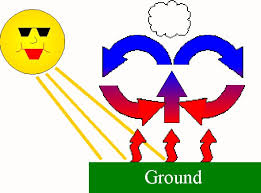
Select 4 answers. Which of the following is an example of Convection?

Convection currents

The energy driving the water cycle

lava lamp ^v

water boiling

hitting hot metal

Which describes what can happen as a result of radiation?
A piece of wood burns in a fire.
A shirt is hot after having been ironed.
A can of soup is heated in a pot on a stove.
A car’s inside temperature rises to over 100 degrees on a sunny day.
Match

radiation

radiation AND conduction

convection

