
 Worksheets
Unit 9: Solving Quadratic Equations Unit Test
Total questions: 48
Worksheet time: 2hrs 36mins
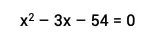
Solve the equation by factoring.


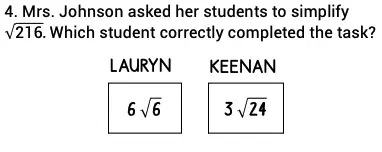

Which of the following represents the positive solution to the equation?
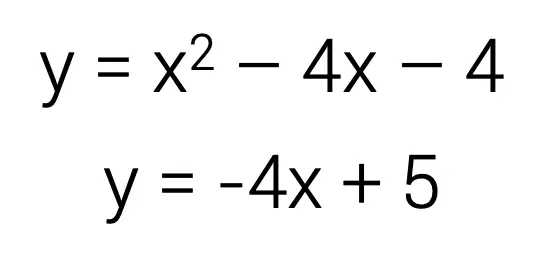
A system of equations is shown below. Find the solution(s) to the system of equations. Write as ordered pairs.
(a)

(a)
What is the vertex of (x + 9)² − 5 = 20? Write as an ordered pair.
(a)
What are the solutions to (x + 9)² − 5 = 20? Check all that apply.
Pedro is analyzing the quadratic function y = x² – 6x + 20. Which of the following is NOT true?

Three students wrote quadratic equations. Use the discriminant to determine which student(s) wrote equations with two real solutions.
What are the solutions to x² + 13x = -40?
(a)
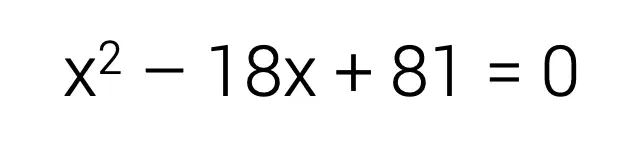
Solve the equation below.
(a)
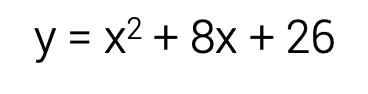
Convert the quadratic function shown below to vertex form using the steps of completing the square.
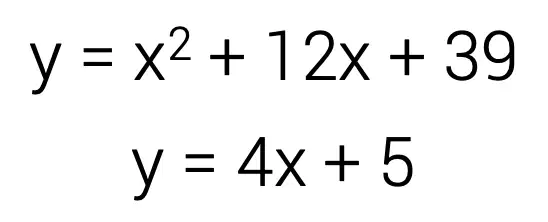
Use the discriminant to determine the number of real solutions to the system of equations shown below.
(a)
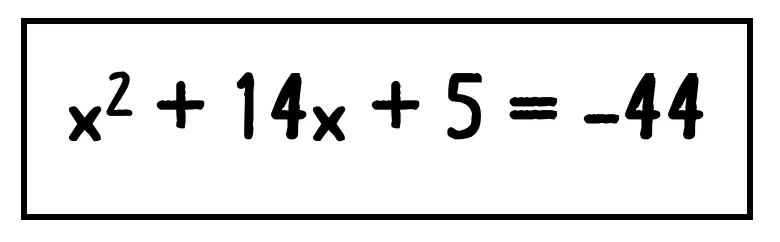
Mr. Bailey writes the quadratic equation shown below on the board. Which of the following statements is true?
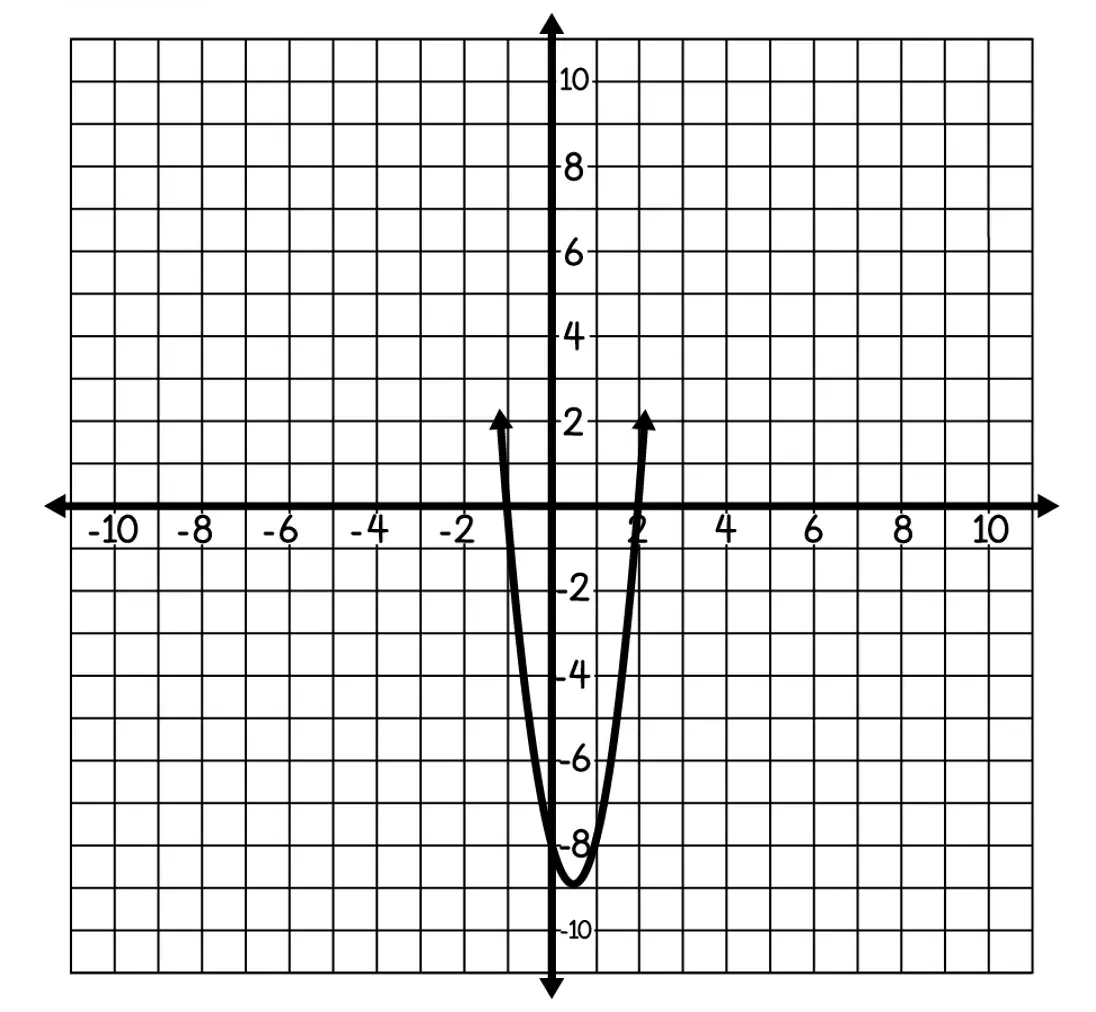
Write the quadratic equation that represents the function.

Find the sum of roots in the equation given.
(a)



Write an equation with the roots given..

-6
8
3
4

Find the product of roots for the equation given.
(a)
Graph y=(x−3)2−4
A quadratic functions is defined as:
f(x)=(x−4)2+3
What is the equation of the parabola in standard form?
(a)
f(x)=x2−8x2+19
f(x)=x2−8x−13
f(x)=x2−4x+19
f(x)=x2−4x−13
f(x)=x2+8x+19
A quadratic is defined as y=(x+3)2−6
What is the equation for this function in standard form?
Your answer needs to be in the form of:
y=ax2+bx+c
Enter your answer in the space provided.
You need to know the vertex to state the (a) which comes from the x value of your vertex.
You also need to know the Vertex to state the (b) which comes from the y value of your vertex.
What is the positive solution to this equation? 2x2−5x=12
Match each option to the types of solutions produced
2(1)−3±9−4(1)(−3)
Irrational Solutions
2(1)−3±9−(4)(1)(3)
Complex Solutions
2(1)−3±9−4(1)(2)
Rational Solutions
Solve the equation:
(x+5)2=81
Enter the larger solution only.
What is the positive solution of x2−2x=80 ?
Identify a, b and c in the quadratic equation: 2x2−3x−5=0
a = 2 , b = 3, c = -5
a = 2, b = -3, c = 5
a = 2, b = -3, c = -5
a = -2, b = 3, c = 5
b2−4ac is called the . . .
Square root
Quadratic formula
X-intercepts
Discriminant
Solutions of a quadratic equation are also called
roots
x-intercepts
zeros
All of the above
If there are no real solutions, the discriminant is
zero
a postive number
a negative number
a perfect square
If there is one solution, the discriminant is . . .
zero
a postive number
a negative number
a perfect square
If the discriminant is equal to -2, how many solutions are there?
2 Imaginary Solutions
1 Real Solution
2 Real Solutions
Infinite Solutions
Solve the following equation using the quadratic formula: 5x2−6=13x
x=−2, x=−53
x=2, x=53
x=3, x=−52
undefined
x2 + 10x + ____
What value of c would complete the square?
x2 +8x + c
4
16
64
-16
Complete the Square:
x2 + 14x + (a)
x2 + 14x + 49
Match the following
x2 - 16x + 64 =
(x - 8)2
x2 + 8x + 16 =
(x + 4)2
x2 + 4x + 4 =
(x + 2)2
x2 - 4x + 4 =
(x -2)2
Put the steps to Completing the Square in the correct order
Move constants to one side
add (2b)2 to both sides
Factor the trinomial
Take the square root of both sides.
Solve both cases.
x2 - 4x + 4 = 20,
what goes in the blank?
(x - __ )2 = 20
Solve for x by taking the Square Root:
(x+6)2 = 49
x = 7 and 12
x = ±7
x = 1 and -13
x = 43 and -55

