
Font size
 Worksheets
SS 6B Semester Exam Review
Total questions: 74
Worksheet time: 40mins
What is a defining characteristic of a "Golden Age" in history?
Decline in cultural achievements
Economic instability
Significant advancements in arts and science
Frequent military conflicts
Which civilization was known for building Tenochtitlan on the largest lake?
Maya
Aztec
Inca
Olmec
What type of farming technique is associated with the Aztecs?
Terrace farming
Slash and burn
Chinampas
Crop rotation
Which Mesoamerican civilization developed a calendar system that included lunar and solar calendars?
Maya
Aztec
Inca
Toltec
What was a significant achievement of the Inca civilization in terms of infrastructure?
Building pyramids
Developing floating gardens
Creating an extensive road network
Inventing the zero concept
What does the word "democracy" mean in Greek?
Rule of the land
Power of the people
Government by the few
Leadership of the majority
What type of democracy was practiced in ancient Athens?
Representative democracy
Monarchical democracy
Direct democracy
Indirect democracy
Who were allowed to participate in the Athenian democracy?
All residents of Athens
Free men who owned land
Women and slaves
All children over the age of ten
How is modern democracy different from Athenian democracy?
Modern democracy allows only men to vote
Modern democracy practices direct democracy
Modern democracy uses a representative system
Modern democracy excludes property owners
In a modern representative democracy, who makes the final decisions on laws?
The general public
Elected officials
Non-governmental organizations
Foreign advisors
What did Alexander the Great encourage his subjects to learn under his rule?
Persian laws
Greek alphabet
Egyptian rituals
Indian mathematics
Which cultures blended to form the Hellenistic culture during Alexander the Great's empire?
Greek and Persian
Persian and Egyptian
Greek, Persian, Egyptian, and Indian
Greek and Roman
What concept did Alexander the Great bring from Greek civilization to the conquered territories?
Democratic governments
Monarchy
Theocracy
Oligarchy
How did Alexander the Great show respect to the cultures of conquered nations?
By adopting their military tactics
By changing his religion
By dressing in Persian clothing and marrying the daughter of the king
By imposing Greek culture exclusively
Who were the Consuls in the Roman Republic?
Military leaders elected by the Senate
Elected leaders with the power to veto each other
Members of the Assembly
Permanent members of the Senate
What was the role of the Senate in the Roman Republic?
To elect the Consuls
To serve as the judicial body
To control state matters and finances and monitor the Consuls
To represent the plebeians
Who could participate in the Assembly during the Roman Republic?
Only the Consuls
Patricians and plebeians
Any Roman citizen
Only the senators
What power did the tribunes have in the Roman Republic?
They could make laws
They had military control
They could veto decisions made by the Consuls
They were responsible for financial decisions
Who were the leaders of the executive branch in ancient Rome?
Senators
Consuls
Tribunes
Plebeians

What document served as the basis for Roman law according to the image?
U.S. Constitution
Code of Hammurabi
Twelve Tables
Code of Justinian
Which citizens were allowed to vote in the Roman Republic?
All adult citizens
Only adult males whose parents were both Athenian
Males who owned land
All adult males
According to the image, what is a common feature of the government in the United States?
Only adult males can vote
Citizens participate in all levels of government
Laws written to protect the citizens
Citizens serve in the military
What system is used to maintain power distribution in the Roman Republic as shown in the image?
Direct democracy
Checks and balances
Only adult males vote
Leaders are not elected
What did the Han Dynasty invent to measure earthquakes?
Compass
Seismograph
Telescope
Abacus
Which field did the Han Dynasty NOT make advances in according to the image?
Literature
Medicine
Science
Technology
What was one of the medical advancements during the Han Golden Age?
Invented the stethoscope
Developed anesthetics
Created the first vaccine
Discovered penicillin
What artistic achievement is attributed to the Han Dynasty?
Oil painting
Sculpting in marble
Silk-making techniques
Digital art
Which empire relied on trade via the Silk Road for economic strength?
Roman Empire
Han Dynasty
Gupta Empire
All of the above
What was the unifying system of beliefs in the Han Dynasty?
Hinduism
Confucianism
Christianity
Buddhism
Which empire used Sanskrit as its literary language?
Roman Empire
Han Dynasty
Gupta Empire
None of the above
What common issue did the Roman Empire, Han Dynasty, and Gupta Empire face that contributed to their downfall?
Strong military leadership
Economic prosperity
Inability to defend borders
Cultural advancements
Which empire was weakened by both external invaders and internal conflicts according to the image?
Roman Empire
Han Dynasty
Gupta Empire
Byzantine Empire
According to the image, what was a common financial problem faced by all three empires mentioned?
Excessive wealth
Inability to collect taxes to support public works
Trade deficits
Overspending on military expeditions
Who is the leader of the Roman Catholic Church according to the 11th century description?
Patriarch
Emperor
Pope
Bishop
What is a common goal of both Roman Catholic and Eastern Orthodox branches of Christianity in the 11th century?
To maintain peace among all religions
To convert people to Christianity
To establish schools
To collect taxes from followers
Which language is used in Roman Catholic services during the 11th century?
English
Latin
Greek
Russian
In the Eastern Orthodox Church, who has authority over the church officials?
The pope
The patriarch
The emperor
The bishops
What is a key difference in the clergy of the Roman Catholic and Eastern Orthodox branches?
In Roman Catholicism, priests may be married.
In Eastern Orthodoxy, priests may not be married.
In Roman Catholicism, priests may not be married.
In Eastern Orthodoxy, all priests must be women.
How can significant events change the course of history?
By altering political boundaries
By changing weather patterns
By influencing music trends
By modifying language usage
How can the fall of an empire create a new society?
By redistributing wealth
By changing leadership
By introducing new cultures and ideas
All of the above

Who is at the top of the feudal system according to the diagram?
Knights
Peasants/Serfs
Nobles/Lords
King
What was the primary duty of knights in the feudal system?
Provide food and service
Pay rent to the lord
Provide protection and military service
Grant land to peasants
What did the nobles/lords provide to the king in the feudal system?
Workforce and food
Military service
Money and knights
Land grants
What role did peasants/serfs play in the feudal system?
Provided military service
Paid rent and provided food and service to those above
Granted land to knights
Provided money to the king
What does the Magna Carta state about the king and the law?
The king can change the law as he wishes.
No man, not even the king, is above the law.
The king is the sole interpreter of the law.
Only the king is above the law.
According to the Magna Carta, what is the role of the Church in relation to the king?
The Church must pay taxes to the king.
The Church is under the complete control of the king.
The Church is to be free from royal interference.
The Church should support the king unconditionally.
What does the Magna Carta guarantee about trials?
Trials are to be conducted without a jury.
Everyone has a right to due process (fair treatment and trial by jury).
Only nobles are entitled to a trial by jury.
Trials are to be conducted by the king alone.
How does the Magna Carta address the issue of representation in government?
Only the king's appointees can be in the government.
People are not allowed to have any representation.
People are allowed to be represented and have a say in their government.
Representation is limited to the nobility.
Who is the founder of Islam according to the chart?
Muhammad
Abraham
Jesus Christ
None of the above
What is the main holy book of Christianity?
the Bible
the Qur'an
the Torah
None of the above
According to the chart, what is a common belief in Judaism?
The Messiah will restore peace on Earth
Allah is the one true god
Jesus is the son of God
Muhammad is Allah’s final and greatest prophet
Which religion's main beliefs include the concept of the Trinity?
Islam
Judaism
Christianity
None of the above
What do all three monotheistic religions listed in the chart believe in?
Multiple gods
A single god
Reincarnation
Polytheism
According to Confucianism, what should be the nature of the relationship between parent and child?
Parents should be strict, children should be obedient.
Parents should be loving, children should be respectful.
Parents should be distant, children should be independent.
Parents should be authoritative, children should be submissive.
What is expected of husbands and wives in the Five Constant Relationships of Confucianism?
Husbands should be passive, wives should be controlling.
Husbands should be indifferent, wives should be supportive.
Husbands should fulfill their duties, wives should be obedient/appreciative.
Husbands should be demanding, wives should be submissive.
How should rulers behave according to Confucianism?
Rulers should be tyrannical.
Rulers should be benevolent (kind).
Rulers should be indifferent.
Rulers should be authoritative.
What are the key values highlighted in Confucianism that benefit society?
Right Behavior, Importance of Education, Knowing One's place in society.
Wealth accumulation, Social superiority, Individualism.
Entertainment, Leisure, Personal freedom.
Competition, Ambition, Self-interest.
Match the following based on oldest to youngest West African Empire:
First West African Trading Empire (Oldest)
Ghana
Second Oldest West African Trading Empire
Mali
Third (most recent) West African Empire
Songhai
The Turks conquered Northern India & left it in the hands of two former slaves.
Muslims, the minority, ruled over majority, Hindus and they made it difficult to practice other beliefs. This was called the (a) and caused Islam to spread through (b) .
In Southeast Asia and Indonesia, _____ caused Islam and Buddhism to spread the most.
trade
conquest
disease
population growth
How did the Bubonic Plague contibute to the decline of Feudalism?
Killed off everyone in the Feudal system
Gave more power to the clergy allowing them to gain more land and taxes
Desperate need for workers and now workers could demand more rights
Stopped all legal reforms which gave power back to its original owners
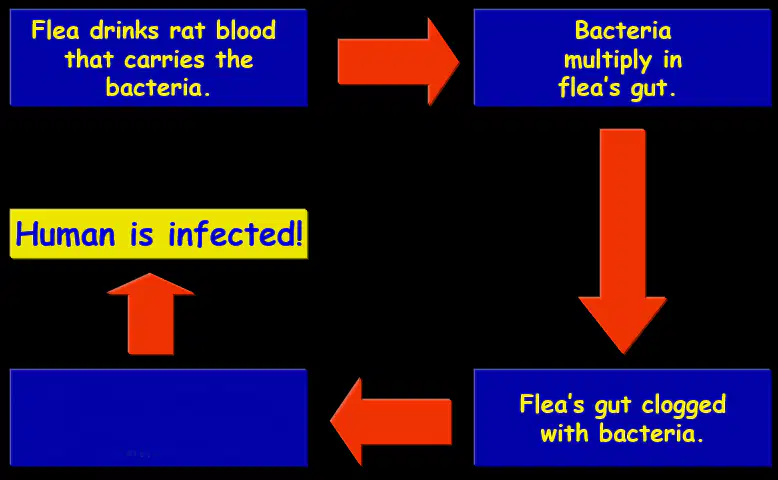
Complete the cycle of infection.
Flea climbs into human hair and bursts.
Flea bites human and regurgitates infected blood into the wound.
Flea vomits on human skin or clothing.
Flea infects human food.
Northern renaissance art different from Italian renaissance art because
It focused on everyday life and used oil paints
It focused on religion and the need for change
It recreated art of the classical time period
It did not use perspective

All of the following were results of the Reformation except
people became more curious about science & the natural world
Protestants and Catholics resolved their religious conflicts
the idea of self-government began to take hold
Northern European countries became largely Protestant
King Henry VIII
Created the Church of England
Martin Luther
German monk who wrote 95 Theses
John Calvin
Believed in Predestination
Ignatius
Started the Jesuits charity
Elizabeth
Protestant Queen who had the Golden Age
Which of the following were key changes that came out of the Renaissance and Reformation period that helped set the stage for the Scientific Revolution?
emphasis on individuality
monarchs decreased in power and an increase in the power of the Church
development of the printing press
an understanding of germs and how disease spread
European exploration of Africa, Americas and Asia as well as the increased wealth of merchants involved in overseas trade
Which of the following was an important result of the Protestant Reformation?
The power of the Church increased as Protestants came in to conflict with each other
Learning decreased as people stopped attending Catholic services
The wealth of the Catholics quickly outpaced that of the Protestants
Learning and literacy increased as people were encouraged to read the Bible for themselves
What was the impact on religion of the scientific discoveries made during the Scientific Revolution?
The power of the church in Europe weakened, and science began to become a secular field.
The scientists spent more time researching the role of God in the universe.
The church became even more responsible for spreading the new scientific discoveries.
The church gained support from the scientists to promote the teachings of Aristotle.
One Enlightenment
idea was the social contract which means
citizens give up some freedom they would have in a state
of nature, and in exchange the government can do whatever it wants
citizens give up some freedom they would have in a state
of nature, and in exchange the government can take their money
citizens give up some freedom they would have in a state
of nature, and in exchange the government
protects citizens’ right to life, liberty, and property
citizens give up some freedom they would have in a state
of nature, and in exchange the government can do anything
How did Rousseau influence America's government?
If a new leader is chosen during an election, it's because people feel like their rights aren't being protected by the government
We aren't allowed to elect leaders in the United States
Freedom of speech means that people can vote for whoever they want during elections
Leaders are allowed to rule regardless of what religion they practice
How did Thomas Hobbes influence America's government?
Thomas Jefferson emphasized the idea of inalienable natural rights
The first amendment protects freedom of speech and religion
American government emphasizes the importance of law and order
No single branch of the government controls everything
How did Montesquieu influence America's government?
There are three branches of the government, and no single branch has absolute power
There are three branches of the government, and the president controls everything
The president has absolute, unchecked power
People have no way of holding leaders accountable
How did John Locke influence America's government?
Thomas Jefferson emphasized the idea of inalienable natural rights
The first amendment protects freedom of speech and religion
American government emphasizes the importance of law and order
No single branch of the government controls everything

