
Font size
 Worksheets
Year 10 Physics Midterm
Total questions: 40
Worksheet time: 43mins
_________ is the unit of Spring Constant
N
N/m
m
If the original length of a spring is 20m and its extended length is 30m. What is the extension?
20m
12m
75m
45m
10m
A 25,000 N Car is supported by 4 springs. If each spring is deflected by 0.040 m what is the spring constant? (Think about how much weight each spring holds up!)
160,000 N /m
620,000 N/m
630,000 N/m
120,000 N/m
A net force of 1400 N acts to stretch an extension spring. How far will the spring stretch if its spring constant is 700 N/m?
1.0
0.5m
1.5 m
2.0 m

At point P, _______.
the force applied to the spring is equal to its elongation
Hooke's Law ceases to be valid
the spring is can be stretched but still springs back into shape reversibly
the spring constant increases

When comparing spring A to B,
both experience the same maximum force
both experience the same elongation
both store the same amount of elastic potential energy
both have identical spring constants
When comparing spring A to B,
A has a larger spring constant than B so A is a stiffer spring
B has a larger spring constant than A so A is a stiffer spring
A has a larger spring constant than B so B is a stiffer spring
B has a larger spring constant than A so B is a stiffer spring

If a spring is extended beyonds it elastic limit, what two things does this mean for the spring?
The spring will no longer return to its original length.
The spring will no longer obey Hookes Law.
The spring will no longer extend.
The spring will bounce back to its original length.

Which would be the least likely to sink into soft ground?
A loaded lorry with 4 wheels.
An empty lorry with 4 wheels.
A loaded lorry with 6 wheels.
An empty lorry with 6 wheels.

A brick of weight 80 N rests on the ground. What is the maximum pressure it can exert on the ground?
0.08 N/cm2
0.8 N/cm2
0.4 N/cm2
1.6 N/cm2

Ice cracks if the pressure on it is more than 3000 N/m². A man of weight 900 N wants to safely walk over the ice. What should be the area of each of his snowboots?
0.15 m2
0.30 m2
1.67 m2
3.33 m2

A sharp knife has
a large contact area and a large pressure
a small contact area and a large pressure
a small contact area and a small pressure
a large contact area and a small pressure
Which of the following is NOT a unit for pressure?
Pa
N/cm2
Nm2
N/m2

When blood pressure is measured, the cuff of the sphygmomanometer is wrapped round the upper arm and must be held at the level of the heart. Why?
Blood pressure depends on the level of the blood.
Blood pressure is normal when the cuff and heart are at the same level.
Blood is able to flow easily to the wrist.
The pressure of sea water at the bottom of the sea is 1.2 × 10⁸ N m–2.
Determine the depth of the sea.
[Density of sea water = 1020 kg m–3]
1.2×10⁴ m
1.02×10⁵ m
1.11×10⁴ m
1.108×10⁵ m

Diagram shows the design of a dam. Why does the thickness of the dam increase with its depth?
The design of this structure is stronger.
Water pressure increases with depth.
The cost of construction is lower.
Water pressure acts uniformly in all directions.

The figure below shows a reservoir on a hill. The reservoir supplies water to a water tank on a tall building.
Calculate the water pressure at X.
(Density of water = 1000 kg m–3)
1.14×10⁹ Nm–2
1.4×10² Nm–2
1.37×10⁵ Nm–2
1.3×10⁸ Nm–2

A coin sinks to a depth of 5 m in a liquid of density 800 kg m–3. At what depth, in a different liquid of density 600 kg m–3, will the coin be subjected to the same pressure?
6.67 m
8.67 m
9.67 m
5.67 m

The figure shows a pond with two fish P and Q.
What is the correct relation of the water pressures on fish P and fish Q?
Water pressure on fish Q > Water pressure on fish P.
Water pressure on fish Q < Water pressure on fish P.
Water pressure on fish Q = Water pressure on fish P.
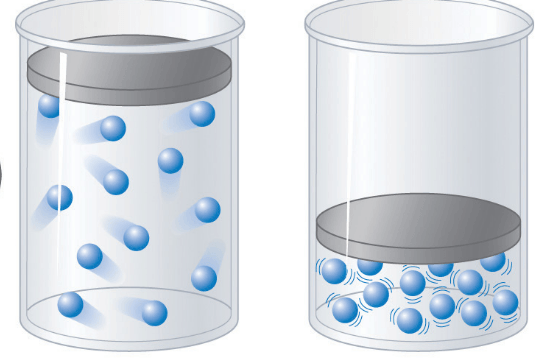

A car tyre runs over a nail which makes a hole in it. The air in the tyre leaks out. Why does the air leave the tyre?
The pressure inside the tyre is greater than the pressure outside.
The pressure inside the tyre is less than the pressure outside.
The temperature inside the tyre is greater than the temperature outside.
The temperature inside the tyre is less than the temperature outside.
Choose factors that affect the pressure in liquid.
depth of liquid
gravitational strength
density of liquid
volume of liquid
A diver is at 100 m depth in a sea. If density of the sea water is 1025 kg m-3 , calculate the water pressure acting on the diver? Use g = 9.8 m/s2
1005.5 kPa
1000.0 kPa
1025.0 kPa
1020.0 kPa

Diagram 10 shows a water container being tilted to increase the outflow of the speed of water.
Which factor increases the speed of water?
Gravity
Depth of water
Volume of water
Density of water
The pressure due to water at the base of a pond is measured as 50 kPa. What is the depth of the pond?
[density of water is 1,000 kg m-3]
10 meter
12 meter
8 meter
5.1 meter

What is the pressure at point X?
Density = 1000 kgm-3
29.43 Pa
6.87 Pa
22.54 Pa
23.45 Pa
Hint: Boyle's Law

