
NEW
Font size
 Worksheets
Reproduction Storyline Review
Total questions: 30
Worksheet time: 17mins
Asexual reproduction has
1 parent
2 parents
Sexual reproduction has
1 parent
2 parents
Asexual reproduction creates offspring that are
genetically identical to the parent
different from the parent
different from each other
formed by 2 parents
Budding, vegetative propagation, regeneration, and binary fission are all types of
sexual reproduction
asexual reproduction
In mitosis, how many cells are made?
2 cells with identical genetic information
2 cells with different genetic information
4 cells with identical genetic information
4 cells with different genetic information
In meiosis, how many cells are made?
2 cells with identical genetic information
2 cells with different genetic information
4 cells with identical information
4 cells with different genetic information
The egg cell of a koala contain 12 chromosomes. How many chromosomes does a normal cell contain?
6
12
24
36
A hydra has 32 chromosomes and reproduces by budding. How many chromosomes does its offspring have?
8
16
32
64
The remnants of a mature follicle after ovulation
Corpus albicans
Corpus luteum
Graafian follicle
Corpus albuginea
The mature egg cell goes into the fallopian tube where it waits for a sperm cell. Thus, the fallopian tube serves as the site of fertilization.
True
False

Where does the following occut?
A) Meiosis?
B) Fertilization?
C) Growth & Development of Baby?
A) 5
B) 4
C) 3
A) 4
B) 5
C) 3
A) 3
B) 4
C) 5
A) 3
B) 5
C) 4

"C" will inherit...
46 chromosomes from each parent
half of their chromosomes (23) from each parent
Double the amount of chromosomes from each parent
Pairs of chromosomes from each parent

Identify the structure labeled "B".
Fallopian Tubes
Ovaries
Uterus
Placenta

What is the function of A & B?
A - transport gametes (eggs)
B - Produce eggs
A - produce eggs
B - transport gametes (eggs)
A - transport gametes (sperm)
B - produce sperm
A - produce sperm
B - transport gametes (sperm)
What is the periodic shedding of tissues and blood from the inner lining of the
uterus?
menopause
ovulation
pregnancy
menstruation
In an embryo, the process when the cells start becoming the many specialized types of tissues and organs it needs is known as
Fertilization
Differentiation
Genetic recombination
Meiosis
Which structure allows nutrients to pass to the embryo and takes wastes away from the embryo?
Placenta
Ovary
Testes
Fallopian tubes
The combining of a sperm cell and an egg cell creates
Zygote
Umbilial cord
Uterus
Embryo
What is the function of the human male reproductive system?
grow and develop baby
produce egg and deliver egg to female
internal fertilization
produce sperm and deliver sperm to female
The products of MEIOSIS have _______ number of chromosomes.
haploid
diploid
Differences in DNA between individuals or populations
Environmental Variation
Genetic Variation
Adaptive Feature
Genetic Engineering
Which sequence represents the correct order of processes that result in the formation and development of an embryo?
meiosis-fertilization -mitosis
mitosis-fertilization-meiosis
fertilization -meiosis -
mitosis
fertilization -mitosis -
meiosis
Which of the following best describes stem cells?
Cells that have already differentiated
Cells that cannot undergo cell division
Cells that have been mutated
Original human cells that are able to develop into specialized cells
Which best explains why muscle cells are different from blood cells?
Muscle cells are produced by the brain, but blood cells are produced by the heart.
Different genes are activated in muscle cells than in blood cells.
Muscles cells experience different environmental influences than blood cells.
A mutation occurs during the development of muscle cells but not in blood cells.

What is implantation?
The process by which the fetus is delivered from the uterus
The formation of the placenta
The attachment of the fertilised egg to the uterine wall
The formation of the amniotic sac
The male and female reproductive systems are regulated by...
hormones
sex drive
number of chromosomes
heredity

What is the amniotic sac?
The fluid-filled sac that surrounds the fetus
The organ that connects the fetus to the mother's blood supply

The karyotype diagram below represents a human male. Chromosomal analysis of this karyotype reveals the abnormality in this karyotype is:
a missing X chromosome
a missing Y chromosome
an extra 21 chromosome
missing chromosome #9
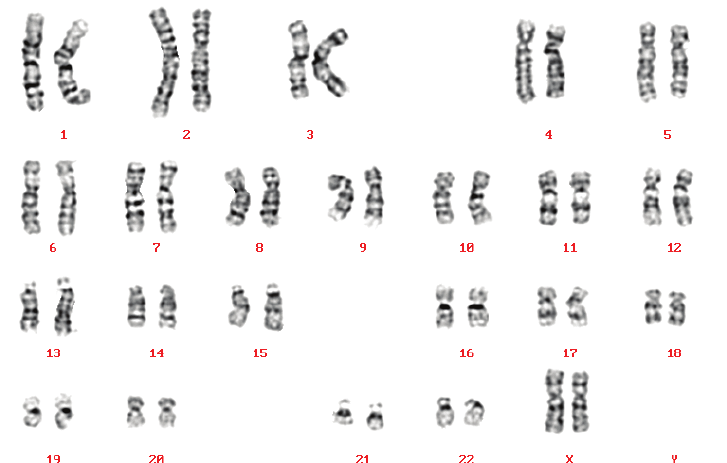
By looking at the chromosomes how can you tell that this person is biologically female?
Because there are two X chromosomes
Because there are more chromosomes than in a male
Identical twin girls are separated at birth and cared for by two different families. After twenty years, the twins have different heights and weights. What is most likely the cause of these differences?
One twin had a genetic condition that prevented her from growing tall.
The DNA of one twin was different from the DNA of the other twin.
Each twin was provided a different diet and physical activities.
The proteins made by one twin were different than the proteins made by the other twin.

