
 Worksheets
ICP Chemistry Review
Total questions: 220
Worksheet time: 18hrs 20mins
What should you do if a piece of equipment breaks?
Keep it to yourself
Tell your lab partner
Notify your instructor
Clean it up by yourself
What should you do if you do not understand part of the lab instructions?
Ask your instructor for help
Skip that part of the lab
Ask your lab partner
Figure it out during the lab
What should be done with long hair before starting a lab?
Do nothing, let it hang freely
Hold it back with your hand
Tie it back out of the way
Use a hat to hold it back
What type of footwear would be best worn in a laboratory?
High Heels
Sandals
Sneakers
Flip-Flops
When is horseplay, or goofing around, acceptable in a laboratory?
Always
Sometimes
Never
Depends
Why are food and drink not permitted during an experiment?
They could make your lab partner hungry
They could attract ants and other insects
They could make your instructor hungry
They could contaminate the experiment

Which of the following is not an example of quantitative data?
Temperature
Speed
Height
Texture
What is the difference between a scientific law and a scientific theory?
A scientific law explains what happens(rule), while a scientific theory explains why something happens
A scientific law explains why something happens, while a scientific theory explains what happens
A scientific theory explains what happens(rule), while a scientific law explains why something happens
Both scientific theories and scientific laws explain why something happens
Which step, when solving a problem, involves making an inference based on reasoning and observations?
Present results
Perform the experiment/collect data
Form hypothesis
Analyze the data
At one point in time, many people thought disease was caused by fate or by incorrect behavior. Following the invention of the microscope, bacteria were discovered. After this, a new theory of what causes disease arose that was known as the germ theory. Why was the original theory modified?
It quickly became obvious that germs cause disease.
The person who invented the microscope became ill.
New evidence prompted revision to the original ideas.
The original theory was modified due to heavy political influence.
Jane Goodall spent years with the chimpanzees of Gombe. Sitting quietly for hours, she watched the animals closely and took notes about their behavior. What was Jane Goodall doing?
Testing Variables
Making Observations
Watching a Control Group
Creating a Theory/Law
Making an Inference
Which of the following statements about a controlled experiment is true?
All variables must be kept the same.
You should only test one variable at a time.
Controlled experiments must be completed within a lab.
The whole purpose of experiments is to prove your hypothesis was right. We collect data to support our hypothesis.
Explains something we see in the natural world that has been verified through repeated experiments or testing.
hypothesis
law
theory
Inference

Identify the dependent variable according to this graph.
Seed Type
Number of Bird Species
Sunflower and Sorghum
Sunflower
What is the purpose of the scientific method?
to answer questions
to create solutions to problems
to collect data based on an experiement
to get peer reviewed

It is a branch of Science that studies all living things
Life Sciences
Physical Science
Earth Science
Astronomy

It is the study of Earth. It studies the processes that form and shape Earth's surface
Biology
Earth Science
Physics
Chemistry

If you want to know an unknown plant species found in the garden, who do you ask for help?
Chemist
Physicist
Astronomer
Botanist

A fossil is found in your backyard and you want to identify its history. Who is the right person to help you?
Microbiologist
Molecular biologist
Paleontologist
Botanist
The SI unit for mass is _________.
Pounds
Inches
Kilograms
Ounces
A system of units of measure widely accepted by the scientific community (SI for short)
International System of Units
World Wide Weight
Science Instruments
Use These Measures


The SI unit for time is the __?__.
hours (h)
liter (L)
gram (g)
second (s)
What SI unit is used to measure length?
meters
liters
centimeters
kilograms
8 kilometers equals how many meters?
800 m
80,000 m
8,000 m
0.008 m

To convert from cm to m, you should...
multiply by 100
multiply by 10
divide by 100
divide by 10
Which is the SI unit of measurement for length?
Centimeters
Meters
Millimeters
Red Strings
What is the symbol for the prefix kilo-?
L
m
k
kg
Which two units of volume are the same? (select all that apply)
cm3
L
cm2
mL
The SI units of science are based on the __________ system
Emperical
Standard
Metric
Science

What is the volume of the Green Jade sample in the image?
60.5 cm3
10.5 mL
50 mL
10.5 cm3
When measuring the volume of soda in a large bottle, what unit of measure should be used?
L
mL
kL
Gallons
Which options shows the correct conversion between grams and milligrams?
85g = 8500mg
85g = 8.5mg
85g = .85mg
85g = 85000mg
Which SI unit is used to measure amount of substance?
m
K
mol
A
Which unit is the largest?
What prefix does the abbreviation d stand for?
denti
deka
decto
deci
10,000 meters
There are ___ millimeters (mm) in 2.7 centimeters (cm)
270 mm
0.27 mm
27 mm
.027 mm
There are ___ meters in 25 kilometers (km)
250 m
2,500 m
25,000 m
0.025 m
How many millimeters (mm) = 1 meter (m)?
1
10
100
1,000
Which statement is true?
25 mL is larger than .25 L
1,300 g is equal to 1.3 kg
1 cm is ¹/₁₀ of a m

7,000 g = ____ kg
70
700
7
0.07

3 km = ___________ mm
30
300
3,000
3,000,000

32.9 km = ___________ cm
32,900
329,000
3,290,000
32,900,000

1000 grams = _____ kilograms
0.0001
1,000,000
10
1
How would you write 0.0005 in scientific notation?
50 x 10-5
5 x 10⁻⁴
5 x 10³
.5 x 103
Which of the following numbers is written in scientific notation?
20.35 x 10⁴
.2035 x 104
2035 4
2.035 x10⁴
Express the following in scientific notation:
.000457
457 x 106
457 x 10-6
4.57 x10⁴
4.57 x 10⁻⁴
Convert to scientific notation:
520,000,000
52 x 107
5.2 x 10⁻⁷
5.2 x 10⁸
0.52 x 10⁹
If the exponent is a negative number the original number was...
a really large number.
a really small number.
------------
2 x 10⁶
4 ⋅ 1048 ⋅ 107
2 ⋅ 103
2 ⋅ 1011
24 ⋅ 103
0
(8 ⋅ 103) + (5 ⋅ 102)
8.5 ⋅ 103
13 ⋅ 103
1.3 ⋅ 102
3⋅ 103
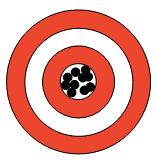
This bullseye demonstrates...
High Accuracy & High Precision
High Accuracy & Low Precision
Low Accuracy & High Precision
Low Accuracy & Low Precision
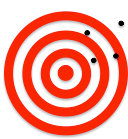
Describe the accuracy and precision of the image
Very accurate and somewhat precise
Very accurate but not precise at all
Not accurate at all but very precise
not accurate and not very precise
Which type of mixture is uniform throughout?
Homogeneous
Heterogeneous

What is a change in which a new substance is NOT formed?
physical change
chemical change
color change
physical property

Chex mix is a
Mixture
Compound
Element
Chocolate milk is
Element
Mixture
Compound
All elements are composed of extremely small particles called
compounds
mixtures
atoms
molecules
Substances that cannot be broken down chemically into other substances are
elements
compounds
mixtures
solutions
What are the 3 subatomic particles of an atom?
carbon atom, proton, electron
quarks, neutrons, protons
nucleus, protons, electrons
protons, neutrons, electrons
What is the smallest particle of an element?
atom
molecule
cell
compound
Why isn’t water on the Periodic Table?
because it is a liquid at room temperature
because it doesn't have any protons
because it is a compound
because it is not made up of elements
Which of the following cannot be broken down into something simpler?
a compound
an element
a chemical formula
a mixture

This substance can be separated by physical means
Mixtures
Pure Substances
Elements
Compounds
The composition of this substance is uniform throughout
Homogenous mixtures
Heterogeneous misxtures
Elements
Compounds

How does the amount of energy change in the substance in the phase change from gas to a liquid?
energy is not affected
increases the amount of energy
decreases energy the amount of energy
amount of energy cannot be determined
How does the amount of energy change in the substance in the phase change from a solid to a gas
energy is not affected
increases the amount of energy
decreases energy the amount of energy
amount of energy cannot be determined
Classify the following as an element, compound, homogeneous mixture, or heterogeneous mixture.
Gold (Au) and Oxygen (O2)
Homogenous mixtures
Heterogeneous mixtures
Elements
Compounds
Classify the following as an element, compound, homogeneous mixture, or heterogeneous mixture.
Water (H2O), Table Salt (NaCl)
Homogenous mixtures
Heterogeneous mixtures
Elements
Compounds
Identify the following changes as chemical or physical
Burning Paper
Chemical
Physical
Cannot be determined
The properties of liquids include (SELECT ALL THAT APPLY)
definite volume
take the shape of the container
can flow
are relatively incompressible
can diffuse and have surfacre tension
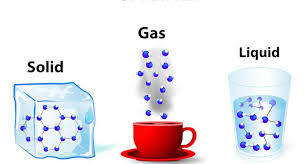
Which states of matter are fluid?
gases and liquids
liquids and solids
gases only
liquids only
The kinetic theory of matter states that all particles are constantly
growing
contracting
reacting
moving
Temperature is a measure of a substance's average
kinetic energy
heat
density
electrostatic force
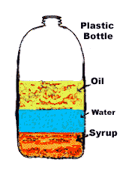
What is the unit for Density?
Grams (g)
Milliliters (mL)
Grams/Milliliter (g/mL)
Why is a hot air balloon able to rise into the sky?
The hot air is less dense then the atmosphere, so it rises
The hot air is more dense then the atmosphere, so it rises
The hot air has the same density as the atmosphere, so it rises

Density = Mass/Volume
electrons
protons
neutrons
electron cloud
The subatomic particles with a negative charge are ____.
electrons
neutrons
protons
quarks
He claimed that matter was made of small, hard particles that he called “atomos”.
Democritis
Dalton
Moseley
Einstein
The scientist ______ used the Gold Foil Experiment to discover the nucleus.
Bohr
Rutherford
Schroedinger
Einstein
John Dalton stated:
Atoms are tiny, invisible particles.
Atoms of one element are all the same.
Atoms of different elements are different.
Compounds form by combining atoms.
All of the statements listed.
Which part of the atomic theory did Niels Bohr prove?
there are electrons
there is a nucleus
electrons are in energy levels
gold foil experiment
What experiment did JJ Thomson use?
gold foil experiment
cathode ray tube experiment
JJ Thomson came up with which model for the atom?
planetary model
electron cloud model
plum pudding model
nuclear model
The number of protons is equal to the number of electrons for an atom. This means an atom is-
electrically neutral
electrically positive
electrically negative
What determines the identity of the atom?
protons
neutrons
electrons
isotopes
What are atoms with the same number of protons but different numbers of neutrons?
electrons
protons
neutrons
isotopes
Who came up with the first atomic theory?
Dalton
Socrates
Thomas
Rutherford
Rutherford's "gold-foil" experiment using alpha particle scattering concluded that
the center of the atom is empty
atomic mass is spread over the whole atom
the center of the atom has a negative charge
most of the atom is empty
What is the correct order of scientists in order of their work related to the atomic theory from earliest to most recent?
Ernest Rutherford, JJ Thomson, John Dalton, & Democritus
JJ Thomson, John Dalton, Ernest Rutherford, & Democritus
Democritus, John Dalton, JJ Thomson, Ernest Rutherford.
John Dalton, JJ Thomson, Democritus, & Ernest Rutherford

Look at the picture of Argon from the periodic table. Which of the following is true for this element?
18 protons
40 protons
39.948 protons
21.9 protons
The atomic mass of an atom is equal to
number of protons plus number of neutrons
number of protons plus number of electrons
number of electrons plus the number of neutrons
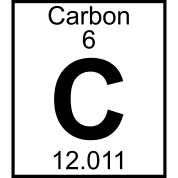

What does the 6 represent?
Atomic mass
atomic number
chemical symbol
element name
An atom has 10 protons, 15 neutrons and 10 electrons what is its mass number.
20
10
35
25


How many neutrons does indium have?
49
114.818
115
66

The element Carbon, exists as two isotopes; Carbon-12 and Carbon-14 for example, what has changed in the atomic structure?
Number of protons
Number of neutrons
Number of electrons
None of the above
When you have a negative ion of an atom, O-2 for example, do you have a higher number of protons or electrons?
Number of protons
Number of electrons
What is an Atom?
Building block of elements
Neutron
Unit of mass
Atomic mass unit

Atomic Mass
Average number of different masses
Mass of an atom = to the number of protons and neutrons
1 amu
The SI atomic unit in a cell

Atomic Number
The number of Atoms in a cell.
The number of protons in the nucleus of an atom, which determines the chemical properties of an element and its place in the periodic table.
The atomic symbol that is on the periodic table.
Electron cloud in an Atom.
Electron Cloud
Building blocks of elements.
Unit of mass used to express atomic and molecular weights.
The area around an atom's nucleus where electrons are most likely to be found.
Particle of matter that defines a chemical element.
Isotope
Two or more forms of the same element that contain equal numbers of protons but different numbers of neutrons.
Element on the periodic table.
The center of a cell.
Particle that makes up an atom (protons, electrons, neutrons).
Nucleus
The area around an atom's nucleus where electrons are most likely to be found.
Particle that makes up an atom (protons, electrons, neutrons).
All of the aboive
Small, dense region consisting of protons and neutrons at the center of an atom.
Subatomic particle
Particle that makes up an atom (protons, electrons, neutrons).
Unit of mass used to express atomic and molecular weights.
The area around an atom's nucleus where electrons are most likely to be found.
Two or more forms of the same element that contain equal numbers of protons but different numbers of neutrons.
Column of elements in the periodic table of the chemical elements. There are 18.
Periodic Family
Periodic Group
Octet
Period
A row of chemical elements.
Period
Series
Halogen
Noble Gas

smallest unit of an element
positive subatomic particle
negative subatomic particle
parts that make an atom

outside part of an atom where electrons are found
parts that make an atom
center of an atom. where protons and neutrons are found
negative subatomic particle

Orbtial
where electrons are most likely to be found
smallest unit of an atom
negative subatomic particle

Mass Number
smallest unit of an element
at the bottom of an element square,equals number of protons and neutrons
at the top of an element square,equals number of protons
Electrons orbit a certain distance from the nucleus. Either radiate or absorb energy when jumping orbitals.
Dalton
Thomson
Rutherford
Bohr
The atom is mostly large empty space with a small, dense nucleus at the center
Dalton
Thomson
Rutherford
Bohr
Atoms are indivisible (cannot be broken down)
Dalton
Thomson
Rutherford
Bohr

What scientist proposed this atomic model?
Dalton
Thomson
Rutherford
Bohr

What scientist proposed this atomic model?
Dalton
Thomson
Rutherford
Bohr
In a famous experiment conducted by Ernest Rutherford, positively charged alpha particles were scattered by a thin gold foil. Which of the following is a conclusion that resulted from this experiment?
The nucleus is negatively charged
The atom is a dense solid and is indivisible
The mass is conserved when atoms react chemically
The nucleus is very small and the atom is mostly empty space
What subatomic particle was discovered in the cathode ray tube experiment?
Proton
Neutron
Electron
Nucleus


What were J. J. Thomson's three contributions to the atomic theory?
Discovered the electron
Discovered the nucleus -did the gold foil experiment
Used the cathode ray tube in his discovery
Created a model of the atom with electrons moving around the nucleus in fixed orbits
Created the "plum pudding" model of the atom

The number of protons in the nucleus of an atom; used to determine an element's position in the Periodic Table.
subatomic particle
electrical charge
atomic number
electron cloud
The electron(s) located in the outer energy level (electron shell).
valence electrons
nucleus
group
period
What is the overall charge of the NUCLEUS?
+1
0
-1

All matter is made of _________.
What is the chemical symbol for Hydrogen
H
He
Hy
Hg
Strontium
Potassium
Chlorine
Neon
How many valence electrons does an alkali metal have?

Which color on the image of the periodic table corresponds with the metalloids.
yellow
red
teal
light blue
Has a +1 charge
Alkali metals
Alkaline Earth metals
Halogens
Noble gases
Oxygen group
This type of element is dull, brittle solids and gases, insulators, poor conductors of heat and electricity, as well as having low melting points.
metals
metalloids
nonmetals
The is family has properties of both metals and nonmetals.
Alkali
Halogens
Nonmetals
Metalloids
Which of the following is the least reactive group of non-metals?
The elements in this family are soft, silvery, and very reactive with water.
Alkaline Earth Metals
Alkali Metals
Transition Metals
Lanthanides
bromine
What are the three main groups of the periodic table?
alkali family
metal
nonmetals
metalloids
very reactive metals
What are the vertical columns on the periodic called?
groups
periods
nonmetals
metals
metalloids
What do the vertical columns on the periodic table tell us?
The number of orbitals
The number of valence electrons
Which family an element belongs to
What are the horizontal rows on the periodic table called?
periods
groups
metals
nonmetals
metalloids
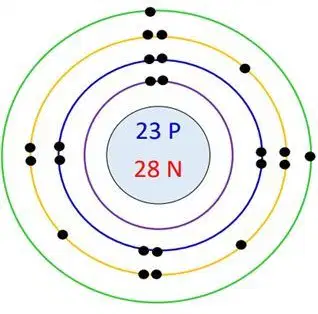
What is the name of the element?
sodium
magnesium
vanadium
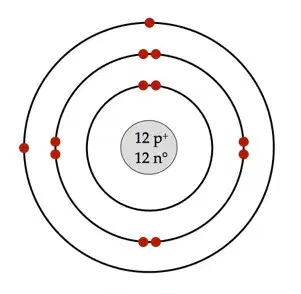
What group and period does this element belong in?
period 1 and group 3
period 3 and group 1
period 2 and group 3
period 3 and group 2

How many valence electrons does the element have?
1
2
3
4

How many protons and electrons does nickel have?
28
58.69

What is the atomic mass?
58.693
28

Who discovered the nucleus?
Rutherford
Bohr
Thomson
Dalton
The Periodic Table of Elements is arranged by
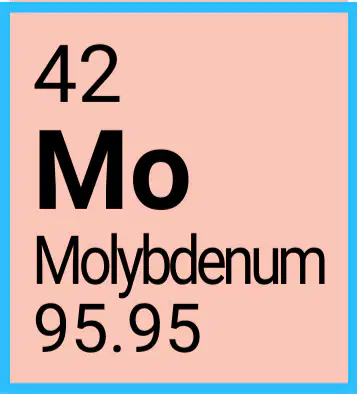
What does the 42 represent?
Very little/none of the mass of an atom is found in its _____.
protons
The periodic table is mostly comprised of what type of element?
Metals
Nonmetals
Metalloids

Which elements are to the RIGHT of the zigzag?
metals
nonmetals
metalloids

Which elements are colored red?
nonmetals
metals
metalloids
dull
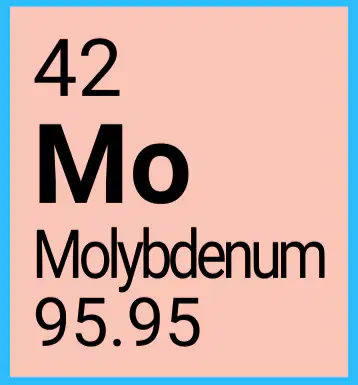
96
42
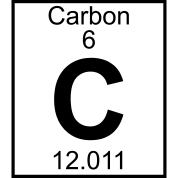

Which scientist created the Periodic Table and arranged elements in increasing atomic mass?
Rutherford
Thomson
Mendeleev
Moseley
Elements in the same group or family have _____________.
the same number of valence electrons and different properties.
the same number of valence electrons and similar properties
different number of valence electrons and similar properties.
different number of valence electrons and different properties.
Which class of elements are brittle, poor conductors of heat and electricity, and dull
metals
nonmetals
metalloids
ions
What is the name of the elements that are unreactive and have a full octet?
Halogens
Noble Gases
Alkali Metals
Transition Metals
What is the symbol for Lead?
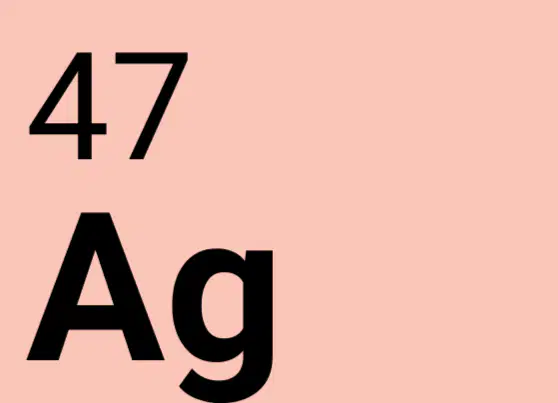
Agium
Silver
Bromine

