
Font size
 Worksheets
CHAPTER 1 SIX SIGMA LECTURE NOTES QUIZ
Total questions: 1
Worksheet time: 17hrs 30mins
What is Sigma primarily used for in statistics?
To represent a specific constant value
To quantify the variability in a process around the mean
To denote a sum of multiple values
To indicate a fixed benchmark in data analysis
Which of the following is NOT a function of Sigma?
Statistical unit of measure
Greek symbol for subtraction
Measure of process capability
Measure of quality
In the context of Sigma, what does the term "mean" refer to?
The highest value in a data set
The lowest value in a data set
The average value in a data set
The most frequently occurring value in a data set
What is Six Sigma primarily described as in the document?
A certification program
A business philosophy
A financial strategy
A marketing technique
According to the document, what does Six Sigma aim to increase?
Investment returns
Employee performance
Quality and customer satisfaction
Speed of production
What is one of the goals of Six Sigma as mentioned in the image?
To simplify company policies
To reduce variation
To increase stock value
To decrease workforce
What long-term benefit does Six Sigma aim to achieve for a business?
Decrease in operational costs
Increase in employee turnover
Expansion of business size
Increase in market share
What is the primary approach of Six Sigma?
Random problem-solving
Systematic project-based approach
Occasional team meetings
Regular financial audits
What does Six Sigma focus on to align with business goals?
Customer feedback only
Employee satisfaction
Aligning customer needs and business goals
Marketing strategies
Which of the following is a key characteristic of Six Sigma practitioners?
Part-time involvement
Minimal training
Full-time practitioners who receive significant training
External consultants only
What type of projects does Six Sigma typically focus on?
Long-term and ongoing
Broad and undefined
Discrete and cleanly finite
Low priority
How does Six Sigma primarily drive improvements?
Through increased sales only
By reducing employee turnover
By changing business measurements
Through data and metric-driven processes

What is the objective of the graph shown in the image?
To show the financial growth over 20 weeks
To demonstrate the reduction in defects and waste over time
To compare different teams' performance
To illustrate the number of projects completed per week

According to the graph, what does the term "Lean Sigma" signify?
A point where defects increase
A methodology applied to reduce defects
The highest point of defects
The name of the team handling the project

What does the circled area in the graph represent?
A period of increased defects
A breakthrough in reducing defects
A change in the measurement system
An error in data recording

How does the trend of defects change from the start to the end of the 20 weeks?
It increases significantly
It remains constant
It fluctuates before decreasing
It decreases steadily
What is one of the benefits of Six Sigma related to customer interaction?
Increased marketing efforts
Better understanding of changing customer requirements
Higher employee turnover
Decreased operational flexibility
Which benefit of Six Sigma is directly related to product development?
Enhancement of competitive position
Continuous improvement
Development of robust products and processes
Improvement of quality and delivery
What does Six Sigma primarily aim to reduce?
Employee satisfaction
Cost of training
Waste and cost
Customer base
How does Six Sigma contribute to a company's market standing?
By reducing the number of employees
By enhancing competitive position
By limiting product offerings
By increasing raw material usage
What does the function Y = f(x) represent in the context of Six Sigma?
The number of defects per million opportunities
The relationship between a factor and the output
The percentage of long-term yield
The sigma level of a process
According to the table, what is the Defects Per Million Opportunities (DPMO) for a Sigma Level of 4?
6,210
66,807
308,537
233
What is the Long Term Yield for a Sigma Level of 6?
99.15%
93.32%
99.38%
99.99966%
What does the term "Accuracy" in the context of variability refer to?
Spread of data points
Centering of data points
Range of data points
Distribution of data points
What does "Precision" signify in the context of variability?
Centering of data points
Spread of data points
Skewness of data points
Peak of data points

According to the image, what is the goal when reducing spread (variation) in a process?
To increase defects
To meet customer targets
To ignore customer targets
To widen the distribution curve
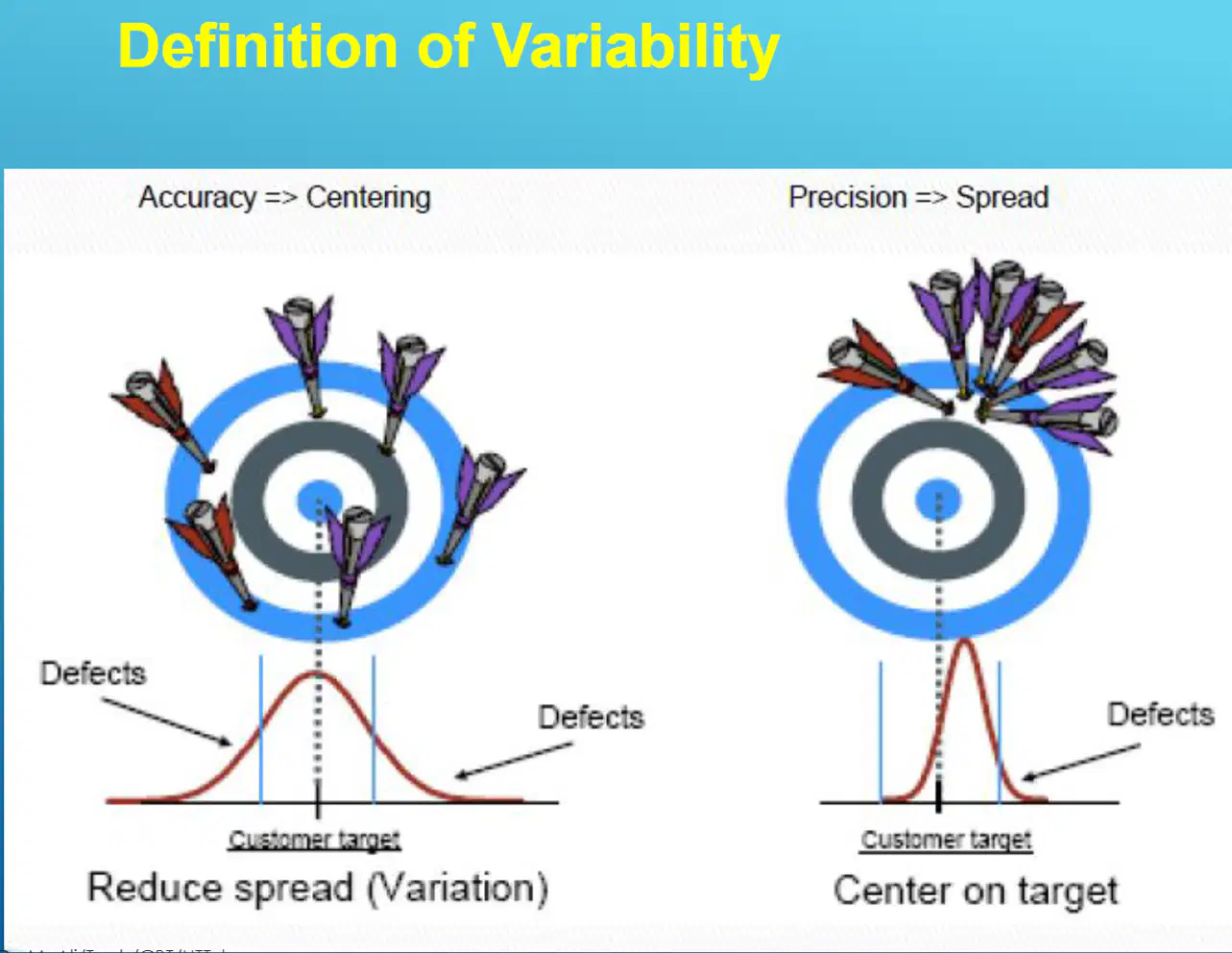
What is indicated by the term "Center on target" in the diagram?
Increasing the precision
Reducing the accuracy
Aligning the process output exactly with the customer's target
Expanding the range of process outputs

What does the diagram primarily illustrate in terms of business management?
The financial impact of customer feedback on a business
The relationship between process efficiency and customer satisfaction
The comparison between employee performance and customer expectations
The balance between supply chain management and marketing strategies

What is the primary goal of Six Sigma as depicted in the diagram?
To reduce production costs
To exceed or meet customer needs
To increase production speed
To minimize employee workload

What is the average value used in both the 3 Sigma and 6 Sigma processes shown in the diagram?
1
0
2
1.5

According to the diagram, how many defects per million opportunities are created by shifting a 3 Sigma process by 1.5σ?
3.4
66,807
3.4 million
0

What is the standard deviation (StDev.) value for the 6 Sigma process as shown in the diagram?
2
1
0
1.5

How many defects per million opportunities are essentially created by shifting a 6 Sigma process by 1.5σ according to the diagram?
66,807
3.4
0
1.5
What is a necessary condition for tolerating variability in a process according to the slide?
The process must be unpredictable.
The process must be on target.
The process must be frequently adjusted.
The process must be complex.
According to the slide, when can the total variability in a process be tolerated?
When it is large compared to the process specifications.
When it is relatively small compared to the process specifications.
When it is exactly equal to the process specifications.
When it does not affect the process outcome.
What does the slide imply about the stability of a process over time?
It should be variable.
It should be decreasing.
It should be stable.
It should be increasing.
What is the Sigma level of performance if the quality is 99% good?
4.5 Sigma Level
5 Sigma Level
3.8 Sigma Level
6 Sigma Level
How many wrong prescriptions occur each year at a 99% quality level?
680 wrong prescriptions
2,000,000 wrong prescriptions
1,000 wrong prescriptions
500,000 wrong prescriptions
At a 99.99966% quality level, how often does a short/long landing occur?
Every 200 flights
Every five years
Every month
Every year

According to the image, how many incorrect surgical operations occur per week at a 99% quality level?
1.7 incorrect operations
5,000 incorrect operations
100 incorrect operations
500 incorrect operations
What is the Defects per Million Opportunities (DPMO) for a process at Sigma Level 4?
6,210
66,807
308,537
233
According to the table, what is the Long Term Yield for a Sigma Level 5 process?
99.98%
99.38%
93.32%
69.15%
Which Sigma Level has the lowest Defects per Million Opportunities (DPMO) according to the data?
Sigma Level 2
Sigma Level 3
Sigma Level 5
Sigma Level 6
What is the Long Term Yield for a Sigma Level 2 process?
99.99966%
99.98%
99.38%
69.15%

What does "X" represent in the process focus diagram?
Dependent variables
Output variables
Independent inputs and causes
Results of the process

What is the function of "Y" in the process focus diagram?
To display the process outputs that are critical to satisfaction
To list the independent variables
To control the inputs of the process
To initiate the process

Which of the following is NOT listed as critical to satisfaction in the process focus diagram?
Cost
Delivery
Quality
Speed
What is a common consequence of past success in companies, according to the slide?
Increased innovation
Reduced costs
Arrogance
Improved efficiency
Which of the following is NOT listed as a reason for most companies operating at 3 - 4 sigma levels?
Dependence on inspection and rework
Reliance on trial and error
High focus on quality metrics
Rewarding fire-fighting behavior
According to the slide, what behavior is rewarded in most companies that operate at 3 - 4 sigma levels?
Proactive problem-solving
Fire-fighting behavior
Strategic planning
Team collaboration
What does the slide suggest is lacking in most companies with respect to quality management?
Regular audits
Focus on quality metrics
Employee training programs
Financial investment in tools

What is essential for companies to make a breakthrough strategy leap according to the image?
New office locations and marketing strategies
Conviction in the opportunity, belief in methodology, openness to challenge “Status Quo” behavior, new skills, tools and information, new management behaviors
Increased budget and financial support
Hiring more staff and expanding departments

Which of the following is NOT listed as a need for most companies to achieve a breakthrough strategy leap?
Belief in methodology
Openness to challenge “Status Quo” behavior
New marketing strategies
New management behaviors
What is the first phase in the Characterization category of the Breakthrough Strategy?
Measure Phase
Analyze Phase
Define Phase
Control Phase
Which phase is not part of the Optimization category in the Breakthrough Strategy?
Improve Phase
Control Phase
Define Phase
Measure Phase
What is the purpose of the 'Define performance objectives' step in the Actionable category of the Breakthrough Strategy?
To establish baseline process capability
To identify variation sources
To define performance standards
To determine final process capability
Which of the following is a step in both Characterization and Optimization categories?
Analyze Phase
Define Phase
Implement process controls
None of the above

What is the first phase of the DMAIC process as depicted in the image?
Measure Phase
Control Phase
Define Phase
Analyze Phase

According to the image, how many inputs are typically processed during the Improve Phase in the DMAIC model?
30 - 50 Inputs
10 - 15 Inputs
1 - 6 Inputs
8 - 10 Inputs

What is the final phase of the DMAIC process as shown in the image?
Measure Phase
Control Phase
Define Phase
Improve Phase

How many inputs does the Measure Phase handle according to the funnel diagram in the image?
30 - 50 Inputs
10 - 15 Inputs
1 - 6 Inputs
8 - 10 Inputs
What is the first step in the Define phase of DMAIC?
Building effective teams
Identifying, prioritizing, and selecting the opportunities
Developing project team charters
Identifying the customer segment and requirements
Which of the following is NOT a part of the Define phase of DMAIC?
Defining the processes to be improved
Preparing process maps
Developing project team charters
Analyzing the data collected
What is essential for building in the Define phase of DMAIC?
Effective teams
Customer feedback
Financial analysis
Technology upgrades
What does the Define phase of DMAIC focus on regarding customer interaction?
Gathering customer feedback
Identifying the customer segment and requirements
Increasing customer satisfaction
Reducing customer complaints

