
Font size
S
M
L
XL
 Worksheets
2nd Semester Physical Science FINAL
Total questions: 50
Worksheet time: 50mins
Name
Class
Date
1.
Charging by ____________ is the rearrangement of electrons on a neutral object caused by a nearby charged object.
a)
conduction
b)
induction
2.
___________ are materials that do not allow electric current to pass through easily.
a)
insulators
b)
conductors
3.
___________ is the accumulation of electrical charges on an object.
a)
static electricity
b)
voltage
4.
Charges flow from ___________ voltage to ___________ voltage.
a)
high to low
b)
low to high
5.
Making wires thinner, longer, or hotter ___________ the resistance.
a)
increases
b)
decreases
6.
What is the potential difference (voltage) if a resistance of 20 ohms produces a current of 10 amperes?
V=IR
a)
200 volts
b)
2 volts
7.
area around charged object; exerted by a charged object; allows us to charge by induction
a)
electric field
b)
grounding
8.
Protons have ___________ electrical charge
a)
positive
b)
negative
9.
Electrons have ___________ electrical charge
a)
positive
b)
negative
10.
Mr. Robinson and his class are conducting an experiment. The class needs to choose a good insulator. Which of the following could be used as an insulator?
a)
plastic plate
b)
silver spoon
11.
What is the current produced by a 9-volt battery flowing through a resistance of 0.2 ohms? I= V/R
a)
1.8 amps
b)
45 amps
12.
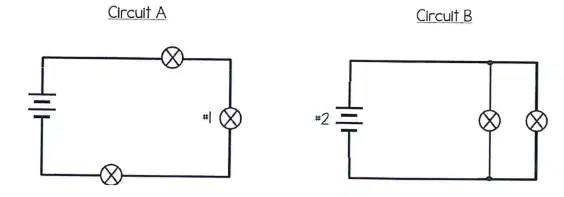
What does the symbol labeled #1 represent?
a)
lights
b)
batteries
13.

What does the symbol labeled #2 represent?
a)
lights
b)
batteries
14.

Circuit _____ is wired in parallel, and circuit _____ is wired in series.
a)
A; B
b)
B; A
15.
An electric current does NOT exist in ______ circuit.
a)
series
b)
parallel
c)
open
d)
closed
16.
Temporary magnet made by placing a piece of iron inside a current carrying coil of wire.
a)
Ferromagnetism
b)
Electromagnets
17.
The Law of Conservation of Charge states that
a)
charge cannot be created and destroyed but it can be transferred.
b)
charge cannot be created and destroyed and it cannot be transferred.
18.
Which of the following statements about electric charge is true?
a)
Objects must be touching on another to exert electrical force.
b)
Electrical forces act at a distance.
19.
Which two areas of physical science are closely related to the development of electric motors and generators?
a)
electricity and sound
b)
electricity and magnetism
20.
Refraction occurs when a wave changes its ________________ as it passes through a different medium.
a)
speed
b)
intensity
21.
____________________ need a medium to travel through.
a)
mechanical waves
b)
transverse waves
22.
____________________ is the process of a wave striking a surface and bouncing off.
a)
reflection
b)
refraction
23.
Which is an example of a compressional wave?
a)
x-ray
b)
sound wave
24.
What is the wavelength of a water wave that is moving at 38 m/s with a frequency of 2 Hz?
⁁=v/f
a)
76 m
b)
19 m
25.
What is the velocity of a wave having a frequency of 25 Hz and a wavelength of 10 m?
a)
2.5 m/s
b)
250 m/s
26.
A glass prism is able to bend light because
a)
light is refracted as it enters a different medium
b)
the prism creates destructive interference
27.
Which electromagnetic wave comes from the sun to give you Vitamin D?
a)
gamma rays
b)
ultraviolet waves
28.
Light waves travel the fastest in
a)
a solid
b)
a liquid
c)
a gas
d)
outer space/ a vacuum
29.
Sound waves travel the fastest in
a)
a solid
b)
a liquid
c)
a gas
d)
outer space/ a vacuum
30.
When two or more substances are physically combined, the result is a(n)
a)
element
b)
mixture
31.
Three examples of physical changes are
a)
sawing wood, crushing a can, and burning a marshmallow
b)
boiling of water, blowing up a balloon, and melting a candle
32.
Milk, paint, and mayonnaise are all examples of
a)
homogenous mixtures
b)
heterogenous mixtures
33.
Hydrogen (H2), gold (Au), and iron (Fe) are all examples of
a)
elements
b)
compounds
34.
A piece of wood that measures 3 cm by 6 cm by 4 cm has a mass of 80 g. What is the density of the wood?
d=m/v
a)
1.11 g/cm3
b)
5,760 g/cm3
35.
Atoms of elements in the same group of the periodic table share the same
a)
number of energy levels
b)
number of valence electrons
c)
atomic numbers
36.
What is an atom’s nucleus made of?
a)
protons and electrons
b)
protons only
c)
protons and neutrons
37.
Atoms of the same element that have different numbers of neutrons are called
a)
ions
b)
isotopes
38.
Boron, Carbon, Nitrogen and Oxygen are all members of the same
a)
group
b)
period
39.
Hydrogen is in group 1 with Lithium, Sodium, Potassium, Rubidium, Cesium, and Francium because it
a)
has 1 valence electron
b)
is a gas
40.
Who arranged the elements on the periodic table based on atomic mass
a)
Dmitri Mendeleev
b)
Ernest Rutherford
41.
Symbol for Xenon
(a)
42.
Name of Fe
(a)
43.
Tungsten
(a)
44.
2 HgO --> 2 Hg + O2
How many many molecules of HgO are in the reactants?
a)
1
b)
2
45.
What coefficient should be used to make the following equation balanced?
N2+O2--> __?__NO
a)
1
b)
2
c)
3
d)
4
46.
What is the little number after an element in a chemical equation called.
Example: H2
a)
subscripts
b)
coefficient
47.
Which of the following equations are correctly balanced?
a)
12CO2 +H2O --> C6H12O6 + O2
b)
6CO2 + 6H2O --> C6H12O6 + 6O2
48.
Is the following equation balanced?
4Fe + 3O2 --> 2 Fe2 O3
a)
Yes
b)
No
49.
Is the following equation balanced?
2C2H2 + 5O2 --> 4CO2 + 2H2O
a)
Yes
b)
No
50.
How many HCl molecules do you need to balance this equation?
Mg + __HCl ---> MgCl2 + H2
a)
1
b)
2
c)
3
d)
4
Reset

