
Font size
 Worksheets
Unit 3 review
Total questions: 50
Worksheet time: 1hrs 15mins
4Br2(g) + CH4(g) ↔ 4HBr(g) + CBr4(g)
In the following reaction
Sn2+ + 2Fe3+ → Sn4+ + 2Fe2+
the oxidizing agent is....
Sn4+
Sn2+
Fe3+
Fe2+
What is a disproportionation reaction?
A reaction in which at least two different oxidation states are produced
A reaction in which elements are reduced and oxidised
A reaction in which at least one element is oxidised
A reaction in which the same element is both oxidised and reduced
BF3, BCl3 and AlCl3 can be described as..........
electron rich
electron deficient
amphoteric
electron acceptors
Which one of the following can reduce concentrated sulfuric acid down to hydrogen sulfide?
Fluoride ions
Chloride ions
Bromide ions
Iodide ions
Nitrogen cannot exhibit covalency more than four due to
presence of vacant d orbitals
presence of vacant p orbitals
due to absence of vacant d orbitals
due to inert pair effect
What is a ligand?
A molecule with empty d-orbitals
A molecule with a lone pair that can form a coordinate bond to a transition metal
A molecule which can form ionic bonds to a central metal atom
A complex which is coloured
Identify which of the following ions are most likely to form coloured compounds
Sc3+
Cu+
Zn2+
Fe3+

What is y?
order of reaction with respect to reactant A
order of reaction with respect to reactant B
overall order of reaction
coefficient of reaction B in a balanced equation
If the unit of the rate is moldm-3 s-1 and the overall order is 2, what is the unit of the rate constant?
s-1
moldm-3 s-1
mol-1dm6 s-1
mol-1dm3 s-1
For a reaction, Rate = k[NO]2[O2]. What happens to the rate when [NO] is doubled?
doubled
halved
tripled
quadrupled
First electron affinity of an element is usually ________ and second electron affinity is ____________.
exothermic, endothermic.
exothermic, exothermic.
endothermic, endothermic.
endothermic, exothermic.

What enthalpy change does the number 4 represent?
Formation
1st ionisation energy of Na
1st electron affinity of Na
Atomisation of Na
Which enthalpy change is NOT required in a Born Haber cycle for aluminium chloride?
2nd ionisation energy of aluminium
2nd electron affinity of chlorine
Lattice enthalpy of aluminium chloride
Enthalpy of formation of aluminium chloride
What factor determines the feasibility of a reaction?
Change in entropy
Change in enthalpy
Both change in entropy and change in enthalpy
None of the above
Which represents a -ΔS?
ice melting
salt dissolving
water heating up
none of these
Choose the correct correlation between Gibbs free energy and feasibility.
a reaction to be feasible, ΔG has to be negative.
a reaction to be feasible, ΔG has to be positive.
a reaction to be feasible, ΔG has to be zero
no correlation between ΔG and feasibility
The following cell has an EMF of +0.46 V.
Cu | Cu2+ || Ag+ | Ag
Which statement is correct about the operation of the cell?
Metallic copper is oxidised by Ag+ ions.
The silver electrode has a negative polarity.
The silver electrode gradually dissolves to form Ag+ ions.
Electrons flow from the silver electrode to the copper electrode via an external circuit.

Use the data in the table to answer this question.
The most powerful oxidising agent in the table is
Mn2+(aq)
Zn(s)
MnO4-(aq)
Zn2+(aq)

What is the formula of this complex?
[Co(H2O)6]2+
[Co(OH)2(H2O)4]2+
[Co(OH)2(H2O)4]
[Co(OH)6]3-
A green precipitate that is unchanged on adding excess NaOH contains
Cr3+
Fe2+
Mn2+
Cu2+
A blue solution produces a blue precipitate with a little ammonia solution. What happens with excess ammonia solution?
No change
The precipitate dissolves to give a yellow solution
The precipitate dissolves to give a purple solution.
The precipitate dissolves to give a deep blue solution.
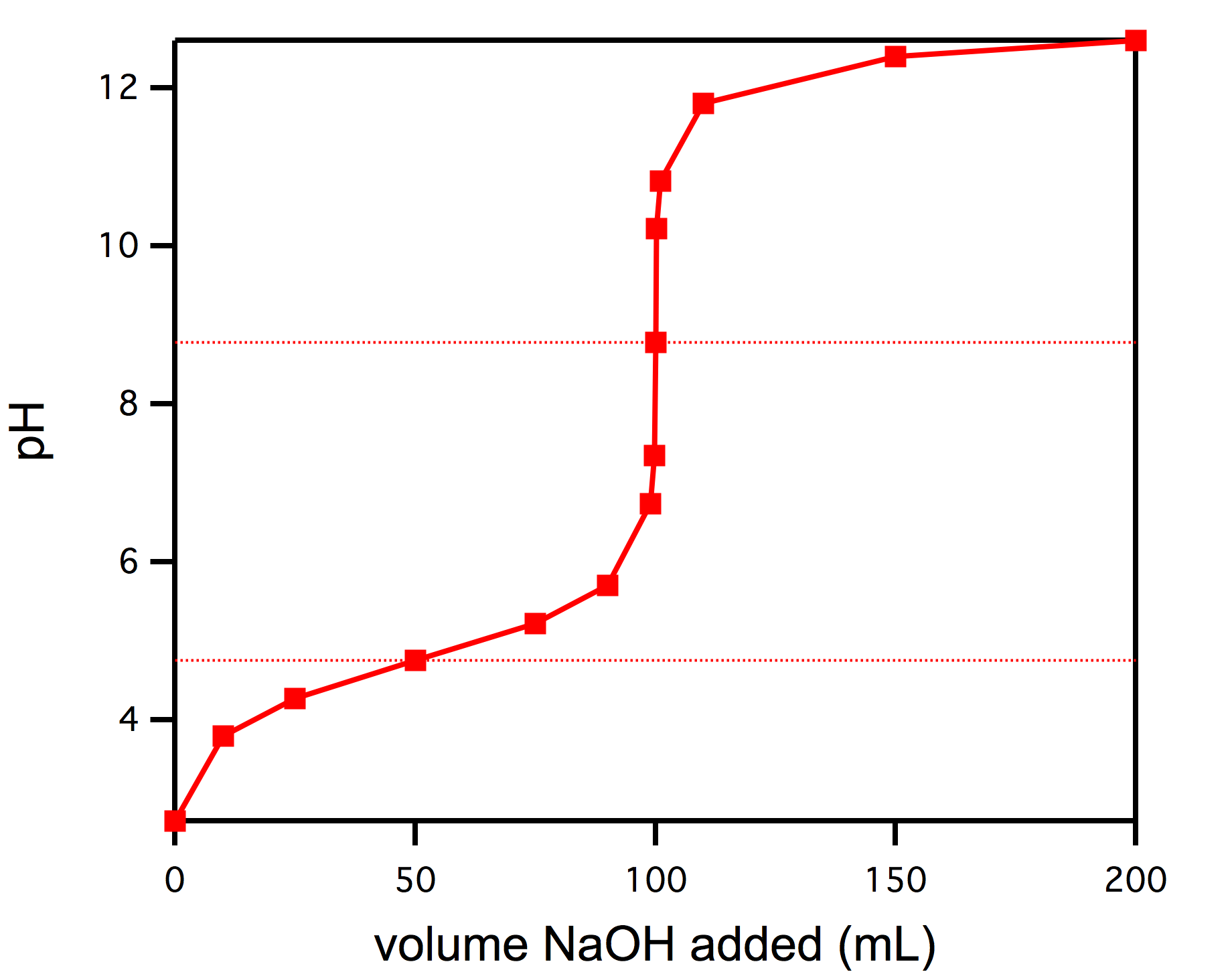
What is the pH at the equivalence point.
The pH is approximately 5
The pH is approximately 6
The pH is approximately 8
The pH is approximately 9

What is a buffer compromised of?
(CHECK ALL THAT APPLY)
A weak acid and its conjugate base
A weak base and its conjugate acid
A strong base and its conjugate base
A strong acid and its conjugate acid

Which species will oxidise Fe2+(aq) to Fe3+(aq)?
Br2 (aq)
Cl-(aq)
I2 (aq)
Mn2+(aq)

Which species will oxidise Fe2+(aq) to Fe3+(aq)?
Br2 (aq)
Cl-(aq)
I2 (aq)
Mn2+(aq)
Which of these is not a redox reaction?
A. Cu2O + H2SO4 → CuSO4 + Cu + H2O
B. MgO + 2HCl → MgCl2 + H2O
C. SnCl2 + HgCl2 → Hg + SnCl4
D. MnO2 + 4HCl → MnCl2 + 2H2O + Cl2
What factor determines the feasibility of a reaction?
Change in entropy
Change in enthalpy
Both change in entropy and change in enthalpy
None of the above
Which reaction has a +ΔS ?
AgNO3(aq) + NaCl(aq) → AgCl(s) + NaNO3(aq)
H2O(g) + CO2(g) → H2CO3(aq)
H2(g) + I2(g) → 2Hl(g)
C2H2O2(g) → 2CO(g) + H2(g)
What information do we need to perform a calculation of Gibbs Free Energy?
Enthalpy of the reaction.
Entropy of the reaction.
The temperature of the reaction in Kelvin.
All of the above are needed.
Choose the correct correlation between Gibbs free energy and feasibility.
a reaction to be feasible, ΔG has to be negative.
a reaction to be feasible, ΔG has to be positive.
a reaction to be feasible, ΔG has to be zero
no correlation between ΔG and feasibility
Which combination of ΔH and ΔS NEVER has a spontaneous reaction?
+ΔH and +ΔS
+ΔH and -ΔS
-ΔH and -ΔS
-ΔH and +ΔS
O- (g) + e- --> O2- (g)
1st electron affinity
2nd electron affinity
3rd electron affinity
4th electron affinity
The more negative the enthalpy of formation of a compound.......
the less stable the compound is
the more stable the compound is
the more soluble the compound is
none of these
First electron affinity of an element is usually ________ and second electron affinity is ____________.
exothermic, endothermic.
exothermic, exothermic.
endothermic, endothermic.
endothermic, exothermic.
What does Kp relate to in a reversible reaction?
The ratio of gaseous products to gaseous reactants at equilibrium
The amounts of solid products and reactants at equilibrium.
The temperature of the reaction.
The pressure of the system.
Which of the following statements is true about the equilibrium constant (Kc)?
It is affected by the concentration of reactants.
It is affected by the presence of a catalyst.
It is affected by the temperature of the system.
It is affected by the pressure of the system.
What is y?
order of reaction with respect to reactant A
order of reaction with respect to reactant B
overall order of reaction
coefficient of reaction B in a balanced equation
How do we find the value of x and y?
from experiments
from the balanced chemical equations
from the data booklets
from the textbooks

What order is that with respect to this reactant?
0
3
2
1
When the concentration of a reactant doubles, the reaction rate increases 4 times. What order is it with respect to this reactant?
0
1
2
3

For the hypothetical reaction, 2 A + B → C, what is the rate law for this reaction?
Rate= k[A][B]
Rate= k[A]2[B]
Rate= k[B]2
Rate= k[A][B]2
Inert pair effect is......
the tendency of s2 pair of electrons in an atom to stay paired leading to a lower oxidation state
the tendency of s2 pair of electrons in an atom to stay paired leading to a higher oxidation state
the tendency of s2 pair of electrons in an atom to become involved in bonding
none of these
Which of the halogens is the strongest reducing agent?
bromide
chloride
iodide
fluoride
What is a buffer solution?
A solution that is resistant to changes in pH
A solution that accepts changes in pH
Any solution containing an acid and a base
None of these
What is the pH at the equivalence point.
The pH is ~4.5
The pH is ~6.0
The pH is ~8.5
The pH is ~12.0
What happens to the pH of a buffer solution when a small amount of strong acid is added, according to the Henderson-Hasselbalch equation?
The pH increases significantly
The pH decreases significantly
The pH remains relatively stable
The pH becomes neutral

