

wayground logo

Free Printable Worksheets

Font size

S
M
L
XL
Worksheets

5.4 Practice Quiz

Total questions: 25

Worksheet time: 15mins

Name
Class
Date
1.

Absolute Zero

a)
state of matter that consists of charged particles, super hot and dense
b)
states all matter & energy in the universe was compressed into an extremely small volume, then expanded
c)
negative 273 degrees Celsius; temp. at which all particle motion stops
d)
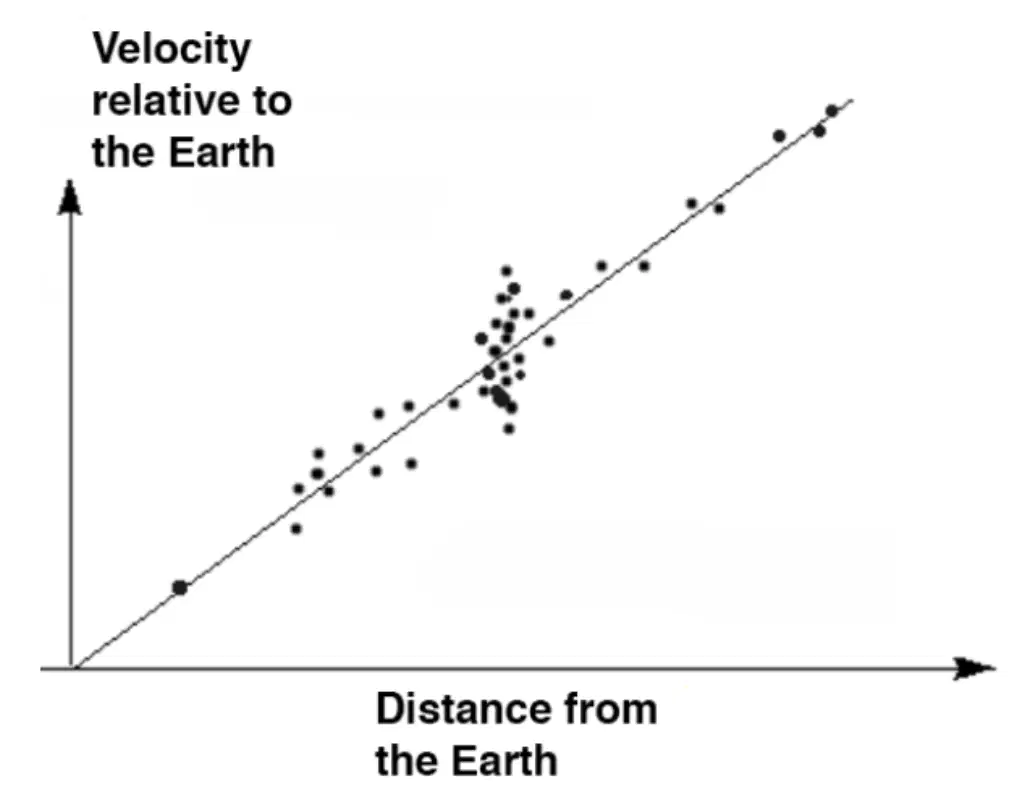
galaxies are moving away at a speed that is proportional to their distance
e)
massless particles of electromagnetic radiation, light
2.

Big Bang Theory

a)
state of matter that consists of charged particles, super hot and dense
b)
states all matter & energy in the universe was compressed into an extremely small volume, then expanded
c)
negative 273 degrees Celsius; temp. at which all particle motion stops
d)
galaxies are moving away at a speed that is proportional to their distance
e)
massless particles of electromagnetic radiation, light
3.

Hubble's Law

a)
state of matter that consists of charged particles, super hot and dense
b)
states all matter & energy in the universe was compressed into an extremely small volume, then expanded
c)
negative 273 degrees Celsius; temp. at which all particle motion stops
d)
galaxies are moving away at a speed that is proportional to their distance
e)
massless particles of electromagnetic radiation, light
4.

Photons

a)
state of matter that consists of charged particles, super hot and dense
b)
states all matter & energy in the universe was compressed into an extremely small volume, then expanded
c)
negative 273 degrees Celsius; temp. at which all particle motion stops
d)
galaxies are moving away at a speed that is proportional to their distance
e)
massless particles of electromagnetic radiation, light
5.

Plasma

a)
state of matter that consists of charged particles, super hot and dense
b)
states all matter & energy in the universe was compressed into an extremely small volume, then expanded
c)
negative 273 degrees Celsius; temp. at which all particle motion stops
d)
galaxies are moving away at a speed that is proportional to their distance
e)
massless particles of electromagnetic radiation, light
6.

The age of the universe is

a)
13.7 billion years
b)
5 billion years
c)
1 billion years
d)
15 million years
7.

An increase in wavelength and a decrease in frequency of a wave would indicate

a)
red shift spectra of galaxies
b)
blue shift spectra of galaxies
c)
the existence of black holes
d)
the existence of giant stars
8.

Cosmic background radiation confirms that the temperature of the universe

a)
was once very hot and then cooled down over time
b)
was once very cold and heated up over time
c)
has stayed the same
d)
changes every billion years
9.

The temperature of cosmic background radiation is

a)
about absolute zero
b)
100 degrees warmer than absolute zero
c)
colder than absolute zero
d)
above 3000 degrees Celsius
10.

If we observed blue shift in the spectra of galaxies, this would tell us that

a)
galaxies are moving closer to us
b)
galaxies are moving away from us
c)
galaxies are at a constant distance away from us
11.

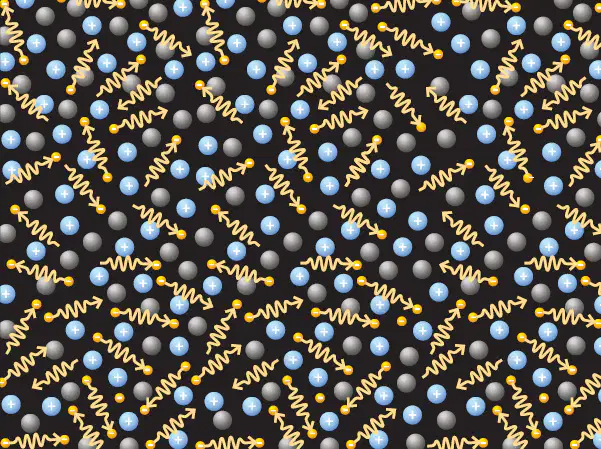
Cosmic Microwave Background Radiation originated as the first light. The universe transitioned from _________ to __________.
a)
opaque, transparent
b)
transparent, opaque
c)
light, dark
d)
dark, light
12.

How does red shift provide evidence for the big bang?

a)
it suggests the universe is contracting
b)
it suggests the universe is expanding
c)
it suggests the universe is staying the same
13.

What characteristic of the Cosmic Microwave Background Radiation (CMBR) provides evidence that the universe is expanding?
a)
CMBR shows blueshift in the galaxies spectra
b)
CMBR shows our universe is getting smaller
c)
CMBR shows uniform radiation
d)
CMBR can be detected coming from all directions
14.

Right after the big bang the universe was opaque and light was unable to go through it. Why is that?

a)
all photons were absorbed
b)
it was so dense, no photons could get through
c)
protons could not be produced
d)
photons were too heavy
15.

What determined the temperature, density, and ratio of elements of the universe soon after the big bang?

a)
the rate of nuclear fusion of first stars
b)
the rate the universe expanded
c)
the density of the material the universe expanded into
d)
the timing of the change from transparent to opaque universe
16.

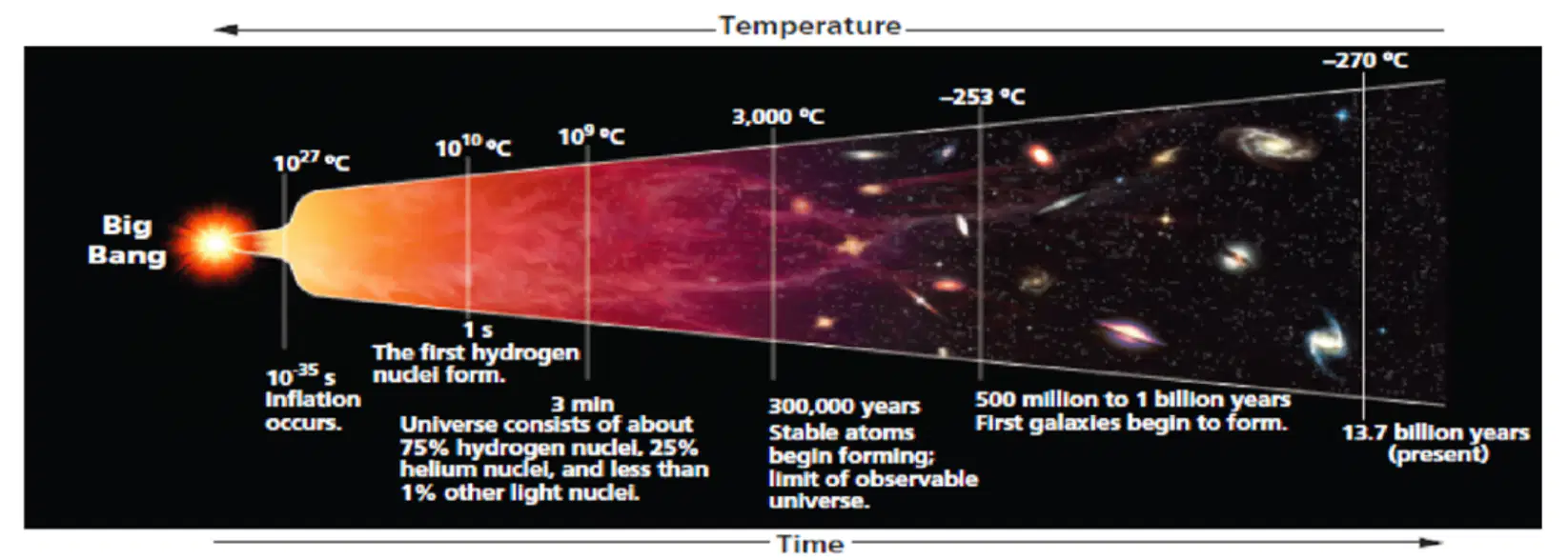
Since the Big Bang occurred, what has happened to the temperature of our universe?
a)
increase
b)
decrease
c)
stayed the same
17.

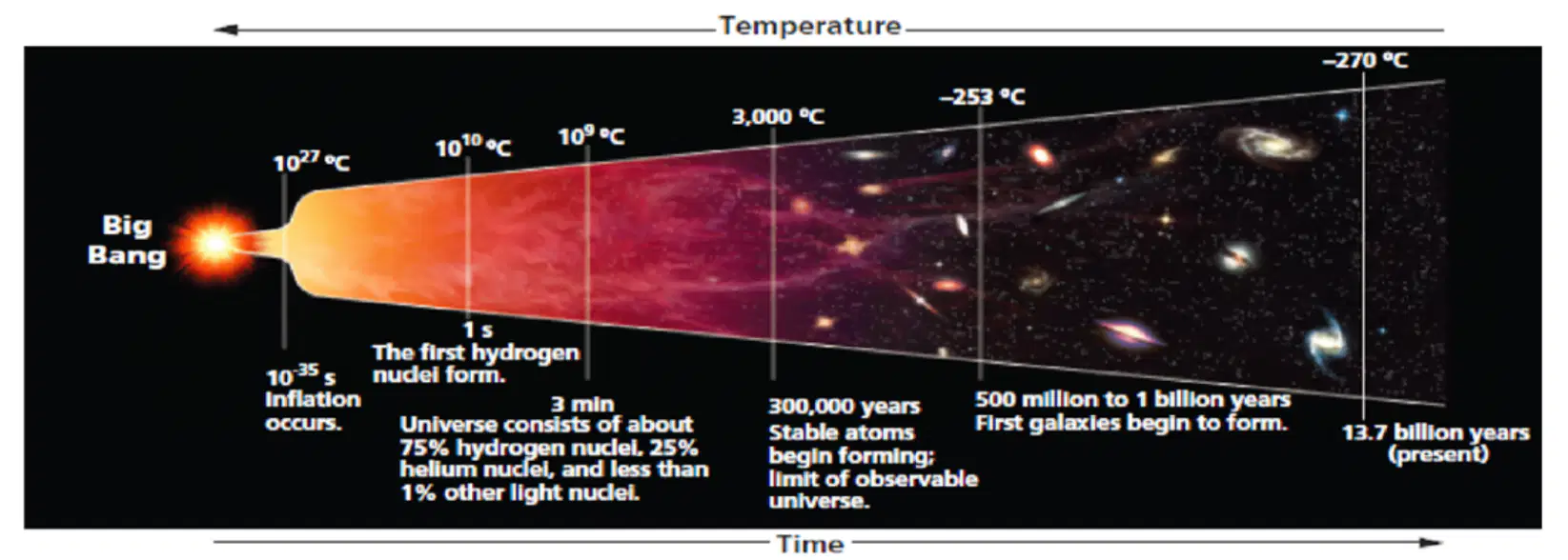
According to the diagram above, when did the first Helium nuclei form?
a)
0.000006 seconds after the big bang
b)
1 second after the big bang
c)
3 minutes after the big bang
d)
380,000 years after the big bang
18.

According to the diagram above, when did atoms form?

a)
0.000006 seconds after the big bang
b)
1 second after the big bang
c)
3 minutes after the big bang
d)
380,000 years after the big bang
19.

According to the diagram above, when did the first galaxies form?

a)
1 second after the big bang
b)
3 minutes after the big bang
c)
380,000 years after the big bang
d)

 500 million to 1 billion years after the big bang

20.

All energy and matter of the big bang before expansion outward was:

a)
tightly packed in a large, open area
b)
loosely packed in a large, open area
c)
loosely packed in a small, dense area
d)
tightly packed in a small, dense area
21.

What is happening with our universe?

a)

It is expanding.

b)

It is shrinking.

c)

It is heating up.

d)

It has reached a constant point of equillibrium.
22.

Hubble’s discovery that there is a red shift in the spectra of galaxies is evidence that the universe is ​ (a)   ​ .

Choose from the below words
expanding
full of black holes
contracting
full of red light
increasing in temperature
23.

Since the Big Bang occurred, the temperature of space has cooled from 1027 degrees Celsius to -270 degrees Celsius.

a)

True

b)

False

24.

The universe began​ (a)   years ago.

Choose from the below words
14 billion
1 billion
10 million
50 billion
25.

The CMB (Cosmic Background Radiation) is:

a)

the remaining energy from the big bang.

b)

incredibly cool.

c)

a cloud of light

d)

only located in certain places in the universe.
