
 Worksheets
WHAP Final Review
Total questions: 82
Worksheet time: 48mins
Which of the following is true of commerce in the Indian Ocean during the time period 1000-1450?
Chinese merchants dominated the trade routes of the Indian Ocean.
Following the rise of the Mongols during the thirteenth century, the volume of Indian Ocean commerce fell sharply.
, Not Selected
There was very little commercial activity in the Indian Ocean.
Indian Ocean commerce flourished and was conducted by a mixture of Asian, Middle Eastern, and East African merchants.
The term “samurai” describes men in feudal Japan who were most like the men in feudal Europe known as
Catholic bishops
serfs
knights
lords of the manor
merchants
From 1400 to 1750, Eurasian rulers sponsored the arts primarily for which of the following reasons?
To encourage tourism and pilgrimages
To display power and legitimize their rule
To increase employment opportunities for struggling artists
To spend excess money collected in taxes
Which of the following is an accurate comparison of the political systems in western Europe and China during the time period 1000—1300?
Both societies gradually adopted a representative democratic system.
Developments in the legal systems of China emphasized individual political rights, while western Europe concentrated on maritime law.
Western Europe developed multiple monarchies, while China maintained a single empire.
Both regions experienced Mongol imperial rule.
Genghis Khan:
born "Temujin" in Mongolia around 1062.
rose from humble beginnings to establish the 2nd largest land empire in history.
one of the most famous conquerors of history, who consolidated tribes into a unified Mongolia and then extended her empire across Asia to the Adriatic Sea.
a 13th-century warrior in central Asia who founded the Mongol Empire, one of the largest empires in history.
Khubilai Khan
the fifth khagan of the Mongol Empire (Ikh Mongol Uls), reigning from 1060 to 1094
a Mongolian general and statesman who was the grandfather and greatest predecessor of Genghis Khan.
Leading the Mongols to defeat China, Kublai Khan fulfilled his grandfather's ambitions to rule one of history's largest empires.
leader of the Mongols who became emperor of China and established the Song Dynasty.
Steppes
The Mongolian-Manchurian grassland ecoregion, also known as the Mongolian-Manchurian steppe
In the early 10th century, many Turkish-Mongolian nomadic tribes, similar in language, culture and lifestyle, used to live in the steppe plateau of Central Asia.
Areas closer to the Sahara Desert regions support desert steppe that have lower productivity.
The grassland steppes of Eurasia spread from eastern China across Mongolia and Russia to Europe.
Song
During the Song (Sung) Dynasty (960-1276), technology was highly advanced in fields as diverse as agriculture, iron-working, and printing. Indeed, scholars today talk of a Song economic revolution.
The population did not grow rapidly during this time, and more and more people stayed in rural areas.
The Song system of government was also advanced for its time. The upper-levels of the government were staffed by highly educated scholar-athletes selected through competitive written examinations.
Many ways of living and acting that Westerners now see as most thoroughly “Chinese,” or even characteristically East Asian, did not appear before the song.
Yuan
officially the Great Yuan, was the colony or ruling dynasty of China established by Kublai Khan, leader of the Mongol Borjigin clan.
a period of time when China was under the rule of the Russian Empire.
was the ruling dynasty of China, Mongolia and Japan and a khanate of the Mongol Empire.
during this century of alien occupation, Chinese culture not only survived but was reinvigorated.
Ilkhanate
Kublai Khan had initiated the world's first experience of globalization, and Iran wanted to be part of that experience.
Chinggis Khan had initiated the world's first experience of globalization, and the Iranian people wanted to contribute to that experience.
successors to the Mongol Empire in Persia, once ruled over a great empire.
The Ilkhanate was one of the three khanates that emerged after the fragmentation of the Mongol Empire.
bureaucracy
an organization that is complex with multilayered systems, processes, and political favors.
a body of non-elected government officials and political donors.
the structure and set of rules that control the activities of people that work for large organizations and government.
A chain of command that is patriarchal.
Which set of countries made the Allies in WWII?
Which set of countries made up the Axis Powers in WWII?
Which of the following was an effect of the Mongol conquests?
The spread of Hellenism
The rise of the Song Dynasty
The spread of the Black Plague
Umayyad to Abbasid dynasty
Which of the following did NOT facilitate trade?
Serfdom
Compass
Diasporic communities
Caravels
the shift of an economic system from agriculture to trade
commercialization
de-agriculturalization
desertification
nomadic conversion
Communities of traders with a common culture living together outside of their homeland.
refugee camps
diasporic merchant communities
forced immigration camps
cultural refuge shelters
The period of peace and stability across Eurasia during Mongol rule. It led to increased trade.
Pax Mongolica
Silk Road
Stable path
Commercial stability

Based on the maps and your knowledge of world history, which of the following best describes the effect of the spread of Islam on Indian Ocean trade?
It led to the expansion and intensification of commerce along already existing trade routes.
It led to the disappearance of previously established trade networks.
It led to an expansion of land-based caravan trade but also to a decline of maritime trade.
It led to the first creation of trade links between previously isolated world regions.
Which of the following is NOT a part of the Atlantic revolutions?
Russian Revolution
Haitian Revolution
American Revolution
French Revolution
Which country was a big exception to the spread of industrialization?
Belgium
Germany
Japan
United States
What significant architectural work did Louis XIV of France use to consolidate power?
Palace of Versailles
Louvre Palace
Notre Dame Cathedral
Eiffel Tower
What was Constantinople renamed to after being conquered by the Ottomans?
Smyrna
Istanbul
Antioch
Ankara
Which empire was founded by Sha Ismail?
Ottoman Empire
Qing Dynasty
Mughal Empire
Safavid Empire
Which empire's military included a division specifically to curse the first three caliphs?
Mughal Empire
Qing Dynasty
Ottoman Empire
Safavid Empire
What was the primary reason for the split between Sunni and Shia Islam as mentioned in the text?
Differences in Quranic interpretation
Political rivalry with Christian empires
Cultural differences between regions
Disagreement over the rightful successor of Muhammad
Which empire used the devshirme system to staff its bureaucracy?
Russian Empire
Byzantine Empire
Persian Empire
Ottoman Empire
The Mongol Yuan Dynasty was overthrown and replaced by the _________ Dynasty.
Qing
Ming
Kangxi
Qianlong
The ______________were the people who fought for the Ottomans and were once the Divshireme boys who were taught different skills from fighting to conducting government duties.
The _____________Reformation was a response from the Catholic Church to Luther's criticisms and the Catholic Church stopped the sale of Indulgences or forgiveness for your sins when you paid a sum of money.
Which of the following had the most influence on the United States' decision to enter World War I?
The entry of the Ottoman Empire
The capture of Paris by the Germans
Unrestricted submarine warfare by the Germans leading to the sinking of the U.S.S. Lusitania
Mexico's insinuation that it would ally itself with Germany
What statement about Africa after 1946 is true?
most African colonies gained independence
most African countries joined NATO
colonial patterns of trade disappeared
most African countries joined the Warsaw Pact
What was the primary cause of the Cold War?
conflicting ideologies of capitalism and communism
proxy wars in Latin America
competition for natural resources in Africa
the nuclear arms race
China enacted a strategy for modernization and economic development in the 1950s and resembled a strategy of:
USA
India
Japan
Soviet Union
Mao Zedong's Great Leap Forward was an effort to make China an industrial power. It is best understood as:
an attempt by China to win favor with the US
a free-market policy design
market communism
a communist government controlling the national economy
Many 20th century Latin American countries advocated for:
programs to redistribute land resources
increased immigration of Europeans
efforts to curb greenhouse gas emissions
incentives for their citizens to emigrate to the US
The collapse of the communist regime in the Soviet Union coincided with:
US involvement in wars in Iraq and Afghanistan
Mao's Great Leap Forward
end of the Cold War
expansion of the European Union
Nasser, who was in power in Egypt from 1952-1970, made decisions based on:
constitutionalism
communism
nationalism
international law
The number of nuclear weapons skyrocketed because of:
decolonization of empires in Asia and Africa
competition between western and communist powers
the 2nd industrial revolution
the outbreak of WWII
The new Muslim state of Pakistan was created in 1947; meanwhile, India was predominantly Hindu. The result of drawing these boundaries was:
nuclear proliferation
a peaceful transition
religious and ethnic violence
the peaceful annexation of Kashmir
Which country experience the most rapid economic growth during WWII?
USSR
Germany
Japan
USA

The "American War/Vietnam War" began because...
The United States wanted to stop the spread of communism.
The United States wanted to end the enslavement of the Vietnamese population by the Japanese during WWII.
The French had begun to spread capitalism and freedom to communist countries, but ran out of funding to continue in Vietnam.
The occupation after World War II led the nation to be divided in half, much like Berlin and Germany.

How did the United States challenge the Soviet Union in the "Space Race" after Sputnik was launched into orbit in 1957 ?
American spies were sent to retrieve Soviet space secrets
War was declared on the Soviet Union
The US put nuclear missiles closer to the Soviet Union in Turkey and Italy
NASA was created and the US spent more on math and science education to make engineers.

How did the Soviets begin the "Space Race" which started in 1957?
They launched the first ICBM (Intercontinental Ballistic Missile)
They launched the first artificial satellite named Sputnik into space
They created the first space station
They produced the largest hydrogen bomb ever

US President Harry Truman's policy of preventing the spread and expansion of communism was -
Containment
Deterrence
Militarism
Diplomacy

What was the political and military alliance of Western, non communist nations?
North Atlantic Treaty Organization
Warsaw Pact
United Nations
League of Nations
Which document is most closely associated with the Arab-Israeli conflict?
Balfour Declaration
Kyoto Protocol
Communist Manifesto
Treaty of Nanjing
What was the main goal of Zionism?
forming a representative government in China
establishing a Jewish homeland in the region of Palestine
improving the standard of living in developing countries
creating an international peacekeeping organization to solve global conflicts
What was an immediate result of the Great Leap Forward (1958)?
independence of Kenya from Great Britain
the breakup of the Soviet Union
the relocation of Bosnian refugees
increased famine in China
What was a non aligned country?
Joined Communist countries
Joined Capitalist countries
Joined the United Nations
Did not join Capitalist or Communist countries
What did Gamal Abdel Nasser want for Egypt?
Control over Suez Canal
Join Communist bloc of countries
Become a Capitalist country
Develop a nuclear bomb for Egypt
Who was Ho Chi Minh?
Leader of African indpendence movement
Led guerilla movement for Vietnamese independence
Fought for recognition of aboriginal rights
Fought for control of land and resources in South America
A similarity of the goals of Nelson Mandela and Mohandas Gandhi is that both leaders wanted to
secure political power for the majority of the people
encourage a greater degree of industrialization
improve the economy by expanding governmental control
gain independence from the Soviet Union
In 1947, India adopted a parliamentary form of government. This event reflects the influence Great Britain had in
ending religious conflict between Muslims and Hindus
introducing Western institutions to India
continuing the caste system in India
preventing the partition of the Indian subcontinent
Which conference took place at a resort on the Black Sea, where leaders focused on plans for reconstructing Eastern Europe and for defeating Japan.
Munich Agreement
Tehran Conference
Yalta Conference
Potsdam Conference
Which of these was a cause of the Korean War?
NATO air and naval forces blocked ships sailing to North Korea.
United Nations inattention allowed guerrillas to infiltrate South Korea.
North Korean forces, with Soviet approval, invaded South Korea.
Widespread anti-colonial riots forced the Korean government to begin the war.
writing which had the purpose of outlining Bolivar's philosophical and political ideals for Latin America
Jamaica Letter
Tanzimat Reforms
Franco Letter
Declaration of the Rights of Man and Citizen
Proclamation of 1763

Capitalism is
An economic system in which the means of production are privately owned and money is invested to make profits.
An economic system in which the means of production are owned by the public (government) and operate for the welfare of all.

Commander Perry is connected to
the opening of Japan for trade
the attack on China during the Opium wars
Russia's rapid growth as a power
the defeat of the Napoleon
The Mughals practiced what religion
Hinduism
Buddhism
Islam
Christianity

Who was Martin Luther?
A dance club DJ who plays hip-hop music
An African-American civil rights leader
An NFL quarterback for the NY Jets
A Germen priest who rebelled against the Catholic Church
What was the Protestant Reformation?
an attempt to reform the Catholic practices that were considered corrupt.
a call for Christian Europe to reclaim the Holy Land from the Arabs.
an attempt to overthrow the Pope and replace him with a Frenchman.
How did Gutenberg's printing press contribute to Reformation?
It spread ideas that were different than those of the church
Gutenberg refused to allow the church to use the printing press
It allowed people to print copies of their indulgence documents so they didn't need the church


What was the MAIN reason for the Age of Exploration to start?
To find better routes to Asia to buy spices and luxury goods
To find new crops to feed starving Europeans
To ease overpopulation in Europe
To find places where they could freely practice their religion
What does the word indigenous mean?
Transporting goods
People who moved to a new region.
The first people who lived in any region.
Encomienda, hacienda, and mit'a are all examples of...
Racial categories
Maritime empires
Coerced labor systems
Bureaucratic systems
Which of the following empires ruled over a mostly Hindu population?
Safavids
Ottomans
Mughals
Tamerlane

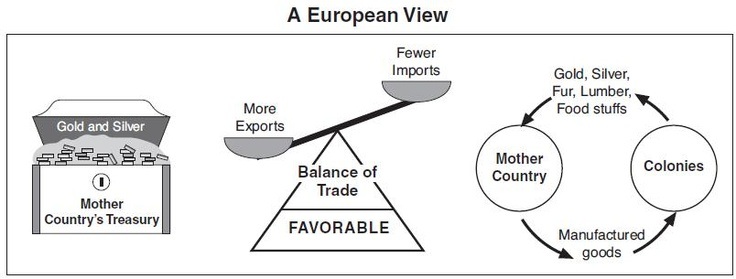
What is mercantilism?
A system where a mother countries gains money and power from natural resources that come from its colonies.
where colonies trade gold and silver with each other.
Wars that start over money.
Plantation colonies trading slaves for money.

The impact of mercantilism was that
The rate of slavery in the Americas went down
Trade was limited in the Atlantic
The Colony grew wealthy
The Mother Country grew wealthy
One example of a syncretic religion created after Spanish colonization of the Americas is ____.
Christianity
Islam
Sikhism
Vodun/ Voodoo
Companies formed when investors pooled their money together in exchange for a percentage of ownership on the company through stock. Such arraingements were used to fund England's early colonial efforts.
Virginia Company
Joint-Stock Companies
Mission System
Mestizos
Owning of human beings as property able to be bought, sold, given, and inherited, is known as.....
Mercantilism
Free trade
Chattel slavery

