wayground logo

Free Printable Worksheets

Font size

S
M
L
XL
Worksheets

FINAL EXAM - - 6th grade

Total questions: 85

Worksheet time: 46mins
Name
Class
Date
1.
What is a light-year?
a)
the average speed at which light travels
b)
the distance light travels in one year
c)
a scientific measurement of space time
d)
the distance light travels in 350 days
2.

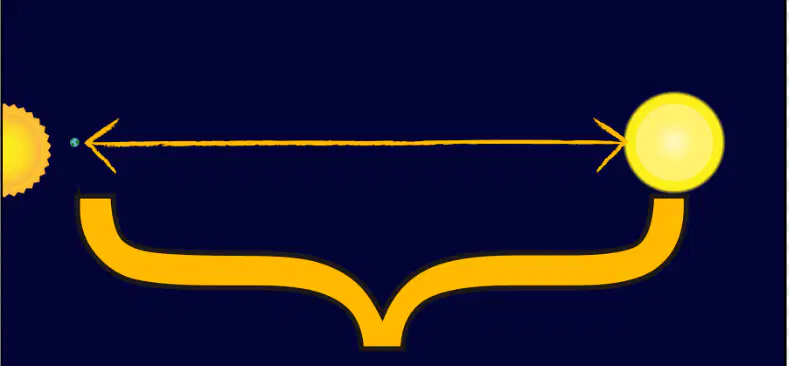
Which term described the object circled in yellow in this image?

a)

galaxy

b)

universe

c)

solar system

d)

planet

3.
What type of galaxy is the Milky Way?
a)
super cluster
b)
irregular galaxy
c)
elliptical galaxy
d)
spiral galaxy
4.
The star, ___________ is 44x wider than our Sun.
a)
Pluto
b)
Aldebaran
c)
Betelgeuse
d)
Rigel
5.

Which of the following is NOT a type of galaxy?

a)

Spiral

b)

Elongated

c)

Irregular

d)

Elliptical

6.

Patterns of stars in the sky are called ______________________

a)
constellations
b)

galaxies

c)

nebula

d)

universes

7.
Stars vary in color, which is related to what?
a)
It's distance from Earth
b)
How old the star is
c)
The strength of its gravity
d)
It's temperature
8.
A __________ is a huge collection of stars, gas and dust.
a)
Galaxy
b)
Super nova
c)
Universe
d)
Variable star
9.
What causes galaxies to gather in clusters?
a)
Dark space
b)
Dark matter
c)
Gravity
d)
Solar System
10.
What color are the hottest stars?
a)
red
b)
yellow
c)
orange
d)
blue
11.
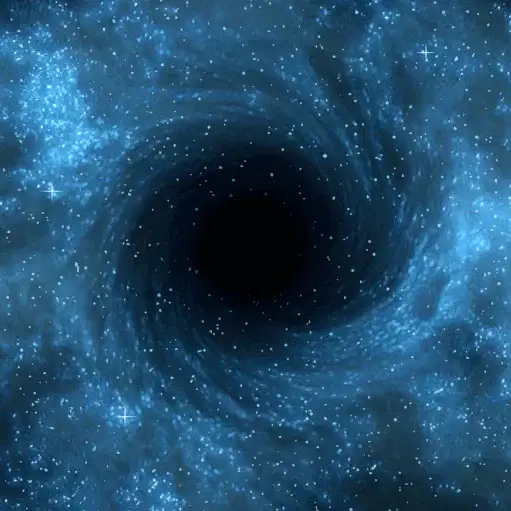
What is an object that is so massive and dense that even light can not escape its gravity?
a)
Main-sequence
b)
black hole
c)
Apparent Magnitude
d)
Comet
12.
Irregular galaxies
a)
are oddly shaped & contain many young stars
b)
are shaped like footballs & contain little gas and dust
c)
have arms that extend from the center & contain many old stars
d)
are shaped like spirals and have a lot of dark matter
13.
Spiral galaxies
a)
are oddly shaped & contain many young stars
b)
are shaped like footballs & contain older, redder stars
c)
have arms that extend from the center & contain many old stars
d)
are shaped like spirals and have a lot of dark matter
14.
Elliptical galaxies
a)
are oddly shaped & contain many young stars
b)
are shaped like footballs & contain older, redder stars
c)
have arms that extend from the center & contain many old stars
d)
are shaped like spirals and have a lot of dark matter
15.
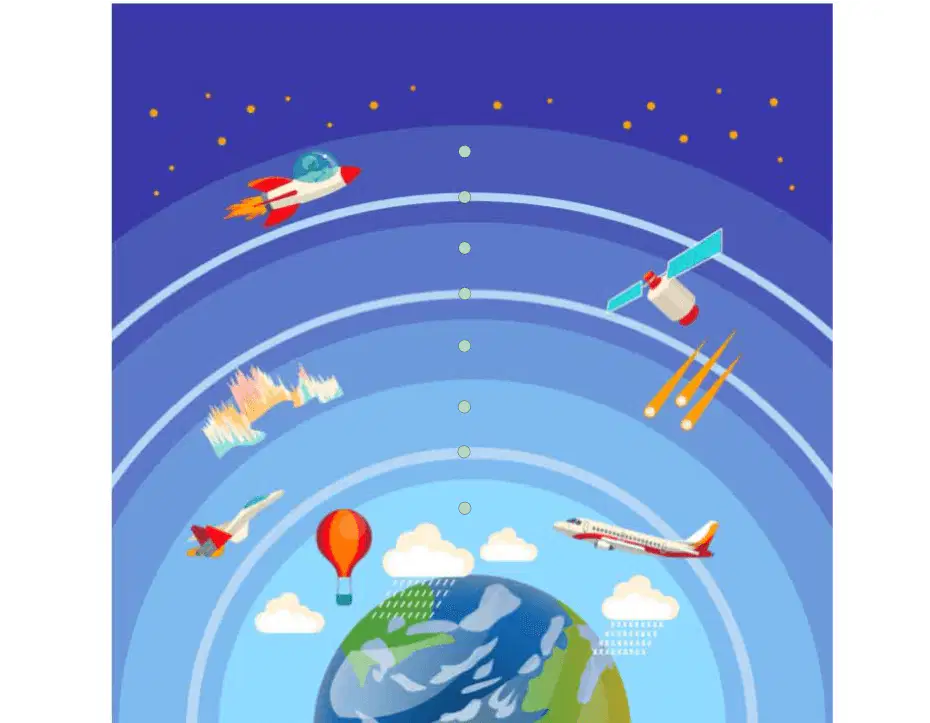
The atmosphere is
a)
the layer in which weather occurs
b)
the layer that contains the ozone layer
c)
the layer of water in the oceans
d)
the layer of gases that surrounds Earth
16.
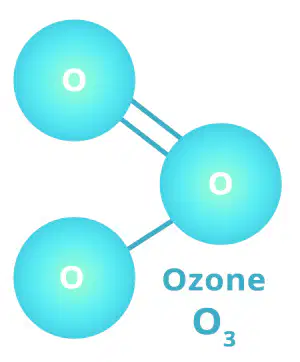
What is ozone?
a)
a deep part of the ocean
b)
a part of the water cycle
c)
layer of atmosphere that blocks UV light
d)
a part of the geosphere
17.
What is the frozen portion of water on Earth's surface called?
a)
Geosphere
b)
Lithosphere
c)
Cryosphere
d)
Hydrosphere
18.
The _______ is Earth's sphere which includes gases like nitrogen and oxygen, as well as dust, rain, and cloud droplets.
a)
liquid outer core
b)
solid inner core
c)
atmosphere
d)
ocean water
19.
The two most abundant gases in the atmosphere are
a)
carbon dioxide and oxygen
b)
carbon dioxide and nitrogen
c)
nitrogen and oxygen
d)
nitrogen and hydrogen
20.
Earth's atmosphere is important to living things because it
a)
contains dust and other particles
b)
is very thin compared to the size of Earth
c)
provides all the gases that living things need to survive
d)
maintains a constant relative humidity
21.
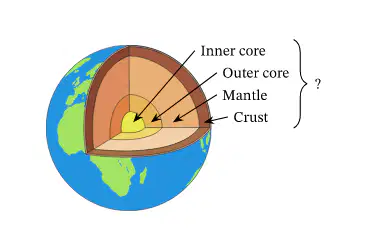
Which sphere does this diagram show?
a)
biosphere
b)
hydrosphere
c)
cryosphere
d)
geosphere
22.
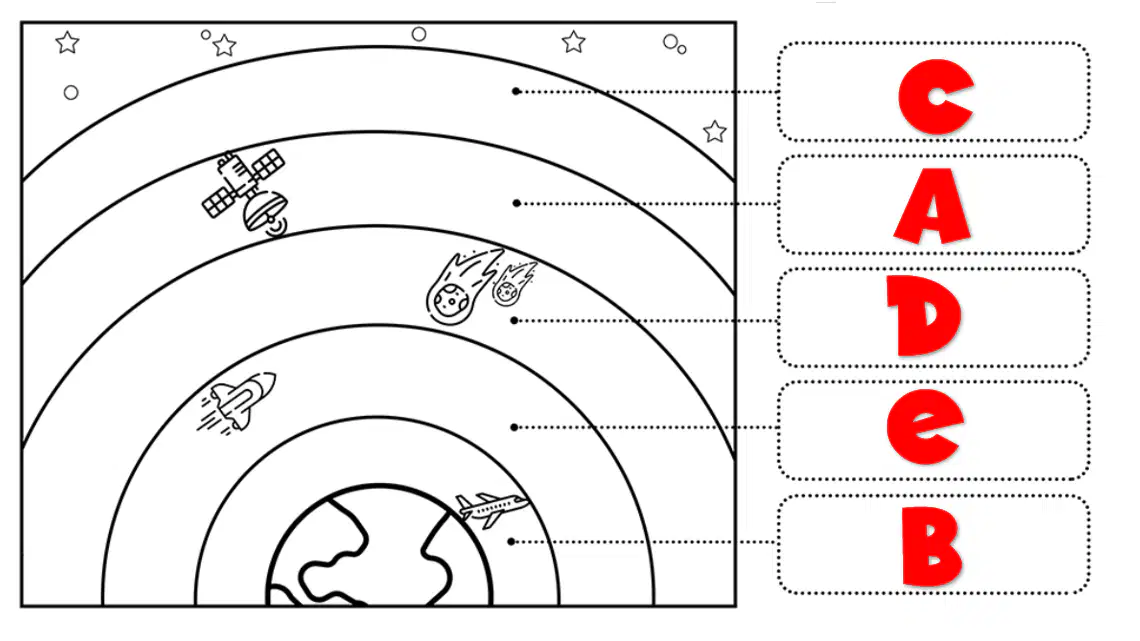
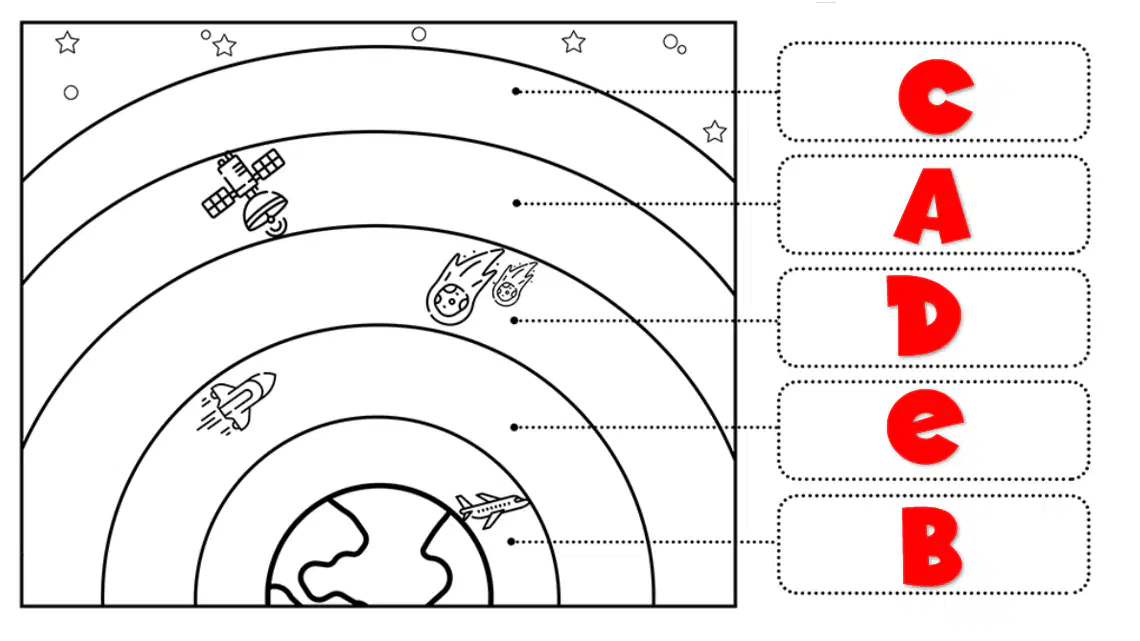
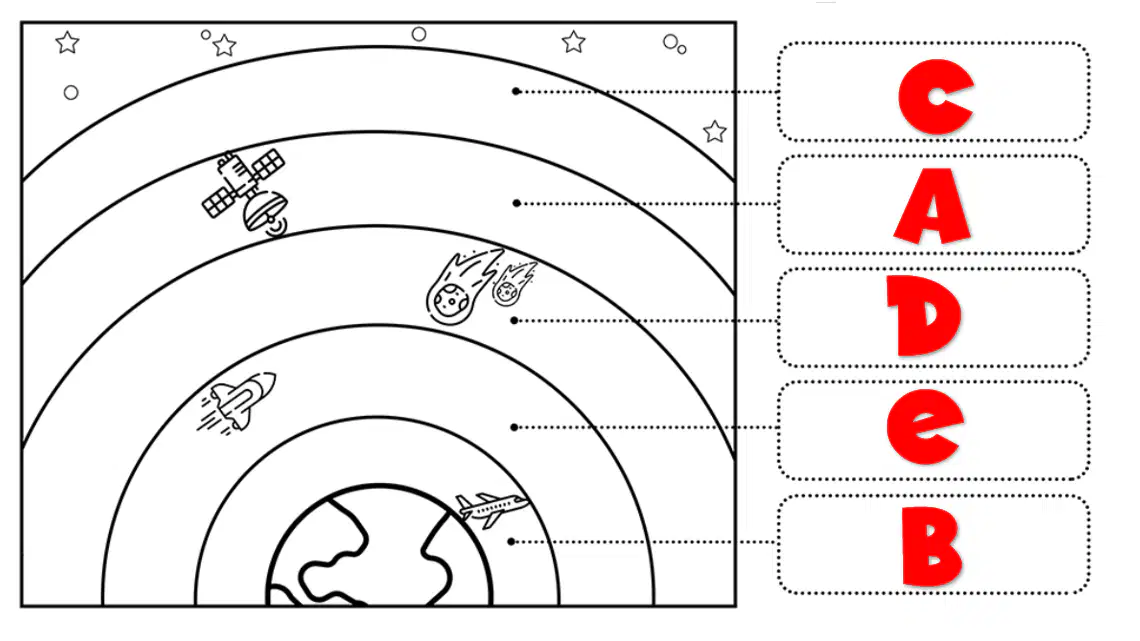
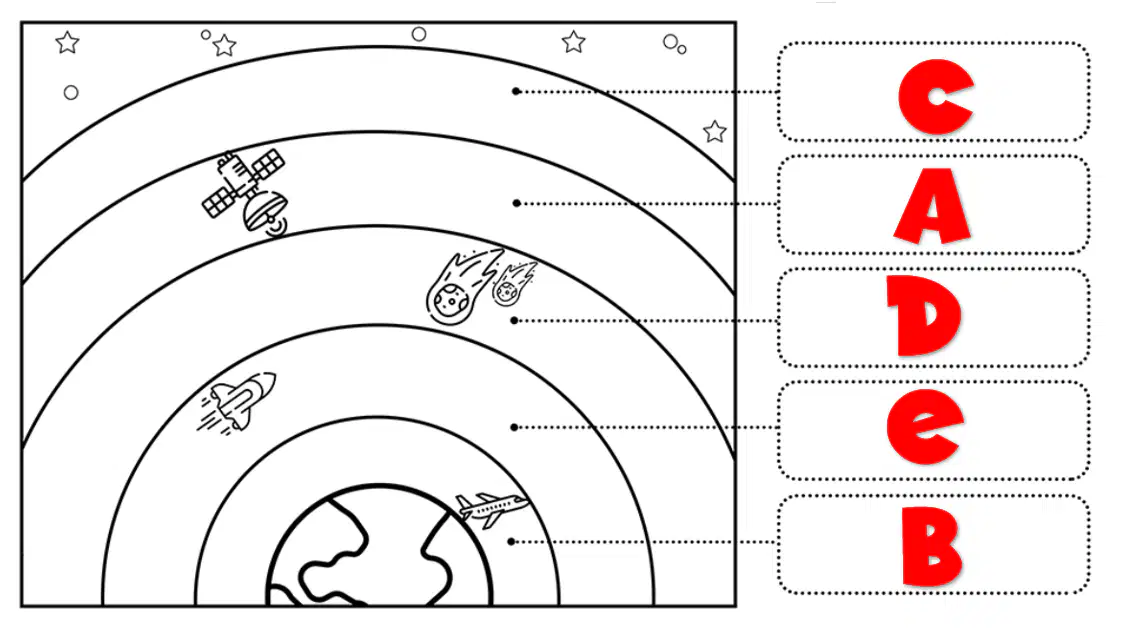
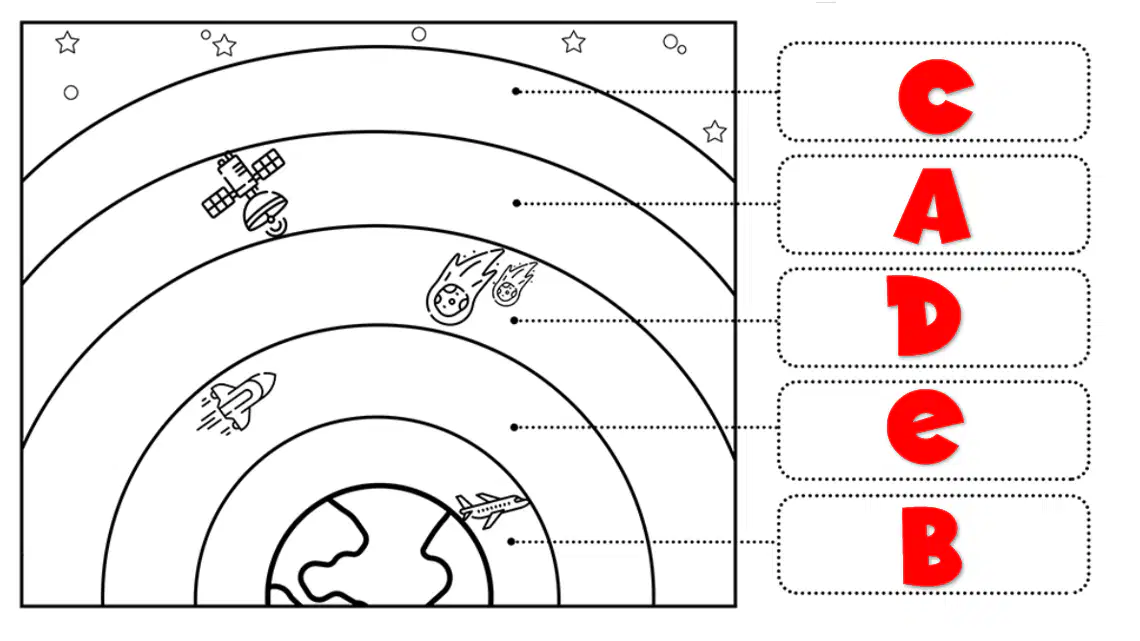
What is the name of the layer "A"?
a)
Stratosphere
b)
Troposphere
c)
Thermosphere
d)
Mesosphere
e)
Exosphere
23.
What is the name of the layer "B"?
a)
Stratosphere
b)
Troposphere
c)
Thermosphere
d)
Mesosphere
e)
Exosphere
24.
What is the name of the layer "C"?
a)
Stratosphere
b)
Troposphere
c)
Thermosphere
d)
Mesosphere
e)
Exosphere
25.
What is the name of the layer "D"?
a)
Stratosphere
b)
Troposphere
c)
Thermosphere
d)
Mesosphere
e)
Exosphere
26.
What is the name of the layer "E"?
a)
Stratosphere
b)
Troposphere
c)
Thermosphere
d)
Mesosphere
e)
Exosphere
27.
Which layer of the atmosphere is the one we live in?
a)
stratosphere
b)
mesosphere
c)
thermosphere
d)
troposphere
28.
What layer of the atmosphere did Felix Baumgartner jump from?
a)
mesophere
b)
troposphere
c)
stratosphere
d)
ionosphere
29.
The layers of Earth's atmosphere are determined by changes in _________.
a)
temperature
b)
density
c)
ozone amounts
d)
color
30.
What layer of the atmosphere is the thickest and hottest?
a)
mesophere
b)
thermosphere
c)
stratosphere
d)
ionosphere
31.

Meteors burn up in this layer.

a)

Troposphere

b)

Stratosphere

c)

Mesosphere

d)

Thermosphere

e)

All of the above.

32.

Coldest layer.

a)

Troposphere

b)

Stratosphere

c)

Mesosphere

d)

Thermosphere

e)

All of the above.

33.
Which layer of the atmosphere contains the ozone layer?
a)
troposphere
b)
stratosphere
c)
thermosphere
d)
exosphere
34.

Where satellites orbit.

a)

Troposphere

b)

Stratosphere

c)

Mesosphere

d)

Thermosphere

e)

All of the above.

35.
Layer of electrically charged particles in the thermosphere that absorbs AM radio waves during the day and reflects them back at night.
a)
exosphere
b)
troposphere
c)
stratosphere
d)
ionosphere
36.
Which order is correct from the earth to space (bottom to top)?
a)

thermosphere  troposphere  exosphere mesosphere stratosphere  

b)

thermosphere  troposphere  stratosphere  exosphere mesosphere

c)

troposphere stratosphere mesosphere thermosphere exosphere

d)

troposphere thermosphere   stratosphere  exosphere mesosphere

37.
All weather happens in this layer, hot air balloons fly here too!
a)
troposphere
b)
stratosphere
c)
thermosphere
d)
exosphere
38.
What does the earth's atmosphere do?
a)
help to regulate the temperature on Earth
b)
Help UV rays to reach the Earth's surface
c)
Creates meteors in the sky
d)
Keep ocean waters cold
39.
"Northern Lights" or aurora borealis are seen within this layer.
a)
stratosphere
b)
Thermosphere
c)
mesosphere
d)
troposphere
40.
Water returns to the atmosphere by the process of __________.
a)
radiation
b)
precipitation
c)
evaporation
d)
condensation
41.
Water gathering in rivers, lakes, streams, oceans, and other bodies of water is called...
a)
precipitation
b)
condensation
c)
collection
d)
absorption
42.
An area's average weather conditions over time is called ______.
a)
weather
b)
precipitation
c)
climate
d)
water cycle
43.
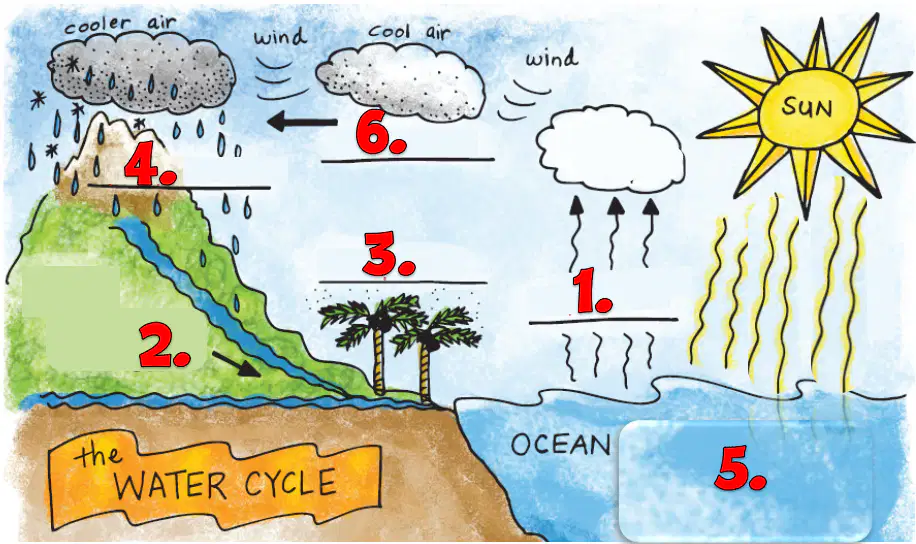
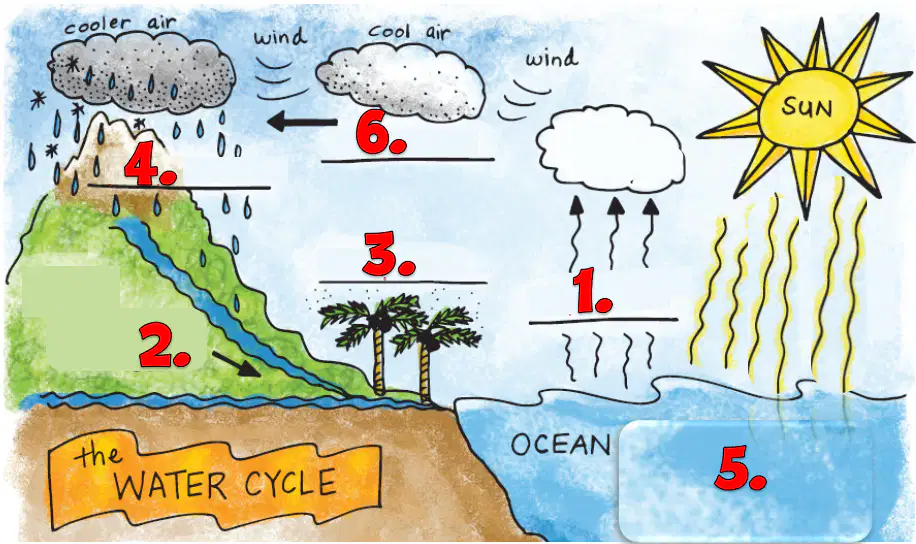
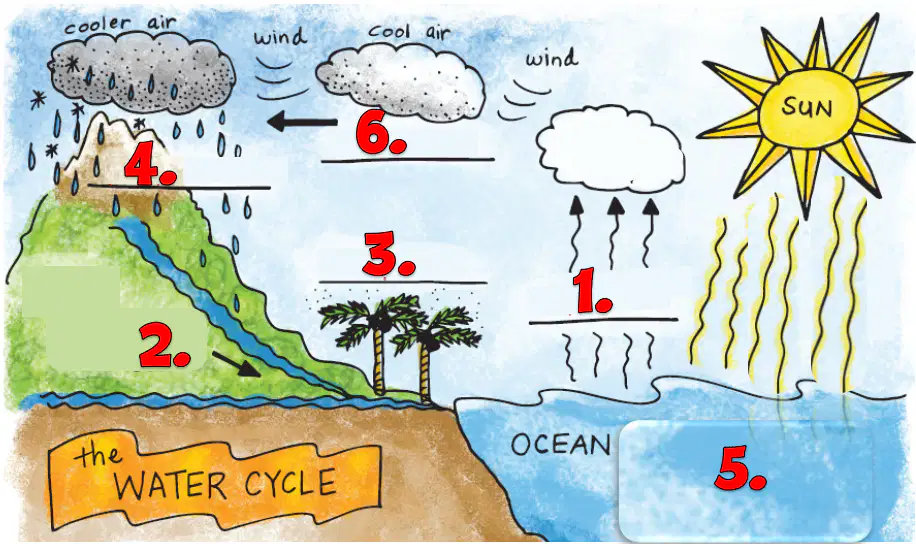
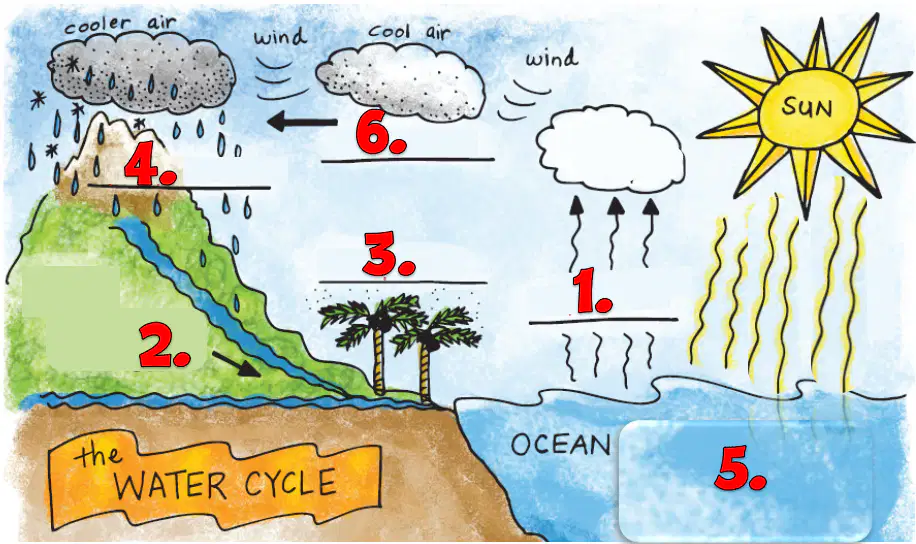
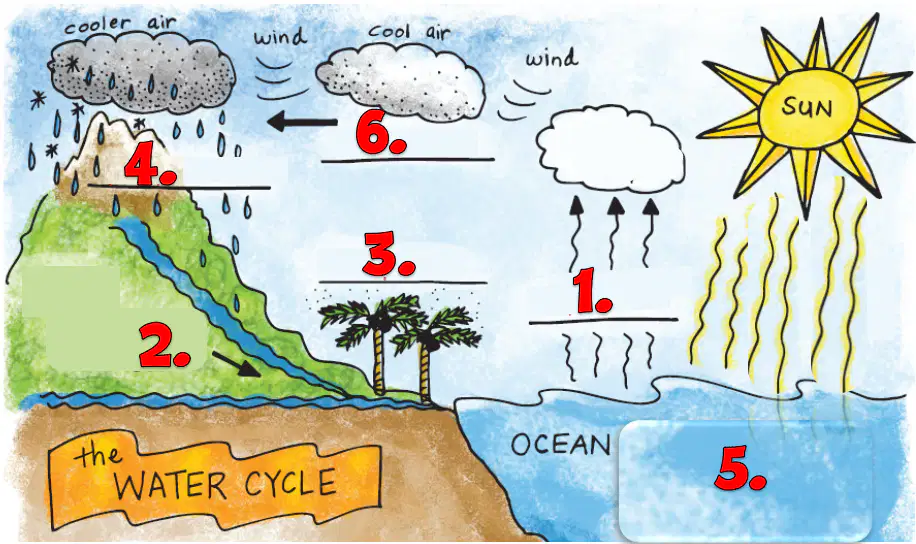
What step of the water cycle is #1
a)
Evaporation
b)
Precipitation
c)
Condensation
d)
Runoff
e)
Collection
44.
What step of the water cycle is #2
a)
Runoff
b)
Precipitation
c)
Condensation
d)
Collection
e)
Evaporation
45.
What step of the water cycle is #3
a)
Transpiration
b)
Precipitation
c)
Condensation
d)
Runoff
e)
Collection
46.
What step of the water cycle is #4
a)
Precipitation
b)
Condensation
c)
Runoff
d)
Collection
e)
Evaporation
47.
What step of the water cycle is #5
a)
Collection
b)
Precipitation
c)
Condensation
d)
Runoff
e)
Evaporation
48.
What step of the water cycle is #6
a)
Condensation
b)
Precipitation
c)
Runoff
d)
Collection
e)
Evaporation
49.
Another name for the water cycle is the ______ cycle.
a)
Hydrogen
b)
Hydroxy
c)
Hydroelectric
d)
Hydrologic
50.

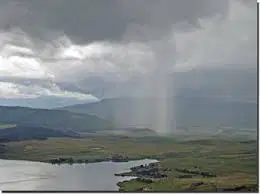
This picture shows -

a)


evaporation

b)

condensation

c)

precipitation

d)

transpiration

51.
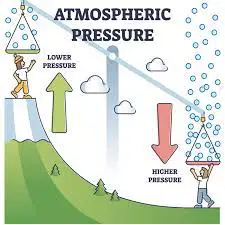
A _______ measures atmospheric pressure.
a)
thermometer
b)
hygrometer
c)
spectrometer
d)
barometer
52.

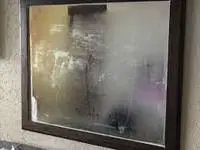
This picture of the mirror shows an example of--

a)

precipitation

b)

transpiration

c)

evaporation

d)

condensation

53.
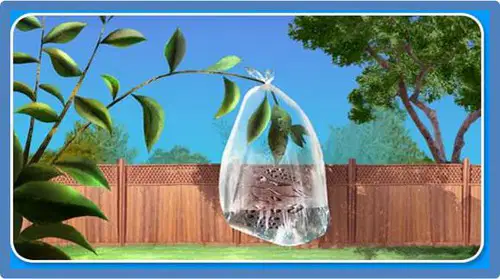
Loss of water from a plant through its leaves (HINT: plant sweats)
a)
transpiration
b)
condensation
c)
evaporation
d)
precipitation
54.
What is the driving force behind the water cycle?
a)
Living organisms
b)
Energy from fossil fuels
c)
Energy from food chains
d)
Energy from the sun
55.
The condition in the atmosphere over a short period of time is called _____
a)
Climate
b)
Weather
c)
Seasons
d)
Ecosystems
56.
_____ is the force exerted by air molecules in all directions.
a)
Humidity
b)
Wind
c)
Air pressure
d)
Air temperature
57.
What is climate?
a)
 What's going on with the atmosphere at any particular time
b)
The type of weather that occurs during a particular season
c)
An area's pattern of weather over a long period of time
d)
How much sunshine an area gets 
58.
When water vapor is cooled and forms droplets and becomes a liquid
a)
transpiration
b)
condensation
c)
evaporation
d)
precipitation
59.
Which occurs when one plate moves underneath another?
a)
shearing
b)
compression
c)
tension
d)
subduction
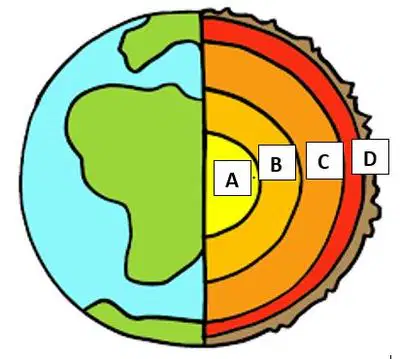
60.
What is layer A?
a)
crust
b)
inner core
c)
outer core
d)
mantle
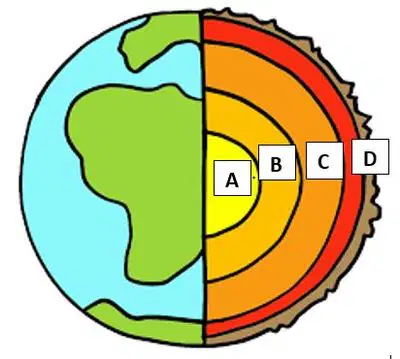
61.
What is layer B?
a)
crust
b)
inner core
c)
outer core
d)
mantle
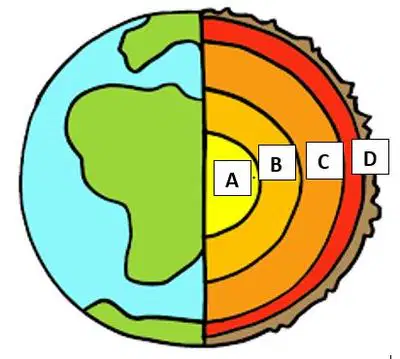
62.
What is layer C?
a)
crust
b)
inner core
c)
outer core
d)
mantle
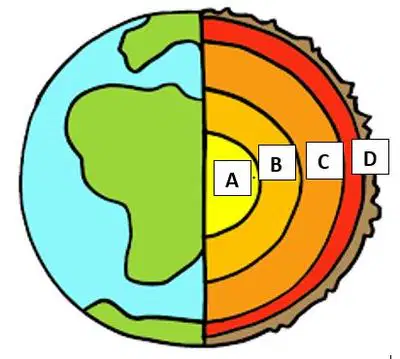
63.
What is layer D?
a)
crust
b)
inner core
c)
outer core
d)
mantle
64.
This is the theory which states that the Earth is broken into large slabs of rocks which can move around.
a)
Theory of Plate Tectonics
b)
Theory of Seafloor Spreading
c)
Theory of Continental Drift
d)
Theory of Land Mass
65.
What do scientists believe is the force behind the plate tectonics?
a)
convection currents
b)
gravity slab pull
c)
the movement of the planets
d)
the Sun's gravity
66.
What type of boundary is shown here?
a)
divergent
b)
convergent
c)
transform
d)
convection
67.
What was Pangaea?
a)
the original name for North America
b)
a large, single landmass
c)
a layer of the Earth
d)
a geologic era
68.
What type of boundary is shown here?
a)
divergent
b)
convergent
c)
transform
d)
convection
69.
What type of boundary is shown here?
a)
divergent
b)
convergent
c)
transform
d)
convection
70.

This is the plastic layer (like silly putty) of the mantle on which pieces of the lithosphere move.

a)
Lithosphere
b)
Asthenosphere
c)
Mesosphere
d)
Crust
71.

What is the process in which two plates move toward each other but one sinks under the other?
a)
subduction
b)
convection
c)
divergence
d)
transformation
72.
This word describes the size of the earthquake:
a)
seismograph
b)
focus
c)
magnitude
d)
epicenter
73.
What is the violent shaking of Earth's crust as built-up energy is released.
a)
earthquake
b)
epicenter
c)
fault
d)
focus
74.
The area around the Pacific Ocean where lots of earthquakes and volcanoes happen is called the ____________.
a)
Ring of Fire
b)
Ring of Earth
c)
Ring of Stone
d)
Ring of Diamond
75.
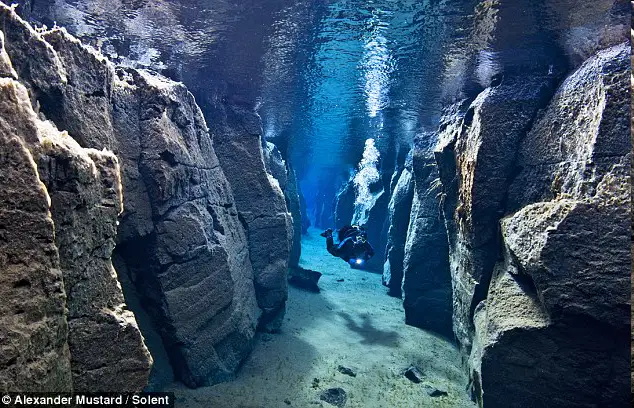

What type of event will occur at this boundary?
a)
Earthquake
b)
Volcano Eruption
c)
Tornado
d)
Mountain Building
76.
The _________ is a volcanic mountain range that extends for more than 40,000 miles.
a)
Mid-Atlantic Ridge
b)
Mt. St. Helens
c)
Mt. Kilauea
d)
Himalayas
77.
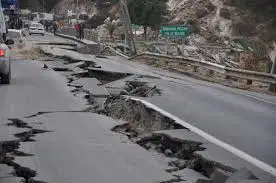
The cracks in Earth's crust are called ___________.
a)
tectonic plates
b)
faults
c)
magma
d)
lava
78.
What is the name of the instrument used to measure the waves of an earthquake?
a)
Richter Scale
b)
Octograph
c)
Seismograph
d)
Fault detector
79.
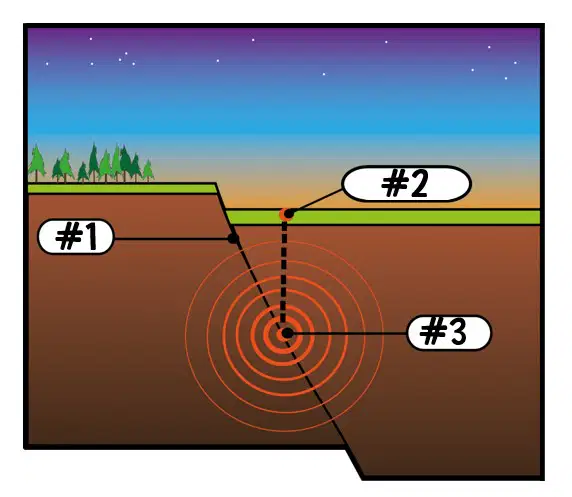
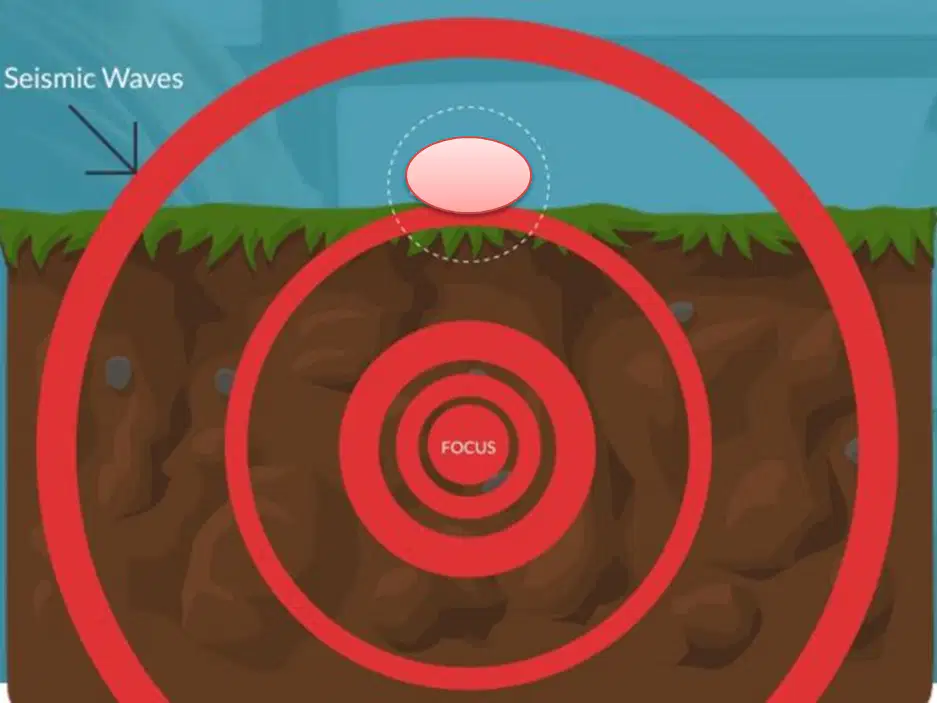
Identify #2. The point on Earth's surface directly above the focus of an earthquake?
a)
earthquake
b)
epicenter
c)
fault
d)
focus
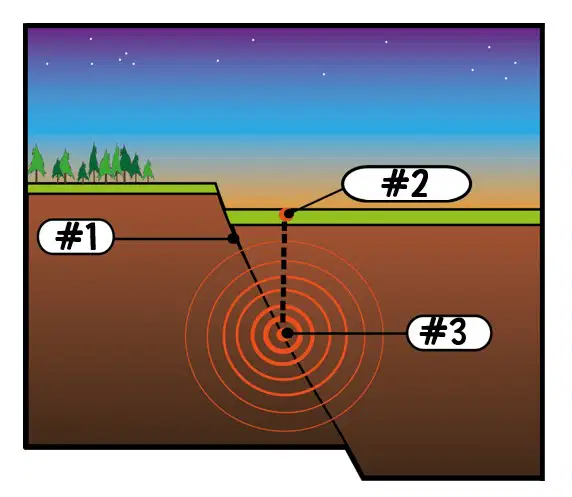
80.
Identify #3. The point underground where the faulting in an earthquake occurs.
a)
earthquake
b)
epicenter
c)
fault
d)
focus
81.
The epicenter of an earthquake is _______.
a)
The point below the surface where rock begins to break and the first motion occurs
b)
The seismic station closest to the earthquake
c)
The place where the greatest damage occurs
d)
The point on the surface directly above the focus
82.
Which of the following causes Earth's tectonic plates to move?
a)
Energy from the Sun
b)
Magnetic Pole Reversal
c)
Convection currents in the mantle
d)
Faults in Mountain Ranges
83.
Magma leaves a volcano through a 
a)

conduit

b)

fracture

c)
vent
d)

magma chamber

84.
Hawaiian islands were formed over a....
a)
hot spot
b)
divergent boundary
c)
fault
d)
focus
85.
_____________ happen when the big pieces of the Earth's crust move.
a)
Lava
b)
Magma
c)
Tectonic Plates
d)

Earthquakes