
Font size
 Worksheets
Natural Selection Acc Bio
Total questions: 28
Worksheet time: 28mins
Which of the following is the correct definition of natural selection?
The idea that organisms less equipped for their environment tend to survive longer
The idea that organisms more well equipped for their environment tend to survive longer
The idea that organisms more well equipped for their environment tend to not survive
None.
the movement of genes into or out of a population
Gene Flow
Random chance; small population
Genetic Drift
A sudden change in one or more characteristics due to a change in a gene
Mutation
Occurs due to physical difference as a result of a genetic difference
Non-Random Mating
The movement of organisms from one place to another
Migration

Which of the following best describes what the image represents?
Genetic Drift
Migration
Mutation
Natural Selection
Which of the following is an example of artificial selection?
Gorillas are in the wild and have a baby gorilla.
A group of ants in an ant pile are exterminated by an exterminator.
A black speckled rabbit is a new favorite among children, a white and black rabbit are picked to make black and white baby bunnies.
Wolves in the wild have pups.

This picture shows how a scientist how a scientist might use this type of data to decide if an animal is closely related or not.
Comparing the anatomy of a living animal to an extinct one
Comparing the DNA of a living animal to another living animal
Comparing the anatomy of a living animal to another living animal
Comparing the development of one living animal to another
Match the following terms with their definitions
Evolution
a change in a species DNA over time because of natural selection
Adaptation
Any variation that makes an organism better able to survive
Variation
An inherited trait that makes and individual different
Mutation
A permanent change in the DNA
How do you "win" at natural selection?
survive
go extinct
survive & reproduce
Starlings produce an average of five eggs in each clutch. If there are more than five, the parents cannot adequately feed the young. If there are fewer than five, predators may destroy the entire clutch. This is an example of:
disruptive selection.
stabilizing selection.
directional selection.
none of the above.
In a lake in South Africa, guppies are eaten by the pike fish, and the larger the guppy, the more difficulty it has escaping its pike fish predator.
disruptive selection
stabilizing selection
directional selection
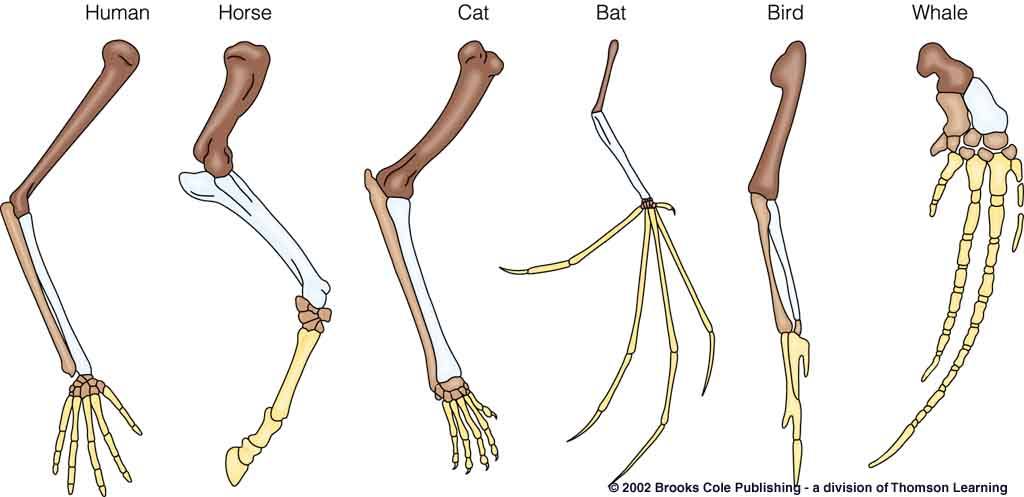
Structures that are similar in function but are not similar in origin (a)
Whales are aquatic mammals that contain a pelvis (hip) bone. Even though it does not aid in its movement, the function must have been used by a common ancestor of the whale. Thus, the pelvis is referred to as a(n)
vestigial structure
analogous structure
homologous structure
How does comparative anatomy provide evidence for evolution?
By disproving the theory of evolution
By proving that all organisms have identical anatomy
By focusing solely on molecular biology
By showing structural similarities and differences among species
Which of the following is a vestigial structure in humans?
Appendix
Heart
Brain
Lungs
What are the four major sources of evidence of evolution mentioned in the video?
Fossil record, genetics, molecular biology, natural selection
Fossil record, comparative anatomy, genetics, speciation
Fossil record, embryology, comparative anatomy, molecular biology
Genetics, natural selection, comparative anatomy, embryology

