wayground logo

Free Printable Worksheets

Font size

S
M
L
XL
Worksheets

Population Ecology & Carbon Cycle Quiz

Total questions: 27

Worksheet time: 14mins
Name
Class
Date
1.
What term best describes a group of different species living together in the same area?
a)
Organism
b)
Community
c)
Biome
d)
Population
2.
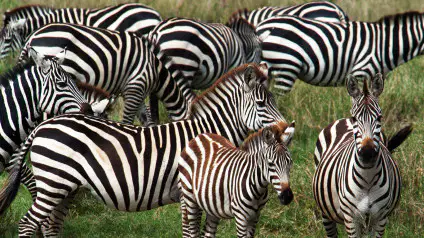
What term best describes the picture below.
a)
Organism
b)
Population
c)
Biosphere
d)
Community
3.
Which of the following is a density-independent limiting factor?
a)
Predation
b)
Parasitism
c)
Disease
d)
Hurricane
4.

Which of the following is a density-dependent limiting factor?

a)

Deforestation

b)

Competition

c)

Forest Fire

d)
Hurricane
5.
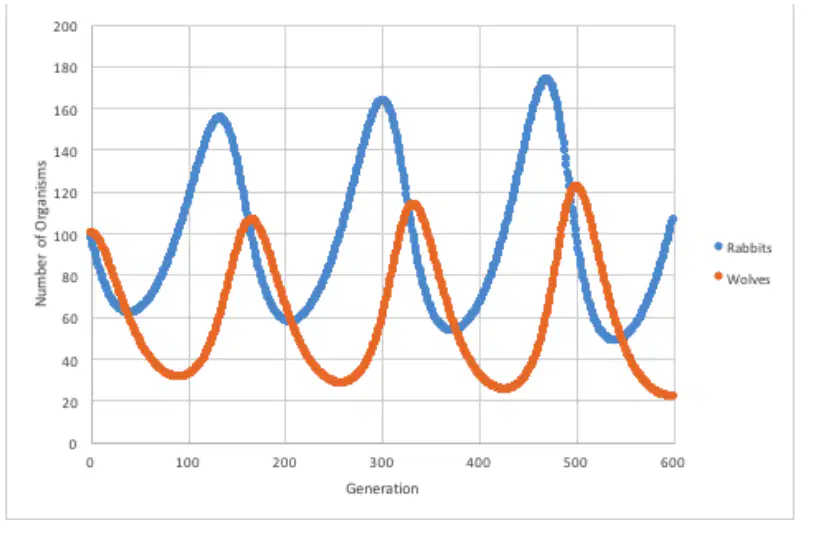
Wolves are predators of rabbits. The graph shows their population over several generations. What type of limiting factor is this?
a)
Density-Independent
b)
Density-Dependent
6.
What is carrying capacity?
a)
The highest population of a species
b)
The amount of weight that an organism can carry
c)
The amount of food needed for a population
d)
The average amount of organisms that an ecosystem can support for a long period of time.
7.
Mosquitos are unable to survive in very cold temperatures. When temperatures drop below 55 degrees, many mosquitos die. What type of limiting factor is this?
a)
Density-Independent
b)
Density-Dependent
8.

A drought has caused a water hole to dry up. What type of limiting factor is this?

a)
Density-Independent
b)
Density-Dependent
9.
Which of the following could increase the carrying capacity of a population?
a)
Increase in parasites
b)
Reduction of water
c)
Increase of food sources
d)
Reduction of space
10.

Which of the following could reduce the carrying capacity of a population?

a)

less mates

b)

less disease

c)
Increase of food sources
d)

increase of space

11.
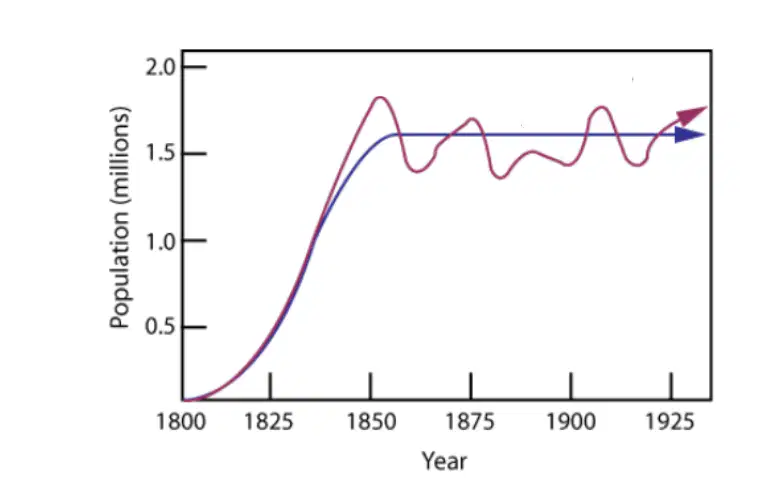
What is the carrying capacity of the population of rabbits?
a)

2.0 million

b)

1.8 million

c)

1.5 million

d)

1.0 million

12.
What term describes how carbon moves from the atmosphere to the biosphere?
a)
Photosynthesis
b)
Cellular Respiration
c)
Combustion
d)
Lithification
13.

What form of carbon exists in the geosphere?

a)
Glucose
b)
Fossil fuels
c)
Carbon Dioxide
d)

Carbon monoxide

14.
What form of carbon exists in the atmosphere?
a)
Glucose
b)
Fossil fuels
c)
Carbon Dioxide
d)
Graphite
15.
How does carbon move from the biosphere the geosphere?
a)
Living things breathe out carbon dioxide which enters rocks.
b)
Living things die and decompose which adds carbon to the soil and can eventually become fossil fuels
c)
Carbon is exchanged with the atmosphere
d)
Fossil fuels are burned as a fuel source
16.
When humans burn fossil fuels, most of the carbon enters the as carbon dioxide.
a)
hydrosphere
b)
geosphere
c)
biosphere
d)
atmosphere
17.
How do animals add carbon dioxide to the atmosphere?
a)
Photosynthesis
b)
Cellular Respiration
c)
Transpiration
d)
Evaporation
18.
True/False: Carbon is neither created nor destroyed, only transferred.
a)
True
b)
False
19.
How does carbon primarily exist within the biosphere?
a)
Carbon Dioxide
b)
Glucose
c)
Methane
d)
Carbon Monoxide
20.
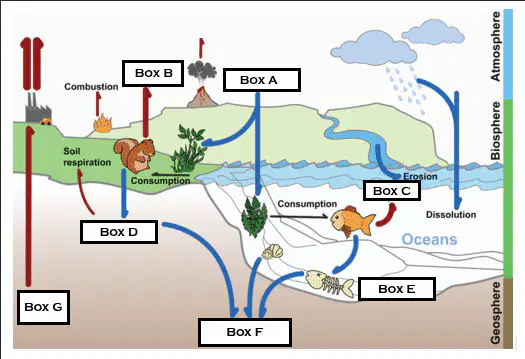
What process is represented by Box E?
a)
Cellular Respiration
b)
Decomposition
c)
Combustion
d)
Photosynthesis
21.
  1. Box A shows carbon moving from the atmosphere into the biosphere. Box A should be labeled with which of the following processes?

a)
Cellular Respiration
b)
Decomposition
c)

Combustion

d)

Photosynthesis

22.
  1. What carbon-based molecule is produced by plants?

a)

Glucose

b)

Carbon Dioxide

c)

Methane

d)

Oxygen

23.
  1. Boxes F and G show the carbon-rich product of the process from Box E.  What is that product?

a)

Fossil Fuels

b)

Carbon Dioxide

c)

Carbon Monoxide

d)

Water

24.

Name the sphere: "All living things on Earth"

a)

Biosphere

b)

Hydrosphere

c)

Atmosphere

d)

Geosphere

25.

Name the sphere: "All the water on Earth"

a)

Biosphere

b)

Hydrosphere

c)

Atmosphere

d)

Geosphere

26.

Name the sphere: "All the solid parts of Earth"

a)

Biosphere

b)

Hydrosphere

c)

Atmosphere

d)

Geosphere

27.

Name the sphere: "The gases that surround Earth"

a)

Biosphere

b)

Hydrosphere

c)

Atmosphere

d)

Geosphere