
 Worksheets
Semester 2 Final Review
Total questions: 117
Worksheet time: 1hrs 7mins
Which of the following is a method to permanently charge an object electrically?
Charging by Friction
Charging by Polarization
Charging by Repetition
Charging by Conservation
A positively charged wand is charged and touched to the bulb of an electroscope, giving the electroscope a positive charge. What type of charging technique was used?
Polarization
Induction
Conduction
Friction
A negatively charged wand is held near (but not touching) the bulb of an electroscope. Meanwhile, you ground the electroscope with your hand. The electroscope should become ______ once you remove the rod and your hand.
Polarized
Negatively charged
Positively charged
Neutral
In a good electrical insulator, electrons are usually ______.
tightly bound to their atoms
fulfilling the octet rule
not moving at all
free to move around
Conservation of charge means that ______.
electrons by themselves can be destroyed
you can give something a charge without taking it from somewhere else
Through friction if one object receives a +3 charge, the other object has a -3 charge
the net charge would have a different magnitude after an interaction.
Like charges ______ while unlike charges ______.
repel, attract
attract, repel
stick together, attract
repel, stick together
You rub a balloon against your hair. If the balloon ends up with a net charge of +7 coulombs, what net charge does your hair have?
+7 C
-7 C
-1.6x10^-19
Neutral
The earth orbits the sun once every 365.25 days. What keeps the earth from falling into the sun?
The earth is in space and does not experience gravity, so it does not fall into the sun
The earth is being repelled by the sun so it stays in the orbit
The earth is falling to the sun but it has orbital velocity which keeps it from hitting the sun.
The sun’s mass keeps the earth from falling into it.
Which force is responsible for keeping the planets in their orbits?
Gravitational force
Force of friction
Force of acceleration
Inertial force
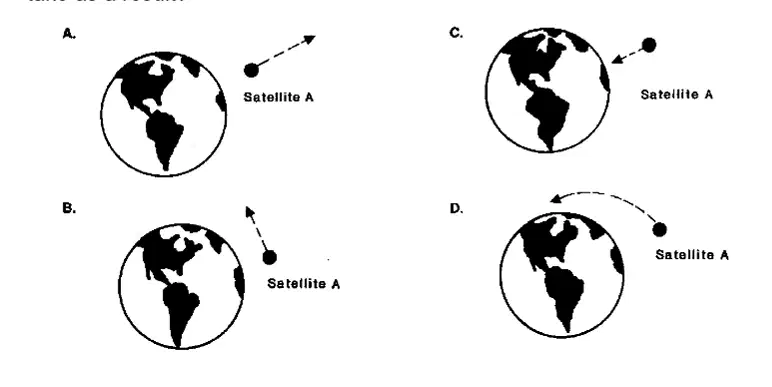
If the gravity of Earth could suddenly disappear, which of the following paths would Satellite A take as a result?
Path A
Path B
Path C
Path D
The force of gravitation between two bodies in the universe depends on ________.
The distance between them
Multiplying their masses
Adding their masses
Both A and B
The following planets are ordered in terms of increasing mass: Mercury, Mars, Venus, Jupiter. Which planet would take a rocket the least amount of energy to leave its surface?
Mercury
Mars
Venus
Jupiter
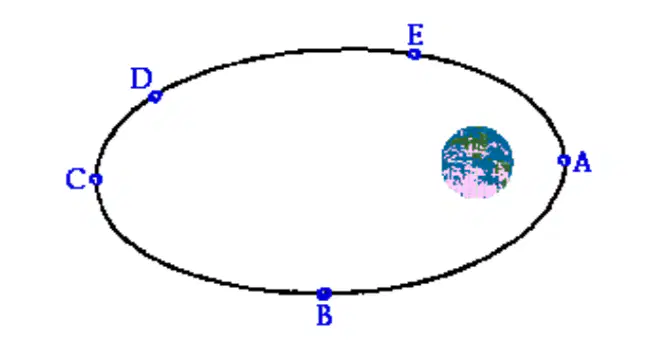
Refer to the diagram provided. In an elliptical orbit around the Earth, at which point is the force of gravity on the satellite the smallest?
Point A
Point B
Point C
Point D
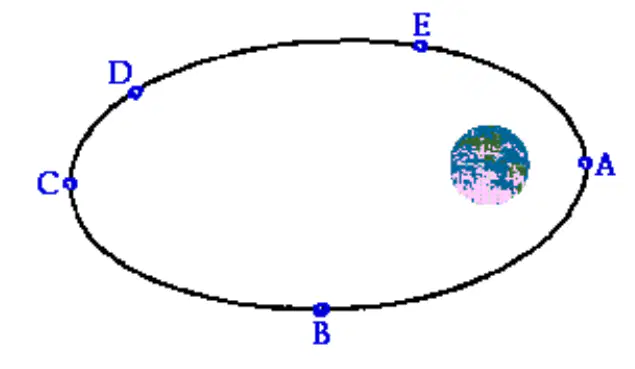
Based on the diagram, where is the potential energy of the satellite the least?
Point A
Point B
Point C
Point D
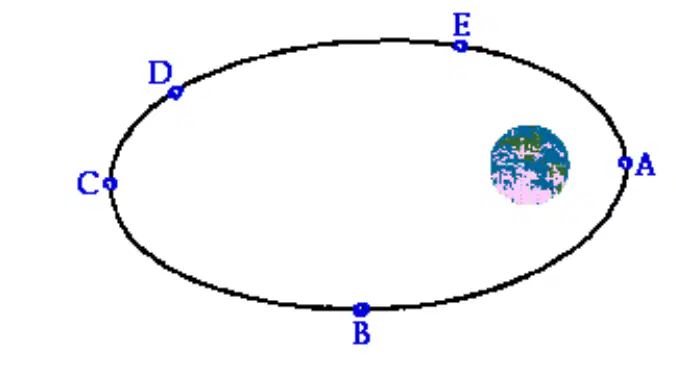
Considering the satellite's elliptical orbit shown in the diagram, at which point is the velocity of the satellite the least?
Point A
Point B
Point C
Point D
For a satellite orbiting the Earth, which statement is true when considering an elliptical orbit?
Potential energy is changing
Kinetic energy is constant
Total energy is constant
Gravity is keeping the satellite in orbit
When observing the motion of a satellite in an elliptical orbit, which of the following is true regarding its speed?
Speed is constant
Speed is changing
The distance is constant between the Earth and the satellite
Gravity has no effect on the satellite
Which statement accurately describes the relationship between the satellite and the Earth in an elliptical orbit?
The distance between the Earth and the satellite is constant
Kinetic energy is constant
Gravity is keeping the satellite in orbit
Total energy is changing
Electromagnetic waves are _______.
transverse waves
standing waves
longitudinal waves
mechanical waves
If you dip your finger more frequently into water to make waves, the wavelength of the waves _______.
gets larger
stays the same
gets shorter
becomes unpredictable
An observer on the ground hears a sonic boom which is created by an airplane flying at a speed _______.
just below the speed of sound
greater than the speed of sound
equal to the speed of sound
none of the above
The Doppler Effect describes when you would observe the source moving away from you only when _______.
Only when the source moves away from you
Only when the source moves toward you
When the source moves away or toward you
The Doppler Effect has nothing to do with the motion of the source
The time needed for a wave to make one complete cycle is its _______.
period
frequency
wavelength
amplitude
The distance between successive identical parts of a wave is called its _______.
frequency
period
wavelength
amplitude
Which wave vibrates perpendicular to the direction in which the wave travels?
Longitudinal wave
Transverse wave
Standing wave
Sound wave
The source of nearly all wave motion is a _______.
movement of matter.
harmonic object.
Vibrating object
region of variable high and low pressure
Sound waves cannot travel in ______.
solid
air
the vacuum of space
water
The singer Caruso is said to have made a crystal chandelier shatter with his voice. This is a demonstration of ______.
resonance
beats
interference
an echo
An echo occurs when sound ______.
is transmitted through a surface
is reflected from a distant surface
changes speed when it strikes a distant surface
out of tune
The pitch of a sound depends on the sound wave’s ______.
amplitude
frequency
speed
friction
The loudness of a sound depends on the sound wave’s ______.
amplitude
frequency
speed
friction
Sound travels fastest in ______.
Solids
Liquids
Gasses
sound travels the same speed in all media
If two Polaroid filters are held with their polarization axes at right angles to each other, how much light will be transmitted?
twice as much
the same
half as much
zero
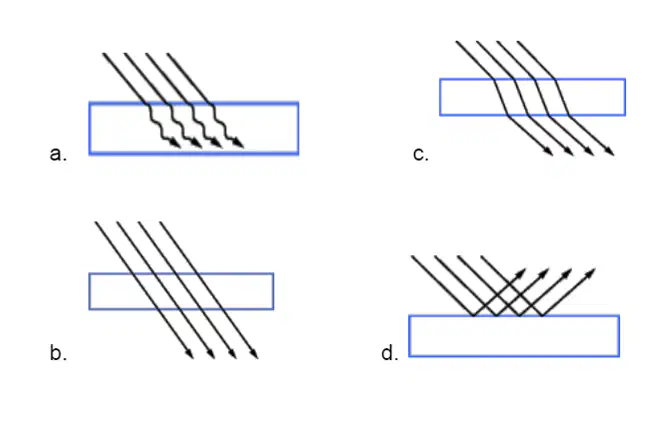
Which of the following models best describes transmission of light?
Diagram a
Diagram b
Diagram c
Diagram d
Which of the following describes an umbra?
a total shadow is formed where light rays cannot reach
has a very clear border
has a very fuzzy border
both a & c
Which of the following describes a penumbra?
a total shadow is formed where light rays cannot reach
has a very clear border
has a very fuzzy border
both a & c
Complementary colors are colors that ______.
look good together
produce white light when added together
are primary colors
are next to each other on the color chart
The three primary colors of light addition are ______.
red, yellow, and green
red, green, and blue
yellow, green, and blue
red, yellow, and blue
The cyan color of ocean water is evidence that the water absorbs ______.
green
blue
red
yellow
When blue light is added to red light, what color results?
blue light
magenta light
red light
cyan light
A chemical or material which is used to selectively absorb certain frequencies of colored light is called a ______.
spectrum
lens
mirror
pigment
The three colors used for color subtraction when printing with ink are ______.
magenta, cyan, and yellow
blue, cyan, and magenta
red, blue, and green
red, magenta, and yellow
What are the primary colors of light in color addition?
Red, Yellow, Blue
Red, Green, Blue
Yellow, Green, Cyan
Cyan, Magenta, Yellow
When red light is mixed with green light, what color is produced?
Yellow
Cyan
Magenta
Blue
What color is produced by mixing blue and green light?
Yellow
Cyan
Magenta
Red
The gravitational force exerted by an object depends on its
volume
mass
weight
The gravitational force exerted by an object depends on its
volume
mass
weight

If I double the distance between two objects, what happens to their gravitational Force?
4x bigger
1/4
2x bigger
1/2
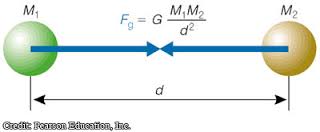

How is the gravitational force between to objects related to their mass
They are directly proportional
They are inversely proportional
They do not affect each other
They are equal

If the distance between 2 masses is increased then the force of gravitation between them will...
increase
decrease
stay the same

If the mass of either m1 or m2 is increased then the force of gravitation between them will...
increase
decrease
stay the same
The planets in our solar system all have ______________ orbits.
spherical
elliptical
circular
highly eccentric
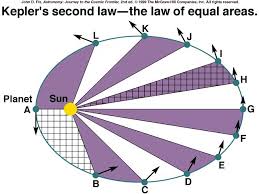
Where does the planet have the most velocity?
Position A
Position B
Position G
Position I

What would cause all of the planets to continue moving in a straight line based on their velocity (direction and speed)?
the sun disappearing
the sun's mass increasing
the distance between the planets and the sun decreasing
the distance between the planets and the sun increasing

Kinetic Energy is constant.
Circular, Elliptical, or Both?
Circular
Elliptical
Both
Velocity changes throughout the orbit.
Circular, Elliptical, or Both?
Circular
Elliptical
Both
Total Energy is constant throughout the orbit.
Circular, Elliptical, or Both?
Circular
Elliptical
Both
Gravity is keeping the planet in orbit.
Circular, Elliptical, or Both?
Circular
Elliptical
Both
Potential Energy changes throughout the orbit.
Circular, Elliptical, or Both?
Circular
Elliptical
Both
Where does the planet have the most Potential Energy?
Position A
Position B
Position G
Position I
Which wave has the longest wavelength?
Radio waves
Infrared
Ultraviolet
X-Rays
Which waves have the highest frequency?
Microwaves
Radio waves
Visible light
Gamma rays
True or False: Most of the EM Spectrum is visible to humans.
False
True
True or False: Light acts both as a wave and a particle.
False
True
What is the speed of light?
100,000,000 m/s
300,000,000m/s
100,000,000mph
100,000,000kph
Why do some objects look white?
They reflect all wavelengths of visible light
Only white light hits the object
They relect white wavelengths of visible light
They absorb all wavelengths of visible light
When an object gains electrons it becomes __________
Neutral
Positively charged
Negatively charged
An atom of oxygen has 8 protons and 10 electrons, this means the atom is ____________
positively charged because it has excess electrons
negatively charged because it has excess electrons
positively charged because it has a deficiency of electrons
negatively charged because it has a deficiency of electrons
After a balloon is rubbed against wool, the two objects will ________ each other because they have ___________ charges
attract; like
attract, opposite
repel; like
repel; opposite
Which statement is true of a positively charged object?
Positively charged objects do not contain any electrons.
Positively charged objects do not contain neutrons or electrons.
There is a lack of electrons on a positively charged object.
The protons and the electrons are both positively charged on such objects.
When two objects are rubbed together, there is a transfer of electrons. How do you determine which object acquires the transferred electrons?
Always transfer from the bigger to the smaller object, to make it even
Transfer is based on the initial charge of the two objects
Transfer is based on how much electron affinity that each object has
Always transfer from the more negative to the more positive object
What is the end result of charging by contact?
Both object have the same charge, so they will attract one another
Both object have the same charge, so they will repel one another
Both object have the opposite charge, so they will attract one another
Both object have the opposite charge, so they will repel one another
What method of static charging is shown in this picture
Contact
Friction
Grounding
Electron Shifting

Which image shows a neutral conductive pith ball after a positively charged balloon is brought near the left side, but doesn't touch?
A
B
C
D
When a charged object contacts another object (one is usually a conductor), there is a transfer of electrons. How do you determine which object acquires the transferred electrons?
Always transfer from the bigger to the smaller object, to make it even
Transfer is based on the initial charge of the two objects
Transfer is based on how much electron affinity that each object has
Always transfer from the more negative to the more positive object

Which electrostatics phenomena is shown in this picture?
Contact
Friction
Grounding
Electron Shifting
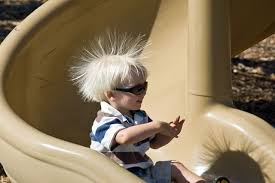
Why does the child's hair stick up?
The boy is grounded since he's at the bottom of the slide
He gained a charge from the slide, and since he's not grounded, his hairs have the same charge so they repel one another
He gained a charge from the slide, and since he's not grounded, his hairs have opposite charges so they repel one another
When hair is neutral, some have a positive side and some have negative side, so they will attract to each other, making it stand up
What is the end result of charging by friction?
Both object have the same charge, so they will attract one another
Both object have the same charge, so they will repel one another
Both object have the opposite charge, so they will attract one another
Both object have the opposite charge, so they will repel one another
After grounding, how will objects interact?
Both will have the same charge, so they attract one another
Both will be neutral, so they will attract one another
Botn will be neutral, so they will repel one another
Both will be neutral, so they will not attract nor repel
A balloon is rubbed against a student's hair and then touched to a wall. The balloon sticks to the wall due to
The balloon is charged neutral, so is the wall, so it attracts to the wall
The balloon is charged opposite the wall, so it attracts to the wall
The balloon has a charge, so it attracts the neutral wall
The wall grounds the balloon, so it sticks
You rub a balloon against your hair. Excess electrons are now on your hair. If the balloon has a charge of +10C, what would be the charge of your hair?
-5C
+5C
-10C
+10C
A negatively charged wand is brought and held near (but not touching) the bulb of an electroscope. Meanwhile, you ground the electroscope with your hand. The electroscope is now charged. What type of charging technique did this demonstrate?
Charging by Induction
Charging by Friction
Polarization
Conduction
A positive and negative charge are held near each other then released. As they move, the force on each particle should be ____________.
Zero
attract & increase
repulse & decrease
attract & decrease
Total Energy is constant throughout the orbit.
Circular, Elliptical, or Both?
Circular
Elliptical
Both
What best describes a penumbra?
The fuzzy border
The clear border
There is a no shadow
The highest point on a transverse wave is the
compression
crest
rest position
trough

#1 refers to the
wavelength
amplitude
crest
trough
#2 refers to the
wavelength
amplitude
crest
trough
#4 refers to the
wavelength
amplitude
crest
trough

An area of spread out particles (bottom red arrow) of a longitudinal wave is an area of ________________.
rarefaction
compression
amplitude

An area of bunched up particles (bottom blue arrow) in a longitudinal wave is an area of ________________ .
rarefaction
compression
amplitude

The frequency of a wave is:
the number of waves each second
the number of seconds for each wave
always 1 second
the number of times the particles in the medium vibrate is some given time
As the frequency increases, the wavelength
increases
decreases
doesn't change
The intensity of the sound depends on the
wave speed
amplitude
frequency
wavelength
The pitch of the sound depends on the
wave speed
amplitude
frequency
wavelength
If this changes, the speed of the wave changes
frequency
amplitude
medium
wavelength
An echo occurs when
two different frequencies occur together
sound bounces off a rigid barrier
sound changes medium
you travel faster than the speed of sound
How much more intense is 20dB than 0dB?
20 times
100 times
10 times
200 times
Resonance occurs when
an echo occurs
a force causes any object to vibrate
an object is forced to vibrate at its natural frequency
the energy of the wave spreads out making the sound quieter
Sound waves in air are made up of
high and low pressure areas
compressions and rarefactions
higher and lower density areas of air particles
all of these
Sound travels fastest in
solid
liquid
gas
vacuum
Transverse waves vibrate _______ to the direction of energy motion.
parallel
perpendicular
counter clockwise
Longitudinal waves vibrate _______ to the direction of energy motion.
parallel
perpendicular
counter clockwise
An object that has lost electrons.
positive
negative
neutral

