
 Worksheets
Unit 3 Momentum Review Questions Complete
Total questions: 116
Worksheet time: 3hrs 23mins
Inertia is related to which of the following?
Mass
Color
Shape
Temperature
Which of the following trains would be harder to stop? Assume the trains have equal mass.
A train moving with a velocity of 5 m/s.
A train moving with a velocity of 30 m/s.
Fill in the blank: A train moving at a higher velocity has more ________ than a train moving at a lower velocity.
mass
momentum
direction
Fill in the blank: The amount of ____ an object has affects its momentum.
mass
volume
temperature
density
The direction of an object's momentum ____.
Does not matter
Matters
Is always constant
Is always changing.
As the mass of an object increases, its momentum ____.
Decreases
Increases
Stays the same
Becomes zero
If the velocity of an object doubles, what happens to its momentum?
It halves
It doubles
It stays the same
It becomes zero
A massive block of stone in the bed of the truck continued moving forward after the truck stopped because it still had a lot of _______.
Speed
Weight
Momentum
Energy
What is the formula for calculating momentum?
A) p = mv
B) p = m/v
C) p = v/m
D) p = m^2v
A car has a mass of 1000 kg and a velocity of 25 m/s. What is its momentum?
250 kg m/s
2500 kg m/s
25000 kg m/s
250000 kg m/s
What happens to the momentum of a rocket if its mass is doubled and its velocity is tripled?
The momentum remains the same.
The momentum doubles.
The momentum triples.
The momentum becomes six times greater.
If the mass of a rocket is doubled, what happens to its momentum if the velocity remains constant?
No change
Doubled
Tripled
Quadrupled
Fill in the blank: If the velocity of an object is tripled, its momentum will be ___ times the original if mass remains constant.
1
2
3
4

The diagram shows three vehicles travelling along a straight road at 14 m/s.
Which vehicle has the greatest momentum?
Motorcycle
Lorry
Van

What is the momentum for Object A? (don't forget units!)
250 kg m/s2
250 kg
250 kg m/s
250 kg/s
Momentum is a ____________________ quantity
science
scalar
vector
energy

Impulse is equal to the variables shown in the equation below.
True
False

Cart A is pulled with a 2 Newton force for 2 seconds, and Cart B is pulled with a 1 Newton force for 3 seconds. Which cart experiences the greatest impulse?
Cart B
Cart A
they are the same

A 5 N force is applied to a 3 kg ball to change its velocity from +9 m/s to +3 m/s. The impulse on the ball is ______.
2.5 N s
10 N s
-18 N s
-45 N s
Which of the following delivers the greatest impulse?
A 5-kg object moving at 4 m/s that sticks to a wall and stops.
A 5-kg object moving at 4 m/s that bounces off of a wall and rebounds in the opposite direction.
Both deliver equal impulses.
Calculate the impulse on the ball.
The equation to calculate impulse is:
J=FΔt
J=mv
J=FΔtmv
J=mvFΔt
A 5 N force is applied to a 3 kg ball to slow it down from 9 m/s to 3 m/s. What is the impulse on the ball?
-2.5 N⋅s
-10 N⋅s
-18 N⋅s
-45 N⋅s
A 75 kg high jumper lands on the mat after her jump. The mat brings her to a stop after 1.5 seconds. She was traveling at 6.5 m/s when she landed on the mat. Note: The speed of the jumper was 0 m/s at the top of her jump, before she started to fall towards the mat.
What was the Force felt by the jumper upon impact with the mat?
Force = 325 N
Force = 11.5 N
Force = 1 N
Force = 500 N
When spiking a volleyball, a player changes the velocity from 4.2 m/s to 24 m/s in the opposite direction. If the impulse delivered to the ball by the player is -9.3 N*s, what is the mass of the volleyball?
0.33 kg
0.47 kg
37.5 kg
29.1 kg
The Law of Conservation of Momentum states:
The total momentum before a collision is equal to the total momentum after a collision.
The total momentum before a collision is greater than the total momentum after a collision.
The total momentum before a collision is less than the total momentum after a collision.
The total momentum before a collision is not related to the total momentum after a collision.

When two objects collide or explode, they experience
the same force for the same amount of time.
different forces for different amounts of time.
different forces for the same amount of time.
the same force for different amounts of time.


The TOTAL momentum of this system is (a) kg m/s.
Enter ONLY a whole number with the correct sign.

Use the information from the diagram.
What velocity should Cart 2 have so the total momentum of this system is ZERO?
Enter the full answer including the value, the units and the correct sign.
(a)

A 7.0-kilogram cart, A, and a 3.0-kilogram cart, B, are initially held together at rest on a horizontal, frictionless surface. When a compressed spring attached to one of the carts is released, the carts are pushed apart. After the spring is released, the speed of cart B is 6.0 meters per second, as represented in the diagram below.
14 m/s
6.0 m/s
3.0 m/s
2.6 m/s
Select the best equation that would help solve the problem:
Ball A and Ball B have the same mass. Ball A rolls and collides with Ball B at rest. Ball A rolls with some velocity after the collision, what is the velocity of Ball B?
Δp = mv
p = mv
(before) mAvA + mBvB = mAvA + mBvB (after)
(before) mAvA + mBvB = (mA + mB)v (after)
Two football players with mass 75 kg and 100 kg run directly toward each other with speeds of 6 m/s and -8 m/s respectively. If they grab each other as they collide, the combined speed of the two players just after the collision would be:
-2.0 m/s
3.4 m/s
-4.6 m/s
7.1 m/s
A 10kg ball moving at 13 m/s strikes a 20kg ball at rest. After the collision the 10kg ball is moving with a velocity of 7 m/s. What is the velocity of the second ball?
3 m/s
12 m/s
6 m/s
4 m/s
A cannon with a mass of 1455 kg fires a 9.4 kg cannon ball with a velocity of 92 m/s. With what velocity does the cannon move after the cannon ball is fired?
-0.59 m/s
0.59 m/s
-1.68 m/s
1.68 m/s
For perfectly inelastic collisions, the objects do not return to their original shape after the collision. True or False?
True
False
In the context of inelastic collisions, what does the term 'permanently' refer to?
Temporary deformation
Permanent deformation
No deformation
Elastic deformation
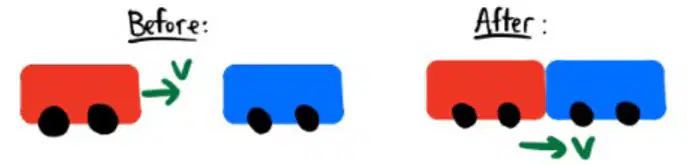
Fill in the blank: In an inelastic collision, the total momentum after the collision is represented as ______.
A) p1 + p2
B) m1v1 + m2v2
C) (m1+m2)v
D) p_total before collision.
Fill in the blank: In an inelastic collision, the masses of the two objects are ______ after the collision.
A) separate
B) combined
C) lost
D) unchanged
What is the main difference in the conservation of momentum equation for inelastic collisions?
A) Objects bounce off
B) Objects stick together
C) Objects explode
D) Objects stop moving
In an inelastic collision, two objects stick together after the collision. If the mass of the first object is 1 kg and its velocity is 5 m/s, and the second object is at rest with a mass of 1 kg, what is the velocity of the combined mass after the collision?
2.5 m/s
5 m/s
0 m/s
10 m/s
When a cannon is fired, what happens to the cannon and the cannonball?
Both move forward
Both move backward
Cannon moves backward, cannonball moves forward
Cannon moves forward, cannonball moves backward
What principle explains why the total momentum before and after an explosion is zero?
A) Conservation of Energy
B) Conservation of Momentum
C) Newton's First Law
D) Newton's Third Law
A 9 kg blob moving at 5 m/s collides and sticks to a second blob at rest with a mass of 5 kg. If the two blobs stick together, what will the velocity of the two blobs move at?
Was momentum conserved with the elastic collisions?
Yes!
NO
Was momentum conserved with the inelastic collisions?
Yes!
NO
Bouncing a tennis ball off the ground straight down and it bounces back straight up.
Elastic
Inelastic
Perfectly inelastic

The picture shows what type of collision?
Explosion
Inelastic Collision
Elastic Collision
Collision where objects collide, and stick together.
inelastic collision
elastic collision
explosion
none of these
Collisions where objects BOUNCE apart.
inelastic collisions
elastic collisions
explosions
none of these

After collision, the two objects move off with different velocity. What type of collision is this?
Inelastic
Elastic
The total momentum before a collision is _________ the total momentum after a collision.
equal to
less than
more than
It depends on the type of collision

The law of conservation of momentum states that the total momentum of all objects interacting with each other will ________________________ no matter of the nature of the forces between the object.
increase
decrease
remain constant
fluctuate
A 23 kg bag of dog food is thrown at a speed of 7 m/s into a stationary shopping cart that weighs 3.5 kg. What is the final velocity of the cart and bag?
6.1 m/s
7 m/s
4.6 m/s
3.5 m/s
A 2200kg car travelling at 30m/s collides with another 2200kg car that is at rest. The two bumpers lock and he cars move forward together. What is their final velocity?
30 m/s
15 m/s
0 m/s
12.5 m/s
A 10kg ball moving at 13 m/s strikes a 20kg ball at rest. After the collision the 10kg ball is moving with a velocity of 7 m/s. What is the velocity of the second ball?
3 m/s
12 m/s
6 m/s
4 m/s
In physics, how is the term "explosion" best defined?
A sudden and violent shattering or blowing apart of something.
The pushing off of particles which cancels their momentums
A process where two or more objects collide and stick together.
A reaction that results in the decrease of energy in a system.
What does the left side of this equation represent? Ft = m(vf - vᵢ)
the impulse experienced by an object
the momentum of an object
the change in momentum of an object
the change in velocity of an object
the acceleration of an object
What does the right side of this equation represent? Ft = m(vf - vᵢ)
the impulse experienced by an object
the momentum of an object
the change in momentum of an object
the change in velocity of an object
the acceleration of an object
A soccer ball experiences an impulse of 25 kg*m/s. The soccer ball's change in momentum is ___________.
less than 25 kg*m/s
greater than 25 kg*m/s
equal to 25 kg*m/s
there is not enough information to answer this
A batter hits a baseball and the ball gains 500 kg*m/s of momentum. The impulse given to the baseball by the bat is ___________.
less than 500 kg*m/s
greater than 500 kg*m/s
equal to 500 kg*m/s
there is not enough information to answer this
Which of the following would result in the largest impulse?
a strong force acting for a short period of time
a strong force acting for a long period of time
a weak force acting for a short period of time
a weak force acting for a long period of time
How much impulse does a 1200kg car experience if it is hit by another car with a 3200N force for 1.3 seconds?
4160 Ns
3200 Ns
2400 Ns
1600 Ns
How much momentum does a 0.045kg golf ball have if it is moving at 45 m/s through the air?
1.5 kg·m/s
2.0 kg·m/s
2.5 kg·m/s
3.0 kg·m/s
A pitcher throws a 0.184 kg softball with an initial velocity of 30 m/s to the right. The batter hits the ball and its velocity changes to 42 m/s to the left. What is the baseball's change in velocity?
12 m/s
72 m/s
-12 m/s
-72 m/s
A 0.057 kg tennis ball has an initial velocity of 20 m/s to the left. It is hit by a tennis racket, and its velocity changes to 33 m/s to the right. What is the tennis ball's change in momentum?
2.997 kg·m/s to the right
3.021 kg·m/s to the right
3.021 kg·m/s to the left
2.997 kg·m/s to the left
A pitcher throws a 0.184 kg softball with an initial velocity of 30 m/s to the right. The batter hits the ball and its velocity changes to 42 m/s to the left. What is the baseball's change in momentum?
-13.248 kg·m/s
13.248 kg·m/s
-7.728 kg·m/s
7.728 kg·m/s
A pitcher throws a 0.184 kg softball with an initial velocity of 30 m/s to the right. The batter hits the ball and its velocity changes to 42 m/s to the left. What impulse is given to the baseball by the bat?
13.248 Ns to the left
13.248 Ns to the right
7.728 Ns to the left
7.728 Ns to the right
A 530 kg bumper car is moving forward at a velocity of 6 m/s. It is hit from behind and its velocity increases to 9 m/s. The time of the impact lasts 0.3 seconds. Calculate the amount of force that the car is hit with.
530 N
2650 N
5300 N
7950 N
A small golf ball can have more momentum than a large bowling ball.
True
False
A slow truck can have more momentum than a very fast race car.
True
False
Which of these objects has more momentum? 1. A 350 kg motorcycle moving at 65 m/s. 2. A 1137.5 kg car moving at 20 m/s
car has more momentum
motorcycle has more momentum
both have equal momentum
not enough information to answer
Match the unit with the quantity.
Force
Newtons (N)
Mass
Kilogram (kg)
Velocity
meters per second (m/s)
momentum or Impulse
kilogram meters per second
(kg.m/s)
(N.s)
Acceleration
meters per second per second
(m/s2)
What happens to the force felt by an object if the time of a collision is increased?
the force decreases
the force increases
the force stays the same
not enough information
Which object experiences the greater change in its momentum? (Assume they both have the same initial velocity of 30 m/s just before the crash) A) a car crashing into a tree, coming to a complete stop. B) a car crashing into another car and bouncing off
A
B
they both experience the same change in momentum
not enough information
Which object experiences the greater impulse? (Assume they both have the same initial velocity of 30 m/s just before the crash) A) a car crashing into a tree, coming to a complete stop. B) a car crashing into another car and bouncing off
A
B
they both experience the same impulse
not enough information
A crash cushion is designed to make the time of a car crash last 4 times longer compared to crashing into a concrete wall. What happens to the force felt by the car when it hits the crash cushion?
4x more force
2x more force
1/2 of the force
1/4 of the force
the force is the same as hitting a concrete wall
Consider the 2 scenarios below. Assume both objects come to a complete stop after landing, with no bouncing. A) an object is dropped onto hard concrete B) the same object is dropped from the same height, but lands on soft dirt Which object experiences the greater change in momentum?
A
B
both objects experience the same change in momentum
not enough information
Consider the 2 scenarios below. Assume both objects come to a complete stop after landing, with no bouncing. A) an object is dropped onto hard concrete B) the same object is dropped from the same height, but lands on soft dirt Which object experiences the greater impulse?
A
B
both objects experience the same impulse
not enough information
Consider the 2 scenarios below. Assume both objects come to a complete stop after landing, with no bouncing. A) an object is dropped onto hard concrete B) the same object is dropped from the same height, but lands on soft dirt Which statement is correct?
Object A feels more force because the impulse lasts for a shorter time
Object B feels more force because the impulse lasts for a shorter time
Object A feels more force because the impulse lasts for a longer time
Object B feels more force because the impulse lasts for a longer time
When a fly crashes into a car's windshield, __________.
the fly feels the greater force
the car's windshield feels the greater force
Both the fly and car’s windshield feel the same force
A fly crashes into a car's windshield. When this happens, __________.
the impulse experienced by the car is greater
the impulse experienced by the fly is greater
both the fly and the car’s windshield experience the same impulse
A fly crashes into a car's windshield. Additionally, __________.
the fly's momentum changes more
the car's momentum changes more
both the fly and the car experience the same change in momentum
A fly crashes into a car's windshield. Lastly, __________.
the fly will experience the greater acceleration
the car will experience the greater acceleration
the fly and the car will both have the same acceleration
Select ALL true statements. Check all that apply.
momentum can be created during a collision
momentum can be destroyed during a collision
during a collision, momentum can be transferred from one object to another
momentum is conserved during a collision
the total momentum before a collision is greater than the total momentum after the collision
A truck crashes into a car. The truck gains 150 kg m/s of momentum. Which of the following statements are true?
the car must have also gained 150 kg m/s of momentum
the car must have lost 150 kg m/s of momentum
the car's momentum did not change
the car gained more than 150 kg m/s of momentum
the car lost more than 150 kg m/s of momentum
A 5 kg bowling ball is moving to the right with a velocity of 7 m/s. It crashes into a 1 kg bowling pin that was originally at rest. After the crash, the bowling ball is moving to the right at 4 m/s.
What is the initial momentum of the bowling ball (before hitting the pin)?
5 kg·m/s
10 kg·m/s
15 kg·m/s
20 kg·m/s
35 kg·m/s
A 5 kg bowling ball is moving to the right with a velocity of 7 m/s. It crashes into a 1 kg bowling pin that was originally at rest. After the crash, the bowling ball is moving to the right at 4 m/s.
What is the initial momentum of the bowling pin (before being hit by the ball)?
0 kg·m/s
5 kg·m/s
10 kg·m/s
15 kg·m/s
A 5 kg bowling ball is moving to the right with a velocity of 7 m/s. It crashes into a 1 kg bowling pin that was originally at rest. After the crash, the bowling ball is moving to the right at 4 m/s.
What is the TOTAL momentum of the ball and pin system before the collision?
0 kg·m/s
5 kg·m/s
10 kg·m/s
15 kg·m/s
35 kg·m/s
A 5 kg bowling ball is moving to the right with a velocity of 7 m/s. It crashes into a 1 kg bowling pin that was originally at rest. After the crash, the bowling ball is moving to the right at 4 m/s.
What should be the total momentum of the ball and pin system AFTER the collision?
0 kg·m/s
5 kg·m/s
10 kg·m/s
15 kg·m/s
35 kg·m/s
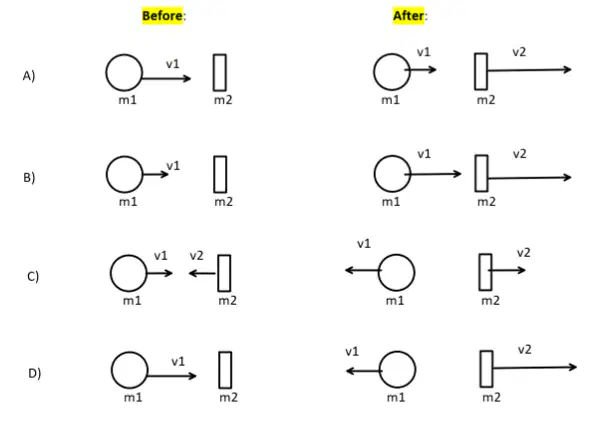
A 5 kg bowling ball is moving to the right with a velocity of 7 m/s. It crashes into a 1 kg bowling pin that was originally at rest. After the crash, the bowling ball is moving to the right at 4 m/s.
Which drawing shown to the right best shows what is happening to the bowling ball and pin, before and after the collision?
A
B
C
D
A 5 kg bowling ball is moving to the right with a velocity of 7 m/s. It crashes into a 1 kg bowling pin that was originally at rest. After the crash, the bowling ball is moving to the right at 4 m/s.
What is the final velocity of the bowling pin after getting hit by the ball, using the law of conservation of momentum?
m1v1 + m2v2 = m1v1 + m2v2
2 m/s
3 m/s
4 m/s
5 m/s
15 m/s
A 10 kg object is hit with a 22N force for a time of 6 seconds. What is this object's change in momentum?
132 kg·m/s
120 kg·m/s
110 kg·m/s
100 kg·m/s
A 5kg ball is hit with a force, causing its velocity to change. The ball had an initial velocity of -15 m/s and a final velocity of 30 m/s. What was the impulse experienced by this ball?
75 Ns
225 Ns
300 Ns
45 Ns

