wayground logo

Free Printable Worksheets

Font size

S
M
L
XL
Worksheets

Applied/ Trig Final Exam

Total questions: 113

Worksheet time: 7hrs 21mins

Name
Class
Date
1.
-8+(-2)
a)
-6
b)
-10
c)
10
d)
6
2.
-6-2
a)
8
b)
-4
c)
4
d)
-8
3.
-5-(-7)
a)
-12
b)
12
c)
2
d)
-2
4.
Emily is a diver. Today she descended to a depth of 40 feet below sea level. Then she swam up 10 feet and descended another 4 feet. How far below sea level is Emily now?
a)
-34 feet
b)
-54 feet
c)
54 feet
d)
-26 feet
5.
Find the value:
15 - 100
a)
-85
b)
100
c)
-100
d)
95
6.
On Friday, Elsa made withdrawals of $50, $60, and $17 from her savings account. On Monday she made a deposit of $135. How much money is now in Elsa's savings account?
a)
$262
b)
$8
c)
-$8
d)
-$262
7.

A Chicago Cubs baseball cap costs $30 including tax. Michael has a coupon that will save him 30% of the price. How much money will Michael save using his coupon?

a)

$9.00

b)

$22.00

c)

$21.36

d)

$21.00

8.

What is the first step you should take when planning your budget?

a)

reviewing and adjusting your expenses

b)

add up all of your income

c)

divide your expenses into fixed vs variable

d)

gather all financial statements

9.

Fixed expenses are...

a)

costs that are necessary and stay the same amount each month

b)

costs that are necessary, but the amount that you spend differs from month-to-month

c)

costs that are easily changed, reduced, or eliminated.

d)

income not spent, but rather putting money aside for big purchases, emergencies, the future, etc.

10.

What is a flexible expense?

a)

costs that are easily changed, reduced, or eliminated

b)

costs that are necessary, but the amount that you spend differs from month-to-month

c)

costs that are necessary and stay the same amount each month

d)

income not spent, but rather putting money aside for big purchases, emergencies, the future, etc.

11.

Which of the following is NOT an example of flexible expense?

a)

going out to eat

b)

making a car payment

c)

going to a vacation

d)

getting your nails done

12.

What is comparison shopping?

a)

Making an unplanned or quick purchase without giving it much thought.

b)

looking at products and prices at different stores before making a purchase.

13.

Which form of income should you base your budget off of?

a)

Net income

b)

Gross income

c)

Both net and gross income

d)

Neither net or gross income

14.

Gross Pay is...

a)

take home pay

b)

overtime pay

c)

net pay

d)

regular pay + overtime pay

15.

Net Pay is...

a)

pay you get after deductions

b)

pay you get before deductions

c)

gross pay

d)

regular pay + overtime pay

16.

How many hours can you work in a week to be considered STANDARD?

a)

35

b)

30

c)

40

d)

45

17.

If Susan worked 52 hours this week, how many hours did she work OVERTIME?

a)

40

b)

0

c)

10

d)

12

18.

Joe worked 35 hours this week and earned $17.25 per hour. What is Joe's GROSS PAY?

a)

$603.75

b)

$595

c)

$54.25

d)

$522.50

19.
a fixed amount you pay for a service
a)
co-insurance
b)
co-pay
c)
premium
d)
claim
20.
Co-payment
a)
Coordination of benefits
b)
Portion of the cost of service to be paid by the insured (a set dollar amount)
c)
Term of conditions not covered by the insurance company
d)
Provider bill for service
21.
The person who gets the money when the insured person dies is called?
a)
Beneficiary
b)
Rate
c)
Term Insurance
d)
Face Value
22.
This life insurance has a savings feature.
a)
Term life insurance
b)
Whole life insurance
23.
What is one advantage of having a credit card?
a)
It prevents you from spending more than you earn.
b)
It allows you to make purchases without carrying lots of cash.
c)
It encourages you to budget your money wisely.
d)
It helps you pay off debts that you may have.
24.
How do credit card companies make money?
a)
By charging late fees and interest to their customers.
b)
By making you pay an extra dollar on every purchase.
c)
By charging late fees and interest to stores and other businesses.
d)
By earning interest on the money they have saved up.
25.
How is charging a purchase like getting a loan?
a)
You borrow money from your credit provider.
b)
You borrow money from the store in order to pay your credit provider.
c)
You borrow money from an ATM in order to pay your credit provider.
26.
The cost of credit expressed as a yearly interest rate is known as:
a)
Annual Percentage Rate (APR)
b)
Annual Fee
c)
Penalty APR
d)
Introductory Rate
27.
The maximum amount you may borrow on a credit card is known as:
a)
creditworthiness
b)
credit report
c)
credit limit
d)
variable rate of credit
28.
How can you avoid paying interest fees on your credit card?
a)
Only use it for groceries
b)
pay off the full balance, on time, each month
c)
you cannot avoid interest fees
d)
only use Discover
29.
It is wise to compare credit card offers before choosing one
a)
True
b)
False
30.
The least amount that must be paid on a credit card each month is
a)
Late Fee
b)
Credit Limit
c)
Payment amount
d)
Minimum Payment
31.
How can a cardholder avoid paying interest on a credit card?
a)
Do not pay anything
b)
Pay the minimum payment after its due date
c)
Pay the minimum balance every month
d)
 Pay the balance in full every month
32.

Which one is not a credit card?

a)

mastercard

b)

discover

c)

visa

d)

debit

33.

This is the percentage of the credit card balance that you are charged when using a credit card. It is also referred to as Annual Percentage Rate (APR). Because you are borrowing money when you use your credit card, you are charged interest when you don’t pay the bill in full.

a)

interest rate

b)

interest frequency

c)

balance

d)

principal

34.

This the day your payment is due. After this, you may be charged a late payment fee

a)

interest rate

b)

due date

c)

penalty

d)

expiration date

35.

This card allows you to make purchases similar to a credit card and also gives you access to ATMs. It is the equivalent of writing a check but with the convenience of a credit card. This card when used deducts the specified amount directly from your checking account.

a)

Credit card

b)

Debit card

c)

Savings account

d)

Prepaid card

36.

A credit card company set limits on how much you can charge on your card.

a)

Balance

b)

Minimum Fee

c)

Interest Rate

d)

Credit Limit

37.

The amount of money owed on a credit card account.

a)

Credit Limit

b)

Balance

c)

Debt

d)

Minimum Fee

38.

Isabella wants to purchase a new refrigerator. When she applies for an installment loan at the appliance store, her loan application is turned down. What consumer law says that a lender must give her the reason, in writing, that she was denied the loan? (a)  

Choose from the below words
Truth-in-Lending Act
Equal Opportunity Act
Fair Credit Reporting Act
Fair Debt Collection Practices Act
39.

Jackson and Kate Jones do not pay their credit card in full each month, so they incur finance charges. On their last credit card statement, the average daily balance is $875 and the monthly periodic rate is 2.25%. What should be the finance charge on the statement? (a)  

Choose from the below words
$19.69
$20.25
$87.50
$196.88
40.

Kate and Albert do not pay their credit card in full each month, so they incur finance charges. On their last credit card statement, the average daily balance is $896 and the monthly periodic rate is 2.75%. What should the finance charge be on the statement? (a)  

Choose from the below words
$2,464
$24.64
$29,568
$29.68
41.

Taylor pays a finance charge on her average daily balance of $2,000. Her APR is 27%. What is her finance charge for this billing cycle? (a)  

Choose from the below words
$54,000
$54.00
$4,500
$45.00
42.


(a)  

43.


(a)  

44.


(a)  

45.

Money added to a checking account is called a

a)

withdrawal

b)

deposit

c)

endorsement

d)

drawee

46.
To take money OUT of your account, is called:
a)
WITHDRAWAL
b)
DEPOSIT
c)
TRUST
d)
STEAL
47.
Cash can be withdrawn from a checking account using all of the following except a(n)...
a)
debit card. 
b)
check. 
c)
ATM.
d)
credit card.
48.

This occurs when the amount you withdraw from your account is more than your balance.

a)

Overdraft

b)

Overdue Payment

c)

Stop Payment

d)

Funds Transfer

49.

Which of the following is an example of online bill pay?

a)

Using a person-to-person app to repay your friend for dinner

b)

Using Apple pay to purchase your groceries at a store

c)

Setting up for your bank to send your rent to the landlord monthly on the 25th

50.
This allows you to withdraw cash from your account or make payments electronically.
a)
Debit Card
b)
Loan Account
c)
Signature Card
d)
Payday card
51.
This action removes money from an account, either at the bank or an ATM.
a)
Withdrawal
b)
Deposit
c)
Loan
d)
Credit
52.
This transaction removes funds from your account.
a)
Debit
b)
Credit
c)
Loan
d)
Deposit
53.
This action includes deposits or additions to your accounts.
a)
Credit
b)
Debit
c)
Loan
d)
Withdrawal
54.
Shannon makes a deposit in her checking account. She has checks for $178.16 and $36.00. She gets back $20.00 in cash.
What is her total deposit?
a)
$214.16
b)
$198.16
c)
$194.16
d)
$234.16
55.

Always use permanent ink when writing a check.

a)

True

b)

False

56.

Sally goes to the bank. She puts her babysitting money in her account. Sally has made a

a)

Deposit

b)

Withdrawal

57.

What is wrong with this check?

a)

Name is incomplete

b)

Check amount is not written out

c)

Signature issues

d)

Date issues

58.
What should be written on line 6?
a)
the date
b)
the amount of the check
c)
who the check is going to
d)
your signature
59.

The routing number found on your check identifies which of the following?

a)

Your Account

b)

Your Bank

c)

Check Number

d)

Bank Phone Number

60.

A ______________ is a list of transactions in your bank account, along with a running balance.

a)

Check Log

b)

Check Schedule

c)

Check Register

d)

Check Report

61.
What is the starting balance on this check register?
a)
4720.33
b)
4500.00
c)
4500.75
d)
4320.00
62.
What happened on 7/5?
a)
a paycheck was deposited
b)
check #164 was written
c)
nothing
d)
the balance went up
63.
What should be written on line 2?
a)
the date
b)
the amount of the check
c)
who the check is going to
d)
your signature
64.
What should be written on line 5?
a)
the date
b)
the amount of the check
c)
reminder/memo
d)
your signature
65.
Transaction:
Hannah paid her rent by writing a $400 check to her landlord.  This is a _________.
a)
Deposit (+)
b)
Withdrawal (-)
66.
Transaction:
Money is automatically transferred into Victor’s checking account for earnings from his job.  This is a __________.
a)
Deposit (+)
b)
Withdrawal (-)
67.

Which of the following are parts of writing a check?

a)

Date

b)

Signature

c)

Who you are paying

d)

The address of the person you are paying.

68.

What is wrong with this check?

a)

They didn't write who they are paying.

b)

The money amount in dollars is wrong.

c)

The money amount written in words does not match the money amount written in numbers.

69.

A cancelled check acts as a receipt for proof of payment.

a)

True

b)

False

70.
What two things does a budget compare?
a)
Income and Expenses
b)
Savings and Interest
c)
Income and Investments
d)
Expenses and Expenditures
71.
Which is an example of a fixed expense?
a)
Cell Phone
b)
Utility bill
c)
Groceries
d)
Gasoline
72.
Which of the following is an example of a want for most people?
a)
A warm jacket
b)
Transportation
c)
Ice cream
73.

Something you like to have such as toys.

a)

borrow

b)

saving

c)

needs

d)

wants

74.

Something you have to have such as food or water.

a)

savings

b)

needs

c)

wants

d)

borrow

75.

Which of the following people would benefit MOST from a personal budget?

a)

Tim carefully keeps track of his expenses.

b)

Sue spends less than she earns.

c)

David is saving for a major purchase.

d)

Bob does not have enough money to pay bills.

76.

Find the balance in the account after the given period.

$12,000 principal earing 4.8% compounded annually after 7 years.

a)

$3,243.19

b)

$16,661.35

c)

$15,243.19

d)

$4,661.35

77.

Find the balance in the account after the given period.

$13,500 deposit earning 3.3% compounded monthly after 1 year

a)

$13,611.38

b)

$14,898.84

c)

$13,537.13

d)

$13, 952.30

78.

An investment of $9,875 earns 4.8% interest compounded monthly over 12 years. Approximately how much INTEREST is earned on the investment?

a)

$7,457.95

b)

$10,359.57

c)

$17,546.55

d)

$484.57

79.
The simple interest formula is I=Prt.  The P represents the principle.  The principle is ___________________. 
a)
the amount of money borrowed or deposited
b)
the amount taxed
c)
the percent interest for this year
d)
the amount the bank owes you for being a customer at their bank
80.
If you are calculating the simple interest and you are given the time in months.  How can you find the time in years?
a)
divide 12 by the months
b)
multiply 12 times the months
c)
divide the months by 12
d)
change the months to a decimal
81.
What is the formula for simple interest?
a)
A=P(1+r)t
b)
I=Prt
c)
I=P(1+r)t
d)
A=Prt
82.

This is putting money into a bank account

a)

withdrawal

b)

induction

c)

deposit

d)

supply

83.

This is a paper you fill out to show how much money you are depositing

a)

withdrawal slip

b)

checkbook register

c)

deposit slip

d)

passbook

84.
Transaction:Hannah paid her rent by writing a $400 check to her landlord.
a)
Deposit (+)
b)
Withdrawal (-)
85.
Transaction:Money is automatically transferred into Victor’s checking account for earnings from his job.
a)
Deposit (+)
b)
Withdrawal (-)
86.
money subtracted from an account
a)
withdrawal
b)
deposit
c)
transfer
d)
balance
87.

Sam has $54 in the bank. If he withdraws $20 , how much money will he have in the bank?

a)

$74

b)

$34

88.

Monte has $165 in the bank. He made a deposit of $30. How much does he have in the bank?

a)

$135

b)

$195

89.

Katie goes to the bank. She takes money out of her account. Katie has made a ___________.

a)

Deposit

b)

Withdrawal

90.

Dennis goes to the bank puts money into his account. Dennis has made a __________.

a)

Deposit

b)

Withdrawal

91.
Bruno was given $2000 when he turned 3 years old.  His parents invested it at a 2% interest rate compounded annually.  No deposits or withdrawls were made.  Which expression can be used to determine how much money Bruno had in the account when he turned 16? 
a)
2000(1+0.02)13
b)
2000(1-0.02)13
c)
2000(1+0.02)16
d)
2000(1-0.02)16
92.

Compound interest

a)

Compound interest is a quick and easy method of calculating the interest charge on a loan.

b)

Compound interest is the addition of interest to the principal sum of a loan or deposit, or in other words,interest on interest.

c)

Compound interest is money in your checking account

93.

If you are investing or saving you want a.....

a)

high interest rate

b)

low interest rate

94.

Ivan deposits $5,000 into an account that pays simple interest at a rate of 5% per year. How much interest will he be paid in the first 3 years?

What is the principle? ​ (a)  

What is the rate? ​ (b)  

What is the time? ​ (c)  

Choose from the below words
$5,000
5%
3 years
95.

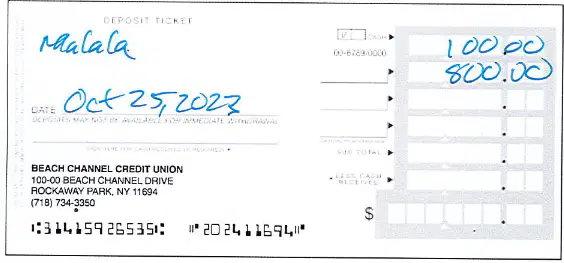
What's wrong with this deposit?

a)

Depositor name missing

b)

Date missing

c)

Cash amount not correct

d)

Total not correct

e)

Signed for "less cash received" which allows teller to steal from you
96.

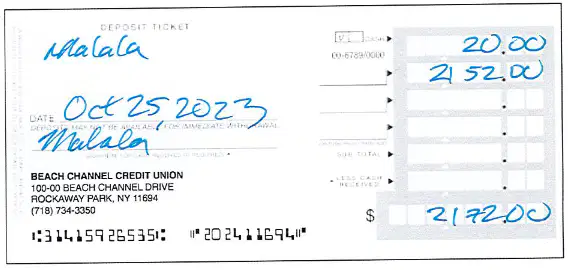
What's wrong with this deposit?

a)

Depositor name missing

b)

Date missing

c)

Cash amount not correct

d)

Total not correct

e)

Signed for "less cash received" which allows teller to steal from you
97.

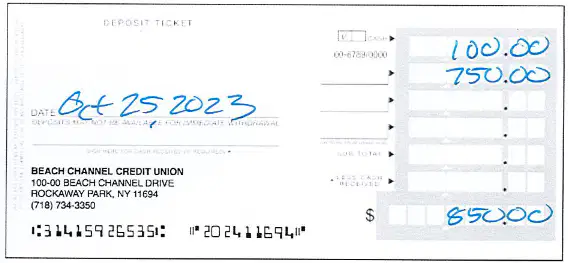
What's wrong with this deposit?

a)

Depositor name missing

b)

Date missing

c)

Cash amount not correct

d)

Total not correct

e)

Signed for "less cash received" which allows teller to steal from you
98.

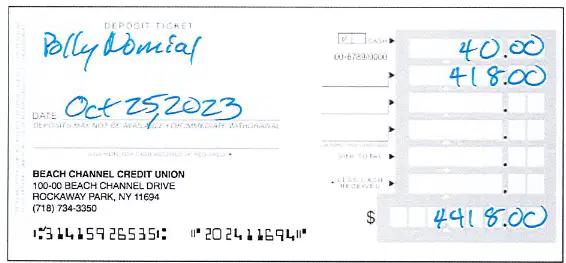
What's wrong with this deposit?

a)

Depositor name missing

b)

Date missing

c)

Cash amount not correct

d)

Total not correct

e)

Signed for "less cash received" which allows teller to steal from you
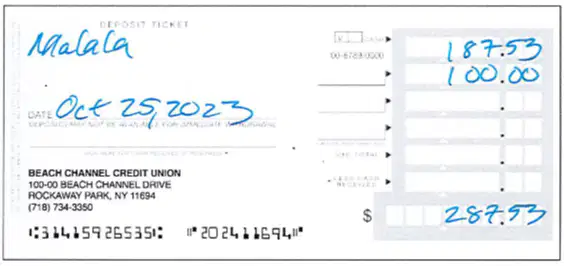
99.

What's wrong with this deposit?

a)

Depositor name missing

b)

Date missing

c)

Cash amount not correct

d)

Total not correct

e)

Signed for "less cash received" which allows teller to steal from you

100.
The rate is given as a percent (%).  Before using it in the simple interest formula, you must first convert it to a______.
a)
fraction
b)
decimal
c)
ratio
d)
dollar amount
101.
The simple interest formula is I=Prt.  The P represents the principle.  The principle is ___________________.  
a)
the amount of money borrowed or deposited
b)
the percent interest for his year
c)
the amount taxed
d)
the amount the bank owes you for being a customer at their bank
102.
Starting money = $350.
Interest rate = 2.5%
TIme = 3 years.
How much interest?
a)
$7.50
b)
$26.25
c)
$87.5
d)
$262.50
103.
Ann puts $300 in a bank account earning 4% interest.  How much will she earn in interest in 1 year?
a)
4
b)
8
c)
12
d)
16
104.
Jerry borrowed $4,000 for 5 years at 6% simple interest rate. How much interest is that?
a)
$800
b)
$1,000
c)
$1,200
d)
$1,500
105.
Ann puts $300 in a bank account earning 4% interest.  How much will she earn in interest in 1 year?
a)
4
b)
8
c)
12
d)
16
106.
If you are calculating the simple interest and you are given the time in months, how can you find the time in years?
a)
Add 12 to the months
b)
divide the months by 12
c)
multiply 12 times the months
d)
You cannot change it to months.
107.
The simple interest formula is I=Prt.  What does the t represent?
a)
Principle
b)
Interest
c)
Time, in hours
d)
Time, in years
108.
What does the "I" in the interest formula stand for?
a)
Principal
b)
Interest
c)
Rate
d)
Time
109.
Maria borrowed $3,000 at a simple interest rate of 4% per year.  How much did she have to repay after 4 years?
a)
$480
b)
$3,480
c)
$4,800
d)
$7,800
110.
Find the ending balance:
$35,600 at 9% for 2 years
a)
$42,296.39
b)
$42,002.27
c)
$42,008.00
d)
$38,804.00
111.
Find the interest: 
$26,500 at 12% for 7 years
a)
$22,260
b)
$2,226,000
c)
$2,252,500
d)
$48,760
112.

The person who will receive the face value of the life insurance policy when a person dies.

a)

Spouse

b)

Child

c)

Sister

d)

Beneficiary

113.
Insurance to cover health events like going to the doctor.
a)
health
b)
long-term care
c)
life
d)
disability