Wayground logo

Free Printable Worksheets

Font size

S
M
L
XL
Worksheets

Graphing Polynomial Functions

Total questions: 118

Worksheet time: 3hrs 2mins

Name
Class
Date
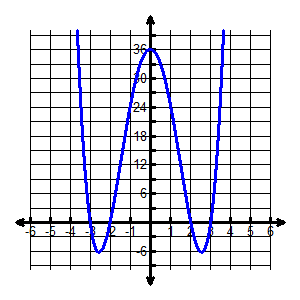
1.
a)
(-2.55, 0), (2.55, 0)
b)
(-3, 0), (-2, 0), (2, 0), (3, 0)
c)
(0, 36)
d)
(0, -3), (0, -2), (0, 2), (0, 3)
2.

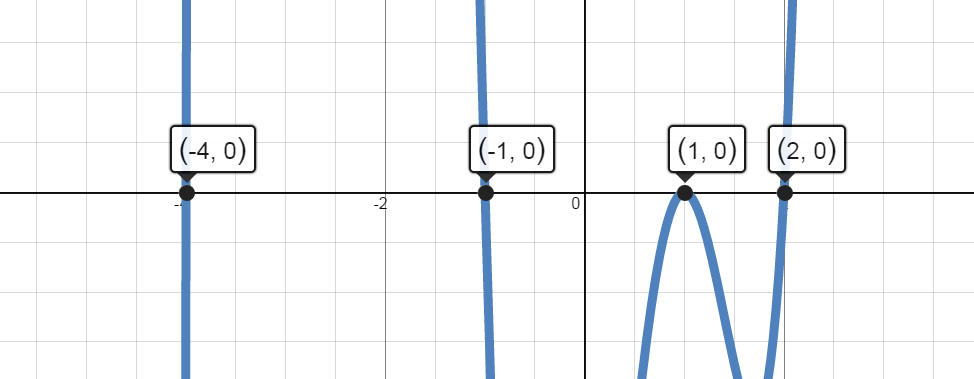
In the above graph, which root has a multiplicity of 2?

a)

-1

b)

-3

c)

-120

d)

4

3.
What are the
zeros of the polynomial
y = 3(x + 4)(x + 1)(x - 3)?
a)
-4, -1, 3
b)
3, -3, 4, 1
c)
4, 1, -3
d)
3, -4, -1, 3
4.
Describe the end behavior of
f(x) = -5x4 - 2x2 + 8
a)
Left side: Rises  
 Right side: Rises
b)
Left Side:  Rises
Right side: Falls
c)
Left side: Falls
Right side: Rises
d)
Left side: Falls
Right side: Falls
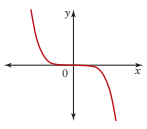
5.
a)
Even Degree
- Leading Coeff.
b)
Even Degree
+ Leading Coeff.
c)
Odd Degree
- Leading Coeff.
d)
Odd Degree
+ Leading Coeff.
6.
The domain of a polynomial function is always (-∞, +∞).
a)
True
b)
False
7.
What is the factored form of a function if it has zeros of 2, 3 and -1?
a)
(x-2)(x-3)(x+1)
b)
(x-1)(x-2)(x-3)
c)
(x-1)(x+2)(x+3)
d)
(x+1)(x+2)(x+3)
8.
The domain of a polynomial function is always (-∞, +∞).
a)
True
b)
False
9.

The degree of the polynomial determines the number of roots.

a)

True

b)

False

10.
What is the leading coefficient?
a)
Positive 
b)
Negative
11.

f(x)=(x+4)(x-3)(x-2)

List the zeros for this function.

a)

x=-4, x=3, x=-2

b)

x=-4, x=3, x=2

c)

x=-4, x=3, x=-2

d)

x=4, x=3, x=2

12.
What is another way to say "where a function crosses the x-axis"?
a)
x-intercept
b)
zero
c)
root
d)
all of these.
13.

If a zero of a polynomial function has multiplicity 3 that means:

a)

The x intercept is at (4, 0)

b)

The graph will "bounce back" at that zero

c)

The graph will "pass through" at that zero

d)

Zeros cannot have multiplicity of 4

14.
Describe the end behavior of
f(x) = 2x2 + 6x5 + 10x
a)
Left side:  Rises
Right side: Rises
b)
Left side: Falls
Right side: Rises
c)
Left side:Rises
Right side: Falls
d)
Left side: Falls
Right side: Falls
15.

Which of the following allows you to describe the end behavior of a polynomial?

a)

the degree and the constant

b)

the leading coefficient and the constant

c)

degree and the variable

d)

the degree and the leading coefficent

16.

f(x)= x2(x – 2)3(x – 7)


Find and select each real zero and its multiplicity

a)

0 (Mult of 2), 2 (Mult of 3), 7 (mult 1)

b)

2 (Mult of 3), 7 (mult 1)

c)

0, 2, 7

d)

2 (mult of 2), 7 (mult of 3)

17.

If the graph of a function crosses the x-axis, what does that mean about the multiplicity of that zero?

a)

Even

b)

Odd

c)

None

18.

If the graph of a function touches the x-axis, what does that mean about the multiplicity of that zero?

a)

Even

b)

Odd

c)

None

19.
What are the x-intercepts of 
f(x)=(x - 10)(x + 10)
a)
10
b)
(10 , 0) and (-10 , 0)
c)
(0, -10) and (0, 10)
d)
0
20.

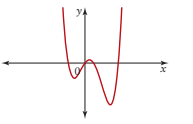
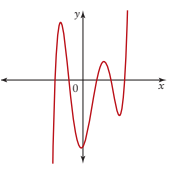
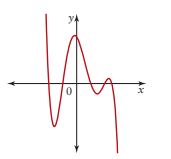
Select all the even degree functions.

a)

A

b)

B

c)

C

d)

D

21.

Which functions have a negative leading coefficient?

a)

A

b)

B

c)

C

d)

D

22.
What CANNOT be determined by the factors of a polynomial in factored form?
a)
y-intercept
b)
x-intercepts
c)
solutions
d)
degree of the polynomial
23.
Which of the following is NOT a solution to f(x)=3x(x-8)(2x+1)2?
a)
0
b)
-1/2
c)
1/2
d)
8
24.
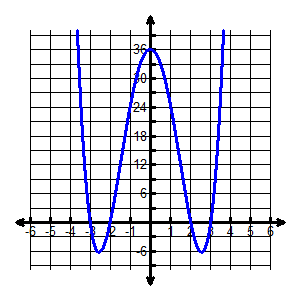
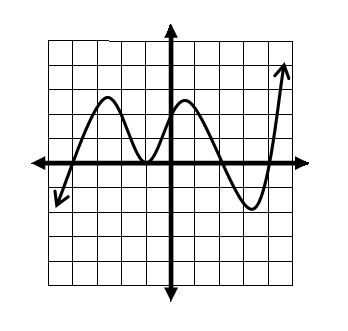
Which equation MOST LIKELY matches the graph?
a)
y = x4 - x3 + 3x2 + 2
b)
y = -x4 + x3 + 5x + 2
c)
y = x3 - 2x2 + 1x + 3
d)
y = -x3 - 2x2 + 1x + 3
25.
Is the leading coefficient positive or negative
a)
positive
b)
negative
26.
Is the leading coefficient positive or negative?
a)
negative
b)
positive
27.
Is this function even or odd?
a)
even
b)
odd
28.

As 

 x→∞, f(x) →x\rightarrow\infty,\ f\left(x\right)\ \rightarrow  

a)

 ∞\infty  

b)

 −∞-\infty  

29.

As 

 x→−∞, f(x) →x\rightarrow-\infty,\ f\left(x\right)\ \rightarrow  

a)

 ∞\infty  

b)

 −∞-\infty  

30.

Choose all that apply:

a)

Even Degree

b)

Odd Degree

c)

Positive Leading Coefficient

d)

Negative Leading Coefficient

31.

Choose all that apply:

a)

Even Degree

b)

Odd Degree

c)

Positive Leading Coefficient

d)

Negative Leading Coefficient

32.

Describe the end behavior of a 15th degree polynomial with a positive leading coefficient.  Choose all that apply.

a)


 As x→∞, f(x)→∞As\ x\rightarrow\infty,\ f\left(x\right)\rightarrow\infty  

b)

 As x→∞, f(x)→−∞As\ x\rightarrow\infty,\ f\left(x\right)\rightarrow-\infty  

c)

 As x→−∞, f(x)→∞As\ x\rightarrow-\infty,\ f\left(x\right)\rightarrow\infty  

d)

 As x→−∞, f(x)→−∞As\ x\rightarrow-\infty,\ f\left(x\right)\rightarrow-\infty  

33.

Describe the end behavior:

a)

As x →∞ f(x)→∞As\ x\ \rightarrow\infty\ f\left(x\right)\rightarrow\infty
As x → −∞ f(x) →−∞As\ x\ \rightarrow\ -\infty\ f\left(x\right)\ \rightarrow-\infty

b)

As x → ∞ f(x) →−∞As\ x\ \rightarrow\ \infty\ f\left(x\right)\ \rightarrow-\infty
As x → −∞ f(x)→−∞As\ x\ \rightarrow\ -\infty\ f\left(x\right)\rightarrow-\infty

c)

As x →∞ f(x) →∞As\ x\ \rightarrow\infty\ f\left(x\right)\ \rightarrow\infty
As x →−∞ f(x)→∞As\ x\ \rightarrow-\infty\ f\left(x\right)\rightarrow\infty

d)

As x →∞ f(x)→ −∞As\ x\ \rightarrow\infty\ f\left(x\right)\rightarrow\ -\infty
As x →−∞ f(x) →∞As\ x\ \rightarrow-\infty\ f\left(x\right)\ \rightarrow\infty

34.

Describe the end behavior:

a)

As x →∞ f(x)→∞As\ x\ \rightarrow\infty\ f\left(x\right)\rightarrow\infty
As x → −∞ f(x) →−∞As\ x\ \rightarrow\ -\infty\ f\left(x\right)\ \rightarrow-\infty

b)

As x → ∞ f(x) →−∞As\ x\ \rightarrow\ \infty\ f\left(x\right)\ \rightarrow-\infty
As x → −∞ f(x)→−∞As\ x\ \rightarrow\ -\infty\ f\left(x\right)\rightarrow-\infty

c)

As x →∞ f(x) →∞As\ x\ \rightarrow\infty\ f\left(x\right)\ \rightarrow\infty
As x →−∞ f(x)→∞As\ x\ \rightarrow-\infty\ f\left(x\right)\rightarrow\infty

d)

As x →∞ f(x)→ −∞As\ x\ \rightarrow\infty\ f\left(x\right)\rightarrow\ -\infty
As x →−∞ f(x) →∞As\ x\ \rightarrow-\infty\ f\left(x\right)\ \rightarrow\infty

35.
Describe the end behavior of
f(x) = -5x4 - 2x2 + 8
a)
Left side: Rises  
 Right side: Rises
b)
Left Side:  Rises
Right side: Falls
c)
Left side: Falls
Right side: Rises
d)
Left side: Falls
Right side: Falls
36.

For  f(x) = 7x3−x2−6x+9f\left(x\right)\ =\ 7x^3-x^2-6x+9 , what is the degree?

a)

2

b)

3

c)

0

d)

1

37.

If f(x)f\left(x\right) has a negative, even degree, what shape will it have?

a)

A sideways S-ish shape going in this direction /

b)

A U-ish shape opening up

c)

A U-ish shape opening down

d)

A sideways S-ish shape going in this direciton \

38.

Can I pass this math class?

a)

I won't pass, but I'm trying

b)

I will pass if I try hard

c)

I will pass without trying

d)

I'm not trying, so I won't pass

39.

Select the end behaviors that apply to the graph.

a)

x →−∞, y →−∞x\ \rightarrow-\infty,\ y\ \rightarrow-\infty

b)

x →−∞, y →∞x\ \rightarrow-\infty,\ y\ \rightarrow\infty

c)

x →∞, y →−∞x\ \rightarrow\infty,\ y\ \rightarrow-\infty

d)

x → ∞, y → ∞x\ \rightarrow\ \infty,\ y\ \rightarrow\ \infty

40.
What is the degree of the polynomial function
P(x)=3x4-7x2-2x7-x+4?
a)
4
b)
7
c)
2
d)
1
41.

In the function m(x)=x2(x+3)(x−3)(x+4)m\left(x\right)=x^2\left(x+3\right)\left(x-3\right)\left(x+4\right)  which zero has a multiplicity of 2?

a)

 −4-4  

b)

 −3-3  

c)

 00  

d)

 33  

42.

f(x) = 2x3 - 3x2 + 4x -10

What is the degree of f(x)?

a)

3

b)

2

c)

1

d)

0

43.

f(x) = x3 - 3x2 - 4x

Find the zeros of f(x).

a)

{-4, 0, 1}

b)

{-1, 4}

c)

{-1, 0, 4}

d)

{-4, 1}

44.
a)
The function is Odd
b)
The function is Even
c)
The function has 5 real zeros
d)
The function is Positive
45.

Choose all that apply:

a)

Even Degree

b)

Odd Degree

c)

Positive Leading Coefficient

d)

Negative Leading Coefficient

46.

 What is the leading coefficient of the polynomial function f(x) = 2x +x 3+4f\left(x\right)\ =\ 2x\ +x\ ^3+4^{ } ?

a)

2x

b)

 x3x^3  

c)

4

d)

1

47.

a)
b)
c)
d)
48.

 f(x) = 5x7 +  2x6  + 6x5 +  2x3 +  7f\left(x\right)\ =\ 5x^7\ +\ \ 2x^6\ \ +\ 6x^5\ +\ \ 2x^3\ +\ \ 7  

How many possible number of turning point this polynomial function have?

a)

5,3,1

b)

5

c)

6

d)

6,4,2,0

49.

a)

The graph is falling to the left and rising to the right.

b)

The graph is rising both left and right.

c)

The graph is rising to the left and falling to the right.

d)

The graph is falling to both left and right

50.

If the degree of the function is even, then...

a)

The ends point in the same direction

b)

The ends point in opposite directions

51.

If the degree of the function is odd, then...

a)

The ends point in the same direction

b)

The ends point in opposite directions

52.

What is the maximum number of inflection points for this function?

 f(x)=x12+7x6−5f\left(x\right)=x^{12}+7x^6-5  

a)

6

b)

12

c)

11

d)

5

53.

What is the maximum number of inflection points for this function:

 −x5−4x3+2x2−9x−18-x^5-4x^3+2x^2-9x-18  

a)

5

b)

4

c)

3

d)

2

54.

Describe the end behavior of this function as x→+∞x\rightarrow+\infty .

 x9−9x2+3x−5x^9-9x^2+3x-5  

a)

 f(x)→−∞f\left(x\right)\rightarrow-\infty  

b)

 f(x)→+∞f\left(x\right)\rightarrow+\infty  

c)

 f(x)→0f\left(x\right)\rightarrow0  

55.

What is the degree of this polynomial?

 −x8−9x7−6x5+9x−1-x^8-9x^7-6x^5+9x-1  

a)

-8

b)

8

c)

9

d)

-1

56.

How many inflection points and zeros does this function have?

a)

inflection points: 5

zeros: 5

b)

inflection points: 7

zeros: 4

c)

inflection points: 4

zeros: 5

d)

inflection points: 5

zeros: 4

57.
What is the leading coefficient of the following polynomial?
5x²-3x+6
a)
2
b)
-3
c)
5
d)
6
58.
Which of these has a negative leading coefficient?
a)
x²+9x-4
b)
6x-9
c)
-8x+8
d)
9x
59.
What is the end behavior as x → +∞, f(x)→ ?
a)
-∞
b)
∞
60.
What is the end behavior as x → -∞ f(x)→ ?
a)
-∞
b)
∞
61.

 f(x)=x4−19x2−6x+72f\left(x\right)=x^4-19x^2-6x+72  has what end behavior?

a)

 As x→∞, f(x)→∞As\ x\rightarrow\infty,\ f\left(x\right)\rightarrow\infty  
 As x→−∞,  f(x)→∞As\ x\rightarrow-\infty,\ \ f\left(x\right)\rightarrow\infty  

b)

 As x→∞, f(x)→∞As\ x\rightarrow\infty,\ f\left(x\right)\rightarrow\infty  
 As x→−∞, f(x)→−∞As\ x\rightarrow-\infty,\ f\left(x\right)\rightarrow-\infty  

c)

 As x→∞, f(x)→−∞As\ x\rightarrow\infty,\ f\left(x\right)\rightarrow-\infty  
 As x→−∞, f(x) →−∞As\ x\rightarrow-\infty,\ f\left(x\right)\ \rightarrow-\infty  

d)

 As x→∞, f(x)→−∞As\ x\rightarrow\infty,\ f\left(x\right)\rightarrow-\infty  
 As x→−∞, f(x)→∞As\ x\rightarrow-\infty,\ f\left(x\right)\rightarrow\infty  

62.

 f(x)=x3+x2−24x+36f\left(x\right)=x^3+x^2-24x+36  has what end behavior?

a)

As x→∞, f(x)→∞As\ x\rightarrow\infty,\ f\left(x\right)\rightarrow\infty
As x→−∞, f(x)→∞As\ x\rightarrow-\infty,\ \ f\left(x\right)\rightarrow\infty

b)

As x→∞, f(x)→∞As\ x\rightarrow\infty,\ f\left(x\right)\rightarrow\infty
As x→−∞, f(x)→−∞As\ x\rightarrow-\infty,\ f\left(x\right)\rightarrow-\infty

c)

As x→∞, f(x)→−∞As\ x\rightarrow\infty,\ f\left(x\right)\rightarrow-\infty
As x→−∞, f(x) →−∞As\ x\rightarrow-\infty,\ f\left(x\right)\ \rightarrow-\infty

d)

As x→∞, f(x)→−∞As\ x\rightarrow\infty,\ f\left(x\right)\rightarrow-\infty
As x→−∞, f(x)→∞As\ x\rightarrow-\infty,\ f\left(x\right)\rightarrow\infty

63.

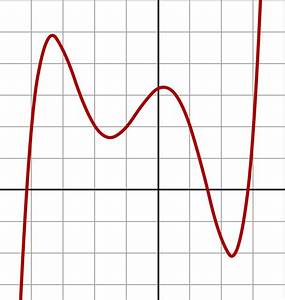
Is the leading coefficient for the polynomial shown positive or negative?

a)

Negative

b)

Positive

c)

Cannot be determined

64.

What is the DEGREE of the polynomial 17x + 4

a)

0

b)

1

c)

2

d)

3

65.

What is the DEGREE of the polynomial 3x3 + 2x4 + 5x ?

a)

1

b)

2

c)

3

d)

4

66.

Which of the following could be a possible equation for the function shown?

a)

f(x) =-2x3 + x2 - 5x + 1

b)

f(x) = 2x3 - 4x2 + x + 1

c)

f(x) = 3x2 + 5x + 1

d)

f(x) = -2x3 +3x - 1

67.

Select all the graphs which show even degree functions.
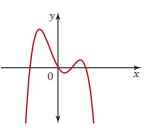
a)
b)
c)
d)
68.

Which of the following functions could represent the graph shown?

a)

f(x) = -2x5

b)

f(x) = -2x4 + 7x3 + 3x2 -5x + 8

c)

f(x) = 2x5 + 3x4 - 3x3 + 5x2 - 3x + 4

d)

None of these functions could represent the graph shown.
69.

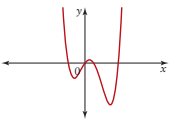
Which description best matches the function shown:

a)

Odd degree with positive leading coefficient.

b)

Even degree with positive leading coefficient.

c)

Degree three, with negative leading coefficient.

d)

Degree four, with negative leading coefficient.

70.
Which function has this end behavior?
a)
-1x4-3x3+3
b)
-2x7+2x4+4
c)
3x8+3x5-4x+7
d)
4x5-4x4+2x3-9
71.
Which function has this end behavior?
a)
-x2-3x+1
b)
-x3+2x2+3
c)
x4+3x3-4x+1
d)
x5-4x4+2x2-1
72.

Which one of these are not a zero of  f(x)=x2(x−1)2(x+5)f\left(x\right)=x^2\left(x-1\right)^2\left(x+5\right)  ?

a)

0

b)

1

c)

-5

d)

-1

73.

Which one of these are not a zero of  f(x)=−2x(3x+1)2(x+7)7f\left(x\right)=-2x\left(3x+1\right)^2\left(x+7\right)^7  

a)

-2

b)

0

c)

 −13-\frac{1}{3}  

d)

-7

74.

What is the multiplicity of the zero x=1 for the function  f(x)=x2(x−1)4(x+5)f\left(x\right)=x^2\left(x-1\right)^4\left(x+5\right)  ?

a)

2

b)

1

c)

4

d)

3

75.

What is the multiplicity of the zero x=-5 for the function f(x)=x2(x−1)4(x+5)f\left(x\right)=x^2\left(x-1\right)^4\left(x+5\right) ?

a)

1

b)

2

c)

3

d)

4

76.

How does a multiplicity of 2 affect the graph?

a)

cross

b)

bounce

c)

wiggle (change direction)

77.
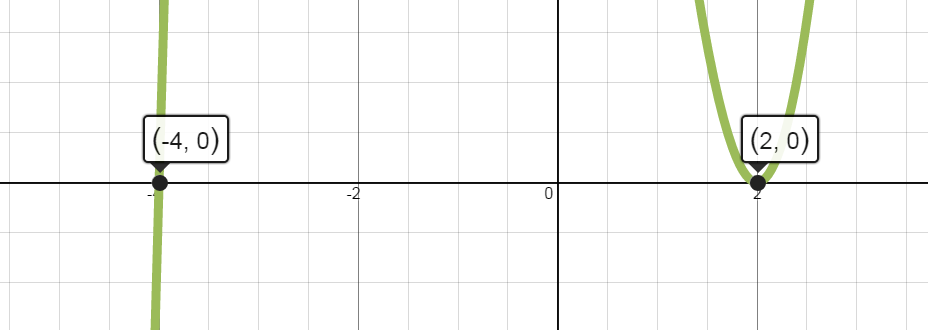
Which root has even multiplicity?
a)
1
b)
-4
c)
-1
d)
2
78.
What is the equation in factored form of this graph?
a)
f(x) = (x-4)(x-1)2(x+2)(x+4)
b)
f(x) = (x-4)(x+1)2(x+2)(x+4)
c)
f(x) = (x-4)(x-1)2(x-2)(x+4)
d)
f(x) = (x+4)(x+1)2(x-2)(x-4)
79.
What are the zeros of the polynomial function?
y = x(x - 6)(x + 5)
a)
0, 6, -5
b)
6, -5
c)
0, -6, 5
d)
1, -6, 5
80.
What are the roots of the polynomial function?
y = (x + 2)(x - 7)3
a)
-2, 7 multiplicity 3
b)
-2, 7, 3
c)
2, -7 multiplicity 3
d)
2, -7, 3
81.
What could be the function for this graph in factored form?
a)
f(x) = (x-4)2(x+2)
b)
f(x) = (x+4)2(x-2)
c)
f(x) = (x-4)(x+2)2
d)
f(x) = (x+4)(x-2)2
82.

Which equation MOST LIKELY matches the graph?

HINT: Write factored equation and multiply!

a)

y = x4 - x3 + 3x2 + 2

b)

y = -x4 + x3 + 5x + 2

c)

y = x3 - 2x2 + 1x + 3

d)

y = -x3 - 2x2 + 1x + 3

83.
a)
y =  _(x + 2)(x - 1)2
b)
y = -(x - 2)(x + 1)2
c)
y = (x - 2)(x + 1)2
d)
y = -x3
84.
Match the equation to the graph.
a)
y=-(x+1)(x-2)(x-4)
b)
y=(x+1)2(x-3)(x-1)3
c)
y = 3x3 – 2x + 1
d)
y=(x+1)3(x-3)(x-1)2
85.
What could be the equation for this graph?
a)
y = -2x3 + 1x + 3
b)
y = (x - 2)(x + 1)(x + 3)
c)
y = (x + 2)(x - 1)(x - 3)
d)
y = -2x2 + 1x + 3
86.
Which graph?
a)
a
b)
b
c)
c
d)
d
87.

Consider the leading term of each polynomial function. What is the end behavior of the graph?

a)

A

b)

B

c)

C

d)

D

88.

What are the zeros of the function? Graph the function.

a)

A

b)

B

c)

C

d)

D

89.

What are the zeros of the function? What are their multiplicities?

a)

A

b)

B

c)

C

d)

D

90.

Remember, if you don't have a graphing calculator, you can use desmos.com!

a)

A

b)

B

c)

C

d)

D

91.

f(x) = 2x3 - 3x2 + 4x -10

State the maximum number of turns the graph of f(x) could make.

a)

3

b)

2

c)

1

d)

0

92.

f(x) = -3x4 + x3 - 2x2 + x - 1

State the maximum number of turns the graph of f(x) could make.

a)

3

b)

4

c)

2

d)

1

93.

f(x) = -3x4 + x3 - 2x2 + x - 1

What is the y-intercept of f(x)?

a)

(-1, 0)

b)

(0, -1)

c)

(-3, 0)

d)

(0, -3)

94.

Write a polynomial with the given zeros.

a)

A

b)

B

c)

C

d)

D

95.

Write a polynomial function with the given zeros.

a)

A

b)

B

c)

C

d)

D

96.
Which point does not represent a zero of a polynomial?
a)
(-2, 0)
b)
(-1, 0)
c)
(0, 4)
d)
(2, 0)
97.
Classify the polynomial by degree.
a)
quartic
b)
quintic
c)
6th degree polynomial 
d)
7th degree polynomial
98.

What is the coefficient of this term?

9x3

a)

None

b)

9

c)

3

d)

x

99.
The number in front of the variable is called the.... 
a)
exponent
b)
base
c)
coefficient
d)
fronter
100.
What is the degree of the function graphed here?
a)
2
b)
3
c)
4
d)
5
101.
Find the factored form of the function graphed:
a)
y = -(x + 1)(x - 1)(x - 2)
b)
y= (x + 1)2(2 - x)
c)
y = (-x + 1)2(x - 2)
d)
y = -(x - 1)2(x + 2)
102.
Which of the following helps determine end behavior?
a)
The leading coefficient
b)
The number of terms in the function
c)
The y-intercept
d)
The x-intercepts
103.

Select the polynomial whose zeros and degree are given by:

Zeros: – 5(multiplicity of 3), 9(multiplicity of 2), – 2, 4 Degree: 7

a)

(x + 5)3(x - 9)2(x + 2)(x - 4)

b)

(x + 5)3(x - 9)2(x + 2)7(x - 4)7

c)

(x + 5)3(x - 9)2(x + 2)

d)

(x + 5)(x - 9)(x + 2)(x - 4)

104.
Determine the y-intercept 
f(x) = x3 - 5x2 - 25x + 125
a)
(0,0)
b)
(0,25)
c)
(0,125)
d)
(0,5)
105.

Is this polynomial ODD or EVEN?

f(x) = -7x3 + 11x5 - 4x6 + 113x

a)

ODD

b)

EVEN

106.

Is this polynomial ODD or EVEN?

f(x) = 6x3 - 2x7 + 8x2 + 11x6 - 9x + 11

a)

ODD

b)

EVEN

107.

Which of the following is the graph of a polynomial with a

negative leading coefficient?

a)
b)
c)
d)
108.

Which function has a root with a multiplicity greater than 1?

a)

A

b)

B

c)

C

d)

D

109.

Which statements are true? Select two.

a)

A root with a multiplicity of 3 will result in a plateau point.

b)

A root with an even multiplicity will cross the x-axis.

c)

An even degree function with a positive leading coefficient will approach infinity as the x values get larger.

d)

Parabolas must cross or touch the x-axis.

110.

Which three statements are true of the function f(x)=2-5x+3x2-2x3?

a)

The function has a y-intercept at 2.

b)

The graph of the function is a parabola.

c)

The function has a negative leading coefficient.

d)

The degree of the function is 3.

e)

As x-values get larger the y-values get larger.

111.
The end behavior of a polynomial function is determined by the degree and the sign of the leading coefficient.
Identify the degree of the polynomial and the sign of the leading coefficient 
a)
Leading Coefficient Positive
Degree - Even
b)
Leading Coefficient Positive
Degree - Odd
c)
Leading Coefficient Negative
Degree - Even
d)
Leading Coefficient Negative
Degree - Odd
112.

Factor Completely: x4-9x2

Hint: Take GCF First!

a)

x2(x+3)(x-3)

b)

(x2+3x)(x2-3x)

c)

(x2+9)(x-3)(x+3)

d)

x2(x2-9)

113.
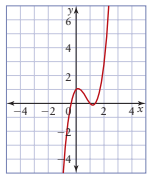
What is the y-intercept of the following cubic function?
a)
(1, 0)
b)
(0, 2)
c)
(-1, 0)
d)
(2, 0)
114.
Which function?
a)
a
b)
b
c)
c
d)
d
115.
What is the degree?
a)
Positive
b)
Negative
c)
Odd
d)
Even
116.

Identify the zeros of the function and their corresponding multiplicities for the function  f(x)=−(x−4)2(x+1)3(x−2)f\left(x\right)=-\left(x-4\right)^2\left(x+1\right)^3\left(x-2\right)  .

a)

x = 4 (mult = 2)
x = -1 (mult = 3)
x = 2 (mult = 1)

b)

x = -4 (mult = 2)
x = 1 (mult = 3)
x = -2 (mult = 1)

c)

x = -4 (mult = 1)
x = 1 (mult = 1)
x = -2 (mult = 1)

d)

x = 2 (mult = 4)
x = -3 (mult = 1)
x = 1 (mult = 2)

117.

Identify the zeros of the function and their corresponding multiplicities  f(x)=x(x+1)(x−2)5f\left(x\right)=x\left(x+1\right)\left(x-2\right)^5  .

a)

x = 1 (mult = 1)
x = -2 (mult = 5)

b)

x = 0 (mult = 1)
x = 1 (mult = 1)
x = -2 (mult = 5)

c)

x = 0 (mult = 1)
x = -1 (mult = 1)
x = 2 (mult = 5)

d)

x = -1 (mult = 1)
x = 2 (mult = 5)

118.

What are the real zeros of the function  f(x)=x3+4x2−12xf\left(x\right)=x^3+4x^2-12x  ?

a)

x = -6, x = 0, x = 2

b)

x = -6, x = 2

c)

x = -2, x = 6

d)

x = -2, x = 0, x = 6