
 Worksheets
Biology EOC Review - Ecology
Total questions: 47
Worksheet time: 58mins


What is the carrying capacity mean?
The number of individuals an area can carry
the number of births
The number of deaths an area has
not sure
The exponential graph is a graph that shows us population size increasing quickly, which one below shows us that


What is the arrow pointing at?
carrying capacity
biotic potential
density-independent
density dependent

parasites, disease, predators, are examples of what type of limiting factors?
density dependent
density independent
survivorship
type 1 curve
In a forest, the carrying capacity for squirrels is about 100. If humans cut down part of the forest to build houses, what will happen to the carrying capacity for the squirrels?
it will increase
it will decrease
it will stay the same

A population of foxes has 36 individuals. In one year, 10 baby foxes are born and 6 older foxes die. The population at the end of the year is (a) .
What two factors decrease the population size?
Births
Deaths
Immigration
Emigration
Carrying capacity is the (a) number of organisms that can survive in an area based on the available (b) , such as food and water.
Select all that apply: Which of the following are abiotic factors?
Sand
Water
Animals
Plants
Match the following levels of classification to their definitions:
1 individual
Organism
All the same species
Population
All the different living things
Community
All the biotic and abiotic things
Ecosystem
What is ecology?
the study of interactions between organisms and their environments
the study of animals
the study of how genes are passed down from generation to generation
the study of rocks
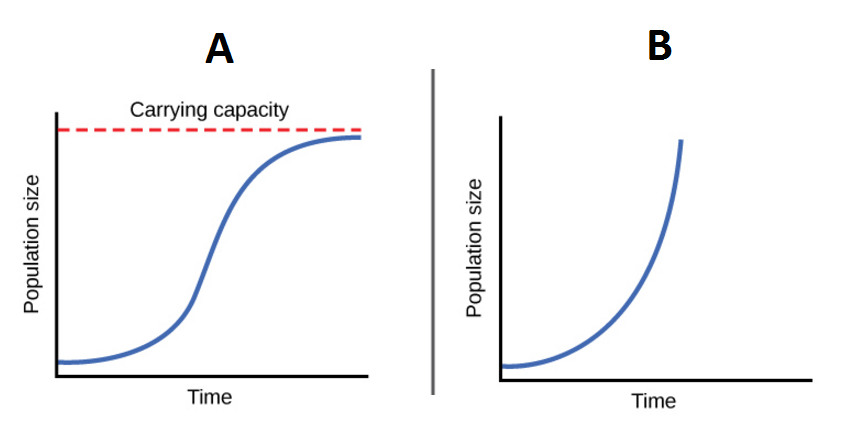
What type of growth model is shown in image B?
Exponential
Logistic
New fuels are being produced by converting corn and grasses into compounds containing alcohols that can be broken down for energy in various engines. The purpose of this research is to
A. cause a loss of biodiversity in the rain forests.
B. reduce the rate of homeostasis in organisms.
C. increase the rate of air pollution.
D. reduce the use of nonrenewable resources.
Salt water is an abundant resource but unusable for irrigation and drinking. As demands on freshwater sources increase, the use of desalination processes to remove salt from ocean water is increasing. A concern of desalinating water is the large amounts of recovered salts that are returned to the ocean. Which of the following describes the most likely impact of desalination on the surrounding ocean environment?
A. Nonrenewable resources in the ocean environment would become depleted and upset the ecosystem's balance.
B. Methane gas would pollute the ocean environment as shoreline organisms begin to die and decay.
C. Alteration in ocean salt levels would cause loss of species and unbalanced populations in marine food webs.
D. Increased levels of salts and minerals in the ocean would result in overpopulation of marine bivalves due to strengthened shells.
The presence of wastes, such as plastic bags and motor oil, in lakes and streams miles away from developed areas suggests that
A. ecosystems are interconnected and human action can alter ecosystem equilibrium.
B. recycling programs have failed to conserve biotic resources.
C. natural processes can alter ecosystem stability.
D. direct harvesting practices have led to irreversible destruction of ecosystems.
DDT and other pesticides used over 50 years ago are still affecting the environment today. Scientists have found these substances in recent glacier runoff. Glacier runoff occurs during the summer, when precipitation that has fallen on glaciers during the winter is released. Ice layers from existing glaciers have been analyzed. The results of this analysis show that the concentrations of DDT and other pesticides were highest about 10 years after the use of these substances was banned.
This information shows that:
A. DDT and other pesticides cause glacier runoff during the summer.
B. it takes humans over 50 years to analyze a glacier.
C. precipitation helps to break down pesticides.
D. the decision of one human generation may have an impact on future generations.
The northern elephant seal was almost hunted to extinction in the 1800s. By the late 1890s, approximately one hundred seals were left, reducing the gene pool of the population. What will be the consequence of this reduction?
A. Competition within the population will increase.
B. The surviving elephant seals will be better able to adapt.
C. Inbreeding will be less frequent among the remaining population.
D. The elephant seals will be more vulnerable to environmental change.
A community is concerned about the water quality of a nearby lake. Increased sedimentation in the lake is endangering the native habitat. The increased sedimentation is most likely caused by which of the following?
A. trees planted along the shore of the lake
B. construction of homes along the lake
C. the amount of sunlight on the lake
D. the amount of fish in the lake
When fertilizers run off farmland into streams and ponds, the nitrogen content of the water increases. This can lead to rapid growth of algae in a process called eutrophication. How can this process affect other organisms in the water?
A. Oxygen is used up as algae is decomposed, reducing the amount available to other organisms.
B. The water becomes better able to support aerobic organisms.
C. The algae provide food for fishes and other organisms, leading to decreased algae populations.
D. The extra nitrogen provides additional food for the other organisms, increasing their population.
A strip mining company wants to lease some land that is currently part of a national park. They promise to reclaim the land should any minerals be mined from the area, and they are willing to pay top dollar for the rights. As an ecologist, what factors would you raise with the local government?
A. the threat to local biodiversity
B. management of the land after the company leaves
C. the new jobs that would be created
D. the increased traffic in the area
Whaling was a very profitable profession until whale populations crashed. The global community came together to enact a ban on whaling. However, Japan and Norway have not agreed to stop whaling. Which of the following is the most likely consequence of their decision?
A. The whale populations are bouncing back very successfully and are unaffected by Japan and Norway continuing to whale.
B. The whale populations are not rebounding as quickly as they might if all of the countries agreed not to hunt whales.
C. The whale populations have mutated into new kinds of organisms.
D. The whales are getting better at avoiding capture.
Which of the following BEST explains what could happen if a food chain or food web became unbalanced?
Change in a food chain/web, like the extinction of a species, will have NO impact on the balance of the ecosystem.
Change in a food chain/web, like the extinction of a species, can have a positive impact on the balance of the ecosystem.
Change in a food chain/web, like the extinction of a species, can have a negative impact on the balance of the ecosystem.
All answers are plausible.
Which of the following best describes an energy pyramid?
Each level represents a producer and the amount of energy available at each level
Each level represents a trophic level and the amount of energy available at each level
Each level represents a set of decomposers and the amount of energy available at each level
Each level represents a apex predator
Which of the following is a producer in the food chain below?
Grass --> Grasshopper --> Bird --> Snake --> Hawk
Snake
Bird
Grasshopper
Grass
What is a common decomposer?
Sediments and Rocks
Bacteria
Lions, Tigers, Bears, Sharks
Trees, Grasses, Plants
The arrows on a food chain/food web represent __________________________________.
the rate of consumption between organisms
the rate of decomposition of dead organisms
the flow of energy from one organism to another
the flow of water and organic carbon from the abiotic to biotic factors
Without __________, energy cannot enter the producers or make its way up a food chain.
the sun
the water cycle
the carbon cycle
NaCl and CO
* Hummingbirds feed on nectar from flowers.
* Flowers are pollinated by hummingbirds as they move from flower to flower.

SC.912.L.17.9
A partial Texas food web is shown.
The populations of which organisms will most likely increase as a result of a disease that suddenly reduced the population of Texas horned lizards?
A. Grasses and ants
B. Ants and grasshoppers
C. Grasshoppers and Texas cottonmouths
D. Texas cottonmouths and red-shouldered hawks

SC.912.L.17.9
A partial meadow food web is shown.
Based on this food web, which organisms are direct sources of energy for secondary consumers?
A. Aphid, Bird, Rabbit
B. Ladybug, Fox, Dragonfly
C. Frog, Butterfly, Berries
D. Mouse, Snake, Hawk

SC.912.L.17.9
The table lists some organisms found in a swamp ecosystem and their sources of energy. When constructing an energy pyramid of the swamp ecosystem, which of these would be placed at the top of the pyramid?
A. Grass carp
B. American alligator
C. Eastern mud turtle
D. Great blue heron
Why are there so few aquatic plants and phytoplankton that live at the bottom zones in the ocean?
The ocean floor contains many decomposers
Very little sunlight reaches these levels
Water is a limiting factor
The temperature in these zones is extremely low
Which of the following is NOT a major cycle of matter?
Oxygen
Carbon
Nitrogen
Phosphorous
The number of pythons found throughout Everglades National Park has increased in recent years. These huge snakes are not native to Florida and are believed to have been released into the wild by pet owners. Wildlife biologists have initiated attempts to capture and remove these pythons. Which statement best explains the biologists' reasons for removing these pythons from the Everglades?
The pythons could upset the territorial boundaries of native organisms
The pythons could adapt to overcome diseases common to native snakes
The pythons could prey on native organisms and cause native population to decline
The pythons could begin to interbreed with native snakes and produce a more successful species
Which of the following is MOST likely to be a limiting factor in a population of organisms?
high birth rate
immigration of new members
fluctuations in atmospheric temperature
availability of food
A flowering plant has seeds that are carried by the wind. What is the most likely dispersion pattern of the plants that grow from these seeds?
uniform
clumped
random
spatial
American bison, which are large grazing mammals, are most often found clumped in small groups. What might you infer about the spatial distribution of American bison?
A clumped group provides better protection from predators.
A clumped group attracts more prey
A clumped group can graze a larger area.
A clumped group takes better advantage of water resources
What is one major distinction between primary and secondary succession?
Primary succession is the sequence of species that become established early in a newly colonized area, and secondary succession is the sequence of species that move in later.
Primary succession is the establishment of a community in an area with no soil, while secondary succession is the establishment of a new community in an existing ecosystem that was disturbed.
Primary succession is the establishment of a new community in an existing ecosystem that was disturbed, while secondary succession is the establishment of a community in an area with no soil.
Primary succession is the sequence of plants that colonize a new area, while secondary succession is the sequence of animals that move in later.
Which of these species might be classified as a pioneer species?
ponderosa pine
choke cherry
aspen
lichen
Which of the following choices represents the sequences in the primary succession of an ecosystem?
bare rock, small annual plants, lichens, shade-intolerant trees, shade tolerant trees, perennial herbs and grasses
bare rock, lichens, small annual plants, perennial herbs and grasses, shade-intolerant trees, shade-tolerant trees
bare rock, lichens, perennial herbs and grasses, small annual plants, shade-intolerant trees, shade-tolerant trees
bare rock, lichens, small annual plants, perennial herbs and grasses, shade-tolerant trees, shade-intolerant trees

